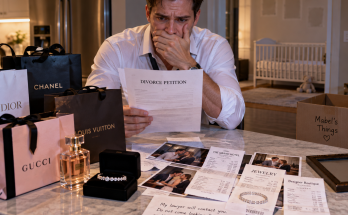
Mark came to the house the next morning with Rachel and a cardboard archive box.
He did not ask to come inside.
He stood on the porch until I opened the door.
That mattered.
“Ethan’s at school,” I said.
He nodded.
“Can we talk?”
I looked at Rachel.
She said, “I’ll stay unless you both agree otherwise.”
“Stay.”
We went to the kitchen.
Mark put the box on the table but kept both hands on it.
The old impulse to ask whether he had slept came back.
I ignored it.
“What did the letter say?”
He sat down.
“My father wrote it three months before he died.”
“Why was it in storage?”
“I think he sent it to Mom.”
Rachel corrected him.
“We know the envelope containing it was addressed to Mark at Barbara’s residence. We do not know who intercepted it.”
Mark gave her a tired look.
“She did.”
“Likely is not proven.”
He nodded.
“Fine.”
He removed several pages.
The paper had yellowed slightly.
I did not reach for them.
“They’re yours.”
He looked at me.
“I want you to read them.”
“Tell me first.”
He swallowed.
“My father said he left because Mom told him she would destroy him if he fought for custody.”
I said nothing.
“He said there were accusations.”
“What kind?”
“Abuse.”
The word landed heavily.
“Against you?”
“Against him.”
“Were they true?”
“He said no.”
Rachel spoke.
“There are court records we can check. His letter is evidence of what he claimed, not proof by itself.”
Mark nodded.
“I know.”
He rubbed both hands over his knees.
“He wrote that he tried for years to contact me.”
“Did you ever hear from him?”
“Birthday cards sometimes.”
“I thought you said he never sent anything.”
“Mom told me they came from my grandmother.”
His face twisted.
“I never looked at postmarks. I was a kid.”
“How old when he left?”
“Twelve.”
He unfolded another page.
“He said every letter he sent came back or disappeared. When I turned eighteen, he tried to reach me directly.”
“And?”
“Mom told me he wanted money.”
I remembered Barbara saying Mark’s father had always been selfish.
It had been repeated so often it sounded like family history.
“What really happened?”
“According to Dad, he wanted to pay for college.”
“You had student loans.”
“I know.”
“How much?”
“Forty-two thousand.”
“Did he send money?”
Mark nodded.
“Apparently.”
“How much?”
“Sixty.”
I stared at him.
“Sixty thousand?”
“Yes.”
“Where did it go?”
“He says he wired it to an account Mom provided.”
Rachel opened a folder.
“The account existed.”
“Barbara’s?”
“Joint account originally opened when Mark was a minor. Barbara remained custodian.”
Mark laughed once.
“I spent twelve years paying off loans while she had sixty thousand meant for tuition.”
I could not think of anything useful to say.
He pulled out another page.
“Dad also wrote about the trust.”
“What did he say?”
“He knew Mom would try to control it.”
“Then why make her trustee?”
“He didn’t.”
I looked at Rachel.
She nodded.
“The original will named someone else.”
“Who?”
“His attorney.”
“What happened?”
“He died before Mark’s father.”
“So Barbara became trustee?”
“Not automatically.”
Mark pushed a document toward me.
“She petitioned.”
“For control?”
“Yes.”
“Did anyone object?”
“No.”
“Mark?”
“I never knew.”
The pattern was so consistent it became almost nauseating.
Barbara did not invent one enormous lie.
She built a life where Mark received only the information she selected.
Enough affection to maintain loyalty.
Enough crisis to maintain urgency.
Enough guilt to prevent questions.
I touched the edge of the document.
“What about the money?”
“Dad estimated the trust would be worth half a million by the time I was thirty-five.”
Karen’s earlier numbers returned.
“How much is left?”
Rachel answered.
“We don’t know yet.”
Mark’s jaw tightened.
“But we know at least one hundred seventy-five thousand was reported as distributed to me.”
“That you never received.”
“Correct.”
He opened the archive box.
Inside were bank statements, photocopies, letters, and several envelopes bound with a brittle rubber band.
One was blue.
“Dad wrote instructions.”
“For what?”
“If the trust records ever looked wrong.”
My pulse quickened.
“What instructions?”
“He named accounts.”
Rachel slid a copied page toward me.
There were six handwritten account numbers.
Some domestic.
One foreign.
“Foreign account?”
“Cayman Islands,” Rachel said.
I looked at Mark.
“Did your father have offshore money?”
“He said it was an investment account established through his company.”
“And Barbara?”
“We don’t know whether she ever controlled it.”
Rachel tapped the page.
“But the account number may help trace later transfers.”
Another paper caught my eye.
My own name.
I reached for it.
“Why am I here?”
Mark’s face changed.
“That’s what scared me.”
The document was dated six years earlier.
Before the lien.
Before Barbara bought her apartment.
Before the post-office box.
It appeared to be a handwritten note from Mark’s father’s former accountant, addressed to the attorney handling the trust.
It said that if Mark married, any trust-related collateral should remain separate from marital property unless Mark’s spouse knowingly consented in writing.
I looked at Mark.
“Collateral.”
“The lien,” he said.
My stomach tightened.
Rachel nodded.
“That is our concern.”
I read the line again.
“What does this mean?”
“Potentially,” Rachel said, “someone used trust assets in connection with a transaction involving your home.”
“Without my consent.”
“If your signature was forged, yes.”
“So the lien may have been designed to make the house collateral for something connected to Mark’s trust.”
“That is one possibility.”
“Why?”
Mark looked at the table.
“To make the withdrawals look legitimate.”
Rachel did not contradict him.
I understood.
If Barbara withdrew money from the trust for Mark’s benefit, she needed reasons.
Housing.
Loans.
Property.
Support.
An artificial lien against the home could create paper evidence that trust money had been used for Mark.
Even when it had not.
“She used my house as an accounting story.”
Rachel’s voice stayed calm.
“That is a theory. A strong one, but still a theory.”
I stood and walked to the counter.
Through the window, Ethan’s bicycle leaned against the fence.
For six years, I had made mortgage payments believing the hardest part was keeping up.
All that time, someone may have been using the property as camouflage for theft.
Mark said quietly, “I’m sorry.”
I turned.
“For which part?”
“All of it.”
“That answer is too large.”
“I know.”
“Then pick something.”
He looked at me.
“For believing her whenever she said you were controlling.”
I said nothing.
“For hiding the cashier’s check.”
Nothing.
“For giving her money after you asked me to stop.”
Nothing.
“For letting Ethan think you were the reason I was unhappy.”
My throat tightened.
That one landed.
Mark looked down.
“And for making you carry the bills while I told myself I was being generous.”
I remained by the window.
“Do you understand why I still want the divorce?”
“Yes.”
The answer came immediately.
Not “but.”
Not “we can fix it.”
Just yes.
That mattered too.
Rachel’s phone rang.
She stepped into the hall.
Mark looked at the blue envelope.
“I used to think Dad didn’t want me.”
“I know.”
“Mom used that every time I questioned her.”
“How?”
“She’d say, ‘I’m the one who stayed.’”
I closed my eyes briefly.
Of course she did.
“She always made loyalty sound like repayment.”
“Yes.”
“Did you ever tell her no?”
“Sometimes.”
“What happened?”
“She got sick.”
I frowned.
“What?”
“Not actually sick, maybe. But she’d call saying her blood pressure was high or she felt faint. Once she went to urgent care after I said I couldn’t pay for a trip.”
“Was anything wrong?”
“They said anxiety.”
“And you paid?”
“Yes.”
He gave a hollow laugh.
“I thought I was keeping her alive.”
The scale of it was becoming difficult to hold.
This was not an excuse for Mark’s choices.
But it explained the machinery behind them.
Rachel returned.
“We have movement on the forty-eight thousand.”
I sat.
“What?”
“Melissa Grant’s attorney contacted investigators voluntarily.”
Mark looked confused.
“Who’s Melissa?”
I explained briefly.
He stared at me.
“Forty-eight thousand from our account?”
“An account associated with the refinance.”
“I never authorized that.”
Rachel sat.
“Melissa claims she was paid to process a business transaction for Barbara.”
My pulse quickened.
“What business transaction?”
“She was told the funds were family investment proceeds.”
“Did she know my name?”
“Yes.”
“Why?”
“Barbara represented that you and Mark were co-investors.”
I laughed without humor.
“Of course.”
“Melissa says Barbara provided signed authorizations.”
“Forged.”
“Likely.”
“Where did the money go after Melissa?”
Rachel opened an email.
“To the property-services company.”
“We know that.”
“There’s more. The company then split it into three transfers.”
“Where?”
“One went to taxes and administrative expenses.”
“How much?”
“About six thousand.”
“The rest?”
“Twenty thousand moved to an investment account.”
“Whose?”
“We’re waiting for bank confirmation.”
“And the remaining twenty-two?”
Rachel looked at Mark.
“It went to an account under a trust-related entity.”
Mark leaned forward.
“What entity?”
She read the name.
Mark went still.
“I know that name.”
I looked at him.
“From where?”
“Dad’s letter.”
He reached into the archive box, searching rapidly through pages.
Then he found one.
His finger stopped on a line.
The entity was listed beside one of the old account numbers.
Rachel compared them.
“Same.”
I felt the pieces shift again.
“So money was moved from an account connected to my house through Melissa, through Barbara’s former company, and back into something connected to Mark’s father’s trust.”
“Yes.”
“Why would anyone do that?”
Rachel answered.
“Possibly to replace money that was missing.”
Mark stared at her.
“What?”
“If funds had been withdrawn improperly, someone facing scrutiny might move money back into a trust-related vehicle to make balances appear less irregular.”
My skin prickled.
“Six months ago.”
“Yes.”
The same month I discovered the fraudulent credit card.
The same period someone impersonated me at the bank.
Something had frightened Barbara six months earlier.
“What happened then?” I asked.
Mark frowned.
“In our lives?”
“Anything involving your mother.”
He thought.
“Nothing.”
“Think harder.”
He stared at the table.
Then his face changed.
“Dad’s old attorney.”
“What?”
“A man called me.”
“When?”
“About six months ago.”
My heartbeat accelerated.
“You never told me.”
“I thought it was spam.”
“What did he say?”
“He asked whether I had received a trust accounting.”
Rachel sat forward.
“Name?”
“I don’t remember.”
“Try.”
Mark closed his eyes.
“Something Hale. Or Hall.”
“Did you call him back?”
“No.”
“Did you tell Barbara?”
He opened his eyes.
And there it was.
The answer.
“Yes.”
I felt cold.
“What did she do?”
“She got quiet.”
“And?”
“She asked for the number.”
“You gave it to her.”
“Yes.”
“What happened after?”
“The next day she told me the man was a scammer.”
Rachel was already typing.
“How long after that did Sarah’s fraudulent credit account open?”
I answered.
“Less than two weeks.”
“And the forty-eight-thousand-dollar transfer?”
Karen’s records had given us the date.
“Three weeks later.”
Mark looked physically ill.
“So somebody asked me about Dad’s trust, I told Mom, and then she started moving money.”
“That is the timeline,” Rachel said.
My phone rang.
Mr. Sterling.
I put him on speaker.
“We found the attorney who called Mark.”
Rachel exchanged a look with him.
“Alive?”
“Yes.”
“Where?”
“Arizona.”
“Did he really work with Mark’s father?”
“For twenty years.”
Mark gripped the edge of the table.
“Why did he call me?”
Mr. Sterling paused.
“Because he had been reviewing old files before retirement.”
“And?”
“He noticed something inconsistent in the trust accounting.”
“What?”
“A beneficiary acknowledgment from eight years ago.”
Mark frowned.
“What acknowledgment?”
“A document stating that you had received a distribution of one hundred ten thousand dollars and waived further claims regarding that portion of the trust.”
“I never signed that.”
“I know.”
“How do you know?”
“Because the attorney kept the original correspondence surrounding it.”
The room went quiet.
Mr. Sterling continued.
“The acknowledgment bears your signature.”
Mark whispered, “Forged?”
“Apparently.”
“By Mom?”
“We don’t know yet.”
I asked, “What did the attorney do six months ago?”
“He contacted Mark. After Mark failed to respond, he contacted the trustee.”
“Barbara.”
“Yes.”
“And then?”
“He received a letter telling him Mark did not wish to revisit the matter.”
Mark stood.
“I never sent that.”
“We know.”
“How?”
“Because the letter was signed by someone else.”
My pulse accelerated.
“Who?”
Mr. Sterling’s answer came carefully.
“Sarah.”
I stared at the phone.
“What?”
“A letter was sent in your name instructing him to stop contacting the family.”
“I never wrote any letter.”
“I know.”
“Do you have it?”
“Yes.”
“Send it.”
A few seconds later my email chimed.
I opened the attachment.
There was my name at the bottom.
Sarah Carter.
The signature looked close enough to pass quickly.
But the letter contained one sentence that made my blood turn cold.
My husband has no interest in reopening old financial matters, and I have full authority to speak for him.
Mark read it over my shoulder.
“You never say ‘my husband’ like that.”
I barely heard him.
Because beneath the signature was a telephone number.
Not mine.
Not Mark’s.
I recognized it anyway.
I had called it hundreds of times.
Barbara’s home number.
Click here to continue reading: PART 9: The Letter Forged in My Name Gave Us the First Direct Link to Barbara, but Mark Recognized Something Worse in the Signature
My Husband Came Home Proud of Giving Away His Paycheck, Until He Realized I Had Stopped Asking Permission
Part 8 of 31