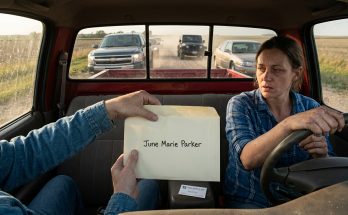
Mark slammed the door of his Silverado.
Dale climbed from the Jeep. Carol picked her way across the gravel in black funeral heels that had no business being anywhere near a cattle gate.
June lowered her window.
“What are you doing?”
Mark spread his hands. “We came to talk.”
“You followed us.”
“We’re family.”
June stared at him.
“Interesting timing.”
Carol reached the truck, breathing harder than she wanted anyone to notice.
“If Harold left instructions concerning the farm, this isn't something you handle by yourself.”
June looked at the envelope in my hands.
Then at Carol.
“You mean the farm everybody started pricing before Grandpa was buried?”
Carol's face changed.
“I don't know what you're implying.”
June did.
So did I.
Money had entered the room before the will was ever read. Now it had followed us twenty miles into the country.
June held out her hand.
I returned the envelope.
She tore it open herself.
Inside were three objects.
A letter.
A small brass key.
And a business card.
June picked up the card.
Prairie State Bank. Salina. Private Client Services.
There was handwriting on the reverse.
Grandpa's.
June read it twice.
“What?”
I leaned closer.
The note instructed her to ask for a man named Richard Vernon.
Mark had moved close enough to see the bank logo.
“What account?”
June ignored him and unfolded the letter.
Her lips moved over the first lines.
Then, unexpectedly, she laughed.
A wet, broken little laugh.
“What?” I asked.
She handed me the top of the page.
Grandpa had opened with a joke about finally escaping June's dry meatloaf.
For two years he had complained about that meatloaf every Wednesday.
For two years he had eaten every bite.
June pressed her fingers against her mouth.
Then she continued.
The humor lasted only a few sentences.
Grandpa wrote that she had been the one person who continued coming when he had nothing obvious left to offer except chores, old stories and an aging body.
Other people arrived needing favors.
June arrived because he needed help.
Carol folded her arms.
June's voice became firmer as she read.
Grandpa had anticipated accusations.
The one-dollar inheritances were deliberate.
His mental competency had been documented.
There were medical evaluations, witnesses and records.
Dale looked away.
Mark kicked at the gravel.
Then June reached the sentence that changed everything.
She stopped.
“What?” I asked.
Her eyes moved over the line again.
“The farm isn't mine.”
Mark stepped forward.
“What does that mean?”
June kept reading.
Her eyebrows drew together.
“No.”
“What?” Carol demanded.
June looked toward the farmhouse.
“He sold it.”
Silence.
Mark laughed first, but there was no humor in it.
“That's impossible.”
“Fourteen months ago.”
Carol shook her head.
“Your grandfather would never sell this place.”
June read farther.
Grandpa had sold the farm under an arrangement allowing him to live there until his death.
The money had gone elsewhere.
Somewhere the family could not reach.
Mark held out his hand. “Give me the letter.”
“No.”
“This affects all of us.”
June looked up.
“Apparently Grandpa disagreed.”
Dale walked toward the fence.
“This land has been Parker property for seventy-three years.”
“Then I guess seventy-three years ended fourteen months ago.”
Carol stared at the farmhouse.
“How much did he sell it for?”
June's eyes moved to her.
“Why?”
“I’m his daughter.”
“And I’m his granddaughter.”
“That isn't the same.”
June went quiet.
I remembered another day when I had seen that quietness.
Grandpa had fallen in his bathroom and lain there for hours before June arrived. She had called the ambulance, cleaned the blood from the tile and then calmly telephoned every relative who lived closer than she did.
Nobody enjoyed those calls.
“You're right,” June told Carol now. “It wasn't the same.”
Carol flushed.
June returned to the letter.
The final instructions were brief.
If she wanted what Grandpa had left her, she was to take the brass key to Prairie State Bank before five that afternoon.
If she did not want it, she could return the key to Mr. Albright and walk away.
I checked my phone.
4:07.
Salina was roughly thirty minutes away if traffic behaved.
Mark saw the time.
“We should go together.”
“No.”
“June.”
“No.”
“We can follow you.”
She stared at him.
Then something shifted in her expression.
“Fine.”
Mark blinked.
“Fine?”
“Follow me.”
She climbed behind the wheel.
I barely had my seat belt fastened when the Tacoma rolled forward.
Except June did not turn back toward County Road 18.
She drove through the open cattle gate.
“June.”
“What?”
“This is a pasture.”
“I know.”
“There isn't a road.”
“There used to be.”
She accelerated.
The Tacoma bounced so hard my teeth clicked.
In the mirror, Mark hesitated.
Then the Silverado came after us.
Dale followed.
Carol's Buick sat at the gate for several seconds.
I thought sanity might prevail.
It did not.
The Buick lurched into the pasture.
June drove around the pond and across an old drainage line.
“How do you know where you're going?”
“Grandpa showed me.”
“When?”
“Years ago.”
All I could see was grass.
June apparently saw roads that had vanished decades earlier.
Behind us, Mark kept pace.
Dale fell farther back.
Carol's Buick hit something and lost a piece of plastic beneath the front bumper.
I covered my mouth.
June looked in the mirror.
“Don't.”
“I'm not.”
“You're laughing.”
“So are you.”
She was.
For perhaps ten seconds, grief loosened its grip.
We were children again, bouncing in Grandpa's pickup while he took country roads too fast and made us promise not to tell Grandma.
Then June's smile disappeared.
“I miss him.”
“I know.”
“He asked me to stay for coffee.”
“You told me.”
“I keep hearing myself say no.”
“You came every Wednesday for two years.”
“I know.”
“He knew.”
June looked straight ahead.
“I hope so.”
The forgotten trail emerged behind a grain elevator.
June hit pavement.
Mark came through behind us.
Dale appeared less than a minute later.
Carol did not.
The dashboard clock showed 4:18.
“We can make it,” June said.
For the next twenty-eight minutes, we barely spoke.
Mark's truck remained behind us.
At 4:46 June pulled into Prairie State Bank.
She grabbed the key, letter and business card.
Mark parked badly across two spaces.
Dale arrived three minutes later.
We hurried inside.
A teller looked toward the clock.
“We're closing shortly.”
June placed Grandpa's business card on the counter.
“I need Richard Vernon.”
The teller read the card.
Then looked at June.
“June Parker?”
June stiffened.
“Yes.”
The teller immediately stood.
“I'll get him.”
Mark and Dale entered.
“They aren't with me,” June said.
Mark gave a disbelieving laugh.
“We absolutely are.”
A tall gray-haired man appeared from a hallway.
He wore rimless glasses and a navy suit.
He looked at June for a long moment.
Then his expression softened.
“You have Harold's eyes.”
June nearly lost her composure.
“You knew Grandpa?”
“Forty-one years.”
He introduced himself as Richard Vernon.
Mark immediately stepped forward and identified himself.
Dale did the same.
Mr. Vernon acknowledged them politely.
Nothing more.
Finally Mark gestured toward June's key.
“We're here about our grandfather's estate.”
Mr. Vernon turned to June.
“Do you authorize either gentleman to participate?”
“No.”
“Then this conversation is private.”
Mark's face reddened.
“This is family money.”
Mr. Vernon adjusted his glasses.
“No, sir.”
He led June through a secured door.
I stopped.
June caught my sleeve.
“You're coming.”
Mr. Vernon asked whether she authorized me.
“Yes.”
The door locked behind us.
Through the glass I saw Mark pacing.
Mr. Vernon took us to a small conference room.
No vault.
No dramatic boxes of cash.
Just three chairs, a table and a thick blue folder.
He set the folder before June.
“Your grandfather created a trust.”
June frowned.
“What kind?”
“A substantial one.”
Mr. Vernon explained that Harold Parker had spent decades buying small interests in agricultural property and investing money almost nobody in the family knew existed.
June stared at him.
“Grandpa washed aluminum foil so he could reuse it.”
“Yes.”
“He saved grocery coupons.”
“Yes.”
“He unplugged appliances because he thought standby electricity was robbery.”
Mr. Vernon smiled faintly.
“He also invested consistently for more than fifty years.”
June's humor vanished.
“How much?”
Mr. Vernon opened the folder.
He turned one page toward her.
June looked down.
Nothing happened.
Then she covered her mouth.
I leaned over.
The figure was $3,842,611.17.
I read it twice.
“This was Grandpa's?”
“It was.”
June shook her head.
“He would've told me.”
“No. He deliberately chose not to.”
“Why?”
Mr. Vernon folded his hands.
“He wanted to know who would continue treating him like Harold when there appeared to be nothing worth inheriting.”
June looked away.
Mr. Vernon turned another page.
The money was only one part.
There were agricultural interests, commercial properties and mineral rights.
A map unfolded across the table.
Red marks covered parcels June had never known Grandpa owned.
“Why me?”
Mr. Vernon's answer was quiet.
“Because you came on Wednesdays.”
June cried then.
Not loudly.
Tears simply fell onto the map.
Mr. Vernon waited.
When she recovered, he explained the condition.
For twelve months she could not give, lend or transfer trust assets to any family member.
She could not pay relatives' debts.
She could not buy them homes or vehicles.
The only narrow exception involved a medical emergency affecting a minor.
“And if I break the rule?”
“Control transfers elsewhere.”
“To Mark?”
“No.”
“Dale?”
“No.”
“Carol?”
Mr. Vernon almost smiled.
“Definitely not.”
A pounding sound came from outside.
Mark.
“June!”
Dale's voice followed.
Then another voice rose in the lobby.
Carol had finally arrived.
She was shouting that her father had promised her the farm.
Mr. Vernon looked tired rather than surprised.
“I was afraid of this.”
“Of them?”
“Not exactly.”
He closed the blue folder.
“Your grandfather believed somebody in your family learned about the trust before his death.”
June's face went still.
“How?”
“We don't know.”
“Who?”
“He never identified the person with certainty.”
Then Mr. Vernon told us something I had never expected to hear about Harold Parker.
Three weeks before his death, Grandpa had come to the bank frightened.
Someone had entered his house while June was driving him to a medical appointment.
Nothing obvious was stolen.
But drawers had been opened.
Files disturbed.
Grandpa installed a hidden camera afterward.
Mr. Vernon reached into the folder.
He removed a photograph and placed it facedown.
“The person came back.”
June stared at the photograph.
Her fingers hovered above it.
Then she turned it over.
I leaned closer.
The picture showed Grandpa's study.
His filing cabinet.
A man crouched in front of the bottom drawer.
June whispered, “No.”
I looked again.
It was not Mark.
Not Dale.
Not Carol.
It was the man who had embraced June at Grandpa's funeral and told her how proud Harold had been of her.
The man who claimed he had not been back in Kansas for months.
June's father.
Robert Parker.
The timestamp showed that he had entered Grandpa's study nine days before Grandpa died.
Click here to continue reading: PART 3: The Hidden Camera Exposed June’s Father, but Grandpa’s Final Recording Pointed Toward a Second Betrayal Inside the Family
The Will Gave Us Each One Dollar, Then the Lawyer Put Grandpa’s Sealed Envelope in Front of June
Part 2 of 50