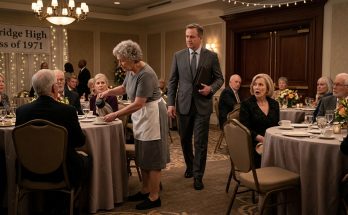
The notary’s name was Calvin Ross.
Once I knew it, I remembered more.
Not much.
A careful man with rimless glasses.
Soft voice.
Good suit.
At the fundraiser, he had spent most of dinner listening rather than speaking.
David introduced him as “someone who knows how to get complicated things done.”
I had assumed lawyer.
Claire remembered differently.
“David said Calvin handled paperwork.”
Elaine requested that I not contact him.
I had no intention of doing so.
Calvin had notarized a fraudulent power of attorney giving Sarah authority over my finances.
Whatever explanation existed, I wanted it given to someone carrying a badge.
Morales already knew his name.
The forged document had led investigators to him weeks earlier.
Until Claire produced the photograph, however, Calvin had denied any meaningful relationship with David beyond occasional professional work.
The photograph contradicted that.
So did financial records.
M.R. Holdings had paid Calvin Ross nine times.
Amounts varied.
Five hundred.
Eight hundred.
Twelve hundred.
One payment exceeded four thousand dollars.
“For notarizing things?” I asked.
“That is what we intend to ask him again.”
Calvin’s second interview lasted nearly four hours.
I was not there.
By evening, his attorney contacted prosecutors.
He wanted protection in exchange for cooperation.
Keene told me the next morning.
“Protection from what?”
“He believes he is exposed criminally.”
“Is he?”
“Yes.”
At least Keene did not soften it.
Calvin admitted notarizing signatures without the signers present.
He admitted applying his seal to my false power of attorney.
He admitted witnessing documents for Mercer Ridge transactions he knew were incomplete.
He denied knowing that David intended to use Leo as leverage.
He denied participating in the forged medical statement.
He denied creating the false beneficiary forms involving Michael.
“What does he admit about Sarah?”
Keene turned one page of his notes.
“A great deal.”
Calvin said Sarah was not merely aware of Mercer Ridge.
She handled introductions.
She found potential investors.
She reassured people.
She gathered documents.
David designed most financial structures.
Sarah made them believable.
The description hurt because I recognized it.
David could sell an idea.
Sarah could sell trust.
She had spent her entire life understanding what made people lower their guard.
With me, it was love.
With Claire, friendship.
With Margaret, familiarity.
With lenders, a devoted daughter helping a sick father.
With Calvin, apparently, money.
“How long?”
Keene answered.
“According to Ross, at least six years.”
Six years.
Michael had still been alive.
I looked at Elaine.
She kept her expression neutral.
“What happened with Michael’s insurance?”
Calvin claimed he never saw those forms.
But he knew David had been searching for ways to access family assets.
Calvin remembered one conversation in particular.
David complained that Michael had “locked everything down.”
“What did he mean?”
Passwords.
Insurance.
Bank access.
The house.
Michael had become suspicious.
That explained the verbal password on the life-insurance policy.
Maybe more.
Calvin said David believed Michael’s illness created a short window.
Either they obtained access before he died, or afterward everything would pass to me.
Then I would control it.
“And they thought I would be easier?”
Keene hesitated.
“Yes.”
The answer should have offended me.
Instead, it felt accurate.
Michael asked questions.
I made excuses.
Michael put passwords on accounts.
I handed Sarah my medical login.
Michael suspected danger.
I feared conflict.
Sarah and David understood the difference.
Calvin described a conversation after Michael died.
Sarah said I was devastated.
She believed I would agree to nearly anything if she framed it as necessary for keeping the family together.
My throat tightened.
“Those were her words?”
“His recollection.”
“That matters.”
“Yes.”
I needed the distinction.
Evidence, not revenge.
Keene continued.
Mercer Ridge began as a real idea.
David considered purchasing rural property.
He never had enough capital.
So he began soliciting money before any purchase existed.
Initially, he may have intended to complete the project.
Then funds were diverted.
Debt grew.
New money covered old obligations.
Once that happened, every month required a new explanation.
Sarah became increasingly involved.
“Why didn’t they stop?”
Keene looked at me in the way people do when the obvious answer is also the cruelest.
“Stopping would have exposed what had already happened.”
That sentence explained more than any psychological theory.
The machine kept running because turning it off would reveal the missing pieces.
My mortgage payments gave them room.
Claire’s investment gave them room.
Michael’s stolen credit line gave them room.
Every new dollar delayed the day someone asked where the old dollars had gone.
I thought about Sarah’s original message.
The one asking me to disappear.
Maybe she had not truly wanted distance.
Maybe she wanted me quiet.
A mother kept outside their daily life would ask fewer questions.
A mother still making automatic payments would remain useful.
Distance without financial separation.
Silence with access.
It suddenly made terrible sense.
Calvin also explained the guardianship plan.
That part had been David’s suggestion initially.
Sarah refined it.
She told Calvin which incidents could be made to sound like cognitive decline.
She supplied medical records.
She researched guardianship standards online.
She asked whether an emergency petition could temporarily freeze my control over accounts.
Calvin warned that they would need medical support.
David proposed forging it.
Calvin claimed he refused.
“Do you believe him?” I asked.
Keene did not answer directly.
“We corroborate cooperation. We don’t adopt it.”
Good.
I had learned the difference between useful testimony and moral rehabilitation.
Calvin could help tell the truth without becoming innocent.
Later that week, Leo had another session with Dr. Patel.
While he was inside, I sat in the waiting room reading nothing.
A woman across from me turned pages of a magazine.
A little boy built a tower from wooden blocks.
Every few minutes, he knocked it down himself.
I watched him rebuild it.
When Leo came out, Dr. Patel asked to speak with me briefly.
Leo had begun expressing anger at Sarah rather than only fear.
She considered that progress.
“He has been protecting her emotionally.”
“Why?”
“Children often do.”
I knew something about that.
Adults did too.
For years I protected Sarah from my own conclusions.
Dr. Patel said Leo wanted to know whether he could stay with me permanently.
My chest tightened.
“He asked you that?”
“Yes.”
“What did you say?”
“That adults are working on what will be safest.”
I nodded.
“That’s what I tell him.”
“He also worries you might get tired of him.”
That hurt in an entirely different place.
“Why would he think that?”
“Because he believes adults can decide someone is inconvenient and send them away.”
Sarah’s message.
Disappear.
Distance.
Boundaries.
Leo had watched adults turn love into access rules.
“He isn’t inconvenient.”
“I know.”
“I’ll tell him.”
“Show him too.”
So I did.
That weekend we painted the guest room.
It had been beige for years.
Leo chose blue.
Not pale blue.
A deep color that made me nervous while wet and surprisingly beautiful after drying.
We moved his schoolbooks into the desk.
He placed Michael’s brass level on the shelf.
“Can this stay here?”
“Yes.”
“Was it Grandpa’s favorite?”
“I don’t know if it was his favorite.”
“He used it a lot.”
“Yes.”
Leo placed it carefully beside a small model airplane.
“I like that it tells you if things are crooked.”
“So did he.”
Sunday evening, Sarah’s lawyer requested permission for her to write Leo a letter.
The therapist would review it first.
I agreed.
Three days later Dr. Patel showed me the letter.
Sarah apologized for frightening him.
She said she loved him.
She wrote that adults sometimes make bad choices when afraid.
Then she blamed David.
Not completely.
But enough.
Your father convinced me that Grandma was going to abandon us.
Your father made me believe we had no options.
Your father said everything would be fixed soon.
Leo read the letter during therapy.
His response consisted of one sentence.
Mom knew I was scared and did it anyway.
He did not want to write back.
The criminal cases moved slowly.
Investigators searched old accounts, devices, emails, and storage records.
Then Calvin provided something nobody expected.
A flash drive.
David gave it to him almost two years earlier.
Calvin claimed he kept it as insurance.
“If things ever went bad?” I asked.
“Apparently.”
The drive contained spreadsheets.
Passwords.
Scans.
Copies of communications.
Records of M.R. Holdings.
Investor lists.
My name appeared repeatedly.
So did Michael’s.
Claire’s.
Margaret’s.
Several others.
But one folder mattered more than the rest.
It was labeled FAMILY OPTIONS.
Inside were files concerning me.
My property.
My accounts.
My medical history.
My insurance.
My will.
My credit.
Leo.
Photographs of documents taken inside my house.
One image showed my desk drawer open.
Another showed my passport.
Another showed the deed.
I recognized Sarah’s hand in the corner of one photograph.
Her wedding ring was visible.
The folder included a document titled AFTER AMBER.
I could not open it at first.
Elaine did.
Her face changed.
“What?”
She rotated the laptop toward me.
It was a list.
If I died.
That was the premise.
House value.
Estimated bank balances.
Retirement accounts.
Potential inheritance.
Personal property.
Life insurance.
The numbers were incomplete, but the intention was unmistakable.
They had calculated what Sarah might receive after my death.
Beside several assets were notes.
PROBATE?
TRANSFER?
BENEFICIARY?
ACCESS BEFORE?
I stopped at the final phrase.
Access before.
Before what?
Before I died?
Before anyone noticed?
Before I changed documents?
At the bottom was a timeline.
It began after Michael’s death.
It included increased financial support.
Access to accounts.
Medical records.
Power of attorney.
Possible guardianship.
And finally a line that made my skin turn cold.
IF RESISTANCE INCREASES—LEO CONTACT.
They had written my grandson into a strategy document.
Not in panic.
Not during David’s warehouse breakdown.
Long before.
Leo’s role had been planned.
Then I saw the file creation date.
Eighteen months earlier.
A year and a half before Sarah sent me the message asking for distance.
A year and a half before the forged home-equity loan.
The threat of taking Leo away from me had been considered long before it was used.
Elaine closed the laptop.
I stared at the black screen.
“You don’t have to read more tonight.”
“Yes, I do.”
“There are hundreds of files.”
“I don’t mean tonight literally.”
She waited.
“I mean I’m not turning away anymore.”
Elaine nodded.
Calvin’s drive also contained audio.
Most files were business calls.
One was labeled A/S PLAN.
The initials meant Amber and Sarah.
The recording began with David’s voice.
Then Sarah spoke.
They were discussing me.
My daughter’s voice sounded calm.
No tears.
No panic.
No coercion I could hear.
David asked what would happen if I ever stopped paying voluntarily.
Sarah answered without hesitation.
“She won’t.”
David asked how she could be sure.
Sarah laughed softly.
“Because Mom would rather lose money than lose me.”
I closed my eyes.
Then Sarah added one more sentence.
“And if that stops working, there’s always Leo.”
The recording ended.
No argument.
No protest.
No confusion.
Only certainty.
For years, I had believed my greatest fear was losing my daughter.
Now I understood that Sarah had known it too.
She had measured it.
Budgeted around it.
Built plans on it.
The worst discovery was no longer that my daughter had betrayed me.
It was that she had known exactly how much I loved her—and had treated that love as one more asset she could borrow against.
Click here to continue reading: PART 9: The Recording Destroyed Sarah’s Last Excuse, but the Files Behind It Revealed a Decision She Had Never Expected Me to Make
The Message That Removed Me From My Daughter’s Life Came With One Expectation She Never Thought I Would Question
Part 8 of 36