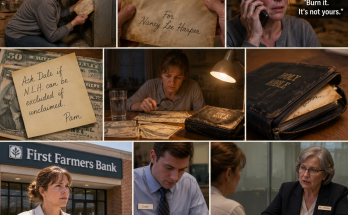
Grandpa’s house remained the final unresolved piece.
The independent estate administrator completed inventory.
Debts were paid.
Tax filings prepared.
Specific personal gifts distributed.
Then came the house.
Under Grandpa’s older will, it would have passed to Dale.
His later written instructions attempted to redirect discretionary inheritance toward restitution if Dale had intentionally diverted my funds or Robert’s records.
The legal effectiveness of that instruction was uncertain because it had not been executed as a formal will amendment.
Another potential fight.
Another lawyer’s bill.
Another year.
Dale surprised everyone.
He disclaimed the house.
Not to me.
To the estate.
That allowed the administrator to distribute or sell according to the remaining estate plan and negotiated family agreement.
I asked him why.
We were standing in the workshop archive when he handed Mr. Creighton the signed disclaimer.
“I don’t want it.”
“You wanted it six weeks ago.”
“I thought I deserved it.”
“What changed?”
He looked at the shelves.
“A lot.”
Not enough of an answer.
He knew.
“I used Grandpa’s house like it was already mine.”
“Yes.”
“Controlled who came.”
“Yes.”
“Moved papers.”
“Yes.”
“I don’t want to live there.”
“Who said anything about living there?”
He shrugged.
“I don’t want the argument either.”
Fair.
The house had modest value compared with everything else.
But enormous emotional weight.
Alan wanted no share.
Pam had no direct inheritance right under the existing will.
Ben and Luke told me they did not care.
Dale’s children did not want involvement.
The administrator asked whether I wanted to purchase it from the estate at appraised value.
My first answer was no.
Too many rooms.
Too much history.
Too much maintenance.
Then I walked through one last time.
Empty.
Estate-sale stickers gone.
Furniture mostly removed.
Pale rectangles still marked the walls where photographs had hung.
The kitchen smelled less like Grandpa now.
That hurt.
I opened the cabinet where he kept coffee.
Empty.
Checked the junk drawer.
Three rubber bands.
A dead battery.
One bent spoon nobody wanted.
Ordinary remains.
I went downstairs.
The basement had been cleared except for the workbench.
The archive trust had considered moving it to Robert’s workshop.
I had not decided.
I ran my hand across the scarred top.
Grandpa had taught Ben knots there.
Luke built the potato bird there.
I found that wooden bird in a box weeks earlier.
It now sat on my bookshelf.
One unfinished wing.
The other smooth.
I opened the narrow hidden drawer.
Empty now.
No ledger.
No envelope.
No secrets.
Good.
On the workbench sat a chipped coffee mug.
Not the one from Grandpa’s box.
Not the second matching one from the estate.
A third.
I laughed aloud.
“How many did you own?”
Marjorie, standing behind me, answered.
“Six.”
I turned.
“What?”
“She bought him a set.”
“Who?”
“Your grandmother.”
Of course.
Six identical cheap ceramic mugs.
Three chipped.
Probably all eventually.
“I have been emotionally manipulated by mass-produced coffee cups.”
Marjorie laughed so hard she had to sit in Grandpa’s chair.
It felt good.
We stayed in the basement.
She told me stories.
Not financial ones.
Grandpa once tried to repair her garbage disposal and flooded her kitchen.
Robert had welded the wrong side of a trailer hitch.
Dad hated mushrooms.
Grandma cheated at cards.
The family existed before the ledgers.
That mattered.
Marjorie reached into her purse.
“I found something.”
My stomach tightened automatically.
She saw my face.
“No financial documents.”
“Thank God.”
“Just paper.”
“That phrase has ruined me.”
She handed me a folded note.
Grandpa’s handwriting.
No date.
I opened it cautiously.
Nancy likes the basement because nobody performs down here.
I stared.
“What does that mean?”
Marjorie shrugged.
“He wrote things.”
The rest continued.
If house gets sold, ask Nancy before workbench goes.
She might want it.
Not because valuable.
Because boys made things here.
My throat tightened.
No secret account.
No confession.
A workbench.
Grandpa had finally identified something I might value without assigning it financial importance.
Then one more line:
If she says no, believe her.
I laughed and cried at once.
There it was.
The lesson reduced to six words.
If she says no, believe her.
No hidden meaning.
No deciding she did not understand.
No assuming she would regret it.
No rerouting choice.
Believe her.
Marjorie touched my shoulder.
“You okay?”
“Yes.”
For once, simple.
I bought the workbench from the estate for twenty dollars because the administrator insisted some value had to be assigned.
Twenty dollars.
I paid cash.
Got a receipt.
Of course.
The house itself I did not buy.
I surprised myself.
For weeks, I thought reclaiming the family home might feel like closure.
It didn’t.
Grandpa had lived there.
So had I for years after Dad died.
But possession was not memory.
I had learned that the hard way.
The house went on the market.
A young couple bought it.
They had a toddler and another baby coming.
I hoped they never learned what had been hidden behind the furnace.
They did not need our ghosts.
The workbench moved to Robert’s workshop archive.
We placed it along the opposite wall from Robert’s.
Two benches.
Two brothers’ lives intersecting again.
Dad’s photograph sat between them.
Not like a shrine.
Just context.
When the house sale closed, the estate distributed proceeds.
My share under the final negotiated resolution was modest.
I accepted it.
Dale received less than the older will anticipated because he had disclaimed the house.
He did not challenge.
Alan received his share.
No one used mine as leverage.
Simple transfers.
Statements.
Receipts.
Boring.
One afternoon, I met Ben and Luke at the archive.
They had seen pieces of the story but not the full collection.
I walked them through it.
Not every humiliating detail.
Enough.
Dad’s settlement.
Grandpa’s decisions.
Robert’s insurance.
Alan’s diversion.
Dale’s actions.
Pam’s role.
My loan.
The trust.
The settlement.
The workshop.
Ben stood beneath the bluebird.
“So all of this started with you cleaning a basement?”
“Pretty much.”
“For three hundred bucks.”
“Yes.”
Luke laughed.
“Did Dale ever actually pay you?”
I stopped.
Nobody had asked.
The three hundred dollars.
I had put the bills into an envelope the night he hired me.
Then everything exploded.
I went home and found it in my kitchen drawer.
Three crisp hundred-dollar bills.
Still there.
Dale had paid me.
I had forgotten.
The next day, I brought the envelope to the archive.
Dale was there reviewing roof invoices with the trustee.
I held it toward him.
“What?”
“Your three hundred.”
He stared.
“No.”
“You hired me to clean.”
“You cleaned.”
“I stopped halfway.”
“You found what I hired you to find.”
The sentence was so absurd we both laughed.
“Keep it.”
“I don’t want it.”
“Then donate it.”
“To what?”
He pointed around.
“The archive roof.”
I shook my head.
“No.”
“Why?”
“Accounting.”
He groaned.
I donated it to a local legal-aid organization that helped older adults with financial exploitation and estate questions.
No grand gesture.
Three hundred dollars.
Exactly what started it.
I did not tell Dale until later.
He said that was annoyingly appropriate.
He was right.
The insurer completed its internal review several months after the civil settlement.
It acknowledged serious defects in the beneficiary-change verification process.
It did not place sole responsibility on one employee.
Teresa’s missing memorandum had been mishandled internally.
The secondary verification should have been stronger.
The company contributed to the settlement and changed procedures.
Teresa received a formal thank-you from its legal department.
She sent me a copy.
Not because she wanted credit.
Because after twelve years, someone had finally acknowledged she had raised the concern.
I understood why that mattered.
Sometimes the money was not the only thing needing restoration.
The record did too.
Dale’s separate legal situation continued beyond our settlement.
His attorneys handled it.
I did not follow every development.
That choice surprised me.
For weeks, I had needed to know everything.
Then I understood that some matters no longer required my supervision.
Access did not mean ownership.
That worked both ways.
I did not own Dale’s consequences.
I owned my decisions.
Pam eventually filed for divorce.
Not because I told her.
Not because the settlement required it.
She said she could not rebuild a marriage while wondering which facts had been assembled for her.
Dale did not fight her publicly.
Their financial case remained private.
Evelyn kept her house.
The credit line was restructured as part of their resolution.
She made Pam read every page of the new documents aloud.
Twice.
Alan and I became closer slowly.
Not dramatically.
He called.
I answered when I wanted.
Sometimes we ate dinner.
Sometimes I said no.
He believed me.
That was new enough to notice.
Creekside continued operating.
I met Rosa, the bakery owner, every few months.
Eventually I told her I was the trust beneficiary.
She looked horrified.
“I complained to you about the gutters.”
“They were bad gutters.”
“I said the landlord was cheap.”
“He was.”
We laughed.
Then I had them replaced.
Not because I had suddenly become generous.
Because the building needed gutters.
Ownership meant maintenance.
Again, boring.
I began working fewer diner shifts.
Not zero.
I liked the people.
I liked earning money that arrived because I had worked that week, uncomplicated by trusts and dead men.
But I stopped taking every extra shift out of fear.
That was different.
Ben asked whether I planned to leave him and Luke money someday.
“Yes.”
“How much?”
“No idea.”
“Will you hide it behind a furnace?”
“Absolutely.”
He stared.
I laughed.
“No.”
I showed them where my documents were.
Accounts.
Trust.
Beneficiary forms.
Attorney contact.
Passwords stored through proper secure access.
Everything.
Luke said, “This is depressing.”
“Good.”
“How is that good?”
“You’ll remember it.”
He did.
The final settlement payment from HPS arrived two years later.
On time.
Every installment had been on time.
Dale had kept that promise.
Harper Property Solutions survived.
Smaller expansion plans.
No Cedar Grove duplex.
The lender eventually approved a reduced facility after claims were resolved and capital sources corrected.
Employees kept jobs.
Tenants stayed.
Dale continued running the company.
I did not own it.
I did not want it.
The archive trust remained the only property connecting us formally.
Every year it issued a report.
Every key logged.
Every document request noted.
No secret drawer became necessary.
On the second anniversary of Grandpa’s death, we gathered at the workshop.
Not everyone.
Pam came separately from Dale.
Alan brought dinner.
Ben and Luke arrived late.
Marjorie brought cookies.
Evelyn criticized the coffee.
Dale’s daughter brought a new framed photograph of Robert.
No speeches.
Thank God.
At one point, I stood alone beside Grandpa’s workbench.
My chipped mug sat on the corner.
The first one.
The one he had hidden for me.
I ran my finger over the chip.
Grandpa had spent decades trying to protect me with money.
Bonds.
Trusts.
Property.
Accounts.
Most of those things helped eventually.
Some hurt first.
What I needed from him had never been just financial.
I needed him to believe I could know difficult things and still stand.
He learned that too late to tell me face-to-face.
But he learned it.
That mattered.
I looked at his note framed on the archive wall.
Nancy may choose differently than I would. That does not make her wrong.
Beside it, another smaller line.
If she says no, believe her.
That was what I kept.
Not as a slogan.
As a rule.
Ben came beside me.
“You ready?”
Everyone was leaving.
“Yes.”
I picked up the mug.
He looked at it.
“You’re taking that?”
“It’s mine.”
“Which one?”
I smiled.
“Does it matter?”
He thought.
“No.”
Exactly.
We turned off the workshop lights.
The bluebird disappeared into the dark.
I locked the door.
Then logged the lock time in the archive book because rules applied to me too.
For once, nobody had to trust someone’s memory later.
Click here to continue reading: PART 37: Two Years After the Settlement, an Archive Request From a Stranger Forced Me to Decide Whether Our Family Records Belonged Only to Us
Three Hundred Dollars for Grandpa’s Basement Sounded Like Charity Until Dale Made Sure I Understood Exactly What I Was Allowed to Touch
Part 36 of 44