
Julian read every page.
That alone took nearly an hour.
A week earlier, he would have handed the documents to lawyers and signed where they marked.
Now he asked questions.
Annoying questions.
Precise ones.
What authority would interim directors hold?
Could payroll continue?
Could employees be terminated?
Could assets be sold?
Would either he or I have unilateral access to disputed funds?
Grace answered when the questions concerned me.
Corporate counsel answered the rest.
The final structure was strict.
Richard stepped down immediately.
Julian relinquished day-to-day executive authority.
An independent three-person board would oversee Harrington Development during the forensic audit.
One director nominated by the buyer.
One by undisputed shareholders.
One by the court-appointed monitor.
Neither Julian nor I could move disputed assets.
Payroll, vendors, taxes, and ordinary operations continued.
Riverside proceeds would be placed in segregated escrow.
Nothing distributed until ownership was resolved.
Julian reached the final signature page.
He looked at me.
“This may end my career.”
I did not answer.
He smiled bitterly.
“That isn’t meant to make you feel guilty.”
“Good.”
“I’m just saying it.”
I nodded.
He looked back at the page.
“My entire adult life is this company.”
“That was your choice.”
“Yes.”
That answer came without complaint.
He signed.
One page.
Then another.
Then the formal resignation from executive control.
His pen stopped briefly before the last signature.
Then continued.
No dramatic gesture.
No speech.
Just ink.
When he finished, he slid the documents toward corporate counsel.
“Done.”
The lawyer checked everything.
“Effective immediately.”
Julian sat back.
For perhaps the first time since I had known him, he had no company to command.
His phone still rang.
People still wanted answers.
But he could no longer order employees to move money, approve payments, fire staff, sign transactions, or conceal decisions beneath authority.
He looked smaller.
Not weaker.
More proportionate.
I had spent years mistaking power for size.
Without it, Julian finally looked like one man.
Nothing more.
The Riverside closing proceeded the following morning.
Not smoothly.
But legally.
Funds entered escrow.
Employees were paid.
Vendors received scheduled amounts.
No money went to Richard.
No money went to Julian.
No money went to me.
That felt right.
Thomas’s deadline passed without the company collapsing.
He had designed the truth as a bomb.
We turned it into an audit.
That did not make the truth less destructive.
It made the destruction more precise.
Three days later, the independent auditors moved into Harrington Development’s offices.
Daniel assisted but did not lead.
His history with the company made full independence impossible.
He accepted that.
Elena surrendered every device and archive she had ever handled.
She also moved back into a short-term apartment.
Not mine.
I returned her suitcase through a courier.
The navy robe went into the trash.
Not because it was ruined.
Because I did not want it anymore.
There are objects that stop being useful once they become symbols.
Grace filed the ownership claim based on page seven, the forged post-death consent, and succession provisions.
Richard’s attorneys did not contest authenticity.
That mattered.
They contested interpretation.
Forty-two percent was not yet legally final.
But it was no longer speculative.
The audit began tracing every successor entity from Cedar Ridge into Harrington Development.
Michael’s work made the process possible.
My father’s ledger made it faster.
Claire’s preserved copy made it credible.
Thomas’s burned original supported it.
Richard’s confession connected it.
For the first time, all the fragments were in one room.
On the fourth day, I received a letter from Claire.
Not a meeting request.
A letter.
I opened it alone.
Vivian,
I don’t know what to call you yet.
That was the first line.
I smiled despite myself.
She continued.
Michael talked about you constantly, which was irritating considering he was supposed to be getting to know me.
That sounded like him.
She wrote about coffee meetings.
Arguments.
The awkwardness of learning at nineteen that the man she believed was a family friend was actually her biological father.
She wrote that Michael never asked her to replace the father who raised her.
He only asked permission to know her.
Again, Michael.
Ask.
Not take.
She wrote:
He said you would understand that.
I cried then.
Quietly.
Not because Claire called me family.
She didn’t.
Not yet.
Because Michael had believed I would behave well with someone he loved.
That trust mattered.
Her last paragraph was simple.
I’m not ready to meet, but I think I will be.
Please don’t answer through lawyers.
Here is my email.
Claire.
I read the address several times.
Then wrote one sentence.
Whenever you’re ready, I’ll be here.
I did not tell her what Michael would have wanted.
I did not tell her what relationship we should have.
I did not call myself her aunt.
I sent the message and left the rest with her.
Michael would have approved.
Julian moved into a hotel.
He did not ask to return home.
That mattered too.
He sent me one message each evening.
Not emotional.
Not pleading.
Usually factual.
Spoke with detectives.
Met counsel.
Submitted records.
No request for response.
I answered only when necessary.
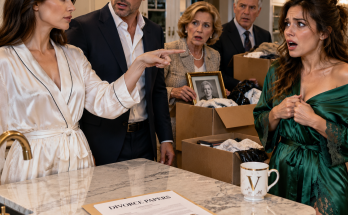
Divorce paperwork remained on my kitchen counter.
I had not signed it.
Not because I wanted reconciliation.
Because there were legal issues Grace wanted separated from criminal and corporate proceedings.
I found that strangely funny.
Julian had tried to accelerate divorce immediately after believing his debt was gone.
Now the divorce waited because the truth had become too complicated to rush.
Richard remained under investigation.
Prosecutors were considering multiple financial charges, obstruction-related conduct, and evidence concealment.
Thomas faced separate exposure related to Michael’s crash, evidence destruction, threats, and his conduct at Cedar Ridge.
Beatrice had not been charged at that point.
Her involvement in the road incident remained under review.
Aaron recovered slowly.
He eventually provided a fuller statement.
He admitted routing Michael onto the lower road.
Admitted concealing his own financial diversions.
Admitted witnessing the forged consent.
Admitted lying about being absent from Aspen Ridge.
He still denied telling Pike to hit Michael’s vehicle.
Pike still claimed Aaron’s instruction had been “make him stop.”
No one could prove what tone or meaning had accompanied the phrase.
The road footage helped.
Pike moved out of Michael’s path after Julian’s call.
That reduced the chance he had intended the fatal collision himself.
Thomas and Beatrice’s vehicle made the actual contact.
Responsibility did not disappear.
It became distributed.
Messy.
Unsatisfying.
Real.
The medical examiner’s review arrived the following week.
Grace read it before giving it to me.
“You may want to sit down.”
I did.
The report concluded that Michael died primarily from internal injuries sustained in the crash.
Could earlier emergency intervention have changed the outcome?
Possibly.
Not certainly.
There was no medical basis to say with confidence that he would have survived if Julian called immediately.
There was also no basis to say the delay was harmless.
Forty-seven minutes remained morally devastating.
Legally and medically uncertain.
I read that section twice.
Julian had spent days expecting a sentence that would tell him whether his delay killed Michael.
No document could give him that certainty.
Maybe that was appropriate.
Some consequences cannot be reduced to clean verdicts.
He had to live with the choice itself.
Not only the outcome.
I called him.
He answered immediately.
“Vivian?”
“The medical review came.”
Silence.
“What does it say?”
I told him.
He breathed out slowly.
“So he might have died anyway.”
“Yes.”
A long pause.
“That doesn’t help.”
“No.”
“I thought it would.”
“I know.”
He was quiet.
Then:
“I waited.”
“Yes.”
“That part doesn’t change.”
“No.”
He cried silently for several seconds.
I did not comfort him.
I did not hang up.
Both choices felt correct.
Finally he said, “Thank you for telling me.”
I ended the call.
Two days later, the forensic auditors asked for me at Harrington Tower.
I had not entered the building since this began.
The lobby smelled exactly the same.
Stone.
Coffee.
Polished wood.
The Harrington name still hung behind reception.
But a temporary notice beside it listed interim management.
No Julian.
No Richard.
I went upstairs with Grace.
Daniel met us outside a conference room.
His expression told me something was wrong.
“What?”
“We found another account.”
I almost laughed.
“Of course.”
Grace gave me a look.
Daniel did not smile.
“This one is different.”
“How?”
“It isn’t tied to Richard.”
“Thomas?”
“No.”
“Aaron?”
“No.”
“Julian?”
He hesitated.
My stomach tightened.
“Daniel.”
“No.”
“Then who?”
He opened the conference-room door.
Three auditors sat around a table.
Bank records covered the surface.
At the top of the first page:
MERCER EDUCATION HOLDINGS.
Laura Mercer.
Claire’s mother.
I stared.
“What is this?”
The lead auditor answered.
“A private account funded over twenty-three years.”
“With Richard’s payments?”
“Partly.”
“How much?”
“Approximately nine hundred thousand dollars total inflows.”
My pulse jumped.
“Richard paid Laura almost a million dollars?”
“No.”
The auditor shook his head.
“Richard’s known payments account for around two hundred and sixty thousand.”
“Then where did the rest come from?”
He slid over another page.
Transfers.
Some from Cedar Ridge successor companies.
Some from Bridge Consulting.
Some from entities connected to Thomas.
And one source I did not recognize.
E.W. FAMILY RESERVE.
My skin went cold.
“E.W.”
“Edward Walsh.”
“My father?”
Grace looked at the dates.
The transfers began before my father died.
I stared.
“Dad knew about Claire.”
Daniel shook his head.
“Maybe not Claire specifically.”
“What else would Mercer Education mean?”
The auditor answered.
“We traced the original account-opening documents.”
He slid them toward me.
Beneficiary: Laura Mercer.
Purpose: education and dependent support.
Authorized contributor:
Edward Walsh.
My father.
I could barely process it.
“Why would Dad give Laura money?”
No one knew.
The auditor continued.
“There is another authorized contributor.”
I looked down.
Michael Walsh.
That made sense later.
But the first contributions from Michael began before Daniel said Michael learned Claire was his daughter.
My pulse changed.
“That timeline is wrong.”
Daniel nodded.
“Exactly.”
Michael had supposedly learned about Claire six years ago.
Yet he had funded this account eight years ago.
Two years earlier.
“Michael knew sooner.”
Grace said.
“Or he knew something else.”
I stared at the account.
“What?”
The auditor handed me one final document.
A beneficiary amendment.
Dated seven years earlier.
It changed the contingent beneficiary if Laura died.
From Claire Mercer.
To:
VIVIAN WALSH HARRINGTON.
I stared at my own name.
“Why am I on this?”
Daniel looked troubled.
“We don’t know.”
My phone vibrated.
An email.
Claire.
I opened it.
Only four sentences.
Vivian,
I think there’s something Michael never told either of us.
My mother finally admitted your father knew about me.
But she says Edward wasn’t helping because of Michael.
She says he believed I was his granddaughter.
I stared at the screen.
No one spoke.
I read the final line.
And she says Michael may not have been my father after all.

One Comment on “PART 28 – Julian Signed Away Control to Save the Company, but the Audit Found One Account Even Richard Had Never Known Existed”