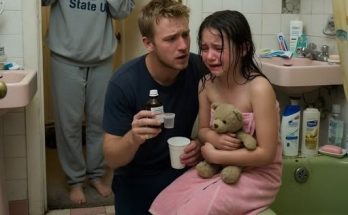
The ambulance doors closed with Sarah inside, but Chloe refused to release her hand until the paramedic explained that she and Liam would be brought to the hospital too. Even then, Chloe watched the vehicle until its red lights disappeared through the rain. She had spent the last hour fearing her mother might die. Now that Sarah was alive, a different fear had taken its place: what happened tomorrow?
Officer Jessica Hayes rode with the children to the hospital. She did not ask Chloe for a detailed statement during the drive. There would be trained interviewers and proper procedures later. Tonight Chloe needed warmth, food, and the knowledge that the adults around her were not going to demand that she solve anything else.
Liam sat beneath a gray blanket, holding a paper cup of water with both hands.
“Is Dad still in the police car?”
“He’s being taken somewhere safe for everyone,” Jessica said.
“Jail?”
“For tonight, yes.”
Liam considered that.
“Does jail have beds?”
Jessica glanced at him.
“Yes.”
“And blankets?”
“Yes.”
“Okay.”
Chloe looked at her brother.
“Why do you care?”
Liam shrugged beneath the blanket.
“He’s still Dad.”
Jessica said nothing.
That was the cruelty children often inherited from violent homes: they could fear someone and love him simultaneously, then feel guilty for whichever emotion happened to be stronger.
At the hospital, Sarah was taken for examination while the children waited with a victim advocate. A social worker named Emily arrived carrying two blankets and hot chocolate.
Chloe did not drink hers.
Neither did Liam.
Emily sat across from them rather than beside them.
“My job tonight is to help your family figure out what happens next.”
Chloe asked immediately, “Are you taking us away from Mom?”
“No.”
“People at school say social workers take kids.”
“Sometimes children need somewhere else to stay if home isn’t safe. But your mother is here, and she wants you with her. Our goal is to keep you together somewhere safe.”
“What if Dad comes?”
“He won’t be allowed into the hospital.”
“What about tomorrow?”
“There are people working on that too.”
Chloe looked toward the corridor leading to the treatment rooms.
“Can I see Mom?”
“As soon as the doctors say yes.”
Liam leaned against Chloe.
He had stopped crying, which somehow made him look more exhausted.
Emily asked whether they wanted anything to eat.
Liam shook his head.
Chloe said, “He likes grilled cheese.”
“I’m not hungry,” Liam muttered.
“You didn’t eat dinner.”
“Neither did you.”
Emily quietly arranged food for both of them.
Twenty minutes later a nurse appeared.
“You can see your mom now.”
Chloe stood so quickly that her blanket fell.
Sarah was propped against pillows when they entered. One side of her face had begun to swell. There was medical tape near her eyebrow, and she moved carefully whenever she breathed deeply.
Liam stopped in the doorway.
Sarah opened her arms.
That was all it took.
Both children ran to her.
Sarah winced when they reached the bed but held them anyway.
“I’m sorry,” she whispered.
Chloe pulled back.
“You said I wasn’t supposed to say sorry.”
“I know.”
“So you can’t either.”
Sarah gave a broken little laugh.
“Fair enough.”
Liam touched the tape near her eyebrow.
“Does it hurt?”
“A little.”
“Did Dad do it?”
The room became quiet.
Sarah had spent years hiding the truth from her children even when the truth was occurring directly in front of them.
She suddenly understood that pretending had not protected them.
“Yes,” she said.
Liam looked down.
“Why?”
“I don’t have a good answer.”
“Was he mad?”
“Yes.”
“Do people hurt people when they’re mad?”
“No.”
Sarah’s answer came quickly.
“People can be angry. They can leave a room. They can talk. They can ask for help. They do not get to hurt somebody because they’re angry.”
Liam seemed to absorb that as new information.
Chloe climbed carefully onto the edge of the bed.
“Are we going home?”
Sarah looked at Jessica, who stood near the doorway.
“No.”
“Ever?”
“I don’t know.”
Chloe waited.
Sarah added, “But not while it’s unsafe.”
That answer was enough for tonight.
The children stayed beside her until Liam fell asleep against a pillow.
Chloe remained awake.
Officer Jessica stepped into the hallway, where Detective Marcus Vance had just arrived.
He carried a notebook but had not opened it.
“How bad?” he asked.
“Victim is stable. Two children witnessed portions of the incident. Nine-year-old made the emergency call.”
Marcus glanced through the doorway.
“Father?”
“David Miller. In custody. Friend is Vince Harper. Both intoxicated. Statements conflict already.”
“House?”
“Photographs underway. Significant damage.”
“History?”
Jessica exhaled.
“That’s what worries me. Sarah’s first concern wasn’t tonight. She said, ‘Don’t let him near them.’ Chloe told dispatch they were hurting her ‘again.’”
Marcus wrote the word again.
That single word changed the shape of the case.
The next morning investigators began assembling what the family had spent years trying not to assemble.
Individual incidents could be excused.
A broken plate.
A bruise.
A canceled dinner.
A child falling asleep at school.
A neighbor hearing shouting.
A mother wearing long sleeves in warm weather.
A father apologizing too loudly the next morning.
Separated, each detail could be explained.
Together, they formed a pattern.
Mrs. Henderson admitted she had heard arguments for months.
“Why didn’t you call?” Marcus asked.
She looked ashamed.
“I thought Sarah would tell someone if it was serious.”
Across the street, Mr. Collins gave nearly the same answer.
“I figured families argue.”
“Did you ever hear things breaking?”
“Yes.”
“Did you ever see Sarah injured?”
“Once. Maybe twice.”
“Did you ask?”
“She said she walked into a cabinet.”
Marcus closed his notebook.
“And you believed her?”
Mr. Collins looked toward the Miller house.
“I wanted to.”
That distinction mattered.
People often accepted the explanation that required the least from them.
Evidence technicians photographed the damaged living room, the broken lamp, marks on the wall, and a doorframe that appeared to have been repaired more than once.
They recovered David’s phone.
Some messages had been deleted.
Digital evidence specialists began restoring them.
Sarah, meanwhile, spoke to Marcus from her hospital bed.
Jessica remained nearby.
Marcus kept his questions simple.
“Do you feel safe returning home?”
“No.”
“Do you believe David would hurt you again?”
Sarah looked at Chloe sleeping in the chair.
“Yes.”
“Has he hurt you before?”
Silence.
Sarah’s fingers tightened around the blanket.
“Yes.”
“How long?”
“I don’t know.”
Marcus waited.
Sarah corrected herself.
“That’s not true. I know.”
She stared at the window.
“The first time was three years ago.”
Jessica did not react outwardly.
Sarah continued.
“He apologized before I even understood what had happened. He cried. He said he had been drinking and that he hated himself.”
“What happened after that?”
“He stopped drinking for a while.”
“And then?”
“He lost his job.”
Her voice flattened.
“He started drinking again.”
“Did the violence become more frequent?”
“Yes.”
“Did the children see it?”
“I tried not to let them.”
Marcus looked toward Chloe.
“Children notice more than adults think.”
Sarah’s eyes filled.
“I know that now.”
Marcus asked about Vince.
“He encourages David when they drink.”
“Has Vince hurt you before?”
“Not directly.”
“Last night?”
Sarah hesitated.
“He blocked the door when I tried to leave.”
That was important.
“Did he touch you?”
“He grabbed my wrist once.”
Marcus recorded it.
“Why were you trying to leave last night?”
Sarah took a slow breath.
“Because I told David I was taking the children and going to my sister’s.”
Jessica looked up.
“Had you told him that before?”
“No.”
“What changed?”
Sarah looked toward Chloe.
“She did.”
Neither officer spoke.
“Two days ago Chloe asked me why I always told Liam not to hit people when Dad was allowed to hit me.”
Sarah covered her mouth.
“I didn’t know she had seen that much.”
Jessica felt something tighten in her chest.
Sarah continued.
“I realized I was teaching them something even when I thought I was hiding it.”
“So you planned to leave?”
“Yes.”
“Did David know?”
“He found the bag.”
“What bag?”
“I packed documents. Clothes. The children’s birth certificates. Some cash.”
“Where?”
“Laundry room.”
“And he found it?”
“Yesterday afternoon.”
That explained the escalation.
Marcus later requested photographs of the laundry room.
Investigators found an empty duffel bag thrown behind the washing machine.
Hours later, restored messages from David’s phone added another layer.
One had been sent to Sarah before he returned home.
They would settle everything that night.
Another warned her against leaving.
There were older messages too.
Apologies.
Threats.
Accusations.
Promises.
The cycle existed in writing.
When Jessica returned to Chloe’s room, she found the girl awake.
Chloe was drawing on a sheet of hospital paper.
“What’s that?”
“A house.”
Jessica sat beside her.
“Can I see?”
Chloe turned the page.
The house had three people standing outside it.
A mother.
A girl.
A small boy.
No father.
Jessica did not ask why.
Chloe stared at the drawing.
“Did I get Dad arrested?”
“No.”
“But if I didn’t call, he wouldn’t be arrested.”
“That might be true.”
Chloe looked confused.
Jessica continued.
“But those are two different things. Your call told us where help was needed. Your father’s choices are why officers arrested him.”
Chloe rubbed the edge of the paper.
“He used to be nice.”
“I believe you.”
“He taught me how to swim.”
Jessica nodded.
“He made Liam’s birthday cake last year because Mom was sick.”
“That can be true too.”
Chloe looked up.
“How can somebody be good and bad?”
Jessica considered the question.
“People are complicated. But you don’t have to decide whether someone is completely good or completely bad before you’re allowed to be safe around them.”
Chloe stared at her for a long moment.
“Mom said we’re not going home.”
“How do you feel about that?”
“I don’t know.”
“That’s allowed.”
“What if I miss my room?”
“You probably will.”
“My books are there.”
“We can try to get them.”
“My stuffed rabbit too.”
“We’ll try to get that.”
Chloe’s eyes lowered.
“What if I miss Dad?”
Jessica answered without hesitation.
“You might.”
“Does that mean I did something wrong?”
“No.”
That seemed to matter more than anything else.
Before Jessica left, Chloe asked one final question.
“Did I do the right thing?”
Jessica crouched beside her.
“You called because somebody was in danger.”
“I was scared.”
“You can be scared and still make a brave choice.”
Chloe considered this.
Then, for the first time since the emergency call, the corners of her mouth lifted.
It was not happiness.
It was exhaustion loosening its grip.
Three days after the assault, Sarah was discharged.
Emily met the family downstairs.
A confidential shelter had space for all three of them.
Sarah signed the paperwork.
Chloe held Liam’s hand.
Outside the hospital, Jessica waited beside an unmarked car.
“You didn’t have to come,” Sarah said.
“I know.”
Sarah looked at her children.
“Thank you.”
Jessica shook her head.
“Your daughter made the call.”
Chloe stared at the pavement.
Sarah reached for her hand.
“And somebody answered.”
They drove away from the hospital without returning to the Miller house.
For Chloe, leaving felt strange.
There was no dramatic goodbye.
No final walk through her bedroom.
No time to gather everything she loved.
A police officer would later collect clothes, school supplies, her books, and the stuffed rabbit.
The house simply disappeared behind them.
At the shelter entrance, Sarah stopped.
The building was plain.
The furniture inside did not match.
Nothing smelled familiar.
Liam looked around.
“Is this our house?”
“No,” Sarah said.
“Then where’s home?”
Sarah looked at Chloe.
She had no answer yet.
But for the first time in years, she understood that not knowing where home would be was less frightening than returning to a place where her children had learned to hide.
Click here to continue reading: PART 4: Sarah Thought Leaving Would End the Fear, Until Her Son Asked a Question That Revealed What the Children Had Learned at Home
A Nine-Year-Old Heard Her Mother Cry Out Downstairs and Reached for the One Phone Her Father Had Forgotten
Part 3 of 43