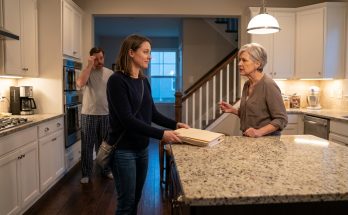
Dad waited six months before asking.
By then the divorce was nearly complete.
The accounting had produced its first final distributions.
Leonard had entered pleas on several financial counts and remained in litigation over the medical cases.
Dunn was cooperating.
Lowell had surrendered his medical license while criminal and professional proceedings continued.
Brenda no longer controlled Northfield.
Jason was completing the first stage of his legal resolution.
Richard and Michael had reached settlements on several properties while continuing to contest others.
Caroline had stepped away from leadership at Mercer & Lowe.
Grace had transferred archival custody to an independent institution.
Miriam remained overseas but continued cooperating through counsel.
Everyone’s life had become smaller in some way.
That did not make it worse.
Dad asked me to meet him at Mom’s grave.
I nearly said no.
Then decided I wanted to go for myself.
Not him.
The cemetery was quiet.
Wind moved through dry grass.
Someone had left white flowers beside Mom’s marker.
Dad stood several feet away.
“You bring those?”
“Yes.”
“She hated white flowers.”
He looked horrified.
Then I laughed.
Mom disliked formal funeral arrangements.
She called white lilies “flowers that already look dead.”
Dad laughed too.
It felt strange.
Not wrong.
We sat on a bench.
For a long time neither spoke.
Then he said:
“I want to know you.”
Simple.
Dangerous.
I looked at him.
“You do know me.”
“Not really.”
“No.”
“I know facts.”
“Yes.”
“Photographs.”
“Yes.”
“What Ellen told me.”
“Yes.”
“Grace’s records.”
“Probably too many.”
He smiled faintly.
“I mean now.”
I understood.
He wanted a relationship.
Not just testimony.
Not only evidence.
A future.
“I don’t know if I want that.”
His face hurt.
He nodded.
“I know.”
“I spent most of my life without you.”
“I know.”
“You made that choice.”
“Yes.”
“Mom made choices too.”
“Yes.”
“Victor manipulated both of you.”
“Yes.”
“That still doesn’t put my childhood back.”
“No.”
He did not say he deserved another chance.
Good.
“I might want coffee sometimes.”
“I’d like that.”
“I may not answer calls.”
“Okay.”
“I may get angry when you tell stories about Mom like you were there.”
He looked down.
“Fair.”
“I may never call you Dad naturally.”
That one hurt him.
He nodded anyway.
“Okay.”
“And I may decide later that this is too much.”
“Yes.”
I studied him.
“You’re not going to argue?”
He almost smiled.
“I’ve spent forty years learning what happens when people confuse love with a right of access.”
That was good.
Maybe too good.
But he had earned the sentence through pain.
“I don’t forgive you.”
“I know.”
“Maybe I will.”
He did not brighten.
Good.
“Maybe I won’t.”
“I know.”
We sat.
Mom’s grave in front of us.
Two people she had loved badly and fiercely.
There was no tidy family restoration.
I did not want one.
Tidy had been the problem.
Later that week, I received the final divorce decree.
Sarah Hayes.
No longer David’s wife legally.
The paper felt surprisingly ordinary.
A stamp.
A signature.
A date.
I sat in my car outside the courthouse reading it twice.
Then David called.
I considered not answering.
I did.
“It’s final,” he said.
“Yes.”
“I got the copy.”
“Okay.”
Silence.
Then:
“I hope you’re all right.”
“I am.”
Not completely.
Enough.
“You?”
“I’m getting there.”
“Good.”
Another silence.
“Sarah?”
“Yes?”
“Thank you for not protecting me.”
I closed my eyes.
That sentence mattered.
I could have used inheritance money to erase his debts.
Could have hidden his conduct.
Could have asked Mom’s attorneys to contain things.
Could have done exactly what everyone had done before.
I did not.
“You’re welcome.”
We both laughed softly because the response sounded absurd.
Then we ended the call.
No promise to remain friends.
No dramatic final declaration.
Just finished.
Brenda wrote me a letter.
I almost threw it away.
Then read it.
She did not ask forgiveness.
Mostly.
She explained that losing Northfield control felt like losing Robert again.
For decades, she treated the assets as proof his fear and compromise had produced something worth preserving.
When accounting took them, she felt his choices had become meaningless.
Then she wrote:
I am beginning to understand that consequences are not the same thing as meaninglessness.
That was better than apology.
She told me she had begun seeing Jason without discussing money.
That sounded almost impossible.
I hoped they managed.
I did not need to participate.
Michael eventually recovered a substantial portion of his historical claims.
Less than he once demanded.
More than he expected.
He donated part to the restructured medical foundation.
When he told me, I asked why.
“Guilt.”
“At least you’re honest.”
“Also taxes.”
I laughed.
Mom would have appreciated that.
Thomas retired completely.
He had threatened retirement for years.
This time he did it.
He sent me a note with no legal language.
I spent my career believing information becomes safe when the right professional controls it. Your mother cured me of that belief too late.
He ended:
Never hire a lawyer who enjoys secrets.
I kept the note.
Caroline testified in several proceedings.
Her testimony implicated Daniel.
Herself.
Leonard.
Charles.
Others.
She lost clients.
Lost positions.
Kept enough money to live comfortably.
That seemed appropriate though I no longer pretended I was qualified to distribute moral outcomes.
Richard surprised everyone most.
He agreed to dissolve several Vale-controlled structures rather than continue expensive litigation.
When asked why, he said:
“I want my children to inherit assets, not arguments.”
I did not know he had children.
I was glad they might receive less history.
Grace chose to give up more than accounting required.
She transferred part of the clean portion of her trust into the medical foundation.
I challenged her.
“Why?”
“Restitution.”
“Or guilt?”
“Both.”
“Are you sure guilt gets to decide this?”
She stared at me.
That was my point.
People could overcorrect too.
Punishment could become another form of control.
“You don’t have to impoverish yourself to prove you’re different.”
She laughed.
“I am not impoverishing myself.”
Fair.
“Then do what you choose.”
“I am.”
Good.
Miriam surrendered Samuel’s original ledger permanently.
She refused to return to the country until her legal exposure was settled.
Grace visited her once.
When she returned, I asked how it went.
“Badly.”
“Good.”
Grace laughed.
“No. Actually bad.”
“Still useful?”
“Yes.”
Relationships did not become healthy because secrets ended.
They merely became possible.
Jason entered a structured repayment and sentencing arrangement.
Part of his punishment involved financial restrictions.
He started working at a small logistics company.
Not glamorous.
No business schemes.
No investment pitches.
He called me once after receiving his first paycheck.
“I made eight hundred and twenty dollars after taxes.”
“Congratulations.”
“I used to lose that before lunch.”
“That is less congratulatory.”
He laughed.
Then said:
“I paid fifty dollars toward restitution.”
“Good.”
“Feels pathetic.”
“It’s fifty dollars more than zero.”
He was quiet.
“Ellen would say something harsher.”
“Definitely.”
We laughed.
Maybe that was forgiveness beginning.
Not erasure.
Distance without hatred.
The medical foundation became the most important institutional consequence.
Independent trustees replaced every family-controlled seat.
No Whitmore.
No Vale.
No Mercer.
No Shaw.
No Holloway.
No Hayes.
The sixty-million fund underwent forensic review.
Money stolen through Meridian vendors was recovered where possible.
Some had vanished.
Some had been spent decades earlier.
Some existed in estates.
The foundation retained enough to continue its charitable mission.
That mattered.
Victor had created it partly as camouflage.
Samuel exploited it.
Leonard looted it.
Margaret manipulated it.
Yet over decades it also paid for real care.
Real patients.
Real research.
A corrupted origin did not mean every outcome was worthless.
That was another lesson I had resisted.
Systems could contain harm and good simultaneously.
Cleanup meant separating them rather than burning everything for emotional satisfaction.
Mom’s estate funded an independent patient-safety program as part of the restitution arrangement.
Not named after her.
I insisted.
No Ellen Whitmore Memorial anything.
Her reputation did not need architecture.
Grace agreed.
Michael complained for two days.
Then stopped.
The program focused on medication traceability and override auditing.
Exactly the weakness Mom died exposing.
That felt right.
Not because it transformed her death into meaning.
Deaths did not need to become gifts.
But consequences could still be useful.
Leonard’s sentencing on the financial counts came first.
I attended.
He looked smaller than I remembered.
No courtroom villain.
An old man.
His attorney described his age.
Health.
Cooperation.
Community work.
Prosecutors described decades of fraud.
Renner.
Mom.
Procurement manipulation.
Leonard spoke briefly.
“I never intended anyone to die.”
I believed that might be true.
Then he said:
“I thought I could control the outcome.”
There it was.
The disease shared by everyone.
Control.
“I was wrong.”
The judge handled the rest.
I did not feel satisfaction.
Just finality around one part.
The medical charges remained.
Later, experts testified that Mom might have lived weeks or months longer without contaminated flushes.
No one could say exactly.
At first, that uncertainty tortured me.
Then I realized I had been given something I never had before.
The truth did not need to tell me how many days were stolen to establish that days were stolen.
One hour would have mattered.
One conversation.
Mom planned to tell me everything the next day.
Leonard’s act helped ensure that day never came.
I allowed myself anger without converting it into fantasy about what our final conversation would have fixed.
Mom and I would probably have fought.
I would have accused her of lying about Dad.
She would have defended herself.
I would have hated some of her choices.
She would have told me I was being dramatic.
Then perhaps we would have eaten something terrible from the hospital cafeteria.
Reality.
Messy.
Ordinary.
Gone.
One evening I visited her house.
It had remained in the estate because I could not decide what to do with it.
Most rooms were empty now.
The study still contained her desk replacement.
Not the one hidden at Dad’s house.
Another.
I sat in her chair.
For years she had worked there building safeguards.
Some wise.
Some damaging.
I opened the drawer.
Nothing hidden.
I laughed.
Then cried.
Then laughed again.
When I returned home, Dad had left a voicemail.
Not urgent.
He asked whether I wanted coffee Sunday.
I stared at the phone.
No obligation.
No crisis.
No threat.
No inheritance issue.
Just coffee.
I called back.
“Ten-thirty.”
His relief was audible.
“Okay.”
“Don’t be early.”
“I won’t.”
“Dad?”
The word slipped out.
We both went silent.
I almost took it back.
Then decided not to.
“Yes?” he said.
“Nothing.”
A long pause.
Then:
“See you Sunday, Sarah.”
After we ended the call, I sat quietly.
I had not forgiven everything.
I had not forgotten anything.
But for the first time, contact with my father was a choice I made with full information.
That made it mine.
Click here to continue reading: PART 40: The Final Ownership Ruling Settled the Fortune Everyone Had Fought Over, but One Last Question About My Mother Could Only Be Answered by Me
Before Sunrise, My Husband Brought His Family to My Door and Asked for Something My Mother Had Already Protected
Part 39 of 44