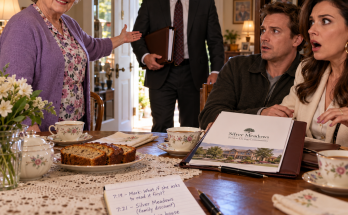
At 8:44 on Tuesday morning, my son walked into my kitchen carrying a folder he believed would change the rest of my life.
He did not come alone. Alicia followed him through the back door, dressed as though we were meeting with a banker instead of having coffee at my kitchen table. She held another folder against her ribs. Mark kept rubbing the side of his thumb with his index finger, an old nervous habit he had had since childhood. Neither of them knew Henry Kaplan was in the hallway taking off his coat.
That ignorance lasted perhaps fifteen seconds.
Henry stepped into the kitchen with his leather case under one arm. At seventy-one, he moved more slowly than when Raymond and I had first hired him, but nothing about his attention had dulled. Gray suit. Navy tie. Silver hair combed neatly back. He had handled our wills, the mortgage payoff, Raymond's estate, and enough other paperwork to know precisely who owned my house.
Mark's face changed the instant he saw him.
Alicia's fingers stopped on the clasp of her folder.
"Morning," Henry said.
I poured him coffee.
"Banana bread?"
"You know me too well."
Alicia stared from Henry to me. "Dorothy, why is Henry here?"
I set the coffeepot down. "Why are those papers here?"
Silence settled over the room.
Less than twenty-four hours earlier, I had still believed my son's visit was supposed to be about gutters.
That was what Mark had told me Sunday. He wanted to check the downspout over the garage before autumn rain started. Alicia might come along. They would bring lunch. Ordinary family business.
Then, at 7:21 Monday morning, Mark's phone called mine.
I answered.
Nobody spoke to me.
Instead, I heard Mark and Alicia talking to each other.
At first I thought the call had connected accidentally while Mark was driving. I nearly hung up. Then Alicia said my name.
I stayed on the line.
For nineteen minutes, I listened while two people I loved discussed my life as though I were an inconvenient transaction waiting for a signature.
Silver Meadows.
A realtor named Bruce.
An estimated sale price.
Money left after fees.
A lake trip.
A boat Mark had apparently been looking at.
Then came the sentence I could not explain away.
If Dorothy tried to read everything, Alicia said, they could simply take her glasses and tell her the legal language was routine.
Mark did not object.
Another sentence followed.
I signed whatever family put in front of me.
Alicia suggested Mark should look worried when they explained why moving would be safer.
Mark agreed.
I had sat on the edge of my bed with the phone pressed against my ear, looking at Raymond's photograph on the dresser.
I did not record the conversation.
The call had come to me accidentally. I had answered it. Once I understood what I was hearing, I reached for the notebook beside my bed and began writing.
At 7:40 the line disconnected.
At 7:43 I called Henry.
He told me not to confront anyone immediately.
"Write everything you remember," he said. "Keep the call log. Don't delete anything. Most important, Dorothy, don't sign anything."
So I wrote until my hand cramped.
Now that notebook rested beneath my palm on the kitchen table.
Mark finally sat down.
"Mom, this isn't what it looks like."
"Finish that sentence."
He looked toward Alicia.
She recovered faster. "We wanted to discuss planning."
"For whom?"
"You."
"What part of my life?"
"Your future."
I glanced toward the folders. "Apparently my future arrived with paperwork."
Henry pulled out a chair beside me.
Alicia's mouth tightened.
He said, "Dorothy asked me to review anything anyone presents for her signature."
"There isn't anything for her to sign," Alicia said.
Henry nodded toward the folder. "Then reviewing it should be uncomplicated."
Mark rubbed his forehead.
"We've been thinking maybe you should look at a community," he said.
"Silver Meadows?"
His head snapped up.
Alicia went still.
That reaction answered more than either of them intended.
"How do you know about Silver Meadows?" she asked.
I opened my notebook.
"Seven twenty-one yesterday morning."
Mark's shoulders sagged.
"Oh, God."
I looked directly at him. "That's the first thing you've said today that sounds completely sincere."
He leaned forward. "Mom, please listen."
"I did, Mark. For nineteen minutes."
Alicia closed her folder.
Too late.
Henry extended his hand. "May I see what you brought?"
"No," Alicia said.
Mark turned toward her.
"If she's decided we're criminals before we've even explained—"
"You planned to remove my glasses if I tried to read."
The room became so quiet that I could hear the refrigerator motor.
Mark covered his face.
Alicia stared at me.
"That was a joke."
"Was the house a joke?"
Her expression hardened.
Good.
I preferred anger to the syrupy patience she had been using with me lately.
"We are worried about you living here," she said.
"Then tell me what worries you."
"The stairs."
"Say stairs."
"The yard."
"Say yard."
"The maintenance."
"Say maintenance."
She crossed her arms.
I leaned closer.
"But don't say boat."
Mark shut his eyes.
Alicia looked at him.
During the pocket call, they had discussed what could happen after my house sold. Not every dollar had been allocated, and I refused to exaggerate what I had heard. But a lake vacation had been mentioned. So had a boat. So had the amount they expected might remain once I was settled somewhere cheaper.
My home.
Their arithmetic.
Henry spoke before anger carried me somewhere unhelpful.
"The deed is in Dorothy's name. Neither Mark nor Alicia presently owns the property."
"We know," Alicia said.
"Then let's see the documents."
This time Mark picked up the folder.
Alicia caught his wrist.
"Mark."
He removed her hand and passed the folder to Henry.
That small movement mattered.
Henry began reading.
Nothing showed on his face, which worried me more than surprise would have.
He separated one page from the stack.
"Dorothy, did you request preparation of a durable power of attorney naming Mark?"
"No."
Mark stared at Alicia.
"It's a draft," she said.
Henry turned another page.
"Did you ask to transfer management authority over financial matters?"
"No."
"Did you ask for Mark to receive authority concerning real estate?"
"No."
My stomach tightened.
Until that moment, I had imagined brochures, perhaps a preliminary application, maybe something connected to a realtor.
This was different.
Someone had prepared papers that could give my son legal authority if properly executed.
They were unsigned.
That distinction was important.
But so was the fact that they were sitting in my kitchen.
Henry looked at Mark. "Who prepared these?"
"Online forms."
"Did an attorney review them?"
Alicia answered. "We were going to have someone review everything."
"Who?"
She did not answer.
Henry continued.
Another document carried my address.
A price estimate.
The name of Bruce's brokerage.
Mark's telephone number.
Alicia's email.
My name appeared at the top.
There was no signature.
Henry explained carefully that the page itself did not sell anything and could not authorize a transaction without my valid consent or some lawful authority to act for me.
The explanation steadied me.
Facts mattered.
I did not need to transform an attempted shortcut into something legally larger than it was.
But I also did not need to pretend it was harmless.
The next papers concerned Silver Meadows.
There were cost estimates, information about different living arrangements, and a preliminary residency form.
My date of birth was already filled in.
Part of my insurance information appeared there.
Mark was listed as emergency contact.
I looked at him.
"Did you apply for me?"
"No," Alicia said immediately.
Henry studied the page.
"Has any part of this been submitted?"
Mark looked down.
"We called them."
My throat tightened.
"What did you tell them?"
"That we were researching options."
"For me?"
"Yes."
"Did you tell them I wanted to move?"
He hesitated.
That hesitation hurt more than I expected.
"We said you were becoming open to discussing it."
I laughed once.
"I learned the name Silver Meadows because your pocket called me."
Alicia pushed back her chair.
"You're turning this into something much uglier than it was."
I stood too.
"No. I spent too long making it smaller."
Raymond used to warn me about that. Whenever somebody behaved badly and I immediately started constructing excuses, he would tell me not to shrink a problem simply because its actual dimensions were uncomfortable.
Henry asked everyone to sit.
Then he gave me three immediate recommendations.
Sign nothing.
Document clearly that I had authorized no property listing, no facility application, and no new power of attorney.
Review every older estate and incapacity document Raymond and I had signed.
That last instruction surprised me.
"Why?"
Henry folded his hands.
"Because today's papers aren't the only documents that matter."
He reminded me that Raymond and I had created our estate plan eight years earlier.
Raymond had been my first choice to manage financial matters if I could not.
Mark had been named after him.
Raymond was dead.
I felt cold despite the warm kitchen.
"What can Mark do now?"
"That depends on exactly how the old instrument works. We'll read it today."
Mark looked genuinely frightened.
"I've never used anything, Mom."
"I hope not."
Henry immediately corrected the tone before suspicion became accusation.
"We're not saying you did. We're establishing what authority exists and under what circumstances."
Alicia stood again.
"This is absurd. We came because we're worried about an old woman living alone."
Old woman.
Not Dorothy.
Not Mother D, the nickname she had once used affectionately.
A category.
A problem type.
"I am seventy-three," I said. "That is not the same as incompetent."
"No one called you incompetent."
"You planned to take away my glasses."
Her face reddened.
Mark rose.
"Alicia, stop."
She swung toward him. "You agreed to everything."
He looked sick.
"Yes."
The word changed something.
He could have blamed her.
I almost wanted him to.
It would have been easier to believe Alicia had manipulated my good-hearted son.
But Mark had participated.
He had carried the folder.
He had discussed the house.
He had agreed to perform concern if necessary.
Alicia may have pushed hardest, but my son had walked beside her.
Henry asked that the documents remain for review.
Alicia reached for the folder.
"No."
He did not argue.
"Then Dorothy would like photographs of the relevant pages that were presented."
I nodded.
Henry photographed them on the table.
Alicia watched, jaw tight.
When he finished, she picked up the folder.
Mark took it from her.
Then he placed it back on my table.
"Leave it," he said.
Alicia stared at him.
He did not change his mind.
It was perhaps the first choice he had made that morning against the momentum carrying them both.
I walked them to the door.
Alicia crossed the porch without saying goodbye.
Mark stayed behind.
"Mom."
"Not today."
"Are you going to cut me out of everything?"
Of all the questions he might have asked, that was the one he chose.
Not whether I was frightened.
Not whether I would ever trust him again.
Everything.
Inheritance.
Money.
Property.
"I don't know what I'm changing."
His face crumpled.
"But I know I'm not signing anything you brought."
He nodded and walked toward the car.
Across the street, Eleanor's curtain moved.
Seconds later my phone buzzed.
She had photographed their arrival and departure from her own property because I had asked her to document timing. No spying through windows. No dramatic surveillance. Just confirmation of who came and when.
I told her I was fine.
Then Henry and I returned to the kitchen.
Four cups sat on the table.
Mine had gone cold.
He pulled my old estate-planning binder from his case.
I had given it to him the previous afternoon.
The folder smelled faintly of paper and the cedar cabinet where Raymond used to keep our important documents.
For eight years, I had regarded those signatures as evidence that we had prepared responsibly for the future.
Henry turned to the durable power of attorney.
I watched his finger move down the page.
"What?"
He did not answer immediately.
He read the section again.
Then he looked at me.
"The documents Mark brought this morning haven't given him authority."
Relief came too quickly.
Henry kept speaking.
"But we need to talk about the authority you gave him eight years ago."
I stared at my own signature.
The handwriting belonged to a woman who had trusted that love and legal power would always point in the same direction.
By noon, I understood that the most dangerous paper in my kitchen had not arrived with Mark that morning.
It had been waiting quietly in my own files for years.
Click here to continue reading: PART 2: The document I had signed years earlier did not surrender my house, but one familiar name suddenly looked completely different
When Mark arrived carrying papers about my future, he did not know I had already invited someone who understood every page
Part 1 of 43