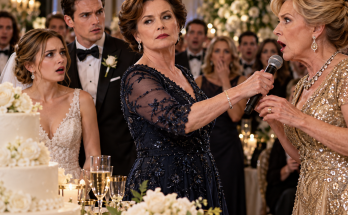
On my eightieth birthday, Daniel tried to organize a surprise party.
He failed.
Noah texted me accidentally three days early:
Do you want chocolate or lemon cake Saturday? Dad says don’t tell Grandma.
I answered:
Lemon.
Then:
Your secrecy training remains poor.
He replied:
Oops.
I was delighted.
The party took place at Willow Creek.
Not a ballroom.
Not the foundation headquarters.
Home.
Thirty people.
Family.
Friends.
A few foundation colleagues.
Joan.
Lorraine.
Claire joined by video from Portugal and complained that nobody mailed her cake.
Robert arrived with his cane and complained about parking.
Curtis came, which surprised me.
Even Rebecca attended without a binder.
I checked.
Emily had become a young woman before I noticed.
Twenty-two.
Art degree nearly complete.
Hair shorter.
Confidence stronger.
Noah was nineteen.
Tall.
Still incapable of identifying most citrus trees correctly.
Daniel was fifty-one.
Renee looked almost exactly as she had seven years earlier until she laughed, and then I could see the years around her eyes.
Good years.
Hard years.
Real years.
I stood in the yellow kitchen while people moved through the house.
For a second, I saw every version layered together.
The guest-room widow.
The secret lottery winner.
The woman buying Willow Creek in cash.
The angry mother.
The suspicious millionaire.
The foundation founder.
The student making terrible pottery.
Me.
All true.
None complete.
Daniel found me near the counter.
“You're hiding.”
“I live here.”
“Same excuse.”
He handed me tea in the crooked mug I made years ago.
“You kept this?”
“Against medical advice.”
“It has character.”
“That is what people say about bad pottery.”
We smiled.
He leaned beside me.
“Happy birthday.”
“Thank you.”
“You eighty?”
“Rude.”
“Legally relevant.”
“For what?”
“Making fun of you.”
“Apparently.”
Then he looked around.
“Remember your seventy-first?”
I did.
Not details.
Harold had been dead.
I lived with Daniel.
I remember cake at their house.
Emily and Noah fighting over candles.
I remember feeling grateful and displaced simultaneously.
“Yes.”
“A lot happened.”
“Yes.”
“You regret any of it?”
“The lottery?”
“Everything.”
That was too broad.
I thought.
“I regret harm.”
He waited.
“I regret not speaking sooner.”
“Yes.”
“I regret letting usefulness become identity.”
He nodded.
“I regret some secrets.”
“Some?”
“Privacy helped.”
“Fair.”
“I regret Harold didn't tell me the truth while he could.”
“Yes.”
“I regret that you and I lost time.”
Daniel looked down.
Then I continued.
“But no, I don't regret this life.”
His eyes filled slightly.
“Even me?”
“Especially you, unfortunately.”
He laughed.
Then looked toward the porch.
“Come outside when you're ready.”
“Why?”
“Not dramatic.”
Suspicious.
But I followed.
The chairs had been arranged facing the garden.
No podium.
Good.
People gathered anyway.
Bad.
“What did you do?”
Daniel smiled.
“Nothing terrible.”
Renee handed me a small box.
“No jewelry,” she said.
“Good.”
I opened it.
A key.
I stared.
“What is this?”
Emily answered.
“The Daylight Fund bought a house.”
I looked at Daniel.
“What?”
“Not us personally.”
“Explain.”
The family emergency fund had grown modestly.
Not enormous.
But enough, combined with a partner nonprofit, to help acquire a small property.
A transitional house for older caregivers leaving unstable family arrangements.
My throat tightened.
“No.”
Daniel smiled.
“Yes.”
“You said Daylight was for family emergencies.”
“It still is.”
“Then?”
“We created a separate charitable partnership.”
“With whose money?”
“Not yours.”
That mattered first.
“Mine, Renee’s, some cousins, a matching grant.”
Lorraine raised one hand.
“And the foundation’s regular open application process.”
I looked at her.
“Recused?”
“Of course.”
Good.
“What is the key for?”
Renee said, “Ceremonial.”
“I hate ceremonial keys.”
“We know.”
Noah laughed.
“Wait until you hear the name.”
I narrowed my eyes.
“If you named it after me, I am leaving my own party.”
Emily smiled.
“No.”
“Harold?”
“No.”
“Miriam?”
“No.”
“Then?”
Daniel looked at me.
“The House With a Door.”
I stared.
That was almost unbearably sentimental.
“I hate it.”
Everyone laughed.
“You love it,” Emily said.
“I hate that I love it.”
The property held six small apartments.
Short-term transition.
Independent leases.
Financial counseling.
Legal services.
No expectation of unpaid family work in exchange for housing.
No giant donor name.
No monument.
A door.
A key.
Choice.
The story had moved forward without needing me at the center.
I looked at Daniel.
“You did this?”
“We did.”
“Why?”
He smiled.
“Because you taught us something.”
“No.”
“Yes.”
“I was learning it too.”
“Exactly.”
That was better.
No saint.
No founder mythology.
People learning together.
I held the key.
Then asked, “What do you want me to do with this?”
“Nothing.”
I stared.
“Nothing?”
“Keep it if you want.”
No assignment.
No board seat.
No speech.
No future responsibility.
I laughed.
“Good.”
People returned inside.
No ceremony.
Thank God.
I remained on the porch with Daniel.
He sat in Harold’s chair.
I looked at him.
“That is your grandfather’s.”
“He’s not using it.”
“Fair.”
I sat beside him.
“Did you ever think we'd get here?” he asked.
“No.”
“What did you think after that dinner?”
“That I had overstayed.”
He winced.
“I know.”
“I also thought I had failed somehow.”
“As what?”
“Mother. Grandmother. Guest. Person.”
Daniel looked at me.
“You didn't.”
“I know now.”
We sat.
Then he asked, “Did winning make it easier to know?”
“Yes.”
“How?”
“Money removed one excuse.”
“What excuse?”
“That I had to stay because I had no options.”
He nodded.
“So wealth gave you the ability to leave.”
“Yes.”
“And then?”
“Then I discovered leaving didn't answer everything.”
He smiled.
“I remember.”
I looked through the glass doors at everyone inside.
Renee laughing with Lorraine.
Robert arguing with Curtis.
Emily showing Joan something on her phone.
Noah stealing frosting.
“Do you know why I kept the lottery secret?”
Daniel asked.
“You've told me.”
“I want the final version.”
I smiled.
He was right.
There had been many versions.
At first:
Because lawyers advised caution.
Then:
Because I feared greed.
Then:
Because I wanted to know how family treated me without money.
All true.
But underneath?
“I needed one thing in my life that belonged only to me long enough to hear myself think.”
Daniel nodded slowly.
“Did you?”
“Yes.”
“What did you hear?”
I looked at him.
“That I wanted to leave.”
He accepted that.
“That I loved you.”
His face changed.
“Both at the same time.”
“Yes.”
“That seems impossible.”
“It isn't.”
“I know now.”
I continued.
“I heard that I was angry.”
“Yes.”
“That I had participated in the pattern.”
“Yes.”
“That I wanted my own home.”
“Yes.”
“And that I did not want revenge.”
He smiled.
“You could have done revenge spectacularly.”
“I considered a solid-gold mailbox.”
“That would have shown us.”
We laughed.
Then I became serious.
“The secrecy helped until it didn't.”
Daniel nodded.
“And money helped until money became another problem.”
“Yes.”
“Then what actually fixed us?”
He asked.
I thought of every answer.
Apologies.
Therapy.
Boundaries.
Time.
Direct questions.
Smaller expectations.
Choosing not to rescue.
Choosing to ask.
Leaving.
Returning.
Nothing alone.
“Practice.”
He frowned.
“Practice?”
“Yes.”
“That's disappointingly ordinary.”
“Exactly.”
We practiced telling the truth sooner.
Practiced asking instead of assuming.
Practiced hearing no.
Practiced saying no.
Practiced helping without owning.
Practiced accepting help without surrendering ourselves.
Practiced apologizing specifically.
Practiced not making every mistake permanent.
No single revelation transformed us.
Not even eighty-nine million dollars.
Daniel smiled.
“Practice.”
“Yes.”
“That's your grand conclusion?”
“I am eighty. I’m allowed boring conclusions.”
He laughed.
Inside, everyone began singing happy birthday without us.
Daniel stood.
“We're missing your party.”
“They know where I am.”
He offered his hand.
I took it.
Not because I needed help standing.
Because he offered.
Inside, the cake waited.
Lemon.
No eighty candles because Renee had common sense.
I blew out eight large candles instead.
“Wish?” Noah asked.
“I have enough.”
Everyone groaned.
“That's terrible,” Emily said.
“I’m eighty. Leave me alone.”
We ate.
Then gifts.
Books.
Ceramic tools.
A scarf from Claire mailed from Portugal.
A framed print from Emily.
Noah gave me a small lemon tree in a pot.
“Now you can leave me the tree without the house.”
I laughed until I cried.
Daniel gave me no gift.
I noticed.
Later I asked.
“Nothing?”
He smiled.
“You said you have enough.”
Fair.
Then he added, “Actually, one thing.”
He handed me an envelope.
I stared.
Everyone shouted:
“No!”
We laughed.
“It is not a secret letter,” Daniel said.
“Open it,” Emily insisted.
Inside was a single sheet.
A reservation.
Two nights in Sedona.
For me.
No foundation event.
No family meeting.
No agenda.
“What is this?”
“A trip.”
“Alone?”
“If you want.”
“Why?”
Daniel shrugged.
“Dad wrote that he wanted to take you somewhere you'd never been.”
“I've been to Sedona.”
“Fine. Somewhere you've been but haven't gone in decades.”
“I don't need to complete his list.”
“I know.”
“Then why?”
“Because I remember the photograph in the metal box.”
1978.
Harold and me beside the borrowed car.
Young.
Sedona.
Daniel continued.
“I thought maybe you'd like to go as yourself now.”
That was different.
Not finishing Harold’s task.
Revisiting my own life.
“Thank you.”
“You don't have to go.”
“I want to.”
Good.
I went the following month.
Alone.
I drove myself.
Stayed in a small inn.
No luxurious suite.
No meaningful reason.
I carried the old photograph.
Not because I planned a ritual.
But because I wanted to compare.
The landscape remained recognizable.
I did not.
Good.
At one overlook, I found approximately where the photograph might have been taken.
No exact match.
Buildings changed.
Road changed.
Memory changed.
I held the picture.
Twenty-five-year-old Margaret looked confident.
She was not.
She had no idea what marriage would contain.
No idea about Desert Oak.
Daniel.
Miriam’s secrets.
Eleanor.
Elaine.
Harold’s fear.
Widowhood.
Lottery tickets.
She knew almost nothing.
That did not make her foolish.
It made her young.
I looked at Harold in the photo.
He knew almost nothing too.
Not future mistakes.
Not future regret.
Not how love would become tangled with control.
He was just a man beside a woman he loved.
I folded the photograph.
No speech to the dead.
No forgiveness ceremony.
No final argument.
I walked.
That evening, I ate alone at a small restaurant.
The server asked whether I was celebrating something.
I thought.
“Yes.”
“What?”
“My birthday.”
“Today?”
“No.”
He laughed.
“What are you celebrating then?”
I looked out the window.
The answer came easily.
“Still being here.”
He smiled.
“That’s a good one.”
It was.
When I returned to Willow Creek, everything looked ordinary.
Mail.
Dust.
A package on the porch.
No alarming handwriting.
Ceramic glaze I had ordered.
Perfect.
I unpacked.
Made tea.
Went outside.
The two chairs stood beside each other.
Mine.
Harold’s.
I sat in mine.
The evening light reached the roses.
Somewhere down the street, a child shouted.
A dog barked.
Cars passed.
Life indifferent to narrative structure.
I thought of the first night after buying Willow Creek.
The silence.
The words:
My house.
Back then the phrase meant ownership.
Now it meant something wider.
My life.
Not because nobody else belonged in it.
Because I did.
I pulled the black notebook from the drawer.
One final page remained.
I read the first five instructions.
Move out.
Stay calm.
Protect what is mine.
Find a home.
Remember tonight.
Then all the lines that followed over years.
For decisions made in daylight.
Ask before helping.
Love is not payment for good behavior.
Tell the truth while everyone is still alive to answer.
Available is not the same as waiting.
The goal is not to need no one.
A life does not need to be useful every hour to be worth living.
I turned to the last page.
For several minutes I did not know what to write.
Then I understood.
No lesson.
No instruction.
No rule.
Those had served me.
I no longer needed another.
I wrote:
I am home.
That was all.
I closed the notebook.
My phone rang.
Daniel.
I answered.
“How was Sedona?”
“Beautiful.”
“Did you find the old spot?”
“Approximately.”
“Emotional?”
“Moderately.”
“Successful then.”
“Yes.”
He paused.
“Dinner Sunday?”
“At your place?”
“Mine.”
“Who cooks?”
“Me.”
“Then I need time to consider.”
He laughed.
“Mom.”
“I'll come.”
“Good.”
Before hanging up, he said, “Need anything?”
The question would once have made me prove independence.
No.
Nothing.
I'm fine.
Now I looked around.
Tea cup empty.
Refrigerator low on milk.
“Bring milk Sunday.”
Silence.
Then Daniel laughed.
“That’s it?”
“Yes.”
“I can do that.”
“I know.”
“Love you.”
“Love you too.”
We hung up.
I smiled.
Needing milk did not make me dependent.
Asking did not make me weak.
Daniel bringing it did not give him ownership of my life.
A simple favor could remain a simple favor.
Perhaps that was the final proof.
Not the house.
Not the foundation.
Not the will.
Not the millions moving through charitable trusts.
Not Daniel refusing money.
Not my ability to say no.
The proof was that help no longer frightened me.
Neither did independence.
I could accept one without losing the other.
The sun lowered.
I remained on the porch.
No one needed me.
Someone loved me.
They were no longer the same thing.
And for the first time in my life, I knew the difference without needing eighty-nine million dollars to prove it.
The End
Read more original stories on Feel Every Story.
After Two Years Inside My Son’s Home, One Quiet Dinner Question Revealed Exactly What I Had Become to Them
Part 47 of 47