The judge’s voice remained calm.
That almost offended me.
There should have been some change in the room when a marriage ended.
A light should flicker.
A window should open.
Someone should acknowledge that two people who had stood before another official only weeks earlier and promised permanence were now asking the law to reverse the shape of their lives.
Instead, the judge reviewed our settlement.
Confirmed our signatures.
Asked whether either of us had been forced to agree.
“No,” I said.
“No,” Mark said.
Asked whether we understood the consequences.
“Yes.”
“Yes.”
Then the judge approved the agreement.
The words came in ordinary legal language.
The marriage was dissolved.
Property provisions incorporated.
Each party responsible for obligations assigned under the settlement.
Neither party entitled to support.
The condo was not discussed.
It did not need to be.
Mom still held title.
Mark had waived any possible claim.
The thing that started the crisis had become almost irrelevant to the final hearing.
“Anything further from petitioner’s counsel?”
Helen said no.
“Respondent?”
Mark’s lawyer said no.
The judge wished us well.
Then the screen changed.
The hearing ended.
I stared at the empty rectangle where Mark’s face had been.
“That’s it?” I asked.
Helen nodded.
“That’s it.”
“How long?”
“About eight minutes.”
I laughed once.
Eight minutes.
Our wedding ceremony had lasted twenty-seven.
The reception disaster lasted hours.
The financial unraveling lasted weeks.
The legal ending required eight minutes.
Helen closed her folder.
“You’re divorced.”
The word entered the room.
Divorced.
Not separated.
Not deciding.
Not filing.
Done.
I expected tears.
Instead, I felt something physical release across my shoulders.
Then guilt arrived.
Helen must have seen it.
“Whatever you’re feeling is allowed.”
“That sounded suspiciously therapeutic.”
“I occasionally branch out.”
I smiled.
My phone remained face down on the table.
I knew Mark would not call.
We had agreed the night before that neither of us would make the other responsible for the immediate aftermath.
No Are you okay?
No Did we make a mistake?
No desperate final appeal after the order.
We would go through the first hours separately.
That had been his suggestion.
It was a good one.
I packed my papers.
At the elevator, Helen handed me a certified copy request form.
“Keep this.”
“Romantic souvenir.”
“Try not to frame it.”
Outside, the city looked exactly the same.
A delivery cyclist yelled at a taxi.
Someone argued into a headset.
A dog refused to walk.
I stood on the sidewalk as an unmarried woman and discovered the world had no interest in marking the occasion.
I walked home.
Not because I needed exercise.
Because I did not want to arrive too quickly.
Halfway there, I passed the restaurant where Mark and I once celebrated his first major Mercer contract.
I remembered champagne.
His hand around mine.
The way he had said, “We’re going to build something enormous.”
At the time, I thought he meant his company.
Later, I thought perhaps he had meant us.
Now I understood he probably meant both.
Mark’s tragedy was not that everything had been calculated.
It was that he had stopped separating love from strategy.
People became part of plans.
Plans became obligations.
Obligations became proof of loyalty.
He had not needed to stop loving people to use them.
He only needed to convince himself the outcome justified the pressure.
That was what made the damage so difficult to name.
At home, I stood inside the condo and listened.
Nothing.
No wedding flowers.
No Mark.
No Diane inspecting rooms.
No banker waiting for signatures.
Just the low hum of the refrigerator and distant traffic.
I walked to the ceramic bowl.
My wedding ring remained inside.
Beside it were two keys.
Mine.
And Mark’s.
He had returned his the previous week through Helen.
No ceremony.
No note.
Just the key in a small envelope labeled Tribeca.
I picked it up.
The metal felt absurdly light.
For months, that key had meant home.
Then access.
Then danger.
Now it was only a key that no longer opened anything for him.
At eleven thirty, Mom called.
I answered.
“Is it done?”
“Yes.”
Silence.
Then she said, “Do you want company?”
“No.”
“Food?”
“No.”
“Your father?”
“Definitely not.”
I heard Dad in the background.
“Tell her I heard that.”
I smiled.
Mom asked, “Do you want me to stop asking questions?”
“Yes.”
“Okay.”
A pause.
Then, “I love you.”
“I love you too.”
No advice.
No victory.
She hung up.
At noon, Rachel sent a photograph of a terrible cupcake with DIVORCED written crookedly in icing.
I laughed so hard I cried.
That opened something.
The tears came fast after that.
Not only for Mark.
For myself.
For the wedding dress still boxed at my parents’ house.
For the version of me who had walked down the aisle knowing enough to be afraid but not enough to understand.
For Mom standing beside me with the condo safely out of reach.
For Dad hearing Mark whisper, Thank God.
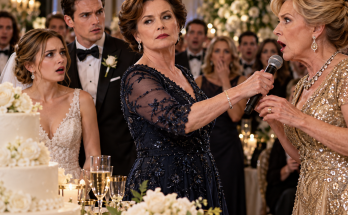
For Diane raising a microphone and accidentally detonating the secret structure beneath our marriage.
I cried until my head hurt.
Then I slept on the couch.
When I woke, it was after three.
One message waited.
From Mark.
I stared at his name.
The agreed silence had lasted several hours.
That was enough.
I opened it.
The order came through. I won’t call today. I just wanted you to know I removed you as emergency contact and beneficiary everywhere I found your name. If anything else surfaces, my lawyer will handle it. You do not need to carry any unfinished part of my life.
I read the message twice.
That was so Mark.
Even his first post-divorce message was administrative.
But the final sentence mattered.
You do not need to carry any unfinished part of my life.
Months ago, that sentence would have been impossible for him.
I replied:
Thank you. I’ll do the same.
He answered:
Okay.
Then nothing.
I updated my own accounts.
Emergency contact: Mom.
Beneficiary designations reviewed.
Joint subscriptions canceled.
A shared streaming account made me cry harder than the legal hearing.
I removed Mark’s profile.
His ridiculous list of unfinished documentaries disappeared.
Ordinary intimacy was everywhere.
At six, the doorman called.
“There’s someone here for you.”
My stomach tightened.
“Who?”
“Mrs. Mercer.”
Diane.
Of course.
I almost said no.
Then remembered she was no longer my mother-in-law.
That made the decision easier.
“Send her up.”
Diane arrived carrying nothing.
No flowers.
No folder.
No emergency.
She stood outside the door.
“I won’t stay.”
“Okay.”
“I know Mark told me not to interfere.”
My body tightened.
“I’m not.”
“Then why are you here?”
She swallowed.
“To return something.”
She reached into her purse.
A small velvet pouch.
Inside was a bracelet.
I recognized it.
Mark’s grandmother’s.
Diane had given it to me the morning of the wedding.
Something borrowed, she had said.
Then later told me to keep it because I was family.
I had forgotten I still had it.
“I thought this was mine.”
“It was.”
“Then why return it?”
Diane looked uncomfortable.
“I want you to decide.”
She placed the pouch on the entry table.
“If you want it, keep it. If you don’t, give it back later.”
“Why not just take it?”
“Because giving it to you was one of the few things I did that morning without a plan.”
I looked at her.
She continued.
“My mother gave it to me. I gave it to you because I was happy Mark loved you.”
The honesty hurt.
“Even while you were planning to move into my condo.”
Diane winced.
“Yes.”
“People are complicated.”
“I’m learning.”
I almost smiled.
She looked older.
Not dramatically.
Just less armored.
“How’s the gallery?”
“Terrible.”
I laughed.
She smiled.
“I love it.”
“That sounds healthier.”
“I make less in a week than Mark used to spend on dinner.”
“Also healthy.”
She nodded.
Then became serious.
“I am sorry the marriage ended.”
“Me too.”
“I am also glad your mother moved the apartment.”
That surprised me.
“You mean it?”
“Yes.”
“Would you have said that a month ago?”
“No.”
“Two weeks?”
“Maybe not.”
I appreciated the answer.
Diane looked toward the living room but did not step farther inside.
“Mark is not doing well today.”
My body tightened immediately.
She saw it.
“No.”
She raised a hand.
“I am not asking you to call.”
“Good.”
“He is with his therapist later.”
“Good.”
“And Evan is taking him to dinner.”
“Good.”
“I’m telling you because I know you care.”
I did.
That was the problem.
“He’ll survive.”
Diane nodded.
“Yes.”
Then she said, “I used to think surviving pain meant someone should prevent it.”
I looked at her.
“And now?”
“I think sometimes surviving it is the point.”
That sounded like something Mark’s therapist might have said.
“Did you steal that?”
“Probably.”
We both smiled.
Diane reached for the door.
“Goodbye, Sophie.”
The word felt final.
“Goodbye, Diane.”
She left.
I closed the door.
The bracelet remained on the table.
I did not decide what to do with it.
Not everything required an immediate answer.
That night, Mark sat across from Evan in a restaurant in Midtown.
I learned about it later.
Evan told Rachel, who eventually told me.
Apparently Mark barely ate.
At some point, Evan asked whether he regretted cooperating with the divorce.
Mark said yes.
Then Evan asked whether he would have fought if he could go back.
Mark said no.
Those two answers could coexist.
Evan asked why.
Mark said:
“Because making it harder for her to leave would have proved she was right to leave.”
When Rachel repeated that sentence days later, I had to sit down.
Not because it changed my decision.
Because it showed Mark understood the most important thing.
Love could not be proved by making departure costly.
The next morning, I woke before sunrise.
My first thought was that I was divorced.
My second was that the coffee machine needed cleaning.
Normal life arrived without permission.
I made coffee.
Opened the windows.
Then noticed something on the counter.
Mark’s ugly second bowl.
I picked it up.
The glaze had pooled unevenly along one side.
A crack ran near the base but did not go through.
I placed my wedding ring inside.
Then changed my mind.
I removed it.
The ring belonged somewhere private.
The bowl did not need to become a shrine to the marriage.
I filled it with lemons.
It looked ridiculous.
Perfect.
At nine, Helen called.
“One last legal item.”
I groaned.
“What?”
“The condo.”
My body tightened.
“Of course.”
“Now that the divorce is final, there is no marital reason for Margaret to continue holding title.”
I looked around the apartment.
“So Mom can transfer it back.”
“Yes.”
“Immediately?”
“If you want.”
The circle was closing.
The condo had left my name to protect me before the wedding.
Now the marriage was over.
The danger it had been protecting me from was gone.
I should have felt eager.
Instead, I hesitated.
Helen heard it.
“What?”
“I don’t know.”
“You don’t have to decide today.”
I smiled.
Apparently everyone had learned the same lesson.
“Good.”
But I knew I would take it back.
Not because the condo was worth nearly five million dollars.
Because it had never truly been about the money.
It was the first major thing I built for myself.
The place Mark had mistaken for available capital.
The place Diane had mistaken for family property.
The place Mom had temporarily taken so nobody else could take it permanently.
Soon, it would be mine again.
Not ours.
Not Mom’s.
Not collateral.
Mine.
And this time, that word did not feel selfish.
Click here to continue reading: PART 38: Mom Prepared to Return My Condo, but One Condition She Added Made Me Confront the Way Protection Can Become Control Too
Three Months Before My Wedding, Mom Asked One Question About My Condo That I Couldn’t Stop Hearing
Part 37 of 44