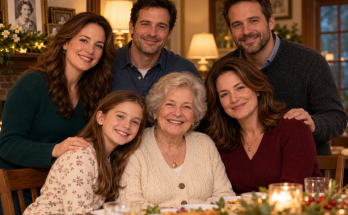
By the time autumn arrived, our family had developed a new rhythm.
It wasn't the easy rhythm we had known before Grandma's birthday. Invitations were discussed rather than assumed, private conversations stayed private, and nobody expected Mom to be the person who repaired every uncomfortable moment. Vanessa was still part of the family, but the relationship she had once taken for granted was no longer available to her simply because she wanted it back.
She had to build something different.
Mom and Vanessa began meeting occasionally for coffee. Their conversations were usually short, and they avoided pretending they could return to being inseparable overnight. Sometimes they talked about Grandma or Lily. Sometimes they discussed practical family matters. On a few occasions, they spoke about their childhood, though Mom refused to let those conversations become excuses for what Vanessa had done.
When Vanessa said she had always felt compared with her sister, Mom listened.
When Vanessa suggested that the family had sometimes favored Mom, Mom asked her to explain specific examples rather than accepting a broad accusation.
And when Vanessa admitted that some of her resentment came from her own choices, Mom acknowledged the honesty without turning it into praise.
It was slow work.
Lily seemed happier, too. She no longer appeared to be measuring every word before she spoke. She visited Mom when she wanted to, told Grandma about school without checking Vanessa's expression, and stopped apologizing whenever she disagreed with an adult.
One afternoon, she came over carrying a school project about family history. She had decided to interview Grandma about the relatives who had passed down the family's heirlooms.
“Can I ask about the bracelet?” she asked.
Mom glanced at me, then nodded.
“Of course.”
Lily sat across from Grandma and opened her notebook.
“I want to know why it mattered so much. Not just because it was expensive.”
Grandma smiled sadly.
“That is a good question.”
She explained that the bracelet had belonged to her mother, who had worn it on important family occasions. It had appeared in photographs at weddings, anniversaries, and gatherings where several generations stood together. The bracelet wasn't priceless because of its diamonds alone. It was valuable because it had connected people to memories they wanted to preserve.
“But that doesn't mean the object is more important than the people,” Grandma added. “If keeping a piece of jewelry means hurting someone you love, then you have forgotten what it was supposed to represent.”
Lily wrote that down.
“Do you think you'll ever wear it again?”
Grandma looked toward the cabinet where the secure storage documents were kept.
“Perhaps. But not until I'm sure I can wear it without remembering only what happened this year.”
Lily nodded thoughtfully.
When she left, I asked Grandma whether she regretted keeping the bracelet in the family for so long.
“No,” she said. “I regret letting the appearance of family harmony become more important than speaking up when something was wrong.”
She paused, then continued.
“I knew Vanessa had taken the bracelet before your mother's birthday. I told myself I would find the right time to address it. I thought I could manage the situation quietly and prevent anyone from being hurt.”
“But Mom was hurt anyway.”
“Yes. And because I stayed quiet, the hurt became worse. I allowed your mother to be publicly accused when I had information that should have made me question what I was seeing.”
Grandma's admission mattered to me. She wasn't the person who had planted the bracelet, but she had recognized part of the truth and failed to act. Her silence hadn't caused Vanessa's decision, yet it had allowed the consequences to spread.
“I should have spoken sooner,” she said. “I'm sorry I didn't.”
I knew she was thinking about Mom, but I also knew she was saying it for herself. She was learning to accept that good intentions could still produce harm when they were used to justify inaction.
A few weeks later, Grandma invited the family to a small dinner. It wasn't a birthday celebration or a formal meeting. She simply wanted everyone together before winter arrived.
Mom agreed to attend. Vanessa came with Robert and Lily, bringing a dish she had prepared herself. She asked Grandma where to place it rather than assuming she could take over the kitchen, and she waited for Mom to finish a conversation before approaching her.
No grand gesture followed.
There was no speech about forgiveness, no dramatic promise that the family would never hurt one another again. The evening passed with ordinary conversation, a little awkwardness, and a few genuine moments of laughter.
After dinner, Grandma brought out a small framed photograph.
It showed her mother wearing the diamond bracelet, standing beside a younger version of Grandma in front of an old house. The image had been taken decades earlier, and the woman's hand rested lightly on her daughter's shoulder.
“I thought this photograph deserved a place where we could all see it,” Grandma said. “The bracelet itself will stay secured, but this reminds me of the people who wore it before us.”
Vanessa looked at the photograph for a long time.
“I remember seeing that picture when I was little,” she said. “I used to think the bracelet was the most beautiful thing in it.”
“And now?” Mom asked.
Vanessa hesitated.
“Now I think it's the way they're standing together. They look as if they trust each other.”
Mom followed her gaze.
“They probably had their own problems.”
“I'm sure they did.”
“Trust doesn't mean nobody ever makes a mistake,” Mom said. “It means people don't deliberately make the other person carry the consequences of it.”
Vanessa nodded.
“I know.”
This time, Mom didn't challenge her. She simply let the statement stand, because the point was no longer to make Vanessa repeat the right words. The point was to see whether she could live by them.
Later, while Robert and Grandma discussed a repair project, Vanessa approached Mom near the kitchen doorway.
“I want to tell you something,” she said. “You don't have to respond.”
Mom waited.
“I used to think that if I admitted how jealous I was of you, it would make me look weak. So I pretended the problem was that everyone treated you better. Then I started looking for ways to prove I was right.”
She looked down at her hands.
“When I took the bracelet, I told myself I was only borrowing it. When I hid it, I told myself I was protecting everyone from unnecessary worry. When I framed you, I told myself you needed to understand how I felt. Every time, I found a reason that made my choice seem less terrible.”
Mom listened without interrupting.
“But none of those reasons changed what I was doing,” Vanessa continued. “I was choosing what made me feel better in the moment, even when I knew someone else would pay for it.”
Mom's eyes glistened, but her voice remained steady.
“I'm glad you're beginning to understand that.”
“I don't expect everything to be normal again.”
“Good.”
Vanessa gave a faint, sad smile.
“I suppose I deserved that answer.”
“It's not about what you deserve. It's about what's true.”
They stood in silence for a moment.
Then Vanessa said, “I'm sorry, Claire. Not because I want you to forgive me. I'm sorry because you didn't deserve any of it.”
Mom looked at her sister.
For the first time, she reached out and touched Vanessa's arm—not as a promise, and not as an invitation to pretend the past had disappeared, but as an acknowledgment that the apology had been heard.
“Thank you,” she said.
Vanessa didn't ask for more.
That was the moment I realized something had changed. Not because Mom had forgiven her, but because Vanessa had finally stopped trying to control the answer.
The family continued to heal unevenly. Some relatives remained cautious. Grandma kept the bracelet secured. Mom still declined certain invitations when she wasn't comfortable attending, and Vanessa learned not to treat those decisions as insults. Lily continued speaking honestly, even when she worried that the truth might disappoint someone.
No one became perfect.
But the old pattern—the one in which Vanessa acted, Mom absorbed the damage, and everyone rushed to restore peace—began to break.
One evening, months after the birthday dinner, Mom and I visited Grandma. The framed photograph was still on the shelf, and the bracelet remained in secure storage. Grandpa's letter and the insurance documents were preserved together, not as weapons against Vanessa, but as part of the family's history.
Grandma poured tea and looked at the photograph.
“It's strange,” she said. “For years, I thought keeping the bracelet safe meant keeping it hidden away. I never imagined that the secret around it would cause more damage than the loss itself.”
Mom shook her head gently.
“The bracelet wasn't what hurt us. It was what people did to one another because they were afraid to tell the truth.”
Grandma nodded.
“And what did we learn?”
Mom considered the question.
“That love isn't the same as trust,” she said. “And forgiveness isn't the same as pretending.”
I looked at the photograph again. The bracelet glittered faintly around the wrist of a woman long gone, but what stayed with me was the way she stood beside her daughter, both of them looking directly at the camera.
For so long, our family had treated the heirloom as something that had to be protected at any cost. We had protected the object, the traditions surrounding it, and the image of a family that always came together.
We had been less careful with one another.
Vanessa's betrayal had exposed that failure, but it had also forced us to make a different choice. We could keep hiding painful truths to preserve appearances, or we could accept that a family sometimes has to endure discomfort before it can become honest.
The bracelet was no longer missing. The accusation against Mom had been corrected. The people who had been hurt were beginning to decide what they could forgive and what they would never allow again.
And Vanessa, for the first time in her life, was learning that she could not demand trust as a reward for saying she was sorry.
She would have to earn it, one choice at a time.
I used to believe the truth would arrive like a dramatic revelation, exposing the guilty person and making everything clear. I thought that once the original bracelet was found, the mystery would be solved and the family could move on.
But the truth had done something more difficult.
It had shown us the damage we had tolerated, the silence we had mistaken for kindness, and the boundaries we had been afraid to draw.
The bracelet had returned to its rightful place.
The family was still learning where everything else belonged.
Click here to continue reading: PART 17: The Invitation Nobody Expected
The Family Gathering That Turned Into a Nightmare When a Missing Diamond Bracelet Put My Mother Under Suspicion
Part 16 of 24