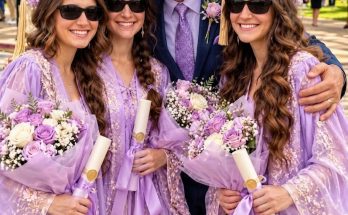
Mara stood quietly for a moment.
The audience waited.
She moved one hand away from the lectern and let it rest at her side.
“I've talked a lot about the person who wasn't there,” she said. “But I don't want her absence to be the only thing you remember about my story.”
I felt my throat tighten.
She turned her face slightly toward the room.
“There were people who stayed.”
Her voice was soft, but clear.
“There were people who made ordinary days possible. People who showed up when they were tired. People who kept their promises in small ways, even when nobody was watching.”
I lowered my head.
I knew she was talking about the life we had built.
Still, I did not want to assume that every word belonged to me.
“I learned that love isn't always a speech or a promise,” Mara continued. “Sometimes it's a person remembering what you need before you ask. Sometimes it's someone sitting beside you when you don't know what to say.”
I remembered the countless evenings when the girls had been quiet.
I remembered sitting with them at the end of a long day, unsure whether they wanted to talk or simply wanted someone nearby.
I remembered how I had gradually learned not to fill every silence.
At first, silence had frightened me.
It felt like a sign that something was wrong.
Over time, I learned that a quiet room could also be a peaceful room.
Mara continued.
“Sometimes love is doing the same ordinary thing so many times that nobody thinks to call it extraordinary anymore.”
I pressed my hands together.
There had been no audience for most of the work of raising my daughters.
There had been no applause for the mornings that began too early or the evenings that stretched too long.
There had been no ceremony for the small decisions that helped a family keep going.
I had not done those things because I expected recognition.
I had done them because the girls needed me.
Hearing Mara describe that kind of love did not make me feel proud in the way I had expected.
It made me feel seen.
And it reminded me that the girls had been paying attention all along.
“I don't want to make my father sound like a perfect person,” she said.
A small smile touched her voice.
“He wasn't perfect, and he would probably be uncomfortable if I stood here and said he was.”
I felt a brief, unexpected laugh rise in my chest.
I kept it quiet.
Mara continued.
“But he stayed. He learned. He made mistakes, and he kept trying.”
She paused.
“And when I was too young to understand how difficult some days were, he still found a way to make sure we knew we were loved.”
My eyes burned.
I looked toward the floor for a moment, then raised my head again.
I did not need her to praise me.
I did not need the room to understand every sacrifice.
What mattered was that she could remember our life honestly.
There had been difficult days.
There had been moments when I did not know what I was doing.
There had been times when I had wanted to give my daughters an answer I simply did not possess.
But there had also been mornings when we laughed over something small.
There had been quiet evenings when we felt safe.
There had been years of growing together.
None of those things erased the others.
They all belonged to us.
“My sisters and I share the beginning of our story,” Mara said. “But we are three different people, and we won't always understand everything in the same way.”
I thought of her sisters.
They had lived through the same broad absence, but each had made her own sense of the world.
I had sometimes watched them react differently to the same question and wondered whether I should try to bring them closer to one shared understanding.
Now I saw the danger in that wish.
They did not need to feel identical things to belong to one family.
They could love one another without agreeing about every memory.
They could each have their own relationship with the past.
“Our experiences are connected,” Mara continued. “But that doesn't mean our feelings have to be the same.”
She let the words rest.
“I hope we can give one another that freedom.”
I thought about all the times the three girls had spoken privately, sharing thoughts I had not heard.
I had tried to respect their space.
Still, part of me had wanted to know that they were all doing well, that none of them felt alone in a way the others could not understand.
But no parent could guarantee that.
Even siblings who loved one another deeply could have different needs.
What I could do was keep the door open.
I could listen without insisting that one daughter's feelings explain another's.
I could let each of them tell her own story.
Mara took another breath.
“I don't know what the future will bring,” she said. “I don't know whether I will ever meet my mother again or whether I will learn more about why she left.”
Her voice remained steady.
“But I know that I don't have to decide everything today.”
A quiet sense of relief moved through me.
She was not making a promise about forgiveness.
She was not announcing that she had stopped caring.
She was allowing herself to remain uncertain.
There was strength in that.
“I can be curious without making promises,” she said. “I can protect my peace without pretending that I have no questions. And I can love the people who are part of my life now without making my feelings about my mother into a test of that love.”
I looked toward the audience.
Several people were sitting with their hands folded in their laps.
Nobody interrupted.
Mara seemed to be speaking less to them now and more to herself.
Perhaps that was what a good speech could do.
It could begin as an attempt to explain something to other people and become a way of understanding it more clearly for yourself.
“I used to think that my story began with being left,” she said.
She paused.
“Now I think that was only one part of the beginning.”
My breath caught.
There it was.
The thing I had wanted her to understand for years, though I had never known how to say it without making it sound as if I wanted her to forget.
Her story had begun before she could remember anything.
It had continued through every ordinary day that followed.
It belonged to her, not to the person who had left.
“The woman who gave birth to me is part of my history,” Mara said. “But she is not the whole of it.”
Her voice grew stronger.
“My father is part of it. My sisters are part of it. The people who have cared about us are part of it. And so are the choices I make for myself.”
I could no longer keep my eyes completely dry.
I wiped one cheek with my thumb and kept facing the stage.
Mara was not asking the room to decide who had been right or wrong.
She was telling them that a life could hold more than one truth.
She had been left.
She had been loved.
She had questions.
She had a future.
None of those facts had to erase the others.
“I don't want to spend the rest of my life trying to make my past simple enough for other people to understand,” she said.
A small smile returned to her voice.
“I want to live a life that feels honest to me.”
She stepped back slightly from the lectern.
“And I hope that anyone who has grown up with an unanswered question understands this: you are allowed to keep living while you search for peace. You don't have to wait for someone else to explain your life before you can begin to enjoy it.”
The room was silent for one long moment.
Then someone began to clap.
Another person joined in.
Soon, the sound spread across the room.
Mara stood still and listened.
I remained in my seat, my hands coming together with the others.
I did not try to call her name.
I did not stand up to make the moment about me.
I simply clapped for my daughter.
For the courage it had taken to speak.
For the honesty she had offered.
For the life she was claiming as her own.
When the applause began to fade, Mara thanked the audience.
Her voice was quiet again.
She stepped away from the microphone, and I heard the small movement of her shoes against the floor.
I stayed seated for another moment.
I had spent eighteen years believing that being a good father meant doing everything possible to protect my daughters from pain.
Now I understood that there was another part of the job.
I had to trust them with their own truths.
I had to let them ask questions I could not answer.
I had to accept that their stories would sometimes include sadness I could not remove.
And I had to keep showing up, not only when they needed help, but when they needed space to speak.
Mara had not solved every mystery about her mother.
She had not promised to forgive her.
She had not declared that the past no longer mattered.
She had done something quieter and, in its own way, more important.
She had stopped allowing an unanswered question to be the only thing that defined her.
I rose from my seat as people began moving through the room.
My hands were still trembling a little.
I did not know what Mara would want to talk about first.
I did not know whether she would feel relieved, exhausted, or simply ready to go home.
I did not need to decide that for her.
I would ask.
Then I would listen.
And whatever she said, I would stay.
Click here to continue reading: PART 17: After the Applause Ended, My Daughter Asked Me a Question I Had Been Afraid to Answer Honestly
The Three Little Girls I Raised Alone and the Question About Their Mother That Followed Us for Eighteen Years
Part 16 of 20