
PART 1: THE LITTLE BOY NOBODY BELIEVED
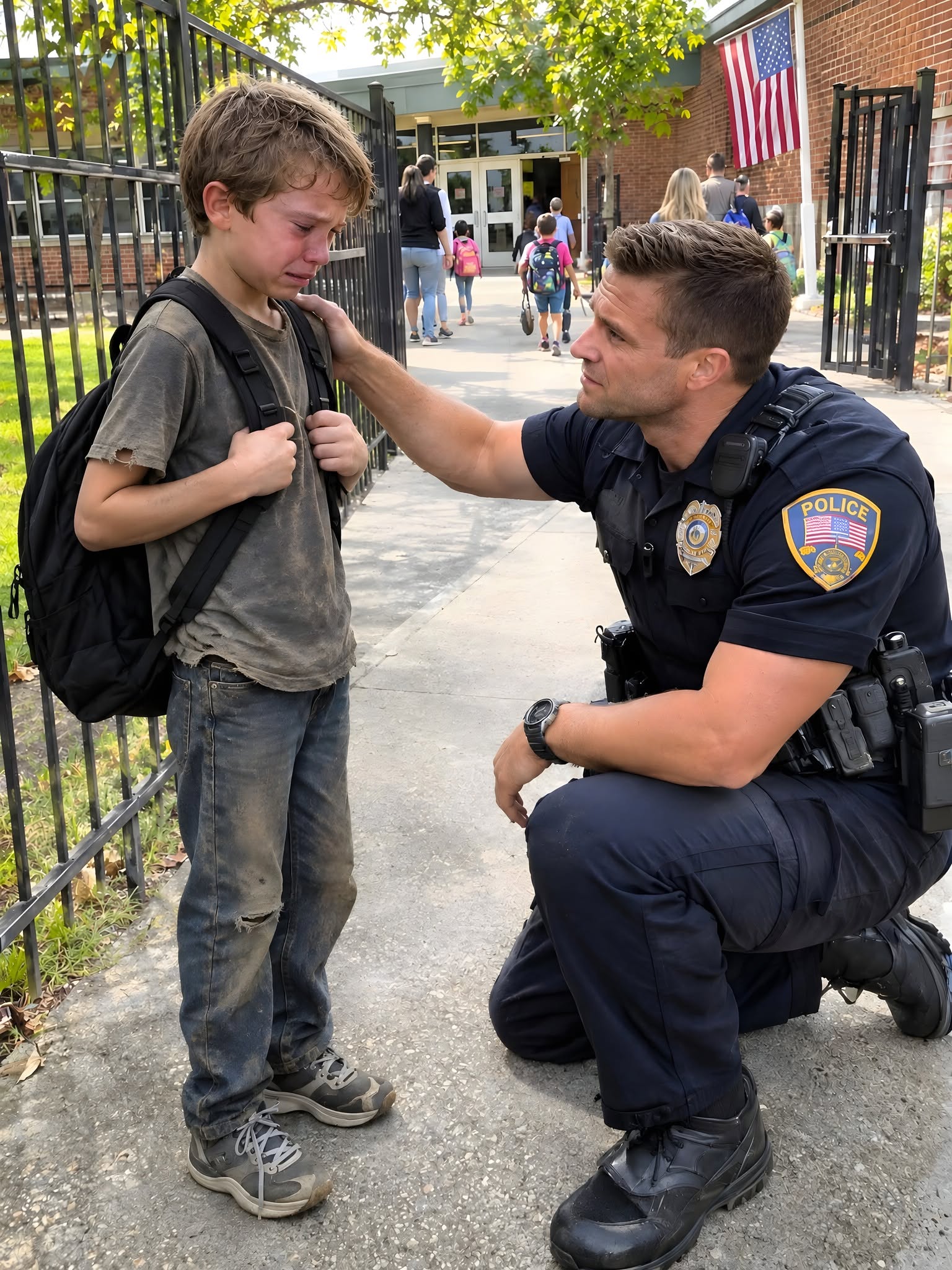
The seven-year-old boy standing outside Brookfield Elementary School wasn’t crying or calling for attention. He stood quietly beside the fence, holding a worn blue backpack while hundreds of other students hurried past, until he finally approached me with a worried expression.
“Officer, would you please walk home with me? I’ve tried telling people something is wrong, but nobody believes me.”
My name is Rebecca Hayes, and I’d served as a police officer in Cedar Falls, Iowa, for twelve years. I’d encountered frightened children before, but there was something especially troubling about this boy’s quiet desperation.
His name was Oliver Bennett, and he had messy sandy-blond hair, large gray eyes, and sneakers with badly frayed laces. When I asked what was happening, he explained that he was frightened his grandmother might not survive much longer.
“My dad says Grandma is just getting old, and Aunt Patricia thinks she prefers being alone. My teacher says I shouldn’t invent frightening stories, but I’m telling the truth.”
Oliver insisted that I needed to see the situation for myself because he couldn’t explain everything outside the school. After contacting the school office, informing my supervisor, and following the appropriate procedures, I agreed to accompany him home.
We walked through a peaceful neighborhood filled with maple trees and modest houses. Oliver spoke very little, occasionally looking over his shoulder to make sure I was still following him.
When I asked why he’d chosen to approach me, he explained that he’d watched me comfort a frightened girl at a playground the previous month. He remembered that I’d remained with her until her mother arrived without becoming angry because she was upset.
At the end of Willow Street, Oliver stopped outside a weathered yellow house with an overgrown lawn. Several newspapers lay untouched on the porch, and a faded flower wreath hung crookedly beside the entrance.
He retrieved a key from his backpack but hesitated before opening the door. His expression suggested that he feared I might turn away once I discovered what was inside.
“Please promise you won’t leave when you see Grandma.”
“I’ll stay and make sure she gets help if she needs it.”
Inside, the house smelled of old food, and unopened letters covered the furniture alongside dusty magazines. A television played quietly in the empty living room as Oliver guided me toward a small bedroom.
An elderly woman sat in a worn armchair beside the window, wrapped in a thin blue blanket. Her silver hair was tangled, an untouched meal rested nearby, and several medication bottles surrounded an empty drinking glass.
She looked confused when Oliver approached, but she managed to recognize his voice. He immediately took her hand and explained that he’d finally brought someone who could help.
I introduced myself and learned that her name was Margaret Bennett. When I asked when someone had last helped her leave the chair, she couldn’t remember.
Oliver explained that his grandmother sometimes forgot meals, confused him with his late grandfather, and had recently struggled to locate the bathroom. He’d tried preparing sandwiches for her, although he knew very little about cooking.
Then he opened his backpack and showed me two granola bars, a juice carton, and a carefully folded napkin. He’d been saving food from school because he was worried his grandmother wasn’t eating enough.
“Oliver, you’ve done everything you could, but looking after Grandma is an adult’s responsibility. You should never have been expected to manage this alone.”
His eyes filled with tears as he asked whether Margaret was going to die. I couldn’t promise him she would recover, but I assured him that I would arrange medical assistance immediately.
As I called for help, Oliver remained beside his grandmother, holding her hand. I realized that the frightened child outside the school hadn’t been exaggerating anything, and his determination to find someone who would listen might have saved Margaret’s life.
PART 2: THE TRUTH HIS FAMILY HAD OVERLOOKED
While waiting for the paramedics, I continued speaking with Margaret and discovered that she was confused about the date and couldn’t remember when she’d last eaten. Oliver remained close to her chair, watching every movement with the anxious attention of a child who had been carrying far too much responsibility.
When the emergency team arrived, Margaret initially resisted their attempts to examine her. She insisted that she didn’t need a hospital because her family would return home soon, but Oliver gently encouraged her to accept their assistance.
“Grandma, please let them help you. I don’t want you to be frightened anymore.”
His words seemed to reassure her, and she eventually agreed to accompany the paramedics. At the hospital, doctors discovered that Margaret was dehydrated, severely undernourished, and experiencing significant memory difficulties requiring further assessment.
The medical team explained that she needed consistent supervision and support. While Margaret received treatment, Oliver sat beside me in the waiting room and quietly asked whether he was going to be punished.
“Dad told me not to talk to strangers about what happens at our house. Will he be angry because I told you?”
“Oliver, asking for help when someone isn’t safe is never something you should feel ashamed of.”
A short time later, Oliver’s father, Grant Bennett, arrived at the hospital. He was a forty-year-old warehouse supervisor who worked long shifts, and his exhausted appearance suggested he’d already been struggling with considerable responsibilities.
Grant demanded to know what had happened to his mother, but his initial reaction was defensive. He claimed Margaret had always been stubborn and frequently refused assistance, making it difficult for the family to care for her.
I explained the conditions we’d discovered and told him about the food Oliver had been bringing home from school. Grant fell silent when he realized his son had been trying to feed Margaret because he believed nobody else understood how badly she needed help.
“I thought he was exaggerating. I didn’t realize things had gotten this serious.”
Grant turned toward Oliver and asked why he hadn’t explained the situation more clearly. The little boy looked at his father and answered with a sadness that immediately changed the conversation.
“I did tell you, Daddy.”
Grant covered his face, visibly shaken by the realization that he’d dismissed his son’s repeated warnings. After a long silence, he knelt beside Oliver and admitted that he’d failed to listen.
Oliver explained that he’d been terrified of losing Margaret because his grandfather had died the previous winter. Since that loss, Margaret’s memory and ability to manage everyday activities had gradually deteriorated.
A 7-year-old boy stopped me outside his school and begged me to walk him home. In a trembling voice, he whispered, “Please… nobody ever believes me.” I assumed he was simply scared and needed an adult he could trust. But the moment he opened his front door and showed me what was waiting inside, I completely froze…
Grant had mistaken the changes for ordinary aging and grief, believing that occasional visits and grocery deliveries were sufficient. His sister, Patricia, had made similar assumptions, and neither had recognized how much Margaret’s condition had worsened.
Oliver, however, spent afternoons at his grandmother’s house while his father worked. He witnessed her forgotten meals, increasing confusion, unopened correspondence, and difficulty moving around the house.
For weeks, he’d tried to explain what he was seeing, but the adults interpreted his concerns as childish anxiety. They hadn’t understood that he was describing a genuine medical and caregiving emergency.
Hospital social workers became involved and helped the family establish a plan to protect both Margaret and Oliver. Grant and Patricia cooperated with the professionals, acknowledging that their mother needed more consistent care.
Margaret remained hospitalized for several days before entering a rehabilitation program. Although doctors remained cautious about her recovery, she gradually regained strength with proper meals, medical attention, and supervision.
Oliver visited regularly with his father, bringing drawings and stories from school. Sometimes he simply sat beside Margaret and held her hand, but he no longer had to shoulder the responsibility of keeping her safe by himself.
PART 3: THE LETTER THAT CHANGED EVERYTHING
Three weeks after meeting Oliver outside Brookfield Elementary School, I received a handwritten letter at the police station. His handwriting was large and uneven, but the message was so sincere that I read it several times before placing it carefully inside my desk.
“Dear Officer Rebecca, Grandma has people helping her now, and she eats breakfast, lunch, and dinner. Dad says I don’t have to worry about her all day anymore, and yesterday I played soccer after school because I remembered how much I love it. Thank you for believing me. Love, Oliver.”
The letter reminded me that helping Margaret hadn’t only improved an elderly woman’s circumstances. It had also allowed a seven-year-old boy to stop acting like a caregiver and begin enjoying his childhood again.
A month later, I returned to Oliver’s school for a community safety presentation. I noticed him laughing with another student, wearing newer sneakers and carrying a backpack decorated with colorful stickers.
When he recognized me, he excitedly raised his hand and announced that his grandmother was improving. He also proudly explained that his father had started listening whenever he expressed concern.
After the presentation, Oliver approached me in the hallway with another piece of good news. He smiled and explained that he no longer needed to save food from his school lunches.
I watched him run outside to join his friends, grateful that he finally looked like an ordinary seven-year-old. His experience reinforced something I’d learned throughout my career: children don’t always need adults to provide immediate answers, but they do need their concerns to be taken seriously.
Six months after our first encounter, Grant unexpectedly called the police station. He reassured me that Margaret was doing much better and explained that Oliver wanted to invite me to her seventy-eighth birthday celebration.
“Officer Hayes, Oliver has been preparing something special for weeks. He says you’re the one person outside our family who absolutely needs to be there.”
I accepted the invitation, curious about what the boy had planned. The following Saturday, I drove to a community center outside Cedar Falls, where colorful balloons and a handmade birthday banner decorated the entrance.
Approximately thirty guests had gathered around tables filled with flowers, homemade desserts, and family photographs. Grant greeted me warmly, looking far more relaxed than the exhausted man I’d met at the hospital months earlier.
Margaret sat near the birthday cake, wearing a lavender cardigan over a floral dress. Her hair was neatly styled, and she was laughing with relatives, appearing healthier and more comfortable than when I’d first found her.
Oliver stood beside her, proudly displaying a drawing of a yellow house surrounded by flowers. When he spotted me, he hurried across the room and eagerly led me toward his grandmother.
Margaret recognized me immediately and warmly thanked me for helping her family. She admitted that she couldn’t remember everything from the difficult weeks before her hospitalization, but she remembered Oliver promising to find someone who could help.
After the birthday cake was served, Grant announced that Oliver had prepared something he wanted to share. The boy approached the front of the room carrying a large blue folder filled with drawings.
His pictures showed Margaret’s old house, his grandmother sitting beside a window, and a small boy holding a police officer’s hand. Oliver explained that he’d been frightened when Margaret became ill because he believed it was his responsibility to make her better.
“Officer Rebecca told me something important. She said taking care of Grandma wasn’t supposed to be my job.”
Grant nodded in agreement, and Oliver reached into the folder for another sheet of paper. Across the top, he’d written three large words in colorful letters: THE LISTENING PROMISE.
What he’d written underneath was about to change much more than his own family.
PART 4: THE PROMISE THAT SPREAD THROUGH THE COMMUNITY
Oliver held up his colorful paper so everyone at Margaret’s birthday celebration could see it. Beneath the title, he’d written three promises about listening to children, finding trustworthy adults when someone needed help, and apologizing when mistakes were made.
He explained that he wanted every grown-up at the party to sign the document. For several moments, the room remained quiet as everyone considered what his request meant.
Grant was the first to approach, but before signing, he knelt beside his son. He apologized for dismissing Oliver’s warnings about Margaret and acknowledged that a child should never have been left carrying such a frightening responsibility alone.
“I’m sorry I didn’t listen when you told me Grandma needed help. You were right, and I promise I’ll do better.”
Oliver accepted his father’s apology, and Grant embraced him before signing the paper. One by one, Patricia, Oliver’s teacher, neighbors, and other relatives added their names, including Margaret herself.
When Oliver brought the document to me, I gladly signed it. He quietly explained that he didn’t want other children to experience the loneliness of asking for help and being ignored.
Two weeks later, Grant contacted me with news that Oliver’s teacher wanted to introduce a classroom activity inspired by the birthday celebration. The school principal approved the idea, and they named the initiative the Listening Promise Project.
The project taught children how to recognize situations requiring assistance, identify trustworthy adults, and express concerns without embarrassment. Teachers practiced responding thoughtfully to students’ worries, while parents received information about recognizing when elderly relatives might need additional support.
Oliver became the project’s unofficial inspiration, but Grant insisted that he shouldn’t be expected to repeatedly describe his frightening experience. His son was only seven and deserved to enjoy his childhood without being turned into a public spokesperson.
Instead, Oliver helped create a colorful poster featuring two hands holding a heart. Beneath the illustration, he wrote a message that captured the project’s purpose.
“SMALL VOICES MATTER TOO.”
A 7-year-old boy stopped me outside his school and begged me to walk him home. In a trembling voice, he whispered, “Please… nobody ever believes me.” I assumed he was simply scared and needed an adult he could trust. But the moment he opened his front door and showed me what was waiting inside, I completely froze…
A 7-year-old boy stopped me outside his school and begged me to walk him home. In a trembling voice, he whispered, “Please… nobody ever believes me.” I assumed he was simply scared and needed an adult he could trust. But the moment he opened his front door and showed me what was waiting inside, I completely froze…
The poster was displayed near Brookfield Elementary School’s main entrance. Within a month, several neighboring schools had expressed interest in the project, extending Oliver’s message beyond the community where his grandmother lived.
By early spring, Margaret had moved into a comfortable assisted-living community approximately fifteen minutes from Grant’s home. Her memory continued to fluctuate, but she received regular meals, medical attention, and consistent supervision.
Grant took Oliver to visit every Sunday, often bringing flowers or playing simple card games with Margaret. Sometimes they watched old family videos together, enjoying moments that no longer required Oliver to worry constantly about his grandmother’s safety.
During one visit, Margaret asked her grandson what he wanted to become when he grew up. Oliver considered becoming a police officer before suggesting that he might prefer teaching because teachers could help children who were frightened.
“Maybe I’ll be a police officer, or maybe a teacher. Teachers can help kids when something’s wrong.”
Margaret smiled and encouraged him, but Oliver soon reconsidered his options. He announced that becoming a soccer player might be even better, making everyone laugh.
His changing ambitions were a welcome reminder that he could finally imagine a future centered on his own interests. He no longer believed that his purpose was to solve problems the adults around him had overlooked.
Nearly a year after our first meeting, I attended the school’s spring festival and spotted Oliver racing across the playground with his friends. When he noticed me, he ran over proudly displaying a small gold-colored medal his soccer team had won.
After showing me the medal, he asked whether I still had the letter he’d written following Margaret’s hospitalization. I assured him that it remained safely inside my desk, and he smiled before reaching into his pocket.
“Good, because I wrote another one for you.”
He handed me a carefully folded piece of paper, then waited while I opened it. I had no idea how much those few handwritten sentences would mean to me.
PART 5: THE GREATEST GIFT WAS HIS CHILDHOOD
Standing at Brookfield Elementary School’s spring festival, I unfolded the letter Oliver had handed me. His familiar uneven handwriting filled the page, and although the message was short, it reflected how dramatically his life had changed during the previous year.
“Dear Officer Rebecca, Grandma is safe, and Daddy is happy again. I have lots of friends, and I don’t feel scared when I go to school anymore. Thank you for helping my family, and I hope you help lots of other kids too. Your friend, Oliver.”
I read the letter twice before looking up, but Oliver had already returned to the soccer field. He wasn’t waiting anxiously for my reaction or checking whether I would follow him, as he’d done when we first walked to his grandmother’s house.
Instead, he was laughing with his friends and enjoying the afternoon. Watching him reminded me of the frightened boy who’d once stood outside the school fence, clutching his faded backpack and wondering whether anyone would finally believe him.
Back then, Oliver had been carrying responsibilities that no seven-year-old should have faced. He’d tried preparing food for Margaret, saved portions of his school lunch, and worried that she might die because the adults around him weren’t recognizing her worsening condition.
His father had been overwhelmed by work, while his aunt assumed Margaret simply preferred being alone. Even his teacher had dismissed his concerns as frightening stories rather than considering that he might be describing something real.
Oliver hadn’t known how to diagnose his grandmother’s condition or arrange professional care. He’d simply recognized that someone he loved was struggling and continued searching for an adult willing to listen.
When I accompanied him home, the evidence of Margaret’s difficulties was impossible to ignore. Her dehydration, inadequate nutrition, and memory problems required medical attention, but the family hadn’t understood how much her circumstances had deteriorated.
The hospital staff, social workers, and rehabilitation professionals eventually helped establish a safer arrangement. Grant and Patricia accepted their responsibilities, and Margaret began receiving the consistent support she needed.
The changes weren’t immediate, and her memory continued to vary even after she moved into assisted living. Nevertheless, she was no longer facing those difficulties without adequate care, and Oliver no longer felt personally responsible for protecting her.
Grant also learned an important lesson about listening to his son. Rather than dismissing Oliver’s concerns because of his age, he began taking his words seriously and recognizing when the boy needed reassurance or assistance.
Their relationship gradually improved as Oliver regained confidence that his father would respond when something was wrong. The birthday celebration and Listening Promise Project became meaningful expressions of that change, but the most important improvement was happening quietly in their everyday lives.
Oliver could attend school without constantly worrying about what might happen to Margaret while he was away. He could spend afternoons playing soccer, drawing pictures, and making friends instead of saving food and trying to solve problems beyond his abilities.
His interests were changing naturally as he grew, and he could imagine becoming a police officer, teacher, or professional soccer player. Those possibilities belonged to him, rather than being shaped by the fear that someone else might suffer if he wasn’t watching closely enough.
As I stood near the playground, I realized that the greatest thing the adults had given Oliver wasn’t the birthday party, the community project, or the signatures collected on his promise. It was the opportunity to experience childhood without carrying the constant burden of responsibility for someone else’s survival.
Later that evening, I returned to the police station and placed Oliver’s second letter beside the first inside my desk drawer. Together, those two pieces of paper reminded me why listening carefully could be just as important as taking decisive action.
The first letter had come from a frightened boy who was beginning to feel safe again. The second came from a happier child who could finally spend his days doing what children were supposed to do.
I thought about the adults who might encounter another child expressing concerns that seemed exaggerated or difficult to understand. Sometimes children misunderstand situations, but their age should never be a reason to dismiss their fear without making an effort to understand it.
When a child finds the courage to say something is wrong, the responsible response is to listen, ask appropriate questions, and determine whether help is needed. Oliver’s experience showed how much could change when someone finally took that responsibility seriously.
His story hadn’t ended when Margaret reached the hospital, nor had it ended when he wrote his first thank-you letter. It continued through his father’s apology, his grandmother’s recovery, the school project, and the ordinary afternoons he could finally enjoy with his friends.
I watched him from a distance one last time before leaving the festival, his soccer medal bouncing against his shirt as he ran across the field. He looked carefree, surrounded by other children and completely absorbed in their game.
A year earlier, he’d approached me because he was afraid nobody would ever believe him. Now his grandmother was receiving proper care, his father had learned to listen, and Oliver could enjoy being seven years old.
That was the ending I would remember most, because the little boy who’d once been afraid to leave his grandmother alone was finally free to run toward his own future.
THE END