Victoria was twenty-six now, still living at home, still driving the replacement BMW, still posting selfies to her two hundred and forty-seven followers. Her business ventures came and went like weather: leggings, essential oils, crypto, an astrology podcast that lasted three episodes.
My parents funded all of it.
I stopped asking questions.
Three weeks before the accident, an invitation arrived in the mail.
Pink envelope. Glitter. Victoria’s handwriting.
You are invited to Victoria’s 26th Birthday Extravaganza. Saturday, March 15. 6:00 p.m. sharp. Cocktail attire. Theme: Victoria’s Vintage Hollywood.
I stared at it for a long time.
Twenty-sixth birthday extravaganza.
My own birthdays had quietly stopped existing when I was ten. I usually spent them alone with takeout and medical documentaries.
But Victoria got extravaganzas.
I should have thrown the invitation away.
I should have said I was on call.
Instead, I asked my supervisor if I could switch shifts.
Some naïve, stupid, hopeful part of me still believed maybe this time would be different. Maybe this time they would ask about my life. Maybe this time they would look at me and actually see me.
The week before the party, I worked six consecutive shifts. Forty-eight hours on, twelve off, then forty-eight on again. A multi-car pileup on I-5. A construction collapse downtown. A catastrophic teenage trauma case that somehow ended in survival.
By Friday night, I was running on fumes, but Saturday was my day off.
Victoria’s party was that evening.
I planned to sleep late, buy a gift, show up, and pretend things were normal.
Friday afternoon, I went shopping and found a designer handbag at Nordstrom. Kate Spade. Dusty rose. Gold hardware. Victoria had mentioned wanting one on Instagram three weeks earlier.
It cost eight hundred dollars.
Three months of savings.
I bought it anyway.
Because some part of me still wanted her approval. Still wanted to belong.
I wrapped it carefully, tied a silk ribbon around the box, and wrote a card that said:
Happy birthday, Victoria. Love, Evelyn.
Then I set it on the counter and went to bed early.
Saturday morning, I woke at six.
I could not sleep. Too anxious. Too hopeful. Too something I did not want to name.
I spent the morning cleaning my apartment, doing laundry, ironing my navy cocktail dress—the one nice dress I owned, bought two years earlier for a hospital gala.
By noon I was ready.
The party did not start until six, but I decided to drive to my parents’ house early and help set up. Be useful. Be good. Be the daughter and sister they always seemed to want, so long as I asked for nothing in return.
Maybe if I tried harder, they would try too.
I picked up the gift, grabbed my keys, and walked outside.
The sky was gray in that classic March-in-Seattle way. Rain hung in the air without falling.
I got into my car—a ten-year-old Honda Civic with two hundred thousand miles on it. It rattled when I pushed it past sixty, but it was paid off, dependable, and mine.
I started the engine.
I pulled onto the highway.
And that is where everything broke.
The rain began at 3:47 in the afternoon.
Not a mist. A wall of water.
The kind of rain that makes windshield wipers useless and turns headlights into smeared halos.
I slowed down, tightened my grip on the wheel, and turned on my hazards.
I was ten miles from my parents’ house. The road was mostly empty because smarter people had already pulled over.
I should have done the same.
I kept driving.
I did not want to be late. Did not want to hand them yet another reason to be disappointed in me.
I was in the left lane when I saw it.
Headlights coming straight at me.
A delivery truck running the light at the intersection.
I had maybe two seconds. One to see it. One to understand.
Then impact.
Metal shrieking against metal.
Glass exploding.
My car spinning once, twice, three times.
The world tilted sideways, then upside down, then vanished into black.
I woke to sirens.
Red and blue light flashed through shattered windows. Rain poured through the space where my windshield had been.
I could not feel my left leg.
I looked down and saw blood, wreckage, and the horrible wrongness of my body.
I tried to scream.
No sound came out.
A paramedic appeared beside me, young and frightened beneath all his training.
“Ma’am? Ma’am, can you hear me? We’re going to get you out.”
I nodded. Or tried to.
“What’s your blood type? Do you know it?”
I forced the words out. “AB negative.”
Something changed in his face.
“Okay,” he said quickly. “Okay. We’re getting you to the hospital. Just stay with me.”
They cut me out of the car. Moved me to a stretcher. Loaded me into the ambulance.
As the doors shut, I reached for my phone.
One call.
Mom.
She answered on the fourth ring.
Music. Laughter. Champagne glasses.
“Mom,” I whispered. “I was in an accident. I need surgery. They need blood donors. AB negative.”
Five seconds of silence.
Then her voice came back—impatient, inconvenienced.
“Evelyn, can this wait? It’s Victoria’s birthday. We’re about to cut the cake.”
The words did not make sense.
Victoria’s birthday.
Cut the cake.
I was bleeding in an ambulance with glass in my chest and my leg destroyed, and my mother was worried about cake.
“Mom,” I said, and my voice cracked. “I’m dying. I need blood. AB negative. Please.”
A sigh came through the line. The sigh she always used when I needed something at the wrong time.
“Evelyn, you’re a doctor. You know how hospitals work. We can’t just drop everything. Victoria has planned this party for months.”
“Please,” I whispered. “I’m scared.”
Another pause.
Then my father’s voice.
He had taken the phone.
“Evelyn, stop being dramatic. The hospital will handle it. That’s what hospitals are for. Don’t ruin your sister’s special day.”
Then I heard Victoria in the background.
“Is that Eevee? Tell her I said hi.”
Laughter.
The call ended.
I stared at the cracked screen, blood smeared across the glass, until the paramedic gently took the phone from my hand.
“It’s okay,” he said. “We’ll find donors. Just stay with me.”
But nothing was okay.
I closed my eyes and let the dark take me.
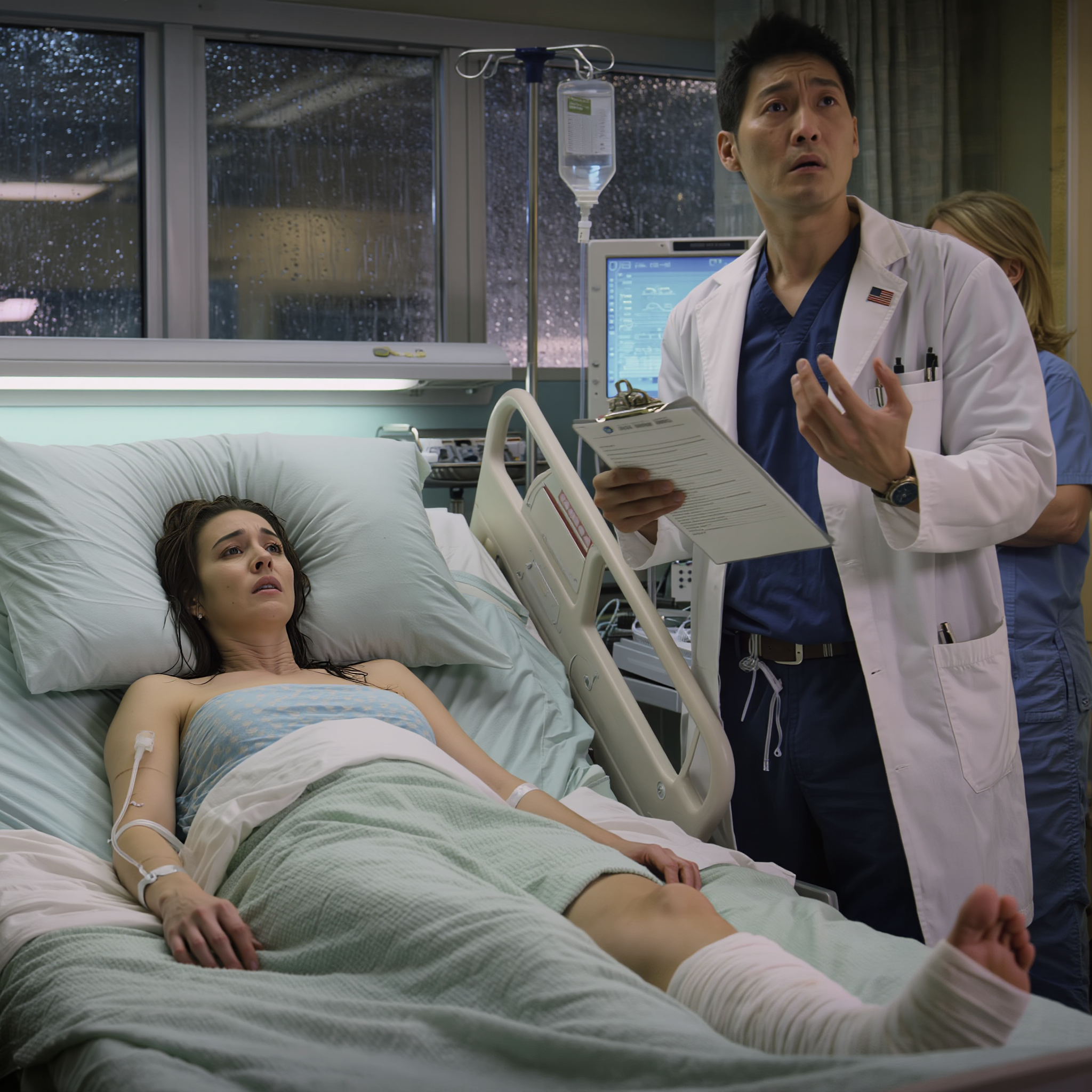
I woke up at Seattle Grace.
My hospital.
The irony was not lost on me.
Fluorescent lights. Monitor beeps. The sharp smell of antiseptic and fear.
A nurse I recognized stood beside the bed—Maria from nights, the one who always brought cookies for the residents. Her eyes were red-rimmed.
“Dr. Harrison,” she said, voice trembling. “You’re awake. Thank God.”
“What happened?”
“You’re out of surgery. They repaired your spleen, stabilized your leg, and stopped the internal bleeding.”
She swallowed.
“You’re going to be okay.”
I should have felt relief.
I felt numb.
“Did my parents come?”
Maria looked away.
That was answer enough.
Then a doctor came in.
Dr. Michael Chen. Head of trauma surgery. My boss. My mentor.
He was fifty-two, silver at the temples, the kind of surgeon whose hands never shook.
Except now they were shaking.
He held my chart in one hand and a clipboard in the other.
“Evelyn,” he said.
His voice sounded wrong—tight, strained.
“How are you feeling?”
“Like I got hit by a truck.”
He did not smile.
Instead, he sat beside my bed and looked at the clipboard for so long it made my skin prickle.
“I need to ask you something.”
“Okay.”
“Your emergency contact form.” He looked up. “The name you listed. Dr. William Harrison.”
My heart gave a strange, hard stutter.
“What about it?”
“Why did you list him?”
I tried to remember filling out the form years before. A blank spot where family should have gone. A last name from the scholarship. An empty space I had not known how to fill.
“I didn’t have anyone else,” I said. “That name was attached to the scholarship that paid for school. I thought… if anything ever happened to me, at least someone with my last name might be contacted.”
Dr. Chen’s face drained of color.
“You didn’t know?”
“Know what?”
He set the clipboard down and dragged a hand through his hair.
“Evelyn, Dr. William Harrison is the former chief of surgery at this hospital. He trained me. He trained half the surgeons in this state.”
I blinked.
“Okay.”
“He’s also your grandfather.”
The room tilted.
“That’s impossible. My grandfather is dead. He died before I was born.”
Dr. Chen shook his head slowly.
“No. He’s alive. Very much alive. And he’s on his way here.”
I could not get enough air into my lungs.
“I don’t understand.”
“Neither do I,” he said. “But twenty-five years ago, he told everyone his granddaughter had died. He grieved for you. He created scholarships in your name. He spoke about you like you were a ghost.”
“But I’m not—”
“I know.”
His voice cracked on the words.
“Someone lied to him. Someone told him you were dead. And someone told you he was.”
The door opened.
A man walked in.
Seventy-eight years old. Tall. White hair. Surgeon’s hands. He wore a coat thrown on in haste, wrinkled like he had dressed while running.
He stopped at the foot of my bed.
His eyes found mine.
And he began to cry.
“Evelyn,” he whispered, and his voice broke apart around my name. “My Evelyn.”
I stared at him.
This stranger.
This ghost.
“Who are you?”
He stepped closer, slowly, as if he feared I might vanish if he moved too fast.
“I’m your grandfather,” he said through tears. “Your real grandfather. William Harrison.”
“My grandfather is dead.”
“That,” he said, sinking into the chair beside me, “is what they told you. It’s also what they told me about you twenty-five years ago.”
My mind snagged on the words.
He took my hand.
“Robert said you died. He said you died with your parents in that accident.”
“My parents?”
“Daniel and Sarah.”
His voice shattered.
“Your real parents. My son. My beautiful boy.”
The room spun.
Daniel and Sarah.
Not Robert and Sandra.
“I don’t understand.”
He held my hand so gently it hurt more than anything else had.
“Robert is not your father, Evelyn. He is your uncle. Daniel was your father. My firstborn.”
My thoughts fractured around the words.
Uncle.
Father.
Accident.
Three years old.
“He died in a plane crash twenty-five years ago. You stayed home because you had a fever.”
I stared at him, unable to speak.
“Robert and Sandra took you in after the funeral. They were supposed to raise you like their own.”
His jaw tightened.
“But they didn’t. They took you, and they cut me out of your life. They told me you blamed me for your parents’ deaths. They told me you never wanted to see me.”
“I didn’t even know you existed.”
“I know.”
He sobbed once, quietly.
“Three years later, they told me you had died too. Some childhood illness. They sent a death certificate. I believed them.”
“They faked my death?”
“They erased you.” His eyes burned. “From me. From the family. They took my granddaughter and made her disappear.”
I could not speak.
Twenty-five years of being overlooked. Twenty-five years of being told I was not special, not enough, not wanted.
And all along, somewhere out there, someone had been grieving a child who was still alive.
“Why?” I whispered.
His hand tightened around mine.
“Because Daniel was my heir. Everything I built was meant for him. And when he died, it was meant for you. Robert knew that. As long as you stayed in my life, he got nothing.”
Money.
All of it for money.
“They stole me,” I said.
“They stole my life.”
“Yes,” he said, and his voice turned to steel. “And they will answer for it. I promise you that.”
Then he reached into his coat and pulled out a small vial.
“But first,” he said, “I need you to live.”
He rolled up his sleeve.
“I’m AB negative. Same as you. Same as Daniel.”
Then he turned to the nurse.
“Take my blood. As much as you need. Save my granddaughter.”
Three days later, I opened my eyes to sunlight.
Real sunlight. Not the cold electrical hum of the ICU.
I had been moved to a private room—the nicest room in the hospital. Flowers covered every flat surface: roses, lilies, sunflowers. The air smelled like a greenhouse in spring.
My grandfather sat in the chair beside my bed exactly where I had last seen him.
He had not left.
Three days. Seventy-two hours.
He had stayed through every minute.
“You’re awake,” he said, voice rough with exhaustion, but his face lit up like Christmas morning.
“You’re still here.”
He gave a soft, incredulous laugh. “Of course I’m still here. I waited twenty-five years to find you. You think I’m going anywhere now?”
I tried to sit up. Pain tore through my chest.
He was instantly on his feet, adjusting the pillows, raising the bed, fussing over me with the kind of care I had spent my whole life imagining other people received.
“Easy. Your spleen ruptured. Three ribs broken. Compound fracture in your left tibia. You are lucky to be alive.”
“I don’t feel lucky.”
“You will.”
He sat again.
“I promise you, Evelyn. From this moment on, everything changes.”
Over the next several days, he told me the truth.
The real truth.
My father, Daniel Harrison, had been the firstborn son. Brilliant, kind, a gifted surgeon who graduated at the top of his class from Johns Hopkins. According to my grandfather, I had his hands and my mother’s eyes.
“He could have run any hospital in the country,” Grandfather said. “Instead, he chose community clinics. Free surgeries for people who had nothing. He believed healing should never depend on money.”
My mother, Sarah, had been a nurse.
They met in the emergency department over a trauma case. Fell in love over twelve-hour shifts and burnt coffee.
“She was fierce,” my grandfather said, smiling through tears. “Tiny thing. Barely five-two. But she would go to war with anyone who mistreated a patient. Daniel used to say she was the bravest person he had ever met.”
They married in a small ceremony. No spectacle. Just family and love.
I was born a year later.
“The day you were born,” my grandfather said, voice shaking, “was the happiest day of Daniel’s life. He called me from the hospital crying. He said, ‘Dad, I finally understand what it means to love someone more than yourself.’”
He brought me photo albums.
Boxes of them.
A whole hidden childhood.
My father holding me as a newborn. My mother rocking me in a chair and singing. The three of us at Christmas. At the beach. At my third birthday.
I stared at my mother’s face for a very long time.
My face.
Same eyes. Same smile. Same stubborn chin.
Twenty-five years, and I had not even known what my own mother looked like.
“What happened to them?” I asked.
Grandfather’s face darkened.
“They flew to a medical conference in Denver. Friday flight. The plane went down in the mountains. No survivors.”
“And me?”
“You had a fever. A bad cold. Sarah insisted you stay home with Robert and Sandra. They were the only family nearby. Daniel asked them to watch you for the weekend.”
He paused.
“That weekend became twenty-five years.”
Robert Harrison, he told me, had always been the overlooked younger brother. The one who grew up in Daniel’s shadow. The one who resented everything Daniel was—successful, admired, loved, chosen.
“Daniel was the golden child,” Grandfather said. “The surgeon. The heir. Robert worked at a hardware store then. Struggled with money. Struggled with bitterness. When Daniel died, Robert saw opportunity.”
The will had been clear.
Everything Grandfather owned—the properties, the investments, the savings—went to Daniel. And if Daniel died before him, then it would pass to me.
“So I was worth something to them.”
Grandfather looked at me steadily.
“You were worth forty-seven million dollars.”
The number hung in the room like a second heartbeat.
“Robert knew that as long as you were in my life, he would get nothing. So he cut me off from you. Told me you hated me. Then told you I was dead.”
Three years later, Robert sent him a death certificate and claimed I had died from a childhood illness.
“I believed him,” Grandfather said, voice raw. “I had no reason not to. But I never stopped wondering.”
He had hired investigators over the years. Something never felt right, but every trail ended cold. Robert had covered too much too well.
Then, five years earlier, Dorothy found discrepancies in old files—medical records that did not match, details that made no sense.
She dug deeper.
She found me.
“Why didn’t she tell me?”
“She wanted to. But my lawyers advised caution. Robert still had legal guardianship for years. If we came too soon, he could have interfered. He could have twisted it.”
“So the scholarship…”
He nodded.
“The Harrison Medical Scholarship. I created it the year Dorothy found you. I couldn’t step into your life yet, but I could make sure you had every possible chance.”
“The anonymous donor.”
“I watched from afar,” he said. “Dorothy sent me updates. Your grades. Your prizes. Your scholarships. Your struggles.”
His voice broke.
“And every time Robert and Sandra treated you cruelly, I knew. I knew and could not yet move. It nearly destroyed me.”
“Why didn’t you come when I turned twenty-five?”
“I intended to. But you had just started residency. You were focused. Driven. Building something. I told myself I would wait for the right moment.”
He looked down at his hands.
“Then Dr. Chen called and said a patient had come in—young woman, Harrison, my name on her emergency contact form. He said you were dying. Said you needed blood. Said your family refused to come.”
His jaw locked.
“I was in San Francisco when I got the call. I chartered a plane. I was here in two hours.”
Two hours.
My grandfather crossed state lines in two hours to save my life.
My parents would not drive twenty minutes because a birthday cake was being cut.
“The blood you donated…”
“AB negative,” he said softly. “The same as Daniel. The same as you. Genetics do not lie, Evelyn. Robert and Sandra could never have donated because they are not your blood. They never were.”
Then he reached into his coat and handed me a folder.
“There’s more.”
Inside were medical records, bank documents, legal correspondence, and one piece of paper that made my chest tighten so hard I thought the stitches might split.
My death certificate.
My name.
My birth date.
Robert Harrison’s signature.
Dated three years after my parents died.
According to that paper, I had died peacefully in my sleep at six years old from pneumonia complicated by a congenital heart defect.
I had never had a heart defect.
I had never had pneumonia.
“Where did you get this?”
“Robert filed it with the county twenty-two years ago,” Grandfather said, voice colder than I had ever heard it. “Forged a physician’s signature. Bribed someone at records. Made you vanish on paper.”
“Why?”
“Because dead children do not inherit.”
He pulled out Daniel’s will.