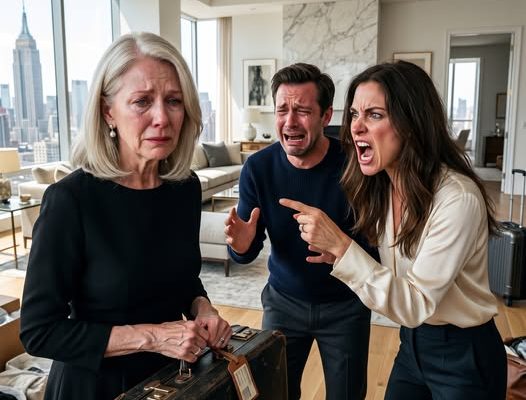
Robert came to the motel on July 3rd.
I was folding laundry in the bathroom sink, standing over my own damp underthings like a woman who had somehow become both a secret millionaire and a widow in a highway motel and was not yet sure which fact felt more absurd.
When he knocked, I knew it was him before I opened the door.
He looked terrible.
Unshaven. Red-eyed. Wrinkled polo shirt. The particular wreckage of a man whose life has not yet fully fallen apart but has stopped pretending not to.
“Mom.”
I did not invite him in immediately. I just stood there holding a damp towel and looked at my son.
Then I stepped aside.
He came into room 12 and stopped dead.
He took in the sagging bed, the stained carpet, the mini-fridge, the television bolted to the dresser, the little table with my Bible and Daniel’s letters stacked on it, the motel room smell of bleach failing to defeat cigarettes.
His face crumpled.
“Jesus, Mom. You’ve been living here for 3 months.”
“Not quite.”
“Why didn’t you tell me?”
I almost laughed.
“Tell you what? That your wife threw me out and you let her? I think you knew.”
He sat down on the edge of the bed and put his head in his hands.
“I didn’t know it would be like this. I thought Vanessa said you had savings, that you’d find an apartment, that you’d—”
“You didn’t think at all, Robert,” I said. “You just did what she told you.”
Then he looked up, and I saw it for the first time in years.
Not the man Vanessa had been shaping.
Not the weak husband.
Not the son who chose silence because it felt safer than conflict.
I saw the boy he had been.
The one who used to crawl into my bed during thunderstorms.
The one who cried on his first day of kindergarten.
The one who once told me, at 7, that I was his best friend.
“She’s pregnant,” he said.
My body went still.
“What?”
“Vanessa. She’s pregnant. Two months. She told me last week.”
That, more than anything so far, twisted the knife.
Because now his fear was no longer only about himself.
“She said if I don’t fix this, if I don’t get us a place to live, she’ll leave. She’ll take the baby and I’ll never see it.”
I sat down in the chair by the window and looked at him carefully.
“Did you see a doctor’s note?”
He blinked.
“What?”
“Did you see a doctor’s note, Robert?”
“She showed me the test. Two pink lines.”
“Home tests can be faked.”
He stared.
“Why would she?”
“Because she’s desperate,” I said. “Because you lost your job and I evicted you and she knows the walls are closing in. When is the last time she let you go to a doctor’s appointment with her?”
He said nothing.
That was answer enough.
I took out my phone and called Brennan.
“I need a private investigator,” I said. “Today. Someone who can verify a pregnancy.”
He did not ask why.
“I know someone. Give me 2 hours.”
The investigator’s name was Nicole Chen.
She met us at a LabCorp in Yonkers at 4:00 p.m. The plan was simple. Robert called Vanessa and told her a blood test was needed for insurance purposes for the new apartment I was supposedly helping them get. Either she believed the lie, or she was cocky enough to think she could bluff her way through it.
Vanessa arrived 20 minutes late in yoga pants and oversized sunglasses.
She didn’t acknowledge me. She kissed Robert’s cheek and sighed dramatically.
“This is ridiculous. I already showed you the test.”
“It’s just a formality,” Robert said.
He looked sick saying it.
Nicole handed Vanessa the paperwork. She filled it out, rolled up her sleeve, and chatted lightly with the phlebotomist about traffic and weather like a woman with absolutely nothing to fear. That impressed me more than it should have. She was good. She had built her life on confidence functioning as camouflage.
The results came in 24 hours.
Nicole called me at noon on July 5th.
“She’s not pregnant,” she said. “Never was. hCG is zero.”
I closed my eyes.
“Send the report to my email and to Robert’s.”
“Already done.”
I hung up and sat with the phone in my hand for almost a minute before moving again. Not because I was surprised. Because I knew exactly what was happening on the other end of the truth. Some lies don’t just expose the liar. They detonate the person who trusted them.
Robert called 30 minutes later.
He was crying.
Not politely.
Not controlled.
“She lied,” he said. “She lied about everything.”
“I know.”
“I confronted her. She said it was a miscarriage. Said it happened yesterday and she didn’t want to tell me because I was already stressed.”
“But the report says she was never pregnant.”
“I know.”
He broke then in full, the kind of sobbing that sounds like choking.
“I chose her over you. I let her destroy you. And she was lying the whole time.”
I did not say I told you so.
What use is that sentence once a person has already reached ruin without your help?
I just listened.
Finally, in a voice scraped raw, he asked, “What do I do?”
“You leave her,” I said.
“I can’t just—”
“Yes, you can. Brennan has divorce papers ready. You sign them today. You owe her nothing.”
“Mom, I don’t have anywhere to go.”
“Yes, you do.”
I let the words settle before continuing.
“429 Willow Street. The house I bought. It’s yours. You move in tomorrow.”
There was a long silence.
Then, quietly: “Why are you doing this?”
I thought of Daniel’s letters.
Of 40 years of love poured into a woman who never learned how to ask for enough.
Of the fact that second chances are wasted on the wrong people and transformed by the right ones.
“Because you’re still my son,” I said. “And because I loved you before I loved anyone else in this world. But Robert, this is the last time.”
He didn’t speak.
“This is the last time,” I repeated. “You choose her again, you walk away from this house, you lie to me one more time, and I’m done. Do you understand?”
“Yes.”
“Say it back to me.”
His breathing shuddered.
“This is the last time.”
“Good,” I said. “Now go pack your things. And don’t tell Vanessa where you’re going.”
That night I slept in the penthouse for the first time.
Not because I was ready. Because I needed one room in the world to feel like mine again.
I brought a sleeping bag, a pillow, and Chinese takeout. I ate on the floor in the living room while the city lights came on beyond the windows and turned Manhattan into something both intimate and unreachable.
Then my phone buzzed.
Linda.
I had unblocked her number by then mostly out of boredom and contempt.
“Vanessa called me,” she said. “She says you ruined her marriage. Says you’re hiding money. Says she’s going to sue.”
“What did you tell her?”
Silence.
“Linda.”
“She offered me $15,000 to testify if it goes to court,” my sister admitted. “I’m broke, Margaret.”
I felt something old and tired in me finally go still.
“You’re my sister,” I said. “The only family I have left besides Robert. And you were considering testifying against me for $15,000 from a woman who has lied to everyone for years.”
“I didn’t say yes.”
“But you didn’t say no.”
I closed my eyes.
“Linda, I have spent my whole life helping people who would not help me back. I’m done. You want money? Get a job. You want family? Start acting like it.”
Then I hung up.
I did not block her.
I simply stopped answering.
Eventually, she stopped calling.
Vanessa filed for divorce 3 days later.
Not Robert.
Vanessa.
She claimed emotional abuse, financial manipulation, and, my personal favorite, alienation of affection caused by a controlling, vindictive mother-in-law.
Brennan sent the filing to me with a note:
She’s flailing. This will be fun.
It was.
Her lawyer was from Whitmore and Associates, the same cut-rate firm that had handled the “voluntary” transfer papers. They demanded mediation, claimed Robert had hidden assets, requested full financial disclosure, and threatened a public fight.
Brennan buried them.
Bank statements showing Robert’s $340 checking account balance.
Credit card debt totaling $23,000, all joint.
Unemployment records.
The LLC wall protecting Willow Street from being traced back to me in any meaningful legal way.
“Where’s the money?” Vanessa’s lawyer kept asking.
“What money?” Brennan replied.
By mid-August, her attorney stopped returning calls promptly. On August 22nd, Vanessa signed.
No settlement.
No alimony.
She kept the leased Audi and half the credit card debt.
Robert called me from the courthouse steps.
“It’s over.”
“Good,” I said. “Come home. I’m making dinner.”
Dinner was spaghetti with store-bought sauce because I had never been much of a cook and saw no reason to start lying about it in old age. Daniel used to joke that my specialty was edible.
Robert ate 2 plates.
We sat at the little kitchen table in the Willow Street house and, for the first time in years, nothing felt sharpened. No Vanessa rolling her eyes. No strategic tension at the edge of every sentence. Just my son and me eating cheap pasta and not performing.
“I got a job,” he said after a while. “Assistant manager at a construction supply company in Tarrytown. $42,000.”
“That’s good.”
“I start Monday.”
He pushed his fork through the sauce.
“Mom, can I ask you something?”
“Always.”
“Where did you get the money for this house?”
I had been waiting for it.
I took a sip of water.
“Your father left me some things,” I said. “More than I expected. I used it to make sure you had a second chance.”
“How much?”
“Enough.”
“Mom.”
I set the glass down.
“Right now, you need to focus on your job, your life, and proving you can stand on your own. When you’ve done that, when I’m sure you’re solid, we’ll talk. Not before.”
He wanted to push. I saw it. But for once he stopped where I asked him to stop.
“Okay,” he said.
October came.
Robert kept the job.
Paid his bills.
Started seeing a therapist—his idea, not mine.
We had dinner every Sunday, sometimes at Willow Street, sometimes at a diner where the coffee tasted like punishment and the waitress called everyone honey.
We didn’t talk about Vanessa much.
We didn’t talk about the money at all.
Then one Sunday in late October, he asked, “Do you ever go back to the old house on Maple Avenue?”
“No,” I said. “I sold it.”
His head jerked up.
“What?”
“I sold it in June. Donated the proceeds to Saint Vincent’s Hospital. The nursing scholarship fund.”
He stared at me.
“That house was worth—”
“I know what it was worth.”
It sold for $920,000.
“That money could have—”
“Could have what?” I asked. “Sat in a bank account? Bought me things I don’t need?”
I shook my head.
“Robert, I spent 30 years at Saint Vincent’s. I worked with nurses who couldn’t afford to finish school. Women working double shifts and night classes just to afford tuition. That money will send 20 students through 4 years of nursing school. That matters more than anything I could have bought.”
He was quiet for a long time.
Then, very softly, “I don’t deserve you.”
“Probably not,” I said. “But you’re trying. That’s enough for now.”
In November, I finally began moving into the penthouse.
Not all at once. I still kept room 12 through December, paid in cash week by week just in case my nerve gave out and I needed the old ugliness to remind me I had survived it. But I brought the quilt. The wedding photograph. Daniel’s letters. I hired a decorator named Patricia and told her, “Simple. Comfortable. Nothing flashy.” She filled the rooms with warm rugs, soft couches, bookshelves, quiet color. The apartment began feeling less like an inheritance and more like a life.
I did not tell Robert.
Not yet.
On Thanksgiving, I cooked dinner at Willow Street.
Turkey.
Mashed potatoes.
Green beans.
Wine Robert brought because he had finally learned not to arrive empty-handed in anyone’s home, including his own.
We sat at the secondhand table he had bought and he said grace for the first time since he was a child.
“Thank you for this food, for this home, and for second chances.”
“Amen,” I said.
After dinner, we sat on the porch under blankets, our breath pale in the cold.
“Mom,” he asked quietly, “are you happy?”
I thought about Daniel.
About room 12.
About the letters.
About the penthouse.
About the life I had lived small and grateful and the life I was only now beginning to occupy fully.
“I’m getting there,” I said.
He smiled.
“You deserve it.”
On December 15th, exactly 6 months after Robert moved into Willow Street, I invited him to 785 Park Avenue.
“Wear something nice,” I said over the phone. “Meet me at 2:00.”
He arrived in the same suit he had worn to Daniel’s funeral, only this time it was pressed and fit properly because grief was no longer the only thing wearing it.
The doorman let him up.
The elevator opened directly into the penthouse.
I was waiting by the window.
He stopped dead.
“Mom… whose place is this?”
“Mine.”
I handed him an envelope.
Inside was a copy of Daniel’s 1985 letter, the estate summary, and a single key.
He read in silence.
When he finished, his hands were shaking.
“$28 million.”
“$26 million now,” I said. “I’ve been busy.”
He looked around the apartment again, then back at me.
“You’ve had this since March.”
“Yes.”
“And you lived in a motel.”
“I needed to see who you’d become without money, without Vanessa, and without me bailing you out.”
That hurt him. I could see it.
Good. Not because I wanted pain for him, but because truth without discomfort rarely changes anyone.
“I don’t know what to say,” he whispered.
“You don’t have to say anything,” I replied. “You just have to keep showing up. Keep being honest. Keep proving the man you’re becoming is worth the second chance you were given.”
He looked at the key in the envelope.
“What is this?”
“The deed key to Willow Street,” I said. “It’s yours. Legally. Completely. No strings. You’ve earned it.”
He stared at me.
“What about the rest?”
“The rest is mine,” I said. “For now. Maybe forever. I haven’t decided.”
That was the truth. Not threat. Not leverage. Just fact. I had spent 40 years making myself smaller around everyone else’s needs. The fortune Daniel left me did not obligate me to become a softer bank in old age.
“But you don’t need it, Robert,” I said. “You never did. You just needed to believe you could stand without it.”
Then he crossed the room and hugged me.
Not a polite hug.
Not a guilty hug.
A real one.
The kind he used to give me when he was little and afraid of storms.
“I love you, Mom,” he said.
“I love you too.”
We stood there together in the fading winter light, Manhattan stretched out below us, Central Park darkening into evening.
“What happens now?” he asked.
I thought of Daniel’s letter.
Of the line that mattered most.
Be free.
I looked at my son, at the city, at the second life opening in front of me after 68 years of giving everything away before I ever asked what I wanted in return.
“Now,” I said, “we figure it out together.”