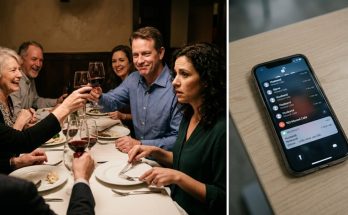
By the third day of the cruise, Rodrigo had called 47 times.
Paulina had sent 31 messages, each more dramatic than the last.
At first, they tried outrage.
You embarrassed us.
You made us miss our flight.
Do you know what Sofia thinks of you now?
Then guilt.
Your father would be ashamed.
Families don’t abandon each other.
You’re acting like a stranger.
Then concern, which was the most insulting because it came after threats.
We’re worried about your mental state.
Please tell us which ship you’re on.
We need to make sure you’re safe.
Then, finally, the message that told me everything I needed to know.
Fine. Enjoy your trip. But we need access to the house because Paulina’s cousin may want to rent it while you’re gone.
I showed that one to Lupita during a video call.
She laughed so hard her camera shook.
“Rent it? They are incredible.”
“They are consistent.”
Lupita leaned closer to her screen. She was in my kitchen, or what used to be my kitchen and was still legally mine. Behind her, the counters were clear. The animals were gone. The funeral flowers had been moved to the patio. She had opened the windows, and morning light filled the room.
“Estela says Rodrigo called her office,” Lupita told me. “He demanded to know who had manipulated you.”
“Did she tell him?”
“She said, ‘Your mother.’”
I laughed.
Lupita’s face softened.
“How are you really?”
I looked beyond my balcony door at the ocean. I had a small cabin, not luxurious but mine. The bed was made because someone else made it. The towels were clean because someone else replaced them. No bell rang. No one knocked to ask whether I had soup ready. No one expected me to know where their medicine was.
“I am strange,” I said honestly. “Not sad. Not happy exactly. Strange.”
“That’s freedom.”
“Freedom feels like forgetting something.”
“No,” Lupita said gently. “Slavery feels like always remembering everything for everyone. Freedom feels empty at first because nobody is standing on your chest.”
After we hung up, I walked the deck alone.
The ship was crossing open water, and the world seemed to have no edges. Passengers leaned over railings, took pictures, played cards, complained about coffee, planned excursions, argued over dinner reservations. I watched them with curiosity. People who belonged only to themselves moved differently. They wasted time without apologizing. They sat in chairs without jumping up when someone entered the room. They ordered dessert just because they wanted it.
At lunch, I sat with 3 women I had met during the safety drill.
Marjorie, a retired teacher from Arizona.
Beatriz, a widow from Guadalajara who wore red lipstick at breakfast.
Anne, a divorced nurse from Toronto who had booked the same 1-year cruise after selling the house where her husband had cheated on her for 18 years.
When they asked why I was traveling alone, I told them the truth.
“My husband died. My son tried to turn me into a pet sitter. So I left the country.”
Beatriz lifted her glass.
“To excellent timing.”
We toasted with iced tea.
That evening, Rodrigo finally sent a voice message instead of text.
His voice was hoarse.
“Mom, I don’t know what you want me to say. Things got out of hand. Paulina shouldn’t have brought the pets like that. Sofia shouldn’t have said what she said. But you also have to understand that this is hard for us too. Dad died. The family is changing. We were just trying to find a way to keep you involved.”
Involved.
Another pretty word for used.
I did not answer immediately.
Instead, I opened the folder I had brought with me. Inside were copies of everything: trust documents, house inventory, cruise insurance, bank permissions, medical power updates, contact information for Estela Rojas, written instructions for the property manager, and a sealed letter addressed to Rodrigo that I had not yet decided whether to send.
I read the letter again.
Rodrigo,
I loved being your mother.
I did not love becoming your servant.
I loved helping you when you were young.
I did not love that you never learned the difference between help and entitlement.
I loved your children.
I did not love being treated like unpaid staff who should feel grateful to be needed.
I loved your father.
I did not love disappearing inside his illness while everyone praised me instead of helping me.
I am not punishing you.
I am retiring from a job no one admitted I was doing.
When I finished reading, I folded it and put it away.
Not yet.
Some truths are wasted when delivered before the other person has developed the capacity to hear them.
The first real confrontation came 2 weeks later, during my stop in Los Angeles.
I was walking back from breakfast with Marjorie and Beatriz when my phone rang.
Estela Rojas.
I stepped aside and answered.
“Doña Elena,” she said, “your son has hired an attorney.”
“Of course he has.”
“He is claiming undue influence, lack of capacity, and emotional instability caused by grief.”
I looked out over the port. A gull landed on a post and screamed at nothing in particular. It sounded like Paco.
“Can he win?”
“No,” Estela said. “But he can be unpleasant.”
“He learned from his father.”
She paused.
“Do you want me to send the medical evaluation?”
Six months earlier, Estela had insisted on it. She sent me to a doctor who certified I was mentally sound, legally competent, and fully aware of every decision I was making. At the time, I felt offended. Now I understood she had been protecting me from exactly this moment.
“Yes,” I said. “Send everything.”
“There is one more thing. Paulina posted online.”
“What did she say?”
Estela sighed.
“That you abandoned your grieving family, fled with money that should have belonged to your late husband’s heirs, and left helpless animals locked in the house.”
I closed my eyes.
Of all Paulina’s talents, pretending to be wounded was perhaps her finest.
“Should I respond?”
“No. Lupita already did.”
That sentence frightened me more than the lawsuit.
“What did she say?”
“She posted the pet boarding receipt, the timestamped photos of the animals being collected safely, the copy of your note, and a very poetic paragraph about adult children who confuse mothers with appliances.”
I smiled.
“Good.”
By sunset, Paulina had deleted her post.
By midnight, Rodrigo sent a message.
Tell Lupita to stay out of family business.
I replied for the first time in days.
No.
It was a small word.
I looked at it on the screen for a long time.
No.
Not an explanation. Not an apology. Not a softening.
Just no.
I had spent a lifetime making no longer than necessary, stretching it into reasons, excuses, cushions, and emotional pillows so no one bruised themselves against my boundary. This time, I sent the word as it was.
Plain.
Hard.
Complete.
Rodrigo did not answer for 2 days.
When he did, the message was different.
Can we talk without lawyers?
I looked at the sea for a long time before replying.
We can talk when you are ready to apologize without asking for anything.
A week passed.
Then another.
The cruise moved north along the coast. I saw cities I had only known from television. I learned to eat breakfast slowly. I took a beginner salsa class and discovered my hips remembered things my marriage had forgotten. I bought a blue scarf in San Francisco because I liked it. I wore my pearl earrings to dinner. No one said they were too much.
At night, I still missed Armando sometimes.
Grief is not obedient. It does not leave just because you are relieved. I would hear a man cough in the hallway and feel my whole body prepare to stand. I would wake at 3 in the morning and think I had forgotten his medication. I would reach for guilt the way one reaches for a light switch in a familiar room.
But the guilt had nothing to hold onto anymore.
I was not failing him.
He was gone.
And I was still here.
One evening, after we left Vancouver, I finally opened the sealed letter again and added 3 lines.
I hope you learn to love me while I am alive, not only when I am useful.
I hope you teach your children better than I taught you.
I hope this hurts enough to change you, but not enough to destroy you.
Then I mailed it from the next port.
Rodrigo called 6 days later.
I answered because I wanted to. Not because he demanded it.
For a few seconds, neither of us spoke.
Then he said, “I got your letter.”
“I know.”
His breathing sounded uneven.
“I didn’t think of it that way.”
“No,” I said. “You didn’t.”
“I thought…” He stopped. “I thought because you always helped, it meant you wanted to.”
I sat on the balcony with a blanket around my shoulders. The ocean was dark and endless.
“Sometimes I did,” I said. “Sometimes I helped because I loved you. Sometimes because I was afraid if I stopped, you would stop loving me.”
He exhaled sharply.
“Mamá.”
The word sounded smaller than usual.
“I’m sorry,” he said.
I waited.
The old me would have rushed to comfort him. She would have said it was fine, that he did not mean it, that mothers forget, that family is family. She would have turned his apology into her responsibility.
I let the silence work.
“I’m sorry about the pets,” he continued. “About the list. About Sofia. About the house. About acting like everything was already mine.”
“Thank you.”
“I don’t know how to fix it.”
“You don’t fix it quickly.”
“What do I do?”
“Start by taking care of your own life.”
He gave a small, broken laugh.
“That sounds obvious.”
“It should have been.”
He was quiet again.
“Are you really staying gone for a year?”
“Yes.”
“What if something happens?”
“Then you will handle it like an adult.”
For the first time, he did not argue.
After that, our conversations became shorter but cleaner.
He did not ask about the house again.
Paulina did not call me. That was one of the unexpected blessings of the sea.
Sofia sent one awkward message that said, Grandma, I’m sorry I asked about the room. Mom said it was normal but I think it sounded mean.
I replied, It was mean, but I accept your apology. Your room is wherever you learn to be kind.
She sent back a heart.
It was not healing.
Not yet.
But it was a beginning.
Three months into the cruise, I stopped counting how many days I had been gone and began counting places I had seen. Seattle rain. Alaskan ice. Hawaiian sunsets. The clean white curve of a beach in Fiji. The neon glow of Tokyo. A church in Manila where I lit a candle for Armando and, after a moment, one for myself.
I became known on the ship for walking every morning before breakfast. Elena with the pearls. Elena who danced on Thursdays. Elena who always ordered fish when it was available. Elena who laughed with Beatriz too loudly near the elevators. Elena who had a son learning boundaries one expensive pet boarding invoice at a time.
One night, somewhere between ports, I dreamed of my old house.
In the dream, I walked through every room. Armando’s chair was gone. The dogs were gone. Paco was gone. Rodrigo’s list had dissolved into dust. My mother’s coffee table shone beneath sunlight. The kitchen smelled of cinnamon and coffee, not medicine.
At the end of the hallway, I saw my younger self standing in the bedroom doorway.
She was 23, wearing the dress from the Acapulco photograph, hair loose in the wind.
She looked at me and asked, “Did we make it?”
I woke with tears on my face.
“Yes,” I whispered into the dark cabin. “We made it.”
A year is a long time.
Long enough for a woman to learn the shape of her own days.
Long enough for a son to discover that pets, children, apartments, vacations, and emotional discomfort are not his mother’s emergency.
Long enough for a granddaughter to send photos of school projects without asking for money.
Long enough for Paulina to learn that silence can be a wall.
Long enough for grief to soften from a chain into a scar.
When the ship finally returned to Puerto Vallarta, I stood at the railing wearing my white dress and pearl earrings. My suitcase was heavier than when I left, full of scarves, postcards, books, and small foolish things I had bought simply because I wanted them. But I was lighter.
Rodrigo was waiting at the port.
Alone.
No Paulina. No children. No pets.
He looked older than he had a year before. Not ruined. Just less certain. That suited him.
When I stepped onto the dock, he did not rush me. He did not grab my suitcase. He stood there with his hands at his sides and said, “Hi, Mom.”
“Hello, mijo.”
His eyes filled.
For one terrible second, I saw the boy who used to run to me with scraped knees and sticky hands. I loved that boy. I loved the man too, though loving him no longer meant surrendering to him.
“Can I hug you?” he asked.
That question mattered more than the hug.
“Yes,” I said.
He held me carefully.
When he pulled back, he wiped his face quickly.
“I got the dogs trained,” he said, as if confessing to a priest. “The parrot still insults everyone.”
“Good. He has character.”
Rodrigo laughed.
It was not enough to erase what had happened.
But it was enough for that moment.
“Are you coming home?” he asked.
I looked toward the city, the mountains beyond it, the road that would lead to the house where I had spent 40 years being useful.
“Eventually,” I said. “But not today.”
His face tightened with surprise, then relaxed.
“Where are you going?”
“Lupita and I rented a small apartment near the beach for 2 months. After that, I might go to Oaxaca. Or Mérida. Or nowhere. I’ll decide.”
He nodded slowly.
“That’s good,” he said.
I smiled.
“It is.”
The house remained mine.
The trust remained untouched.
The foundation remained named in the documents.
I did not give Rodrigo back control to reward his apology. Love is not the same as access. Forgiveness is not a deed transfer. A mother can open her arms without reopening the cage.
Months later, when I finally returned to the house, I did it on a bright morning with Lupita beside me. The locks were new. The rooms were clean. My bedroom was mine. On the dining table, I placed a framed photograph from the cruise: me on deck, pearls in my ears, wind in my hair, ocean behind me.
I put it where Rodrigo’s pet list had once been.
Then I made coffee.
For myself.
Only myself.
I sat at the table and drank it hot, slowly, without anyone calling my name from another room.
I was 64 by then.
A widow.
A mother.
A grandmother.
A woman with a house, a passport, a bank app, a notary, a best friend, a year of ocean inside her lungs, and absolutely no interest in being inherited alive.
People still say, sometimes, “Doña Elena, you were brave.”
Maybe.
But bravery is not always loud. Sometimes it is a blue envelope hidden under old ties. Sometimes it is an Uber at 4 in the morning. Sometimes it is not answering the phone. Sometimes it is telling your son no and letting him survive the shock.
And sometimes it is simply walking out of your own house without asking permission, while a rude parrot yells from the living room and the sunrise waits outside like it has been yours all along.