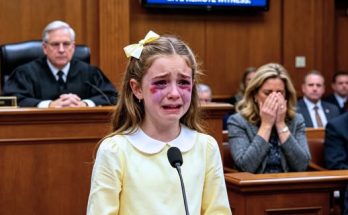
My eight-year-old son lay curled on the living room floor, struggling to breathe.
At first, I thought the fall had just knocked the wind out of him. Kids tumble all the time — off bikes, out of trees, over their own untied shoelaces. But this wasn’t that. His small hands clutched his side, his face pale and tight with pain, each breath shallow and uneven.
“Mom… it hurts,” he whispered.
I dropped to my knees beside him. “Where?”
He pointed to his ribs, and the moment my fingers brushed the area he cried out so sharply that my stomach turned cold.
Across the room stood the boy who had done it — my nephew, Ryan. Twelve years old, tall for his age, fists still clenched like the fight hadn’t fully left him yet.
“What happened?” I demanded.
No one answered.
Ryan looked away first. My sister, Carla, leaned casually against the kitchen counter, arms folded. My parents sat on the sofa like spectators who had wandered into the wrong television program.
“He just shoved him,” Carla said finally, her tone so dismissive it made my ears ring. “Kids get rough.”
My son had tears streaming silently down his face.
I pulled out my phone with shaking hands and dialed 911.
Before the call could connect, my mother lunged forward and snatched the phone out of my hand.
“Don’t you dare,” she snapped.
I stared at her, stunned.
“Mom, he can’t breathe!”
“Boys fight,” she said sharply. “You don’t destroy your nephew’s future over a playground scuffle.”
My father barely glanced at my son.
“You’re overreacting,” he muttered. “He’ll be fine in a day or two.”
I looked at Carla.
She was smirking.
Not worried. Not apologetic. Smirking.
Something inside me shifted in that moment — not loud or dramatic, but solid and final.
My son gasped again, a weak whimper escaping his throat.
I stood up slowly.
“Give me my phone,” I said.
“No,” my mother replied, gripping it tighter. “You’re not calling the police on family.”
The room fell quiet.
None of them understood that their words had just pushed me to act.
So instead of arguing, I did something they clearly hadn’t expected.
I grabbed my car keys, lifted my son carefully into my arms, and walked straight out the door.
He weighed nothing and everything at once, curled against my chest, his breath catching with every step I took toward the car. I laid him as gently as I could across the back seat, buckled him in sideways because sitting upright made him cry out, and drove to the emergency room faster than I have ever driven in my life, hazards on, running two lights I will never apologize for running.
The triage nurse took one look at him and moved us straight back, no waiting room, no forms first. An X-ray confirmed what I already knew in my bones: a fractured rib, displaced enough that the ER physician wanted him admitted overnight for observation, watching closely for any sign the fracture had nicked his lung.
“How did this happen?” the doctor asked, gentle but direct, the particular tone medical professionals use when they’re quietly assessing whether they’re looking at an accident or something they’re obligated to report.
“His cousin hit him,” I said. “During a fight at my parents’ house. My family refused to let me call 911.”
The doctor’s expression didn’t change, but I watched her make a note, unhurried and precise. “We’ll need to document this thoroughly,” she said. “Given the severity and the account of the injury, this will be reported to child protective services as a matter of protocol, and likely to police as well, given the description of a deliberate assault.”
I nodded. I’d expected that. Some small, steady part of me had already decided, somewhere on the drive over, that I wasn’t going to soften this story for anyone’s comfort — not my mother’s, not Ryan’s, not my own discomfort at watching a police report get filed against a twelve-year-old.
My phone, retrieved from my mother’s hand before I left, had fourteen missed calls by the time my son was settled into a room upstairs. I answered the fifteenth.
“You are unbelievable,” my mother said, before I’d even said hello. “You’re going to ruin that boy’s entire future over a family squabble.”
“He broke a rib, Mom. The doctor is worried it might have punctured a lung. That’s not a squabble.”
“Ryan didn’t mean it. Boys don’t know their own strength.”
“He hit an eight-year-old hard enough to fracture bone. Whether he ‘meant it’ is a question for whoever investigates this, not for you to decide unilaterally in your living room while my son couldn’t breathe.”
“You’re calling the police on your own nephew.”
“I’m not calling anyone,” I said. “The hospital is required to report an injury like this. That decision was made the moment you decided a twelve-year-old’s future mattered more than an eight-year-old’s ribs.”
She hung up on me. I let her.
The investigation moved forward over the following weeks, handled by a child protective services caseworker and, separately, a juvenile justice liaison given Ryan’s age. The full picture that emerged was worse than the single incident I’d witnessed: Ryan, it turned out, had a documented pattern at school of physical aggression toward younger children, previously dismissed by my sister as “boys being boys,” never addressed with any real intervention.
Carla was furious with me for months. My parents took her side entirely, framing me as the family member who’d “gone too far,” who’d “made everything worse” by involving outsiders in what they insisted should have stayed a private matter. I stopped attending family gatherings at their house. I did not stop calling to check on Ryan, quietly, through Carla when she’d still answer — not out of forgiveness for that afternoon, but because a twelve-year-old with an unaddressed pattern of violence needed intervention regardless of how furious his mother was at me for finally getting him some.
My son’s rib healed over six weeks, slower than a straightforward fracture because of the initial delay in treatment. He still, over a year later, sometimes flinches when kids roughhouse too close to him at school, a small, lingering echo of an afternoon nobody in that living room thought was serious enough to interrupt.
Ryan, through the juvenile system’s mandated counseling requirement, started actual therapy for the first time in his life — something Carla had resisted for years, insisting he’d “grow out of it.” I don’t know if it’s helped. I hope it has. I still love that boy, even now, even after everything; I just refused to let loving him mean staying silent while my own son gasped for air on a living room floor.
A year later, my son and I have our own small routines now, just the two of us, birthday parties and holidays spent apart from the family that once decided his broken rib was less important than avoiding an uncomfortable phone call. I don’t regret walking out that door. I regret, more than anything, how long it took me to understand that “don’t ruin his future” was never really about Ryan’s future at all.
It was about making sure nobody in that house ever had to answer for what happened in it.
THE END
A Note to the Reader
The chilling detail in this story isn’t the injury itself — it’s the unanimous, immediate consensus in that living room. Nobody paused. Nobody hesitated. A mother snatched a phone away from a woman trying to get emergency help for a child who couldn’t breathe, and everyone else in the room simply watched it happen, already having decided, apparently before this story even started, that protecting the family’s comfort mattered more than protecting an injured child.
It’s worth naming plainly what “don’t ruin his future” often actually means in families like this one: not genuine concern for a child’s wellbeing, but a reflexive instinct to avoid consequences, documentation, or outside scrutiny — even when a child is visibly in pain in front of them. Ryan’s documented pattern of aggression, revealed only once an outside investigation actually looked closely, suggests the family’s habit of minimizing his behavior had been going on for far longer than that single afternoon, and had never once actually protected him either.
If you’ve ever been in a room where a family member’s injury or distress was minimized to avoid consequences for someone else, this story is a reminder that a hospital’s mandatory reporting isn’t cruelty toward the person being reported — it’s often the only mechanism capable of interrupting a pattern a family has already shown it’s unwilling to address on its own.