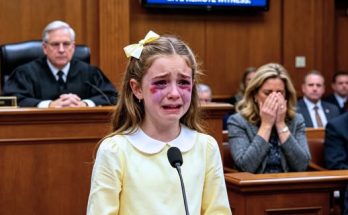
I can still name the second my life split in two.
Before, there was sunlight through Lily’s nursery blinds, pale gold stripes across the changing pad. Before, there was lavender lotion on my fingers, the dry little rattle of the powder bottle, and my daughter’s warm heels kicking against my wrist while she laughed at the stuffed giraffe above her head.
After, there was silence.
Lily had just turned six months old. She had that bubbling baby laugh that made a sink full of bottles, a basket of unfolded onesies, and three hours of broken sleep feel survivable. I was tired in the way only a first-time mother understands, checking bathwater twice, reading labels twice, washing pacifiers when they barely touched the floor. Exhausted, protective, and happy.
My sister Natalie hated that part of me.
She spent the family visit leaning in the nursery doorway like she was watching a ridiculous performance. I wiped down one of Lily’s toys, and Natalie rolled her eyes. I measured formula, and she sighed loud enough for the hallway to hear. I moved a blanket away from Lily’s face, and she laughed.
“You act like she’s made of glass,” she said.
I forced a smile because arguing with Natalie always turned into a family trial, and somehow I was always the one standing before the jury. My mother would call me sensitive. My father would tell me to stop making everything personal. Natalie would smirk because she knew the verdict before anyone spoke.
So when I reached for the baby powder on the shelf that afternoon, I did not question it.
Same white container. Same cap. Same dry shake.
Memory moved my hand.
The nursery was warm, almost too warm, and a pale cloud puffed into the air. For one harmless-looking second, it floated in the sunlight like dust.
Then Lily stopped babbling.
Not faded. Stopped.
One sharp gasp tore out of her tiny body. Her chest started pulling hard, too hard, as if something inside her had locked shut. Her eyes went wide. Her hands clenched. Her lips turned blue at the edges, and the color was so wrong that my mind refused to believe it was happening to my child.
I snatched her up so fast the diaper caddy crashed to the floor. Wipes scattered across the rug. A tiny sock stuck to my sleeve. I called 911 at 2:07 p.m. with hands so slick and shaking I nearly dropped the phone.
“Lily, please,” I kept saying. “Stay with me. Please breathe.”
The paramedics arrived with terrifying calm. One took Lily from my arms. Another asked what she had been exposed to. I pointed at the changing table because full sentences had left me.
He picked up the powder bottle, looked at it, and went still.
Then he sealed it inside a plastic evidence bag without saying a word.
That silence was louder than the siren.
At St. Mary’s, they took Lily through intake and straight into pediatric intensive care. The next three days became fluorescent light, stale coffee, plastic chairs, and machines keeping time because my daughter’s body could not. A ventilator breathed for her. IV tape crossed her tiny arms. Her hospital wristband looked too big on her.
I barely slept. I barely ate. I barely existed outside that room.
I replayed the nursery until it became torture. The bottle. The cap. The cloud. The gasp. I kept searching for the one second when I should have known.
My parents came on the second day.
For one foolish moment, hearing their voices in the hallway almost broke me with relief. I thought they had come to hold me up. I thought maybe, just this once, they would choose the person bleeding instead of the person who caused the wound.
Then Natalie walked in behind them.
She wore concern like a borrowed coat. It did not fit.
My mother reached for my hand and used that soft careful voice she always saved for asking me to swallow something unforgivable. She said they had heard about the flour. Natalie was sorry. It had only been a stupid prank. No one could have imagined something like this would happen.
The flour.
For a second, grief made the word sound unreal.
I looked at Natalie. “You switched my baby’s powder?”
Natalie shrugged and stared at the floor. She said she thought I would notice, freak out, and prove to everyone how dramatic I was.
Some people call cruelty a joke because it lets them demand a laugh after the damage is done. Natalie had always understood that trick. My parents had always protected it.
I asked if she understood Lily was in intensive care because of what she had done. I asked if she understood my daughter had nearly died.
“She didn’t die,” Natalie said. “Stop acting like I tried to kill her.”
Something in me snapped clean through.
I stood so fast the chair screamed backward across the tile. I told them to get out. Not after a discussion. Not after a family vote. Right then.
My father’s face hardened into the look that used to freeze our whole house when I was growing up. He said family forgives family. He said I was not going to destroy everyone over an accident.
“This was not an accident,” I said.
I never saw his hand move.
Only heard it.
The crack landed across my face so hard my head snapped sideways. Heat flooded my cheek. For one stunned second, I just stared at him because my mind could not place violence inside a hospital room where my baby was fighting to live.
The room froze. A nurse stopped at the doorway with one hand still on the frame. My mother’s purse hung half-open from her wrist. Natalie’s mouth stayed parted, almost smiling, almost shocked. Down the hall, a monitor kept beeping in someone else’s room, steady and indifferent, while everyone who claimed to love Lily decided whether my pain was inconvenient.
Nobody moved.
Then my mother grabbed a fistful of my hair and yanked my head back. Pain burned across my scalp so sharply my eyes watered. She hissed that Natalie was upset enough, that Lily was going to be fine, that I needed to let it go.
Let it go.
My baby was unconscious a few feet away.
Natalie stepped closer and said I always made everything about me. She said I loved being the victim. She said even now I was milking it because attention made me feel important.
For one ugly heartbeat, I imagined slapping her back. I imagined shoving all three of them into the hall with my bare hands. I imagined screaming until every doctor at St. Mary’s knew exactly what kind of family had raised me.
I did none of it.
My nails bit into my palms, and I stayed standing because Lily needed one parent in that room who could still choose restraint.
Then Natalie shoved me.
I hit the wall hard enough to lose my breath.
The nurse finally moved. Her face went white, then furious. She ordered them out and reached for the call button. My father pointed at me on his way into the hall and said we would finish this conversation when I was calm enough to be reasonable.
Reasonable.
After they left, I slid down the wall and shook until my teeth chattered. My cheek burned. My scalp throbbed. My lungs felt too small.
But the worst pain was quieter.
My own parents had watched their granddaughter nearly die, then chosen my sister because choosing the truth would make the family look ugly.
At 4:18 p.m., Dr. Patricia Morrison came into Lily’s room carrying a chart and a printed lab report clipped behind it.
She did not stand by the door. She pulled a chair close, sat directly in front of me, and lowered her voice.
“Lily’s test results are back,” she said.
I gripped the edge of the hospital blanket.
Dr. Morrison looked at the swelling on my cheek, then at the ventilator beside my daughter’s bed, then down at the chart.
“The flour explains part of the respiratory distress,” she said carefully. “But it does not explain everything.”
My stomach dropped.
She turned one page. Then another.
When she looked up again, her face had changed completely.
“The flour was not the only foreign substance we found in Lily’s system,” she said. “There is evidence of exposure to something that should never have been anywhere near an infant.”
The room tilted.
I thought of Natalie laughing in my nursery. I thought of the sealed evidence bag. I thought of my parents begging me to forgive her before the truth was even finished arriving.
Dr. Morrison pointed to the second result on the page, and her voice dropped.
“Before I say more, I need you to understand something. This does not look accidental. It looks like someone…”
“…added something to the flour itself, before it ever went into that container,” Dr. Morrison said. “Toxicology found trace levels of a sedative compound alongside the flour inhalation injury. Something consistent with crushed medication — the kind found in a common sleep aid — mixed directly into the substitute powder.”
I stared at her, my mind refusing, for several seconds, to fully process the sentence.
“Someone drugged her,” I said slowly. “Not just the flour. Someone put medication in it too.”
“That’s what the results indicate,” Dr. Morrison said. “The flour caused the acute respiratory event you witnessed — that part is consistent with a young child inhaling a fine powder. But the sedative exposure is separate, and deliberate. Flour doesn’t contain medication on its own. Someone had to add it.”
I felt the room narrow around me, the ventilator’s rhythmic hiss suddenly unbearably loud.
“I have to report this,” Dr. Morrison said gently. “Given the injury, the substance found, and the account you’ve given me of who had access to that bottle, this moves from an accident report to a case involving law enforcement and Child Protective Services. I need to ask you directly — who had access to that nursery shelf in the hours before you used the powder?”
“My sister,” I said. “She was in there alone with Lily for at least twenty minutes that morning, while I was making lunch. My parents were in the living room the whole time. I didn’t think anything of it. She’s her aunt.”
Dr. Morrison nodded slowly, making a note. “I’ll be contacting the hospital’s social work team and local police immediately. I want you to know this isn’t your fault. You had no way of knowing that container had been tampered with beyond the substitution you were told about.”
Detective Anna Reyes arrived within the hour, methodical and careful, taking my full statement while a hospital advocate sat beside me. The sealed evidence bag from the paramedics — the original powder container, thankfully preserved rather than discarded — became central to the investigation, sent for full forensic analysis alongside the toxicology already run on Lily’s blood.
The investigation confirmed what Dr. Morrison suspected. Natalie had crushed a portion of her own prescription sleep medication into the flour before swapping it into my baby powder container — not, she initially claimed under police questioning, intending real harm, but wanting Lily to “sleep more” during the visit so the adults could have an uninterrupted afternoon, a justification that fell apart entirely once investigators noted the dosage relative to an infant’s body weight made the outcome anything but a harmless prank.
Natalie was charged with child endangerment and aggravated assault of a minor, the sedative evidence elevating what she’d tried to frame as a joke into something the district attorney’s office treated with appropriate severity. She ultimately pled guilty rather than risk trial, given the forensic evidence, receiving a sentence that included mandatory psychiatric evaluation and a permanent no-contact order regarding Lily.
My parents’ response to the full truth was, devastatingly, not what I’d hoped for. Even after the sedative was confirmed, even after Natalie’s plea, they continued describing it as “a mistake that got out of hand,” unable or unwilling to fully reckon with what their daughter had actually done, or with the violence they’d used against me in that hospital room to protect her from consequences.
I filed a police report regarding my father’s slap and my mother’s physical assault separately, documented by hospital staff who had witnessed it directly. Both incidents became part of a broader protective order I sought, covering myself and Lily, once it became clear that “family forgives family” was a standard my parents applied selectively, and never in my daughter’s favor.
Lily recovered fully over the following weeks, the respiratory damage healing without lasting effects, according to her pulmonologist, though I remained vigilant, cautious, and considerably less trusting of easy explanations than I’d been before that afternoon.
A year later, Lily is a thriving, curious toddler who has no memory of any of it. I have no relationship with my parents or Natalie, a estrangement I no longer feel guilty about, having finally understood that protecting my daughter and preserving that particular version of “family” were never actually compatible goals.
I still keep the container. Not the original — that stayed with the police as evidence — but a photo of it, on my phone, beside a picture of Lily now, healthy and laughing, a reminder of exactly how far I’m willing to go to make sure nothing like that nursery afternoon ever happens to her again.
THE END