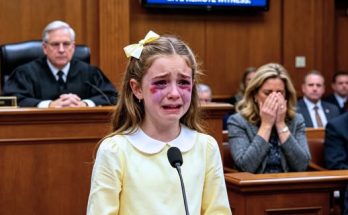
Every single morning played out exactly the same way.
Richard would drag me out into the backyard and beat me. He always spat the exact same words:
“I married you, but you’re completely useless because you can’t give me a boy.”
First, came the slaps.
Then, the kicks.
After that, he would just strike me everywhere — my face, my ribs, my back; it didn’t matter to him.
The neighbors definitely heard my screams, but they simply shut their blinds and closed their windows.
His mother stayed inside the house, quietly praying with her rosary beads in front of a framed picture of a saint.
And me? I just curled into a tight ball like a wounded animal. I silently prayed for the violence to end quickly so I could drag myself up and cook his breakfast.
We had two daughters. Two beautiful, sweet girls. But in that household, they were treated like a literal curse. Every time Richard looked at them, his rage only grew. He would beat me even harder, blaming me entirely for their existence.
That specific Tuesday started just like any other.
As he stood over me, kicking and screaming, my ears began to ring violently. The world around me faded into a dark blur.
With his final, brutal strike, I completely blacked out on the cold dirt.
I eventually regained consciousness in a sterile bed at Parkland Memorial Hospital in Dallas. Richard was hovering right next to me, putting on a perfect performance of a worried husband.
He quickly fed his lie to the attending physician:
“My wife took a terrible fall down the stairs.”
I was far too weak to speak up and argue. I just let my eyes flutter shut.
Because my injuries were so severe, the doctor immediately ordered a series of scans and X-rays. The nurses wheeled my gurney down into a freezing, brightly lit imaging room.
About an hour later, the doctor called Richard out into the hallway. I was lying alone in the hospital room, but the door was cracked just enough for me to hear them.
The doctor’s tone was dead serious:
“Sir, I need you to take a look at these X-rays right now.”
There was absolute dead silence from my husband.
A few long minutes passed before the heavy door swung open.
Richard walked slowly back inside. He was ghostly pale, physically trembling, and clutching a large X-ray film in his shaking hands.
He just stood there staring at me. His mouth opened and closed, but not a single sound came out.
The doctor stepped into the room right behind him, leveled a hard glare at my husband, and said:
“Mr. Alvarez, these scans show eleven healed fractures across her ribs, wrist, and collarbone, at various stages of healing — some several years old, some as recent as a few months. A fall down the stairs does not produce this pattern. This is consistent with repeated, sustained physical abuse over an extended period, and I’m required by law to report it.”
Richard’s mouth worked uselessly, no lie prepared for a room lit as clearly as this one.
“That’s — she’s clumsy,” he finally managed. “She’s fallen before. Multiple times.”
“Eleven fractures in staggered healing patterns is not clumsiness, sir,” the doctor said. “It’s a documented history. I’ve already contacted hospital security and local law enforcement. You’ll need to remain here until an officer arrives to take a statement.”
I opened my eyes fully for the first time since the imaging room, watching my husband’s carefully maintained composure collapse in real time, watching a decade of silence I’d carried in my own bones finally speak for me when my voice couldn’t.
“Elena,” Richard said, turning to me, his voice suddenly soft, pleading, a tone I hadn’t heard from him in years, “tell them it was an accident. Tell them—”
“No,” I said. My voice came out cracked and thin, but it came out.
The doctor’s expression didn’t change, but something in his posture straightened, like a man settling in to make sure this conversation went exactly the way it needed to.
“Mrs. Alvarez,” he said gently, “can you tell me what happened today?”
I told him. Not just about today — about the mornings in the backyard, the words Richard used every time, the years of it, my daughters watching from the kitchen window because they’d learned young that going outside during those mornings meant becoming a target themselves.
Richard didn’t try to interrupt again. I think some part of him understood, watching the doctor’s face harden with every sentence, that the story had already left his control the moment that X-ray came back from imaging.
Officers arrived within twenty minutes. Richard was arrested that same afternoon, charged initially with aggravated assault, the charges expanding over the following weeks as the hospital’s forensic documentation — eleven fractures, meticulously dated and cross-referenced against emergency room visit records going back six years, each one previously explained away with a different convenient lie — built a case that made any defense attorney’s job considerably harder than Richard’s confidence in that hospital room had assumed it would be.
My daughters and I moved into a domestic violence shelter that same week, connected through a hospital social worker who sat with me for over an hour before I was even discharged, walking me through what came next in a voice as steady as the doctor’s had been. It was the first time in years anyone had spoken to me like my safety mattered more than anyone’s convenience.
The trial took eight months. Richard’s mother, to my genuine surprise, testified — not for him, but against him, finally breaking a silence of her own that had lasted the entire length of my marriage, admitting under oath that she’d heard the beatings every single morning and prayed instead of intervening, a confession that cost her something I think she’d spent years avoiding having to name. Richard was convicted on multiple counts and sentenced to a term that meant my daughters would grow up without him in the house, which was, after everything, the only outcome I could bring myself to feel relieved about rather than grieve.
A year later, my daughters and I live in a small rented house two towns away, with a backyard I’ve slowly, deliberately turned into a garden — tomatoes, sunflowers, the kind of ordinary, unremarkable growing things that mean nothing happened here before us. My older daughter asked me recently why we don’t visit her grandmother anymore. I told her the truth, in pieces she could understand, the way a trauma counselor helped me learn to explain it without frightening her more than the explanation itself required.
I still have the X-ray. Not the original — a copy, given to me by the hospital’s advocacy office, tucked into a folder with everything else that became part of the case. I don’t look at it often. But I keep it, the same way you keep proof of anything that once tried to convince you it wasn’t real.
Eleven fractures. Eleven mornings that finally, all at once, found their way into the light.
THE END