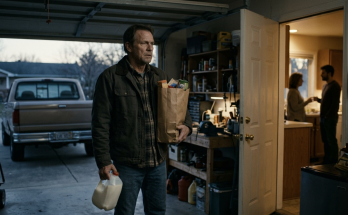
The metal click of handcuffs sounded louder than the siren from Harris’s cruiser, as if the sound carved a space in the air that held everyone’s breath. For a moment there was an odd stillness: a cicada hummed in the yard, a washing line fluttered, and the world seemed to hold itself until someone decided what would happen next. Then June stepped between Rachel and the deputy with the kind of calm that didn’t look calm at all. She planted her feet so close to Harris’s knees he could have tripped on them, and she put one hand flat on Rachel’s shoulder, a tether against whatever the deputy intended. “You are not taking her,” she said, voice low and iron-sure.
Harris kept his tone smooth and professional, the cords in his neck tightening like a drawn wire. “Ma’am, please step aside. I need you out of the way.” June didn’t move. Her eyes didn’t flick to the cruiser, to the uniforms, to the small cluster of neighbors and relatives who had gathered at the sight of law enforcement on their front walk; they were fixed on Harris, unmoving. Her posture was not defiance for spectacle’s sake. It was an unspoken declaration: the boundary she wouldn’t allow anyone to cross. Around us, the air felt charged—more than family tension, more than curiosity. It felt like something larger, ancient and cruel, working a fault line through their lives.
“We have a warrant,” Harris said, as if the paper in his hand were a talisman that made things true. “The estate’s representative identified Ms. Collins as the beneficiary of a series of transfers totaling nearly three hundred thousand dollars. There are signatures, transfer records, and fingerprints on the trust documents.” His words came out clipped, rehearsed. In the pause that followed, Aunt Carol’s face folded into a grin that was all smirk and accusation. Her fingers curled through the strap of her purse, knuckles white. For weeks she had been waiting for the law to vindicate what she’d been saying at family dinners and phone calls—that someone had taken what wasn’t theirs.
June didn’t bother to answer the accusation with reason; she answered with memory. “You don’t understand Rachel,” she said, and the sentence was less explanation than countercharge. “She went to Grandpa’s house when the rest of you wouldn’t. She fixed the light in his kitchen and sat through his bad jokes. She brought him peaches in the summer and patched his cardigan when the elbow slit grew. If anyone line by line told me what justice looks like, it isn’t what you’re clutching in your hand, Deputy.” June’s voice made the words feel like a shield. To see her there, defending Rachel as if she had been defending a child, forced something unsettled and private out into the open—because June and Rachel’s connection had always been more than proximity or convenience. They’d been part of the same small orbit.
Carol’s laugh was short and full of something much harder than mirth. “She’s your friend because she’s convenient,” she said. “She paraded under our roof the last few months and now you want me to believe she’s the saint you’ve painted her to be. You people are naïve. You never see what’s right under your nose.” Her eyes flicked to me then, sharp and accusing. The room narrowed as though someone had pulled a curtain. Attitude shifted like weather—cooperative faces hardened into suspicion, loyalty into gossip—because the arrival of the deputy made everything official and official is always more brutal than rumor.
Harris moved to the back of his cruiser and unfolded a glossy packet. “We executed a search because of an allegation lodged by the estate’s executor. Inside the locked house, we found a stack of documents: a trust in which the decedent appears to have named Rachel Collins as beneficiary of several accounts. The signatures are on every page. There are also fingerprints next to the signature lines.” He raised the packet toward June, toward the winded expression that had become her face for the week: a cross between disbelief and fury. “Security footage also shows a phone being used in the house the night these transfers were initiated.”
June’s mouth flattened. “Security footage,” she repeated, tasting the words like something bitter and metallic. She thought of the surveillance camera that had been installed by Grandpa near his back door, its tiny red eye blinking like a watchful insect. She thought of the machine shed beyond the house—old tools, a humming chest freezer, stale motor oil—where Grandpa sometimes put his small things when he wanted them away from the world. Something in June’s face made Harris hesitate, the faint furrow between her brows like a fingerprint of worry. “You have footage that proves Rachel was there?” she asked.
“There’s footage of a phone signal coming from within the house,” Harris said. “It’s not a full video. It’s a cellular ping.” His voice implied certainty. “We also obtained bank records showing transfers from an account controlled by the decedent to one wired to Rachel Collins. That’s grounds for arrest.” For a beat, his smile looked like the last reasonable thing left in the room—calm, precise, proper. But June was not interested in smiles. She wanted the bones of this claim examined. She wanted not sentiment but a careful dismantling of what the deputy was handing them as proof.
I reached instinctively for the documents Harris held. He let me take them, as if passing paper between people could make anything less real. The trust pages were crisp, the ink fresh and the printed name clear. But what caught my eye was something more intimate and ridiculous—little circles of purple ink pressed beside the printed name on each page where fingerprints would sit: an almost comical stamp in violet, as if someone had set a child’s inkpad beside a legal instrument. The fingerprints were too perfect. They didn’t smudge the way a living finger, sliding down a page in haste or trembling, might. They impressed like an afterthought-stamp rather than a mark made in the tremor of grief.
“They’re in purple ink,” I said aloud, and the smallness of the observation made the room lean in. There was something incongruous about that purple. Handprints belonged to the body; ink that bright belonged to arts and crafts, to childish things, not to legal formalities. June’s eyes narrowed. “That’s not how fingerprints are recorded, not on a trust. They’re typically in black or blue from an ink pad used by officials.” Her voice carried a rapid current of adrenaline now. “Someone wanted fingerprints on the page that read as if they were the decedent’s.”
Harris frowned. “We have a lab report confirming that the prints match the decedent.” He said it like a verdict between two parties in a long argument. “We sent the pages to forensic analysis.” And yet his face registered a flicker, just the tilt of a head that suggested doubt. He cleared his throat and added, “There’s also evidence of tampering with the trust’s margins, signatures that appear to have been traced, and anomalous ink deposits on the reverse.” He folded his hands as if the facts were reciting themselves piecemeal, and in the shadowed corners of the yard you could see the audience taking stock—those who’d long suspected, those who’d always backed June, and those who soldiered on the side of tradition and suspicion.
For a second Rachel didn’t speak. Her cheeks were thin and pale, and her fingers—callused from years of work—twined together like someone wringing a handkerchief. She looked like a woman who had, for months, been tending to every small difficulty in a house not entirely her own. When she finally spoke, she did not plead. She stated facts. “I have never, ever touched Grandpa’s bank accounts,” she said. “I cashed his checks back when he asked me to, and I gave him peace. If he left money, he left money. If he wanted it gone, he’d have said so when he could. I don’t know how anyone expects me to account for him after he’s gone.” Her voice was a rasp of tired clarity, as if all the world’s politeness had been stripped away and left only the stark truth.
Carol’s eyes were a constant accusation. “You keep his house, you keep his key, you keep his time. That’s how you got your hands on whatever records we found.” Her tongue was sharp as metal. Around her, other family members shifted uneasily, calculating loyalties and alibis. The air smelled faintly of cut grass and something else—oil or a faint metallic tang—that clung to the machine shed’s door. The shed’s shadow seemed larger now, a dark mouth swallowing the outline of the house. June glanced at that shadow and then at the packets, and I saw orders rearrange themselves in her face—anger folding into method, resolve into a plan.
“If someone forged Grandpa’s prints,” June said evenly, “they had access to ink and someone who could mimic his print. Someone who knew what his fingerprints looked like.” She looked at Carol, not unkindly, like someone looking for a lost ring in a familiar place. “We can’t let accusations stand without proof.” She addressed Harris directly. “If those fingerprints are in purple ink, can you take them back for deeper analysis? Examine the plate marks? Look at the chemical composition?”
Harris blinked. His training had taught him to be meticulous and to trust labs, but he was also human and could see the politics cracking through the case like a hairline fracture. “Yes,” he said carefully. “We can do a comprehensive analysis. But the bank’s records are pretty clear—transfers, and an account with Ms. Collins’s name.” He let the last words hang, as though the name carried the weight of indictment. The crowd murmured. Aunt Carol’s lips tightened into a line. Someone behind her muttered, and June snapped her head, eyes like flint.
“Which bank?” June asked. “Which branch?” Her tone had changed; she was no longer pleading, no longer the person arguing for sentiment. She was turning into a kind of investigator whose childhood had been spent reading the small print of human behavior instead of poetry. When Harris named the bank, June’s jaw worked. She thought of that bank’s understated brick building downtown where Grandpa had kept a safe deposit box, where he’d signed things with a thumbs-up and an apology when the clerk asked for extra ID. June’s memory threaded through simple scenes: a woman wrapping a wreath, a man choosing melon slices from a grocery bin, a teller counting out a small stack of bills with methodical kindness.
“I’ll call them,” she said. She took a breath and then did something no one expected: she contacted the teller she knew by name because he’d always laughed with Grandpa over the sports scoreboard and the price of gas. The teller’s voice was soft over the phone and then sharp with bureaucratic precision. “We can freeze accounts on a warrant,” he said slowly, “but wire transfers are logged. We’ll send you the official ledger, but it has to go through formal channels.” June thanked him, and in the short silence that followed, the family’s kaleidoscope of opinions shifted again. There was a nervous energy now; the case was no longer something purely accusational, it was procedural. Processes mattered. Names mattered.
While June spoke to the teller, I examined the packet more closely. The margins of the trust had a faint lift to them, as if the paper had been pressed down later that morning with something flat and heavy. Some pages bore not smudges but the predictable ridges of mechanical stamping. In the thin light, I could just make out tiny perforations at the corners that suggested the book might once have been bound with a different spine and then separated. It was the sort of detail an archivist notices when they pull an old photograph from an album; details people usually miss become luminous when you’re trying to prove a falsity. The prints in purple, the lifted margins—none of it smelled like randomness. It smelled like intention.
“You see that?” I asked Harris, nodding. “Those are not kitchen-table fingerprints. They’re placed, deliberately, to create a false impression of authority. Why purple? Who buys purple fingerprint ink for legal documents?” June’s explanation was more than a rhetorical flourish. It was a question that required somebody to look beyond the obvious. Harris’s face softened into a kind of professional curiosity mixed with the first real glint of uncertainty. “I’ll call the lab back,” he said. “We’ll ask for a deeper chemical analysis. If someone has used an unusual dye, we need to know its source.”
Aunt Carol barked a laugh of impatience that became almost theatrical in its cadence. “This is amusement. While you’re picking through ink, my brother’s life has been pillaged.” Her accusation hung there, raw and taut. It landed differently in the yard now—the laboratory, it seemed, could become the slow leak that let suspicion out of anything else. June’s anger, hot and fluent, broke through. “You’re talking like this is a dinner-table dispute over the last piece of pie. Grandpa was a person, not an accounting problem.” She turned to Carol in a voice that had sharpened with hurt: “You made him alone for years. You accused me of taking him away when I tried to make sure he didn’t have to do it alone.”
Rachel’s eyes glowed suddenly with tears she would not let fall. “Carol, stop,” she said quietly, her words like a plea to a neighbor who’d been thrown out of the circle and wanted back in. “You think I planned this? You think I would take the last breath of somebody I loved and run it through the bank? I sat with him. I fed him. I argued with him about his television. If something happened, I’ll stand in front of it like anyone honest would.” Her hands fluttered like small, defeated wings. The house behind her looked suddenly too large for her figure, each window a watchful eye that had been waiting to see whether the family would collapse or consolidate their grief into accusations and verdicts.
Someone from down the street—Mr. Ellison, who fixed televisions and taught Sunday school—stepped forward. He had watched the family ravel tight for days. “I remember seeing Rachel around the place late at night sometimes,” he said. “She would be carrying a lantern or a dish. She ain’t the type to steal. She’s the type to give away what she has.” His voice was slow and measured, the tone of a man who pronounced small truths in front of the noise of big assumptions. June nodded as if taking inventory—every person who could corroborate a kindness, every neighbor who had glimpsed a habit could become a shield against accusation.
Harris’s radio crackled and murmured in his ear like a thread bringing him back to officialdom. He tucked the packet under his arm and said, “We’ll hold on the arrest for now. I don’t have probable cause to handcuff someone when there’s credible reason to doubt the documents are authentic. We’ll rerun the tests and follow the chain of custody for the papers.” There was a complicated relief in the yard then, like a storm easing but leaving the sky colder. Carol’s shoulders tightened with something like fury at the decision. “You’re letting a thief walk because of a technicality?” she asked, the accusation a hot coal being flung.
June’s face did not soften. She stepped forward until she was almost close enough to touch Carol and said, “This is not a technicality. It’s evidence we have to examine. If you want justice for Grandpa, you’ll want the truth, not the easiest villain.” Her voice carried the moral imperative of someone who had been slighted and then learned that righteousness is not a club you hit a person with—you use it to clean the glass of what you see through. Carol’s mouth trembled, and then she looked away, not because she had been convinced, but because in the presence of June’s conviction she recognized she had not thought about truth at all. She’d thought about being proven right.
The lab work became a gravity center for our days. Harris promised he would supervise every step, and June insisted on being present when evidence was packaged and sealed. We drove the pages to the county lab in a car that smelled faintly of old upholstery and fried bacon from that morning’s hurried breakfast. The technician who took the evidence was young and methodical, and his eyes flicked between June and the packet as if the human drama could be separated from the cellulose it sat in. “We’ll run chromatography on the ink and look for dyes,” he explained, pulling on gloves like a ritual. “If these prints were stamped from a pad, the dye will tell us more than whether they’re purple. We’ll look at the pattern of pressure and the ridge detail, but the dye composition will say whether this came from an art store or a forensic pad.”
June sat across from me in the car and exhaled in a way that she had never before—small, almost inaudible, but full of everything that had been compressed into the last few days. Her hands were steady on her knees. “If they used some cheap work-around to fake fingerprints, they must have known Grandpa’s ridges,” she said, not as a question but as observation. “He always let me hold his hands when he complained about them acheing. He would press his thumb into my palm to show me the line where the arthritis started. He did that with anyone who’d listen. Someone who was around often would remember the whorl of his thumb.”
I thought of the machine shed again—the place where Grandpa kept his tools and sometimes his secrets. The shed had a voice in the afternoons, a slow, humming, mechanical sound when the freezer inside kicked and the old radio thudded a low country song. June had always been the one who could coax Grandpa into showing her small things he’d hidden away, the things he’d built and broken and mended. Whoever tampered with the trust must have been close enough to watch him sign, to know the way he pressed a pen, the tilt of his hand. That intimacy felt like betrayal and it made my skin prickle. Such closeness doesn’t exist without choices built into it—who sat with him when the house was silent, who left and who stayed.
As the lab worked, the family atmosphere changed into a long vigil—a waiting room of sorts for truth. People took sides not on whim but on memory: June for her constancy, Carol for her righteous indignation, Rachel for her steady quiet and work-stained hands. Harris circulated, answering questions like an ill-fitting sweater, trying to be both reassuring and honest. He promised a thorough report. He promised witness statements would be taken seriously. And in the slow hours between promises, the house and the shed and the small, ordinary ornaments of Grandpa’s life gathered around us like witnesses: a dented toolbox, a stack of recipe cards in a cabinet, a photograph of a younger man with a grin. They didn’t speak, but their silence was full of accusation and explanation in the same breath.
On the third day, the lab called. Harris took the phone on the porch while June and I stood close enough to hear him through the open window. He listened, his mouth closing into a thin line, and then he nodded. “Yes,” he said. “We’ll arrange for pick up.” He hung up and turned to us with news that felt like both relief and a new kind of danger. The analysis had shown chemicals in the purple ink consistent with dyes used in craft supplies. There were also microscopic fibers adhering to the ink that suggested contact with a common cotton rag—like one used to wipe grease from hands in a shed. The prints lacked the pressure variation of fingers pressed in a living moment; they looked stamped—applied with a steady, mechanical hand.
All the air in the porch seemed to move like wind through loose fabric. Anyone who had held on to certainty faltered, because certainty had been a comfortable blanket and blankets are hard to let go. Carol’s face flickered with something like panic and then an anger that smelled of fear. She stepped back, as if to create distance between herself and the possibility she had hoped for but had also feared. “So you’re saying the prints weren’t his?” she demanded, as if the lab’s analysis were a betrayal of a preferred narrative rather than a call to truth.
June’s reply was small and steady. “I’m saying someone created the impression of his fingerprints,” she said. “If that’s true, then we don’t save ourselves by making a scapegoat. We find who did it and why.” She spoke like a person who had come to know that vengeance tastes hollow if the mechanism behind injustice is left unexamined. She wanted more than a punishment; she wanted an answer that fit the scale of what had been done. Who would patch a life with counterfeit marks? Who could have gotten hold of Grandpa’s papers and a craft pad in purple ink and then dared to use them?
Harris leaned against the cruiser as the sun climbed and threw long, thin shadows across the yard. He had the weary look of a man who had stepped into someone else’s storm and found it more complicated than a speeding ticket. “We’ll widen the investigation,” he said quietly. “We’ll look for access, motives, and any suspicious purchases of ink or stamps. We’ll check neighborhoods for someone who bought craft supplies in bulk. We’ll revisit the executor’s path to those documents.” His voice contained the hard note of someone who believed in procedure. The family listened as if to a priest pronouncing rites: not holy, but systematic.
As the summer waned and the evidence grew more complicated instead of simpler, June sat by the shed’s old doorstep one evening and ran her fingers along the weathered wood. The shed made its familiar mechanical noises—pipes contracting in the heat, the freezer sighing its small chill—and she listened to it like someone waiting for the last cigarette of a long day. “If they wanted to frame Rachel,” she said slowly, as if piecing a puzzle out loud might illuminate a missing corner, “they would have to know she was present or knew she’d be an easy mark. That narrows things.” Her eyes looked out into the yard where the shadows lengthened and turned the lawn into a patchwork quilt of dark and light. She was thinking of proximity, of habit, of the small domestic intimacies that become evidence when turned against a person.