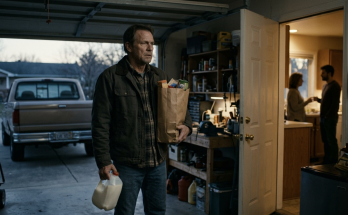
The morning after the hearing, June woke before dawn with the taste of metal in her mouth and the old house around her behaving like a living thing: shutters creaked like joints, the kettle sighed, and the photograph of Grandpa on the mantle seemed to watch her with an expression that had always been a little unreadable. She dressed without thinking, pulling on the jacket that smelled faintly of motor oil and lemon, and walked across town to the diner where Rachel had promised to meet her. Their footing was tentative, but beneath the awkwardness there was an exhaustion that felt like a shared garment—heavy, warm, impossible to shrug off.
Rachel arrived with a paper bag of cinnamon rolls and a face that still carried the shadow of the night before—red-rimmed eyes and the hollow look of someone who had slept in fits. She handed June a roll as if offering peace and said nothing for a long minute, letting the diner’s clatter fill the space between them. When she finally spoke, it was quiet and blunt: “More people have called me. Aunt Lila said she remembers Grandpa signing something when she was over, and Mr. Kline from the bank wants to talk to us.” June put her fingers on her cup until they grew numb. The truth, when it began to move, always did so in unexpected shapes.
Mr. Kline was older than June had pictured—thin, with a deliberate way of speaking that made the diner booths feel like a deposition room. He had been a trust officer at the small bank Grandpa used; his retirement papers were still stacked in his car like unpaid bills. He opened a worn leather folder and slid a photocopy across the table: a ledger page, stamped and annotated in a handwriting that leaned to the right. “You should know what I found,” he said. “I couldn’t keep this on a shelf any longer.”
The ledger chronicled a series of withdrawals and small transfers from the late 2019 through 2025—entries called out with terse notes: ‘home repairs’, ‘medicines’, ‘household’. What caught June’s eye was a pattern: identical amounts, on the same day each month, cleared to a local account held by a business that had suddenly appeared in state filings just after Grandpa’s last hospitalization. Mr. Kline tapped the photocopy with two fingers. “These entries were flagged, then cleared at upper management’s insistence. I stepped down because I kept asking who had the authority to make those calls.”
Rachel swallowed hard. “So someone at the bank helped move money?” Her voice hitched on the last word. Mr. Kline nodded. “Not just helped—made it possible. There were signatures I couldn’t reconcile. The stamp used on paperwork for accounts opened in his name is foreign to our branch. I don’t know where those inks came from.” He folded his hands like someone praying for courage. “I handed everything to a lawyer friend. He told me to go to you.”
Word traveled as it always does in small towns: slow and persistent, like water eroding stone. By late afternoon, an unexpected figure arrived at June’s doorstep—Aunt Lila, Grandpa’s sister-in-law, a woman who had been distant during the funeral but had sent wildflowers in a vase marked with condolence stickers. Her hair was pinned in the way of women who still kept careful hours; her hands trembled when she handed June a tattered envelope. Inside was a single postcard, the back crowded with cramped script that Grandpa had sent from a VA hospital in 2018. The note contained a simple sentence that pulled at the loose seams of everything June thought she knew: “If anything happens, talk to Lila.”
Aunt Lila’s arrival was a small earthquake. She had been estranged from the family for a decade over an argument about a disputed heirloom, but she remembered the rhythm of old loyalties in a way others had forgotten. She said she had been holding back because she had been afraid of stirring a hornet’s nest. “He trusted me,” she told June, voice low. “He told me once that he kept a second set of records hidden—details he didn’t want anyone to find unless something went wrong.” June felt the room tilt; secrets tucked into drawers like moth-eaten sweaters were beginning to breathe again.
Meanwhile, from the other direction came a man June hadn’t seen in years: Tommy’s old friend Hector, who used to fix machines at the feed mill and who’d once been known for a laugh that turned the air electric. Hector had become an unlikely ally after a late-night phone call from Rachel. He arrived carrying a battered metal box wrapped in oilcloth, saying he had been cleaning out a storage unit and found it behind old paint cans where he’d stashed parts. Inside lay a small reel-to-reel tape recorder, a scattering of cassette tapes, and a USB stick wrapped in masking tape.
They set the tape machine on the kitchen table like a small relic from another century and fed in the first cassette. The sound that hissed out was thin and ghostly, but unmistakable: Grandpa’s voice, sometimes coughing, sometimes laughing, telling stories in that peculiar cadence only June could recognize. The tape had been recorded in fragments—voices overlapping at times, a woman’s low murmur that might have been Aunt Carol’s, and a recorder’s timestamp tucked into the background like a cautious witness. In one clip Grandpa said, “If any of this goes wrong, check the dates after October. There’s a ledger I trust, not them.”
June’s hands hovered above the recorder. The tapes were less a solution than a map—crooked, with missing pieces, and full of the places a person had been too careful to mark. Yet the tapes did something important: they changed the stakes of who might be a witness and who might be implicated. If someone had been recording Grandpa, someone had been paying attention in ways the family had not guessed. If the recordings were genuine, they could point at motives, at people who had leaned close enough to press a pen into a paper without being noticed.
From Rachel’s side came an ally whose arrival was quieter but no less consequential: Emilia Grant, a lawyer for public interest who had once been Rachel’s college roommate and had kept loose contact through holiday emails. Emilia was small-boned and sharp-eyed, and she spent the first hour doing what lawyers always do—laying out what could be proven and what rested on rumor. She listened to the tapes with the patience of someone who had built careers out of unspooling tight knots. “This is admissible if we can verify chain of custody,” she said. “We need to show where these tapes were kept, by whom, and when they changed hands.”
Emilia’s counsel had a pragmatic edge that balanced the sentimental urgency everyone felt. She asked for receipts, for eyewitnesses who could corroborate Aunt Lila’s story, and for anyone who could place the tape recorder in Grandpa’s living room during the months before his death. She also requested bank statements—hard copies—to compare against what Mr. Kline had produced, and she urged confidentiality. “If we announce every piece of evidence, we give them time to bury it,” she warned. “Let’s build slowly and keep our papers tight.”
June and Rachel divided tasks like soldiers. June visited the town clerk and dug through the county’s microfilmed property records, tracing transfers and easements that led to an old property deed that appeared to have been altered. The ink didn’t match. The initials at the bottom of one line were faintly different from those on the original contract. This was the kind of small thing that might have been shrugged away if not for Emilia’s insistence that every variance be documented. Meanwhile, Rachel drove to the VA hospice where Grandpa had been discharged months earlier and spoke with a nurse who remembered a man who’d anxiously asked about papers and whispered to a young woman who came by to visit him on Wednesdays—June, she said without hesitation—and someone else described as “another relative, not of the family.”
Those small confirmations—murmurs at the VA, a nurse’s recollection, the telltale ink on a deed—began to pile up like wet leaves in a drain. They made a quiet, unstoppable sound. Aunt Lila produced two boxes of letters from a cedar chest that had belonged to Grandpa’s sister; the envelopes bore postmarks, some old and brown with age, others suspiciously recent. June spent an entire Sunday afternoon sorting them under a lamp, feeling as though she were handling fragile shells. Several envelopes contained short notes: holiday wishes, grocery lists, and a few tense exchanges that hinted at arguments about money and responsibility that had simmered for years.
Then came the person nobody in the immediate family had expected: Marie Thompson, a woman from the nursing co-op where Grandpa had been a member in his late seventies, who showed up at Rachel’s door with a statement and a trembling resolve. Marie had been an old friend of Grandpa’s and kept a meticulous set of daily logs for the co-op as part of her volunteer duties. She produced a small calendar—thin and dog-eared—where she had recorded visits, receipts, and, crucially, a note that read: ‘Signed change? Not by hand.’ June looked down at the entry and felt a cold certainty move through her—someone had been copying signatures, copying more than documents, copying an entire life’s consent.
Emilia took that calendar and smiled in the way lawyers do when they see an opening. She requested a subpoena for the bank’s internal communications and for the personnel files of the employees who had processed Grandpa’s paperwork. Mr. Kline’s earlier admission that upper management had pressured him now had weight. Emilia’s subpoena moved like a slow, precise machine, and before long they had access to a string of emails that read like a script of convenience: directives to close or divert certain accounts, requests to expedite authorizations, and messages that referred vaguely to power of attorney as if it were a flexible suggestion rather than a legal instrument.
The emails were damning not because of one smoking phrase but because of the way they hummed with coordination. Someone had orchestrated a quiet exodus of funds, and the steps were boringly bureaucratic—filled with cliches about client wishes and compliance codes. Yet tucked into one chain was a line that turned the emails from corporate to personal: a clerk wrote, “As instructed by Carol R., ensure transfer to account under Rachel M. is processed today.” There it was, the direct thread linking Aunt Carol’s name to the bank instructions. June felt as though the floor of the room had dropped a foot.
Aunt Carol, when confronted, didn’t break. She held the same steady gaze she had always worn, like a woman who had learned how to carry shame without dropping it. Her defense was neat and rehearsed: she had accompanied Grandpa to the bank often, she managed his day-to-day care, and she had acted in what she believed were his best interests. Her voice never rose; there were no tears. Instead, she offered a narrative of deterioration and emergency decisions, a detail that folded responsibility into a caregiver’s burden. Yet under her account, decisions were made quickly and with paperwork signed in haste. “He couldn’t have managed it,” she said. “He asked me to help.”
Mark’s reaction was more volatile. He had always carried the skin of righteous indignation, and when the emails surfaced that named him in passing—copies sent to his address, a memo noting his sign-off at the branch—his anger unfurled like a flag. He accused everyone in sight of betrayal, of hunting ghosts. Behind his anger, however, June recognized the small, animal fear of a man who had always believed in simple justice and now had the carpet ripped from under him. The house of cards that had kept his sense of self aloft was trembling.
News of the subpoenas and the bank’s internal memos leaked, as such things do, first as gossip in stores and then as terse paragraphs in the local paper. The town became a geometry of looks—sideways glances, nods of sympathy, sudden friendships. Some neighbors who had been quiet now offered statements about seeing Aunt Carol and Mark at the bank, watching documents be signed. Others had stories of their own: a canceled check here, a puzzled teller there. The pile of small confirmations grew into something solid enough to stand on.
One of the most consequential arrivals was from beyond the family circle: a man named Ellis Wynne, an investigative journalist from the state capital who had once covered county courthouses and had an eye for the details officials left uncovered. Ellis had received a tip from a reader about irregular transfers tied to an elderly estate and drove three hours with a recorder and a disarming manner. He sat across from June in the kitchen and listened to her story with the kind of patience that makes people unburden themselves. After an hour, he said he had two contacts—one at the state attorney’s office and one at a private auditing firm—that could trace the money’s path beyond local accounts.
Ellis’s presence made the conflict larger, and for the first time June felt as though they were fighting not just for restitution but for public truth. The auditing firm he recommended had the capability to subpoena interstate transfers and to examine digital footprints: wire routing numbers, intermediary banks, and timestamps that could show when money left the estate’s account and where it landed. There was a technical coldness to this work that contrasted sharply with the familial hurt. But it was necessary. If they could map the money geographically, they could reveal whether it had simply disappeared into the ether or been funneled into real, identifiable hands.
Emilia coordinated with the auditing firm and secured a forensic accounting team that arrived with laptops and a set of quiet protocols. They began to trace wires and identify shell companies that had been used as waypoints. One shell company was registered to a nominee with an address in another state; another appeared to be a lawn-care business that had never sent a mower invoice. These phantom entities had names that sounded like weather—Silver Hollow, Clearbrook Management—but behind them were real accounts receiving real dollars. The tone of the investigation shifted; where it had been personal accusation it now became a forensic pursuit of paper and code.
At the courthouse, something else quietly transpired: a relative whom June had forgotten existed appeared with a lawyer’s letter and a copy of a will that contradicted the one that had gone to probate. This cousin, a woman named Rachel’s Aunt May—no relation to June—had lived in another state and only recently learned of Grandpa’s passing. She produced a notarized draft she said Grandpa had left with her during a summer visit, a document that left June and the others in stunned silence because it named a caretaker trust for June directly, as if Grandpa’s mind had swung and then changed again. Emilia examined the paper with a careful hand and murmured that it might complicate the case by introducing another version of Grandpa’s intent, but also that it suggested a timeline of manipulation may exist.
June held the draft in trembling hands and felt hope and grief like two animals fighting at the edge of the clearing. If this draft could be authenticated it would be proof that Grandpa had intended to provide differently at a moment before the disputed documents appeared. But it also raised questions about why the earlier, supposedly final will had not reflected that intent. Had someone intervened after the draft? Had the draft been ignored or suppressed? June’s sense of betrayal deepened—this time with a bitterness that tasted like cold coffee.
Another unexpected help came from a former neighbor of Grandpa, an older man named Sal Romano who had once been a mason and who kept notes in a ledger with a fidelity that made librarians envious. Sal arrived with a shoebox of carbon copies: receipts for work he’d done on the house years ago, invoices that bore traceable initials and dates. He said he had kept them because “old men forget what they gave away if you don’t write it down.” Among Sal’s papers was a receipt for an unusually large withdrawal in 2022, labeled in handwriting that matched a different sample the team had. Those small physical artifacts added texture to the digital proofs; they became the skeletal vertebrae to the case’s spine.
As the evidence mounted, family dynamics shifted in ways that were as intimate and stubborn as weather. June found herself alone in the evening with Aunt Carol once, sitting on the front porch while the sky bruised with sunset. The two women did not speak about the emails or the forensic reports. Instead, they exchanged small memories that felt like sutures—talk of September harvests, of Grandpa’s insistence on polishing boots even when snow lined the porch, of the sound of radio static in the kitchen at night. There was an unspoken recognition that while the legal contest would determine material outcomes, both women had loved the same man in different languages.
Yet beyond the porch, the world continued to churn. The auditors produced a partial wire trail: hundreds of thousands of dollars routed through intermediary accounts, eventually landing in two distinct places—one, an out-of-state account tied to a business listed under a name that matched a shell company found in the auditors’ search; the other, a private investment instrument held in a brokerage account under Rachel’s name. The sum that had flowed into Rachel’s brokerage was significant but did not total the bank’s reported figure. Instead, it suggested a division: money that had been moved locally into shell accounts and money that had been routed into legitimate instruments. This bifurcation raised new possibilities about who had benefited and how the transfers had been structured.
Faced with the accumulating facts, investigators from the state attorney’s office requested interviews with several family members and bank employees. The interviews were careful and ritualized: questions asked slowly, answers transcribed, pauses recorded. Deputy Harris, who had been uncomfortable in the early moments when the family erupted at the house, now watched with a professional distance that made him easier to talk to. He told June privately that the case had become more complex than a routine estate dispute. “There’s a pattern,” he said. “A string of transactions and actors who could be criminally liable if intent is proven.” His eyes were tired but determined.
In the meantime, Rachel received a letter from the brokerage notifying her of an internal review; her account had been flagged because of the unusual deposits. She handed the letter to June at the kitchen table like a white flag. They both knew this could be the pivot—either clearing her name or confirming the worst suspicions. Rachel sat back, hands steepled over her belly, and for the first time in months allowed fear to cross her face freely. “If this shows I had a role, even unwittingly,” she whispered, “I won’t be able to live with it.” June reached across and squeezed her hand, an act that had once been unthinkable but now felt inevitable.
At night, June replayed the tapes in her head. Grandpa’s voice, the nurse’s memory, the ledger’s dates—all of it began to assemble into a partial narrative: a man growing frail, surrounded by people with differing claims on his care. Some had acted to protect, others to profit, and perhaps a few to do both at once, complicated by affection or obligation. The key, she believed, was to show that decisions had been manufactured by others more than freely chosen by him. If Grandpa’s true intent could be recovered, the legal judgments might follow.
As they prepared to move forward, new evidence arrived like a late-season storm: a photograph taken by a neighbor’s doorbell camera on a dreary afternoon in November two years earlier. The image showed Aunt Carol arriving at Grandpa’s house with a banker’s envelope tucked under her arm, and beside her, a man June did not immediately recognize—his face half-hidden by a scarf. Emilia, with a lawyer’s instinct for patterns, pointed at the scarfed figure and said, “We need to know who that is.” Ellis Wynne took the image and promised to run it through his contacts. He left with a look that suggested he would not rest until every shadow in the photo had a name.
By the end of Part 8, alliances had solidified into a fragile coalition: bank whistleblowers willing to speak, an auditor tracing ghost accounts, lawyers building a case, and old friends and neighbors producing paper trails. Each new participant changed the geometry of the conflict; power slid a few degrees away from family alone and toward the public mechanisms of accountability. Yet despite the progress, the family remained raw and uncertain—torn between loyalty and justice, memory and the hunger for retribution. June found herself sleeping with a lit lamp on, listening for the house to confess more secrets, knowing that what came next would ask everyone to decide what kind of family they wanted to be when the ledger was finally balanced.