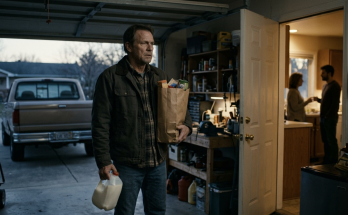
The house smells like smoke and something sweeter now, a faint trace of the cinnamon chips Elena had baked that morning when the storm still felt like a rumor. Snow continues to lace the windows, but inside there is a soft, exhausted warmth that wasn’t there before—worn blankets, a kettle that has been boiled and boiled again, the quiet assurance of people who have been through something hard and come out the other side. I sit on the edge of a sofa someone reclaimed from a curb and watch Tyler move through the kitchen with an awkward ease, carrying a tray of mugs as if he has always known how to balance them. He looks older. The tension that previously hardened his jaw has thinned into lines that say survival and regret together.
Tyler meets my eyes and for a moment the room is only us. There is no background noise—no conversation being forced, no attempt to patch what’s broken with platitudes. He sets the tray down between us and when he speaks, his voice is small but steady. “I was wrong,” he says, two words that bruise with honesty. He doesn’t make excuses for the past; instead he lists it in the barest terms: the calls he ignored, the cut-off texts, the cold goodbye that felt more like a slam than a closure. His confession is not theatrical. It is simple and painful, like a hand rinsed in cold water.
I’ve rehearsed what I would say to him for years—some of those rehearsals were bitter, some were tender—but none of them prepared me for this actual, trembling apology. I find myself surprised at how everything I thought I would need to prove—my worth, my love, my right to be here—falls away when he meets me without armor. “You came,” he says, and there is no triumphant accusation in it. Just a factual astonishment that reads like gratitude. There are many ways to be thankful, I want to tell him. I choose to begin with silence instead.
Chloe drifts in from the hallway, her cheeks flushed from the temporary exertion of brushing off snow from the porch. She carries a sleeping bag like a small concession of ceremony and offers a quick smile that carries fatigue and relief in equal measures. Her children nap in a room that smells faintly of baby shampoo and baby powder, and every now and then a muffled giggle bubbles through the house like a promise. The storm has left them bruised but intact, and that fact alone has rearranged the priorities in everyone’s minds.
We talk about small things at first: the broken generator that stubbornly refused to start until Ray showed up with a coil of wire and undaunted patience, the neighbors who shoveled paths like a line of tiny rescue workers, the way the lantern light made the living room look like a scene from a memory. We laugh a few times, brittle but genuine. Elena refills her cup and watches us with a softness that almost aches; she had been the unseen architect of this fragile peace, the one who listened to me rage and then told me to go anyway. She had known what it would take to break the ice—more than logic, more than timing: presence.
After the laughter dies down, Tyler speaks again. This time he names specifics—small cruelties and bigger omissions. He remembers the birthday I missed when a work call became a wedge, the time I didn’t answer because of pride, the holidays I spent measuring absence instead of reaching across a table. He admits how easy it was to let the quiet become default, to mistreat silence as a refuge instead of a wound. There is shame threaded through his voice, but so is a kind of lightness: accountability feels strangely freeing once you let it be real.
When he says “I’m sorry” in a way that is meant to be received, I hear beyond the formal apology to the accumulation of small acts that had hollowed us out. I think of the winters I spent waiting by a phone that didn’t ring, of the nights I dreamt of reconciliation and woke to old habits. Forgiveness does not arrive all at once. It arrives in increments: a shared story, a returned smile, a hand hesitantly offered, a meal shared without agendas. Tyler looks at me as if asking permission to begin that slow, steady reconstruction.
I choose to answer with truth rather than rivalry. I tell him about my hurt as plainly as he told me his, about how his shutting the door felt like a verdict I had no chance to contest. My voice does not tremble with accusation; it holds a steady, sad rhythm. “I’m hurt,” I say. “I feel like I lost you, the way someone loses a house in a storm—sudden, disorienting, full of paperwork and smoke afterward.” Saying it aloud softens it. Saying it aloud creates an opening for him to understand the contour of my pain, and he leans into that outline with humility.
He reaches for my hands before I can fully withdraw them, his palms warm and callused in a way that somehow reassures me. We sit like that, breathing in and out, the storm muffled beyond the house walls. Outside, wind combs through the trees like a restless animal, but inside there is a growing steadiness. Tyler tells me about the fear that had replaced his anger—how helplessness had taken the shape of stubbornness, how his pride had convinced him that distance was the same as self-protection. He confesses he had been protecting himself from the hurt of potentially being rejected, not realizing that his rejection of me was the harm he feared most.
Forgiveness follows a very human architecture: it needs apology, but it also needs witness. Elena becomes that witness—her presence a quiet bridge—while Ray sends periodic messages that read like supply-chain updates from a kindly general: the roads will be clear by evening, an extra bottle of fuel is on its way. His texts thread the day in a way that reminds us we are not isolated; there are people outside ourselves who choose to keep watch. That knowledge hums beneath the surface of the conversation, a practical faith that steadies us.
Tyler confesses a memory I had not known: during one of the most estranged months, he had looked at his phone and debated calling me, then put it down because he couldn’t bear the thought of being told he was wrong. He says now that such small refusals compounded into a wall he couldn’t see his way over. The admission makes my chest ache—not with triumph, but with compassion. I had imagined him imagining me as a villain, but the truth was simpler: we had both been frightened and clumsy with each other.
We do not perform reconciliation like a set-piece, where gestures are grand and music swells. Instead, it happens in a cluster of small, honest motions: Tyler offers to make coffee tomorrow, a normal domestic promise that is also a vow. He asks about the scar on my knuckle from the summer I fell while chasing a runaway dog; he remembers the name of my favorite tree outside my old house. These are tiny salvations, proof that someone has been paying attention. Each one knits something invisible back together.
Chloe listens from the doorway, hands on her hips like someone balancing a new weight. She had known me only in fragments and rumors, tangled up with her son’s reticence. Watching her watch us, I realize she is part of the repair too. In the quiet between sentences, she steps forward and admits that she, too, had misread our history as permanent. She apologizes for having doubted that reconciliation could be possible and for the way she may have made me feel excluded when I most needed inclusion. Her admission widens the circle of accountability, and the room grows uncomfortably bright with honesty.
We talk then of future holidays as if we are architects planning a small, careful building—rooms defined, expectations clarified, boundaries respected. Tyler says he still needs time sometimes; that he will likely falter, but he wants to try. I tell him I will hold him in my human frailty, that I cannot promise perfection but I can promise presence. Elena nods approvingly, the kind of nod that says the promise between us is not naive; it is deliberate and tested by hardship. We agree to let restoration be gradual, not immediate glamour.
At one point, the children pad in, rubbing sleep from their eyes, the youngest with a chocolate smudge on his cheek. They climb into laps and offer drawings done with crayons in the storm’s temporary calm—lopsided suns, houses with hearts in the windows—and there is a tenderness in how even such small acts of creativity reframe the day. The children do not know about grudges; they know only that warmth and care exist and that when adults stop fighting, they can go back to pretending the world is safe. Their presence is a balm that we hadn’t realized we were waiting for.
Ray arrives at the back of the afternoon with a bag of food and stories about the absurdities of city life in a storm. His laughter fills gaps that words of remorse cannot reach. He brings news that the main roads will be passable by nightfall, a fact that takes the immediate edge off our shared worry. His practical kindness is a reminder that heroism has many forms: some of it is dramatic and some of it is simply bringing extra batteries to an anxious house. He offers no moral judgment; only steady support, which feels like grace.
Later, as dusk softens into an uneasy twilight, Tyler pulls me aside into the back porch where a lantern casts a warm glow that makes our faces look kinder than they feel. He says, haltingly, that witnessing what I did—coming despite his explicit rejection—made him notice the thinness of his own choices. I don’t know if he sees the courage I used or the compulsion that drove me—sometimes love is stubborn and ugly—but he understands, finally, that the world needs repair and that sometimes repairs start with showing up.
He tells me he is not proud of the way he had let his hurt turn into coldness. He admits the fear he felt when the generator sputtered and died, how helplessness triggered rage that he then misdirected at people he loved. There is a humility in his admission I have not seen before. It is not performative sorrow; it is a measured recognition of the consequences of his behavior, and it makes room for trust where there once was only suspicion.
Forgiveness coils slowly, but it is not one-sided. I do not want to be absolved of my own errors by his apology; I want to be invited into a relationship that will be different precisely because we both carry the memory of what went wrong. I tell him I forgive him, but I also tell him I hope we both carry the lessons forward with tenderness. He nods as if he understands that forgiveness is not erasing; it is learning to live with the past as a guide rather than a chain.
Our conversation drifts toward the future in plain, domestic terms: a promise to text every few days, an agreement that if either of us needs space, we will say so without assaulting the other with silence. We sketch out a tentative plan for holiday arrangements that prioritizes being together without demanding that every moment be perfect. This is the core of our reconciliation—not fireworks, but a compromise: being present and being kind, even when kindness is inconvenient.
As evening ripples across the windows, the family gathers around the table, a motley yet comforting assembly. The meal is humble: soup thick with vegetables, bread torn rather than cut, laughter that feels like a soft expulsion of air after a long held breath. Between mouthfuls we trade small, ordinary stories—the kind that do not try to fix, but gently confirm each other’s existence. The children create an impromptu game that involves silly faces and choreographed silliness, and for a few uncomplicated minutes we all join in. It feels like a small miracle.
At the end of the night, when the youngest is tucked in and the quiet stretches long, Tyler sits with me for a long time on the porch. Snow glitters under the streetlamp like powdered glass. He tells me he has been reading about forgiveness and resilience, as if seeking language that can contain what he now feels. He says, softly, that bravery is not only in grand gestures but in the quieter work of making amends. He thanks me again, and I tell him that acknowledging my selfish wants and my mistakes was also part of my bravery. We are honest in our mutual exposure, and that transparency becomes the foundation of something steady.
Before I leave the next morning, the sun doing its slow, persistent work of melting the worst of the drifts, Tyler hugs me with a careful intensity. It is not a dramatic embrace, but it is long enough that I know his arms are sincere. He whispers that he will try—he will call, he will show up, he will not let fear of rejection harden him again. I tell him I will be there, but I will not be a background echo who waits on the periphery of his life. We find a middle path in our exchange: closeness that honors autonomy and care that does not suffocate.
When I walk back to my car, Ray appears with a thermos and a grin like a benediction. He tells me the roads are clearer than the morning, and there are neighbors in the neighborhood bundling up to begin the slow work of shoveling piles of winter into normalcy. Elena squeezes my hand and says nothing at first; her silence in that moment speaks volumes. She had been my anchor through the storm, a witness who never demanded the shape of my gratitude. Her calm has been a lesson without being preachy: steadfastness matters.
I drive away with snow sliding in ribboned sheets off the hood and a warmth nested behind my sternum that I had almost forgotten how to feel. The day is not perfect, and neither are we. But there is a path that winds forward, bordered by fences that once felt like obstacles and now look more like supports. I think of the children laughing at the table, their drawings of houses with hearts in the windows, and the image steadies me like a promise: family, when tended with humility and grit, can heal.
The End
Read more original stories on Feel Every Story.