After Maria Luisa disappeared, I stopped measuring time properly. At first I counted days because counting gave me something to do. Seven days. Eleven. Seventeen. A month. Then the numbers began to feel meaningless. Morning still arrived. Customers still wanted breakfast. Rice still had to be washed. Bills still appeared. But underneath every ordinary task ran the same question: where was my daughter?
I kept the restaurant open.
Closing it would have felt too much like admitting she might never return.
Every morning I unlocked the front door and listened to the bell above it. Every evening I wiped the tables she had chosen. Her handwriting remained on labels in the kitchen. A small burn mark near the stove came from the week we opened. Her old apron hung from its hook.
Customers asked about her.
“She’ll be back,” I said.
I repeated it until the sentence became less prediction than ritual.
The letters came irregularly.
Sometimes three weeks passed.
Sometimes longer.
Always money.
Always a few words.
I’m fine.
Please take care of yourself.
Don’t worry.
I no longer believed any of them.
The money accumulated untouched.
I began storing every envelope, transfer receipt, and note in a metal box beneath my bed. If Maria Luisa returned, I intended to show her exactly what her absence had purchased: nothing.
One evening I took out the first message she had sent twelve years earlier.
The language was almost identical.
That realization changed something in me.
Maria Luisa had developed a vocabulary for captivity.
Short reassurance. No details. No dates. Nothing that could be questioned.
I wondered whether she had chosen those words because they were safe, or because someone else had taught them to her.
Either possibility made me furious.
Neighbors occasionally tried to comfort me without knowing what had happened.
“Your daughter is successful.”
“She sends you so much.”
“You must be proud.”
I learned to smile.
People often mistake financial support for love because money is visible. They cannot see the empty chair at dinner.
At night I sometimes imagined flying to Korea again.
But where would I go?
The old house was sold. The little wooden place had been part of the assets we sacrificed. Kang Jun had released her from his agreement. The people who had taken her back had no address I knew.
I considered contacting Kang Jun.
For days, pride stopped me.
Then fear won.
I found an old number and called.
An assistant answered.
I gave my name.
The line went quiet.
Kang Jun came on several minutes later.
“Theresa.”
“You know where she is.”
No greeting.
No courtesy.
He paused.
“I know she left the Philippines.”
“With whom?”
“I cannot discuss that.”
“You can.”
“I cannot.”
“You spent twelve years controlling my daughter. Do not pretend rules suddenly matter to you.”
His breathing changed slightly.
“I released Maria Luisa.”
“And somebody else took her.”
“She went voluntarily.”
I gripped the phone.
“That does not make it voluntary.”
Another pause.
“What do they want from her?”
“I don’t know the current terms.”
“Current terms.”
I hated the phrase.
“You know who they are.”
“Yes.”
“Then help me.”
“I cannot.”
“Cannot or will not?”
This silence lasted longer.
“Both.”
I almost hung up.
Then Kang Jun said, “If she returned, she did it because she believed it would protect something.”
“Me.”
“Possibly.”
“What else?”
He did not answer.
“Kang Jun.”
“When Maria Luisa decides she is responsible for someone, she becomes difficult to persuade otherwise.”
“You know that well.”
“Yes.”
For the first time, his voice carried something that sounded like regret.
I asked, “Did you ever care about her?”
“That question is irrelevant.”
“No. It is the only question that matters now.”
He exhaled.
“I cared enough to honor the end of our agreement.”
“That is a very small definition of care.”
“Perhaps.”
The call ended without giving me an address.
But he had given me one useful thing.
Maria Luisa believed her return protected something.
Most likely me.
That meant the pressure had not merely been about unfinished business. They had made her believe refusing them would endanger the life she had rebuilt—or the mother standing beside her.
I became angrier than I had ever been.
Not at her.
At the fact that after twelve years of sacrifice, they still knew exactly which part of her to use.
The restaurant became my anchor.
I learned tasks Maria Luisa had always handled. I burned food. Miscounted inventory. Ordered too much rice one week and not enough the next. Regular customers tolerated me.
One afternoon, the tricycle driver who had been our first customer returned.
“Where’s your daughter?”
“Away.”
“When is she coming back?”
“Soon.”
He nodded toward the kitchen. “Her soup is better.”
“I know.”
He smiled. “Tell her.”
“I will.”
After he left, I cried for the first time in weeks.
Not dramatically.
I simply stood over the sink with water running across my hands while tears fell.
Then I dried my face and reopened the door.
Months passed.
Maria Luisa’s letters became less frequent.
The last one contained no money.
Only four words.
Almost finished. Trust me, Ma.
I read them until the paper softened along the fold.
Almost finished.
I wanted to believe her.
But I had heard versions of that promise for twelve years.
Christmas approached.
The restaurant acquired cheap decorations because customers expected them. I hung a string of lights around the window. One section blinked when it should have remained steady.
I left it.
On Christmas Eve, I cooked Maria Luisa’s favorite stew.
I told myself it was for customers.
It was not.
At closing time, one bowl remained.
I placed it at the table by the window.
Steam rose from the surface.
Twelve years earlier, I had done the same thing at home.
I sat opposite the empty chair.
“You are ridiculous,” I told myself aloud.
The empty chair offered no disagreement.
The next morning I opened early.
No miracle occurred.
No daughter appeared.
Life continued.
Weeks later, on an ordinary afternoon, I was in the kitchen preparing onions when the bell above the front door rang.
“I’ll be with you in a moment,” I called.
No answer.
I wiped my hands on my apron.
When I stepped through the kitchen doorway, the knife nearly slipped from my fingers.
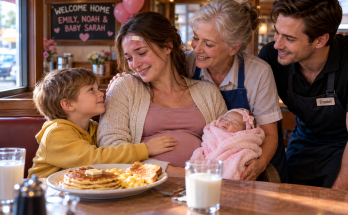
Maria Luisa stood inside the restaurant.
Simple blouse.
Dark trousers.
Flat shoes.
No makeup.
One small bag beside her.
For several seconds, I could not move.
Neither could she.
“Ma.”
The knife clattered onto the counter.
I crossed the room.
My knees weakened before I reached her, but she caught me.
I held her face between both hands.
She was thinner.
There were shadows beneath her eyes.
But something else had changed.
The constant alertness was gone.
“You’re here.”
“I’m here.”
“Are you staying?”
Her mouth trembled.
“Yes.”
I pulled her against me.
This time she cried.
So did I.
We remained near the door until the bell above us moved softly from the air disturbed by our embrace.
Eventually we sat.
I wanted to ask a hundred questions.
Where had she been?
Who had taken her?
What had she done?
Had anyone hurt her?
Why had she sent money again?
Why had she stopped?
Instead I asked, “Have you eaten?”
She laughed through her tears.
“No.”
“Good.”
“Good?”
“I know how to solve that problem.”
I reheated rice and stew.
She ate slowly.
Halfway through the bowl, she closed her eyes.
“Still good?” I asked.
“Better.”
“You are biased.”
“I’ve earned the right.”
Afterward we sat by the window.
I waited.
She knew I was waiting.
“I went back,” she said.
“I know.”
“I needed them to define what they claimed I owed.”
“And did they?”
“Eventually.”
“What was it?”
She looked at her hands.
“Appearances. Confidentiality. Work attached to old arrangements. Things that had been left deliberately unclear.”
“So they could keep calling you back.”
“Yes.”
Anger tightened my throat.
“Why did you agree?”
“Because they had started asking about you.”
I had expected that answer.
It still hurt.
“They knew the restaurant. They knew where you lived. Nothing happened, but they wanted me to understand that they could keep reaching into my life.”
“You should have told me.”
“And watched you challenge them with a soup ladle?”
“If necessary.”
She smiled.
Then her expression became serious.
“I couldn’t spend the rest of my life waiting for the next envelope.”
“So you returned.”
“I told them I would fulfill every legitimate remaining obligation if they documented it and gave me a final release.”
“Did they?”
“Not at first.”
“What changed?”
“I stopped being afraid of losing their approval.”
I studied her.
“They never had your approval.”
“No. But for twelve years they trained me to believe their displeasure was dangerous.”
She looked toward the kitchen.
“Eventually I realized I was still behaving as if they owned the rules.”
“What did you do?”
“I made them use their own rules.”
She had insisted on documentation. Dates. Defined responsibilities. Written completion. No vague extensions. No new obligations added through verbal instructions.
“They hated that.”
“I imagine.”
“Kang Jun helped.”
That surprised me.
“He told me he couldn’t.”
“He told you that because openly helping me would have created problems. Quietly, he gave me the names of people who could confirm which obligations were real and which ones were invented.”
I sat back.
“So he cared after all.”
Maria Luisa considered that.
“In the only way he knows how, perhaps.”
“What happened when you finished?”
“They signed the release.”
“Everything?”
“Everything.”
“You have it?”
She reached into her bag.
A folder appeared.
Of course.
I laughed.
“What?”
“I never want to see another folder as long as I live.”
She laughed too.
Then she pushed it toward me.
I did not open it.
“Tell me.”
“There is nothing left.”
“No hidden arrangement?”
“No.”
“No mysterious man?”
“No.”
“No extra two years?”
“No.”
“No money to repay?”
“No.”
I watched her face carefully.
“Are you free?”
She did not answer immediately.
That frightened me.
Then she smiled.
Not the polished smile from the video calls.
Not the careful smile she had worn beside Kang Jun.
Not even the fragile smile from the first months of the restaurant.
This one arrived slowly and reached her eyes.
“I think I finally know what that word means.”
The following morning, Maria Luisa tied on her apron.
I objected.
“You just returned.”
“I work here.”
“You should rest.”
“I rested on the plane.”
“That does not count.”
“It counts if I say it does.”
I pointed at her.
“There. That attitude. You have definitely recovered.”
She laughed.
Our first customer arrived twenty minutes later.
Maria Luisa went to take his order.
I watched from the kitchen.
Nothing remarkable happened.
That was what made it remarkable.
She did not check the door when a car slowed outside.
She did not study the customer’s clothes.
She did not stiffen when the phone rang.
She simply worked.
The tricycle driver came in at noon.
He recognized her immediately.
“You’re back.”
“I am.”
He ordered the soup.
When he finished, he pointed his spoon toward me.
“Yours is better than your mother’s.”
“I heard that,” I called.
Maria Luisa laughed so hard she had to lean against the counter.
The restaurant never became grand.
We did not become rich again.
Much of the money Maria Luisa had earned disappeared when we bought her freedom from the first contract. More vanished during the final settlement of everything attached to that world.
People occasionally asked whether she regretted losing so much.
They meant money.
Maria Luisa understood the question differently.
“No,” she always said.
Sometimes I still catch myself watching her.
I do it when she is chopping vegetables, carrying plates, arguing with suppliers, or sitting near the doorway after closing.
I look because twelve years trained me to expect absence.
She notices.
“Ma.”
“What?”
“You’re staring again.”
“I am allowed.”
“It’s strange.”
“I am your mother. Strange behavior is included.”
She shakes her head.
Then she returns to whatever she was doing.
The first Christmas after her final return, we closed the restaurant early.
I cooked too much food.
Habit.
Maria Luisa set the table.
When she reached for two plates, I stopped her.
“Wait.”
She looked at me.
For years I had placed an extra setting for the daughter who never arrived.
Now she was standing three feet away.
I took the third plate from the cupboard anyway.
“Who is that for?”
“No one.”
“Then why put it out?”
I smiled.
“To remind myself that empty chairs are only chairs.”
She stared at me for a moment.
Then she understood.
We ate until neither of us could move comfortably.
Later, Maria Luisa carried the unused plate back to the kitchen.
No tears.
No waiting.
No promise about next year.
She was already home.
Before bed, I passed the metal box where I had kept her letters and transfer records.
I opened it.
Twelve years of money, messages, fear, and carefully chosen lies stared back at me.
I took out the final note she had sent before returning.
Almost finished. Trust me, Ma.
For once, the promise had been true.
Maria Luisa appeared in the doorway.
“What are you doing?”
“Remembering.”
“That sounds dangerous.”
“At my age, it is unavoidable.”
She sat beside me.
We looked through a few of the old messages together.
After a while she picked up the earliest one.
“I hated writing these.”
“I hated receiving them.”
“I thought the money would make you feel safe.”
“It did.”
She glanced at me.
“And miserable.”
“Yes.”
“Sorry.”
I folded the letter.
“Don’t apologize for surviving.”
She leaned her head against my shoulder.
Outside, somebody set off an early firecracker. Maria Luisa jumped at the sound.
Then she laughed at herself.
I felt her body relax again.
That small movement told me more about freedom than any signed release ever could.
Freedom had not erased what happened.
It had not restored twelve lost years or returned the money we spent escaping. It did not make Maria Luisa twenty-one again, and it did not turn me into the mother who had known enough to protect her before she left.
It simply gave us tomorrow without someone else owning it.
For us, that was enough.
Click Here to continue read next: PART5: Freedom Became Ordinary Until One Customer Left a Photograph on Our Table That Connected Maria Luisa’s Past to Someone We Both Trusted
For Twelve Christmases My Daughter Sent Money Instead of Coming Home, Until I Finally Followed the Address She Had Given Me
Part 4 of 16