The first Christmas after the final appeal was denied began with Maria Luisa shouting at me about garlic.
“You used too much.”
“There is no such thing.”
“There absolutely is.”
“People like garlic.”
“People also like being able to taste other ingredients.”
I waved her away from the stove.
“This is my kitchen today.”
“It is literally my restaurant.”
“Today it is my kitchen.”
She opened her mouth.
Then closed it.
“Fine.”
Victory.
Outside, morning sunlight warmed the front windows. We had closed the restaurant to customers for Christmas Day, but the room would not remain empty.
Elena and Sofia were coming.
Ana had traveled from Cebu with her brother.
Two women from the small assistance fund had nowhere they wanted to be for the holiday, so Maria Luisa invited them too.
Min-jae had sent a card from Canada.
No mystery.
No coded message.
Just a card.
I appreciated that.
The restaurant smelled of roasted meat, rice, garlic—an appropriate amount, despite Maria Luisa’s complaints—and the sweet dessert she had started preparing before sunrise.
I watched her move around the kitchen.
She was thirty-seven now.
That startled me sometimes.
In my mind, several versions of my daughter existed at once.
The stubborn child repairing a sandal.
The twenty-one-year-old at the airport promising to come home soon.
The polished woman on video calls saying she was happy.
The frightened woman standing inside the Korean house asking why I had arrived without warning.
The restaurant owner complaining about onions.
All of them were Maria Luisa.
None cancelled the others.
“Stop staring.”
“I am not.”
“You are.”
“I’m supervising.”
“You’re holding a spoon.”
“A supervisory spoon.”
She laughed.
That sound still had the power to make me grateful.
Not because she had once stopped laughing entirely.
Because now she laughed without checking whether anyone approved.
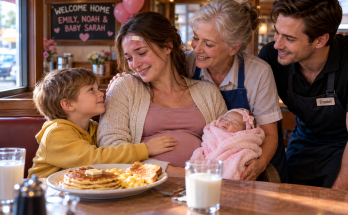
Sofia and Elena arrived first.
They were arguing about dessert.
“You bought enough for twenty people,” Elena complained.
“We might become hungry.”
“There are eight of us.”
“Nine.”
“Who is nine?”
Sofia pointed at me.
“She eats for two.”
I liked her more every year.
Ana arrived later.
Her brother carried a pot and looked slightly terrified by the number of women issuing instructions.
“Where do I put this?”
“Kitchen,” four of us answered.
He obeyed.
The two younger women from the fund came quietly.
One had recently returned from an overseas job where an employer withheld her passport.
The other had escaped a private domestic arrangement that had not yet become a criminal case.
Maria Luisa did not ask them to discuss it.
At our table, nobody owed anyone a testimony.
That mattered.
Lunch became noisy.
Food passed in every direction.
Sofia complained that Maria Luisa’s soup had changed.
“It’s better.”
“Different.”
“Better.”
“Your mother’s garlic destroyed your judgment.”
I pointed my fork at Sofia.
“Careful.”
She grinned.
At one point I counted chairs.
Not empty ones.
Occupied ones.
That difference nearly made me cry.
I did not.
I had food in my mouth.
There are limits to sentiment.
After lunch, people drifted into smaller conversations.
Ana showed Elena photographs from Cebu.
Sofia argued with Maria Luisa over coffee.
The younger women helped clear dishes until I ordered them to sit down.
“You are guests.”
“We can help.”
“No.”
Maria Luisa called from the kitchen, “Do not argue with her. It gets worse.”
“Traitor.”
“Experienced daughter.”
Later, when the restaurant quieted, Maria Luisa and I sat near the window.
For years, Christmas had been the axis around which our separation turned.
The annual transfer.
The promise of next year.
The empty chair.
Now sunlight fell across dirty plates and half-finished drinks.
Nothing looked elegant.
It was perfect.
Maria Luisa placed an envelope in front of me.
I stared.
“No.”
She laughed.
“Open it.”
“No money.”
“It isn’t money.”
“You have trained me to distrust Christmas envelopes.”
“Fair.”
I opened it.
Inside was a plane ticket.
I looked at her.
“Korea?”
“No.”
“Good.”
“Japan.”
I blinked.
“What?”
“You always said you wanted to see cherry blossoms.”
“That was twenty years ago.”
“You stopped wanting to?”
“I stopped imagining I would go.”
“Different problem.”
I looked at the ticket again.
Two passengers.
Her name.
Mine.
“You’re coming?”
“Obviously.”
“Why?”
She stared at me as if the question were ridiculous.
“Because I want to.”
Those four words nearly undid me.
Not because she needed to.
Not because a contract required it.
Not because money depended on it.
Because she wanted to.
“When?”
“Spring.”
“The restaurant?”
“Closed for a week.”
“You cannot close for a week.”
“I own it.”
“Customers will complain.”
“They will survive.”
I smiled.
She had said the same thing about Sundays years earlier.
“Fine.”
“Fine?”
“I will permit it.”
“You will permit my vacation?”
“I am your mother.”
“That continues not to mean what you think.”
We sat quietly.
Eventually I asked the question I had avoided since the trials ended.
“Do you regret going?”
Maria Luisa knew exactly what I meant.
Korea.
Kang Jun.
The agreement.
Fourteen years shaped by one decision at twenty-one.
She did not answer quickly.
“I regret what happened.”
“That is not the question.”
“I know.”
She looked through the window.
“If I say I regret going, then I start imagining another life.”
“Would that be bad?”
“No.”
She thought.
“But I don’t know that woman.”
“What woman?”
“The Maria Luisa who stayed.”
She traced one finger along the edge of the table.
“Maybe she married someone. Maybe she had children. Maybe she struggled with money. Maybe she became happy. Maybe she resented me because I couldn’t afford your treatment.”
I listened.
“I can’t live inside that imaginary life.”
“So?”
“I regret the choices people made against me. I regret the choices I made because I was afraid. I regret lying to you.”
She looked at me.
“But I don’t regret surviving long enough to come home.”
I reached across the table.
“That answer will do.”
She squeezed my hand.
The compensation money lasted.
Not because Maria Luisa hoarded it.
Because she finally understood that money did not need to justify suffering.
Some went into savings.
Some supported the fund.
Some repaired the restaurant roof.
Some bought our Japan tickets.
Ordinary uses.
No moral meaning attached.
That was important.
For years, every peso had needed to prove the lost time was worthwhile.
Now money could simply be money.
Kang Jun served his sentence.
I knew because the case occasionally appeared in the news.
Maria Luisa stopped reading the articles.
Once, years later, she learned through Min-jae that Kang Jun had been released.
She nodded.
That was all.
“Nothing?” I asked.
“What am I supposed to feel?”
“I don’t know.”
“Neither do I.”
She continued chopping vegetables.
He did not contact her.
She did not contact him.
Their story ended not with forgiveness or revenge, but with distance.
That seemed more truthful.
Chairman Park remained imprisoned.
Several companies connected to his network collapsed or changed ownership.
Lawsuits continued.
Other investigations began.
Some women received settlements.
Some wanted criminal prosecutions.
Some wanted anonymity.
Some refused to speak at all.
Maria Luisa stopped believing one ending could serve everyone.
Her own ending belonged to her.
The assistance fund eventually hired a lawyer and a social worker.
Maria Luisa resisted becoming its director.
“I already have a job.”
“You run a restaurant,” Sofia said.
“Exactly.”
“You also answer calls at midnight.”
“That is not a job.”
“That is precisely a job.”
Eventually Maria Luisa agreed to sit on the board.
She refused the title of founder because several women had built it together.
I told her titles were free and she should collect them.
She ignored me.
Our trip to Japan happened in spring.
Maria Luisa had timed it carefully.
The cherry blossoms, naturally, bloomed earlier than predicted.
By the time we arrived in one city, half had already fallen.
I complained.
“You cannot complain to trees,” Maria Luisa said.
“I can complain about anything.”
“That is true.”
We found another park where blossoms remained.
I stood beneath them while petals moved in the wind.
Maria Luisa took a photograph.
“Don’t post that.”
“I wasn’t going to.”
“I look old.”
“You are old.”
I stared at her.
She ran.
I chased her for approximately eight steps before remembering my age.
We laughed until strangers looked at us.
That evening, in a small hotel room, I realized something.
For twelve years, every trip involving Maria Luisa had belonged to someone else.
Business.
Obligation.
Appearance.
Contract.
Even my first journey to Korea had been a rescue mission I did not yet understand.
Japan was useless.
That was its beauty.
Nobody needed us there.
Nothing had to be solved.
We were simply wasting time together.
I had never understood how precious wasted time could be.
Years continued.
The restaurant changed slowly.
The cardboard beneath the rocking table was eventually replaced by an actual repair.
I objected.
“That cardboard had history.”
“It had mold.”
“History often does.”
Maria Luisa threw it away.
The grease stain near the stove remained.
The handwritten menu was finally replaced when sauce spilled across it beyond recovery.
Maria Luisa mourned it for ten minutes.
Customers came and went.
Some knew her story.
Most did not.
She preferred the ones who complained about portion sizes.
They treated her normally.
On one Christmas morning, several years after everything ended, I woke before Maria Luisa.
Age had reversed our schedules.
I walked into the restaurant alone.
The tables waited in the pale morning light.
I began setting places for our family meal.
One.
Two.
Three.
More.
I stopped with a plate in my hand.
For years I had feared empty chairs.
Then I had used one as a symbol.
Now I understood the chair had never mattered.
Waiting had.
The worst part of those twelve years was not that Maria Luisa lived far away.
It was that I never knew when distance would end.
I never knew whether “soon” meant months, years, or never.
Now I knew.
She would walk through the kitchen door in approximately ten minutes and criticize something.
I smiled.
Nine minutes later, she appeared.
“You put the forks on the wrong side.”
There it was.
“People can still eat.”
“That is not the point.”
“You have become controlling.”
She stared at me.
I immediately regretted the word.
Then she laughed.
A full, helpless laugh.
“Ma.”
“What?”
“That was terrible.”
“I know.”
“You’re lucky I love you.”
“I have built my entire retirement around that fact.”
She rearranged the forks.
I watched her.
Thirty-nine.
Then forty.
Then older.
Time was moving again.
For years, I had thought the twelve missing years were a hole in our lives.
They were not.
A hole is empty.
Those years were crowded with things I had not known about: fear, compromises, small rebellions, friendships, Ana, Kang Jun, lies, money, meals eaten alone, nights Maria Luisa wanted to call me and did not.
We could not erase them.
We could only stop allowing them to own every year afterward.
Before everyone arrived, Maria Luisa handed me another envelope.
I groaned.
“Again?”
“Open it.”
“If this is money—”
“It isn’t.”
Inside was a single sheet of paper.
No ticket.
No bank statement.
No legal document.
At the top she had written:
Christmas Plan.
I laughed.
“What is this?”
“Read.”
Breakfast at home.
Restaurant closed.
Lunch with everyone.
No phones unless urgent.
Walk after dinner if Ma stops complaining about her knees.
I looked up.
“That last part is offensive.”
“Keep reading.”
At the bottom was one final line.
Next Christmas: same place, unless we choose somewhere else.
I read it twice.
No promise made under pressure.
No “soon.”
No money instead of presence.
No obligation beyond what we freely chose.
I folded the page.
“You forgot something.”
“What?”
I found a pen.
Beside her final line, I wrote:
Too much garlic.
Maria Luisa stared.
“You are impossible.”
“You inherited it.”
She took the pen and added:
Still coming next year.
I looked at those words.
For twelve years, I would have traded every transfer for them.
Now they cost nothing.
That afternoon, every chair around the table was occupied.
Sofia told a story too loudly.
Elena corrected details.
Ana’s brother brought too much food.
Someone spilled a drink.
Maria Luisa disappeared into the kitchen and returned carrying another dish nobody needed.
I complained that there was no room.
She made room.
That was what she had become good at.
Not enduring.
Not obeying.
Making room.
For work she chose.
For people she loved.
For anger that no longer frightened her.
For memories that did not control the present.
For joy that did not need to compensate for pain.
Late that evening, after everyone left, Maria Luisa and I cleaned the restaurant.
I found the handwritten Christmas plan beneath a plate.
“Keep this?” I asked.
She shrugged.
“If you want.”
Once I would have stored it carefully beside transfer receipts and letters, afraid that paper was the only proof of what existed between us.
Instead I pinned it to the refrigerator.
The following morning, it acquired a sauce stain.
A week later, someone wrote a grocery reminder on the back.
Eventually it disappeared.
I did not mind.
Some things do not need preserving because they are no longer in danger of vanishing.
The next Christmas came.
So did Maria Luisa.
And the one after that.
She did not send one hundred thousand dollars.
She brought food.
She brought complaints.
She brought herself.
Years earlier, I had crossed an ocean because I believed I was going to surprise my wealthy married daughter.
Instead I opened a door and discovered how little I knew about the life behind it.
I found money hidden upstairs.
A contract.
A daughter who had spent twelve years purchasing my comfort with pieces of her freedom.
Later we found worse things.
The system behind the contract.
Sofia.
Ana.
Chairman Park.
The recruitment files.
The forged agreements.
The Christmas payments designed to keep Maria Luisa obedient.
And finally the handwritten sentence proving that the people controlling her had understood the simplest truth about her before I did.
I was the reason she stayed.
For a long time, I hated that sentence.
Eventually I learned to read it differently.
They understood that Maria Luisa loved me.
What they never understood was that love could stop functioning as a chain once the truth reached both ends of it.
When I discovered what was happening, I did not want her money.
I wanted her home.
When she finally understood that, the calculation holding her began to fail.
Not immediately.
Not cleanly.
But permanently.
One evening, long after the court cases stopped appearing in newspapers, I found Maria Luisa locking the restaurant.
“Ready?” she asked.
“For what?”
“To go home.”
I looked through the windows at the empty tables.
“Which home?”
She gave me an impatient look.
“Ours.”
Such an ordinary answer.
I followed her outside.
She locked the door.
No one waited in a black car.
No phone ordered her somewhere else.
No contract determined tomorrow morning.
She put the key into her bag and took my arm because the pavement was uneven.
We walked slowly.
Not because anyone had told us where to go.
Because we had nowhere else we needed to be.
The End
Read more original stories on Feel Every Story.
For Twelve Christmases My Daughter Sent Money Instead of Coming Home, Until I Finally Followed the Address She Had Given Me
Part 16 of 16