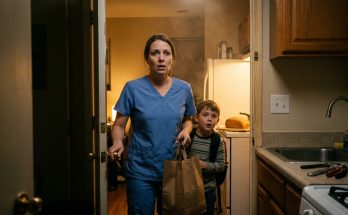
The winter storm arrived faster than forecast.
By late afternoon, snow covered the courtyard.
At six, the wind intensified.
At seven-twelve, power failed.
Everything went dark.
Liam shouted from his room:
“Seriously?”
Emergency lights came on in the hall.
Marcus was already moving.
“Building panel.”
I grabbed his coat.
“You’re not going outside without this.”
“I’m going downstairs.”
“Still cold.”
He put it on.
Liam appeared with a flashlight.
Marcus stared.
“That’s mine.”
“You have nine.”
“Eight.”
“Exactly.”
I checked my phone.
Utility outage map loaded slowly.
Multiple blocks affected.
Estimated restoration unknown.
“Not building-specific.”
“Good.”
Marcus called Elena.
She was already on her way.
I stopped him.
“Roads.”
“She lives four blocks.”
“Still.”
He called again.
“Told her walk only if safe.”
Progress.
The building had emergency lighting.
No generator.
Heat depended partly on electric circulation equipment even though the boilers were gas.
That became the concern.
“How long before apartments get cold?”
“Hours.”
“How many?”
“Depends outside temperature.”
Outside was brutal.
Marcus checked boiler controls.
No circulation.
Power needed.
We had procedures.
Portable battery lights.
Resident contact tree.
Emergency warming plan.
The plan had seemed excessive when Marcus wrote it.
Now it existed.
We posted updates.
Called elderly residents.
Checked medical needs.
One tenant used an oxygen concentrator with battery backup.
We helped arrange transfer to her daughter’s powered neighborhood before the battery became urgent.
No heroics.
Planning.
Mrs. Patel refused to leave.
“I have blankets.”
Marcus said, “If temperature drops below threshold, you go.”
“Who decides threshold?”
“Me.”
“You are not my father.”
“Very thankful.”
By nine, indoor temperatures began falling slowly.
The utility estimated restoration sometime after midnight.
Then the estimate disappeared.
Bad sign.
Liam wore two sweatshirts.
“This is kind of fun.”
“Do not say that near adults paying heating bills,” I told him.
The community room on the ground floor retained heat better.
We consolidated residents who wanted warmer space.
Blankets.
Battery lanterns.
Board games.
Hot water from gas burners only under controlled kitchen supervision.
Marcus banned candles.
One tenant complained.
He did not negotiate.
“Open flame during outage, no.”
“You’re controlling.”
“Yes.”
I smiled.
He saw me.
“What?”
“You’ve evolved.”
“Safety is allowed to be controlling.”
Fair.
At ten-thirty, someone knocked on the lobby door.
A man.
Maybe sixty.
Thin coat.
Snow on his shoulders.
Marcus saw him through the glass.
Everything in the room changed for him.
I felt it.
He did not freeze.
He approached the locked door.
Opened it partly.
“Can I help?”
The man pointed toward the street.
“My car died.”
“Anyone else inside?”
“My wife.”
“Where?”
“End of block.”
Marcus opened the door fully.
“Bring her in.”
No hesitation.
Not because of homelessness.
Because of immediate conditions and available safe space.
The man hurried away.
Five minutes later, he returned with a woman wrapped in a blanket.
She used a cane.
Marcus gave them chairs near the interior wall.
Water.
No interrogation.
Then asked practical questions.
Phone charged?
Tow service?
Medical needs?
Destination?
Their phones had low battery.
The building had power banks.
We lent one.
Liam watched.
I saw the memory too.
Grocery store.
Cold stranger.
Different roles.
The woman said, “We don’t live here.”
“That’s okay,” Marcus replied.
“Can we stay until the tow comes?”
“Yes.”
The answer was simple.
No couch.
No private apartment.
No uncontrolled risk.
A staffed common room with neighbors present.
Systems.
Help had evolved.
At eleven, another knock.
Two delivery drivers stranded after their van slid near the intersection.
Marcus let them into the vestibule while checking conditions.
Soon the community room contained residents plus four temporary guests.
Mrs. Patel announced we were running a hotel.
I said she could handle reception.
She approved.
Then temperatures dropped faster.
Marcus checked indoor readings.
“Two degrees in an hour.”
“Bad?”
“Not yet.”
Elena arrived covered in snow and furious.
“You said only if safe.”
“It was safe when I left.”
“You walked in this?”
“I have boots.”
Marcus gave up.
She checked mechanical systems.
No safe way to operate circulating pumps without proper power.
Someone suggested a portable generator.
Marcus refused indoor use immediately.
Outside connection required safe transfer equipment we did not have.
“No improvised generator hookups.”
Elena nodded.
“Correct.”
A tenant said, “Could run extension cords through the basement.”
“No.”
Marcus and Elena together.
Conversation over.
At midnight, the stranded couple’s tow truck still had not arrived.
They called their daughter.
Roads prevented pickup.
We offered the vacant studio used for emergencies.
The husband resisted.
“We don’t want to take someone’s apartment.”
“It’s vacant.”
“How much?”
“Nothing tonight.”
He shook his head.
“No charity.”
Marcus smiled faintly.
“I know the feeling.”
The man looked at him.
Marcus did not tell the story.
He said:
“Call it storm shelter.”
The couple accepted.
We gave them clean sheets.
Privacy.
A lock.
Choice.
The delivery drivers chose to remain in the community room until roads improved.
At one-fifteen, the power returned.
Lights snapped on.
Everyone cheered.
Marcus did not.
He immediately checked systems.
Boiler pumps restarted.
No alarms.
No burst pipes.
Emergency lights began recharging.
Only then did he smile.
Liam shouted:
“Now can we celebrate?”
“Yes.”
Mrs. Patel demanded coffee.
At one-thirty in the morning.
Apparently emergencies removed normal beverage rules.
The stranded couple slept in the studio anyway.
Roads remained poor.
In the morning, we ate pancakes in the community room.
Marcus cooked.
Liam supervised.
The husband from the car watched him.
“You do this for everyone?”
“Pancakes?”
“Letting people in.”
Marcus flipped one.
“No.”
The man looked surprised.
Marcus continued.
“We had space, people here, safe conditions, and a storm.”
“Still.”
He nodded toward the building.
“You own this place?”
“Partly.”
“How’d that happen?”
Marcus looked at me.
I smiled.
“Long story.”
The man laughed.
When the couple left, he tried to give Marcus fifty dollars.
Marcus refused.
The man insisted.
Marcus suggested donating it to the neighborhood warming center instead.
He agreed.
Liam watched.
“Why didn’t you take it for building costs?”
Marcus stared.
“Future landlord.”
“Money is money.”
“True.”
“Then?”
Marcus thought.
“Because they weren’t tenants receiving a service.”
“They slept here.”
“Still.”
Liam frowned.
Marcus added, “Not every exchange needs to become debt.”
That sentence surprised even him.
I saw it.
The old accounting.
Couch for repairs.
Food for labor.
Help for repayment.
He had spent years learning some things could remain gifts.
The storm created no major property damage.
One exterior pipe froze but did not burst.
Two light fixtures failed.
A section of gutter loosened.
Elena handled most repairs.
Marcus documented.
He did not climb a ladder.
I noticed.
Said nothing.
Later, he told me:
“I wanted to.”
“I know.”
“Then I remembered ten years from now.”
The doctor’s question.
Preserve what the knee could do later.
Good.
A week after the storm, a handwritten envelope arrived.
From the couple.
Their names were Samuel and Ruth Delaney.
Inside was a thank-you card.
And a receipt.
Fifty-dollar donation to the warming center.
Marcus placed it on the refrigerator.
Liam said it belonged in history.
Marcus said not everything belonged in the drawer.
Liam argued that refrigerators were temporary history.
Nobody won.
Then the city contacted Marcus.
Senior inspector position.
Formal promotion.
Not training.
Actual role.
He read the email twice.
“What?”
He handed it to me.
Salary increase.
Mentoring responsibilities.
Complex assignments.
Less field volume.
More review.
“Take it.”
“You didn’t ask what I want.”
I smiled.
“What do you want?”
He smiled back.
“I want it.”
“Then take it.”
He did.
His first week as senior inspector, Aaron submitted a report with a serious concern.
Possible structural movement in a small commercial building.
Evidence uncertain.
Business owner insisted it was old settlement.
Aaron asked Marcus:
“What if I’m overreacting?”
Marcus told me later.
“What did you say?”
“That uncertainty isn’t a reason to hide an observation.”
“Sounds familiar.”
“I told him document what he sees, call structural expertise, don’t diagnose outside scope.”
“And?”
“He did.”
The engineer found no immediate danger.
Minor long-term settlement.
No evacuation.
No crisis.
Aaron apologized for wasting everyone’s time.
Marcus stopped him.
“You didn’t waste time.”
“The building was fine.”
“You verified.”
“What if I keep calling experts for nothing?”
“You improve judgment.”
Aaron looked unconvinced.
Marcus said:
“Being cautious is not the same as being afraid. Learn the difference.”
When Marcus repeated that line at home, I looked at him.
“What?”
“You know.”
He nodded.
Years compressed.
Platform.
Boiler.
Elevator.
Fire exit.
Now mentoring someone through uncertainty.
No grand closure.
Skills passed forward.
At the building, finances finally reached a comfortable place.
Not rich.
Healthy.
Roof replaced.
Reserves restored.
Insurance stable.
Seller-financing balance reduced.
Henderson called after receiving an annual statement required by the financing arrangement.
“You’re paying too fast.”
Marcus laughed.
“You complain when we pay.”
“I planned interest income.”
“Tragic.”
“You people are terrible investments.”
“Thank you.”
Henderson visited that summer.
Grandchildren with him.
He introduced them to everyone as if he still owned the place.
Mrs. Patel corrected him.
Repeatedly.
His granddaughter asked why the management office contained an ancient notebook.
Marcus explained Walter.
Henderson pretended not to care.
Then, when nobody watched, touched the cover gently.
I saw.
Did not mention it.
Liam turned thirteen.
Teenager.
Everything became difficult on principle.
He wanted more independence.
Later curfew.
Phone privacy.
Less supervision.
Marcus navigated cautiously.
He refused to become authoritarian stepfather.
He also refused to become permissive friend.
They fought.
Over homework.
Over chores.
Over Liam leaving his bicycle in the stairwell.
That argument became legendary.
“It blocks egress,” Marcus said.
“It’s one bike.”
“It is still in the path.”
“Nobody uses that corner.”
“Emergencies do not schedule around corners.”
“You turn everything into code.”
“You turn everything into clutter.”
I intervened before international sanctions.
Liam moved the bicycle.
Then slammed his door.
Marcus looked wounded.
“Welcome to parenting,” I said.
“I hate it.”
“Good.”
“Why does everyone say good when things are terrible?”
“Tradition.”
An hour later, Liam came out.
Not apology.
“Can I keep it in the maintenance cage?”
Marcus considered.
“With designated spot.”
“Fine.”
“Not blocking access.”
“Fine.”
“Lock it.”
“Fine.”
Solution.
Relationship survived.
That night, Marcus said:
“He hates me.”
“No.”
“He does.”
“He hates the bicycle rule.”
“Same face.”
“Teenagers have limited faces.”
Marcus laughed.
Then became quiet.
“What?”
“Nothing.”
“The face.”
“I’m happy he’s angry.”
“That is alarming.”
“Because he expects me to still be here afterward.”
I understood.
Liam no longer tested whether Marcus would disappear.
He assumed continuity strongly enough to risk anger.
That was trust too.
Years had done what promises could not.
Repeated evidence.
One November evening, we drove past the grocery store.
Not intentionally.
Traffic detour.
Marcus looked toward the brick wall.
Empty.
Snow beginning.
Liam noticed.
He was old enough now to understand more.
“That’s really where you were?”
“Yes.”
“All night?”
“Not that night.”
“How many nights were you outside?”
Marcus answered.
More than Liam knew.
Liam stared through the window.
“Why didn’t you tell Rebecca?”
“Bad decisions.”
“You were dumb.”
“Yes.”
“You could’ve died.”
“Yes.”
I looked at Marcus.
He did not minimize.
Did not dramatize.
Liam asked:
“Do you think Mom should’ve brought you home?”
Marcus smiled faintly.
“We’ve had this conversation.”
“I’m older.”
“Okay.”
He thought.
“I think your mom made a generous choice that worked out well.”
“That’s politician language.”
Marcus laughed.
“But?”
“But I still wouldn’t tell someone they should copy it.”
“Even if they meet somebody like you?”
“They don’t know they met somebody like me.”
Liam nodded slowly.
“What would you do now?”
Marcus looked at the warming-center sign posted near the grocery-store entrance.
City program.
Night transportation number.
Resources.
“I’d start there.”
“Then maybe help more?”
“If safe and wanted.”
Liam looked satisfied.
The question had matured with him.
So had the answer.
We drove home.
Unit 418 lights warm.
Courtyard repaired.
Roof new.
Pumpkin visible in the 401 window, considerably fatter than when found.
Life did not feel like rescue anymore.
It felt established.
Then, just before Christmas, Marcus received a letter from the hospital network.
Not legal.
Not insurance.
A request.
They were developing a maintenance-safety training program.
Someone had recommended Marcus as an external participant.
He stared at the page.
“No.”
I waited.
“You don’t want to?”
“No idea.”
The invitation asked him to speak about reporting culture, escalation, and near-miss documentation.
Not his settlement.
Not blame.
Safety systems.
Marcus sat.
“They want me back.”
“Not back to work.”
“I know.”
“Back into the building?”
“Yes.”
The hospital.
The place connected to the accident.
His old maintenance corridors.
People who might remember him.
Gavin no longer worked there.
Marcus knew that.
Still.
“What do you want?”
He laughed once.
“That question again.”
“Yes.”
He looked at the invitation.
“I think I want to go.”
“Then?”
“I’m scared.”
“Both can be true.”
He smiled.
“Your favorite theft.”
“When?”
“January.”
He folded the letter.
Not into the yellow legal folder.
That folder was archived.
He placed this one on his desk.
Current work.
Current choice.
Not evidence of injury.
An invitation.
He looked at me.
“I might say no later.”
“You can.”
“I might leave when I get there.”
“You can.”
“I might be fine.”
“You can do that too.”
He smiled.
“Disturbing range of possibilities.”
“Life.”
He nodded.
Then walked to Liam’s room.
Knocked.
Waited.
“Yeah?”
Marcus opened the door.
“Hospital invited me to speak.”
Liam looked up from his laptop.
“The accident hospital?”
“Yes.”
“You going?”
“Probably.”
Liam thought.
Then said:
“Don’t fix everything.”
Marcus stared.
Family branding.
It had spread.
He laughed.
“I’ll try.”
Click here to continue reading: PART 28: Marcus Returned to the Place Where His Old Life Broke, Then Came Home to the Family Built From Choices No One Could Have Planned
The Stranger Outside the Grocery Store Had Stopped Asking for Help Long Before My Son Refused to Walk Past Him
Part 27 of 28