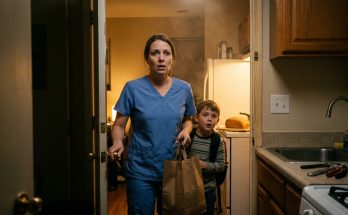
I drove home too quickly.
Not recklessly.
Close enough that I noticed.
Marcus was waiting in the leasing office when I arrived.
Henderson sat behind his desk.
Between them lay a yellowed inspection form.
“Show me.”
Marcus slid it across.
At the top was the name of a hospital-affiliated property management contractor.
Below it:
SITE SAFETY WALKTHROUGH.
Our apartment complex address appeared beneath.
I read it twice.
Then the inspector line.
Marcus Hale.
“That’s your signature?”
Marcus nodded.
“It looks like it.”
“You don’t remember?”
“No.”
Henderson leaned back.
“It was six years ago.”
“I remember most sites.”
I looked at Marcus.
“You inspected apartment buildings?”
“Sometimes.”
“I thought you worked at the hospital.”
“I did.”
He pointed at the contractor name.
“The hospital network owned several outpatient properties. Maintenance occasionally helped affiliated facilities.”
“This building was affiliated?”
Henderson shook his head.
“Not when I bought it.”
“When did you buy it?”
“Five years ago.”
Marcus stared at the report.
“So whoever owned it before you used the same property contractor.”
“Apparently.”
I read the findings.
Loose stair railing.
Exterior lighting failure.
Improper dryer vent maintenance.
Door-closer issues.
My skin prickled.
“These are the same problems.”
Marcus nodded.
“Some of them.”
“Six years ago?”
“Not necessarily the same components.”
Henderson said, “Building’s old.”
Marcus looked at him.
“That isn’t the point.”
“What is?”
Marcus pulled the report closer.
“Look at the recommendations.”
Each issue had a disposition.
Repair ordered.
Contractor notified.
Follow-up required.
At the bottom was another signature.
Not Marcus’s.
A supervisor.
The name meant nothing to me.
It meant something to Marcus.
His face changed.
“Who is that?” I asked.
He did not answer immediately.
“Marcus?”
“Gavin Reed.”
“Who?”
“My supervisor.”
“The one at the hospital?”
“Yes.”
I looked at the paper.
“Was he involved in your elevator case?”
Marcus stared at the signature.
“Yes.”
“How?”
“He was the person who said I failed to follow the platform safety procedure.”
The room became very still.
Henderson leaned forward.
“Same guy?”
Marcus nodded.
I felt the pieces moving before I understood the picture.
“What does an apartment inspection six years ago have to do with your accident?”
“Probably nothing.”
“Probably?”
Marcus rubbed his jaw.
“Gavin signed hundreds of reports.”
“But?”
“But he told investigators he didn’t remember receiving my warning about the freight platform.”
I thought of the maintenance report in the yellow folder.
Marcus’s signature.
Four days before the accident.
“You said the hospital claimed there was no formal warning.”
“Yes.”
“And Gavin supported that.”
“Yes.”
Henderson pointed at the old report.
“So what?”
Marcus looked at him.
“So this shows how our reporting system worked.”
I still did not understand.
Marcus explained.
“Technicians inspected. We documented. Supervisor signed disposition. That signature meant the supervisor received the report.”
I looked down.
“And your freight-platform warning?”
“Same process.”
“Did Gavin sign it?”
Marcus’s eyes met mine.
“That’s the problem.”
“What problem?”
“The copy the insurer produced doesn’t show the disposition page.”
I remembered the stacks.
The folded documents.
The yellow folder.
“Could it be missing?”
“Yes.”
“Could there have been another page?”
“Yes.”
Marcus was already reaching for his phone.
He called Daniel.
The conversation lasted twelve minutes.
By the end, Daniel wanted a copy of the old building inspection.
Henderson agreed.
“Why does he care?” I asked after Marcus hung up.
“Because it may help establish routine procedure.”
“That your supervisor normally signed reports.”
“Yes.”
“Does that prove he signed the platform warning?”
“No.”
Marcus was careful.
“It proves nothing about that specific report by itself.”
“Then what do you need?”
“The missing disposition page.”
“Where would it be?”
“Hospital archives. Contractor records. Maybe nowhere.”
Henderson snorted.
“Six-year-old paperwork survived in my storage room.”
Marcus looked at the report.
“Exactly.”
That afternoon, Daniel filed a request for the complete maintenance-report packet connected to Marcus’s platform warning.
The insurer objected.
Then Daniel pushed again.
The old apartment report was not dramatic evidence.
It did not prove fraud.
It did not prove anyone had deliberately hidden anything.
But it established something concrete.
The reporting process included supervisor disposition.
Marcus’s accident report packet appeared incomplete.
That was enough to ask why.
Meanwhile, Marcus started his new job for Henderson.
He hated the clipboard.
“I have become bureaucracy.”
“You’re wearing a tool belt.”
“Symbolic resistance.”
He inspected every common area.
Created a repair schedule.
Numbered work orders.
Placed urgent items in red.
Routine items in blue.
Henderson complained about the cost.
Marcus told him neglect cost more.
They repeated that argument almost daily.
Tenants loved the system.
Mrs. Patel called Marcus “the superintendent.”
He corrected her every time.
Liam called him “Boss Marcus.”
Marcus threatened to assign him maintenance duties.
Liam requested wages.
I watched the job change him.
Not physically.
His knee still swelled.
Stairs still hurt.
Some mornings, cold weather made his gait stiff.
But he no longer measured his worth by how much weight he could carry.
He directed contractors.
Explained problems.
Inspected completed work.
He knew when somebody was padding an estimate.
Henderson discovered this after a plumbing contractor quoted twelve hundred dollars for a repair Marcus estimated at four hundred.
The final bill was four hundred and eighty.
Henderson became almost affectionate.
“Best money I never wanted to spend,” he said.
Marcus looked offended.
“I’m putting that on a business card.”
My rent improved too.
With the disputed charges reduced and another paycheck deposited, I made a payment large enough that Henderson gave me a receipt without mentioning eviction.
I stood outside his office afterward and stared at the remaining balance.
Marcus found me.
“What?”
“Nothing.”
“You have the expression.”
“What expression?”
“The one you get when numbers are attacking.”
I handed him the receipt.
He read it.
“You’re close.”
“I know.”
“How close?”
“One more paycheck.”
He smiled.
“One more.”
It should have felt triumphant.
Instead, I suddenly wanted to cry.
Marcus noticed.
“Hey.”
“I’m fine.”
He raised an eyebrow.
“Apparently we’ve learned nothing.”
I laughed through it.
“I’m tired.”
“That I believe.”
“I’ve been afraid of that pink notice for months.”
“It’s just paper.”
“It didn’t feel like paper.”
“No.”
He understood.
“It felt like a door closing.”
I looked at him.
“You would make everything about doors.”
“Occupational hazard.”
A week later, Daniel called.
Marcus was in my kitchen when it happened.
He put the phone on speaker.
Daniel sounded cautious.
“We received supplemental records.”
Marcus gripped the edge of the table.
“The disposition page?”
“Yes.”
My pulse jumped.
“What does it say?” Marcus asked.
Daniel paused.
“The platform report was escalated.”
Marcus closed his eyes.
“To Gavin?”
“Yes.”
“Did he sign it?”
“No.”
Marcus opened his eyes.
Confusion replaced hope.
“Then what?”
“There’s a notation.”
“What notation?”
“Inspection received. Equipment restriction pending supervisor review.”
Marcus stared at the phone.
“That means the platform should have been restricted.”
“That is our argument.”
“Who wrote it?”
“Initials only.”
“Whose?”
“We’re checking.”
I asked, “Does this help?”
Daniel answered carefully.
“It helps establish that the warning entered the formal process. The insurer’s prior position was that there was no documented recommendation affecting operation.”
Marcus’s voice hardened.
“So they had this.”
“We don’t yet know who had what or when.”
Daniel would not speculate.
He explained that the document had come from an archived contractor production, not directly from the hospital’s original packet.
The distinction mattered.
Marcus understood immediately.
“So the hospital produced an incomplete copy.”
“It appears their earlier production did not include this page.”
“Accident?”
“We don’t know.”
Marcus looked toward the window.
Daniel continued.
“I’m requesting metadata and retention records.”
“When?”
“Immediately.”
After the call, Marcus paced.
Three steps.
Turn.
Three steps.
Turn.
His brace clicked softly.
“You’re going to wear a trench in my floor.”
“They said I ignored procedure.”
“I know.”
“They said I operated equipment without reporting the problem.”
“I know.”
“I reported it.”
“You knew that.”
“That isn’t the same as seeing proof.”
He stopped.
“I started wondering.”
“About what?”
“Whether I remembered it wrong.”
My chest tightened.
Marcus looked down.
“After the accident, there were medications. Surgery. Lawyers asking the same questions twenty ways. Gavin said I hadn’t submitted the right form.”
“But you had.”
“I thought I had.”
He tapped his temple.
“Then everybody keeps telling you something didn’t happen, and eventually you start checking your own memory.”
I understood more than I wanted to.
Documents could do that.
Authority could do that.
Enough repetition could make a person doubt an event they had lived through.
“Now you have the page.”
“Part of it.”
“You have more than yesterday.”
He nodded.
“More than yesterday.”
The insurer did not restore the temporary payments immediately.
Daniel warned us not to expect miracles.
But the new evidence changed the dispute.
A hearing was scheduled.
Marcus’s surgeon would provide testimony.
The physical therapist’s records were accepted.
Henderson’s work logs were included.
So was my statement.
Marcus prepared obsessively.
He reread every page.
Rebecca called nightly.
Sometimes she talked about the case.
Sometimes she deliberately did not.
She sent photographs of her children.
Marcus began calling them.
His nephew, Ethan, discovered Marcus knew how to repair bicycles and immediately started sending him pictures of a broken derailleur.
His niece, Sophie, wanted to know why Uncle Marcus had disappeared for three years.
Rebecca apparently answered that one before handing over the phone.
“Kids are brutal,” Marcus told me.
“I live with one.”
Liam looked up from cereal.
“I can hear you.”
“Evidence.”
The night before the hearing, Marcus sat at my kitchen table.
The yellow folder was open.
His new work clipboard lay beside it.
Two versions of the same man.
The one fighting to prove he had been injured.
The one learning how to work around the injury.
“You nervous?” I asked.
“Yes.”
Progress again.
“What are you afraid of?”
“That they believe the doctor.”
“Anything else?”
“That I get angry.”
“Then don’t.”
“Excellent legal strategy.”
“You’re welcome.”
He smiled.
Then the smile faded.
“I’m afraid they’ll ask why I kept working for Henderson if I’m as limited as I say.”
“What will you tell them?”
“The truth.”
“Which is?”
“That I can work.”
He looked at his brace.
“I just can’t do the job the way I did before.”
“That seems important.”
“It is.”
The next morning, I took time off.
Marcus protested.
I ignored him.
We reached the hearing room twenty minutes early.
Daniel met us outside.
He carried a thick binder.
“Something happened last night,” he said.
Marcus stopped.
“What?”
Daniel opened the binder.
“The contractor responded to our records request.”
He removed a page.
Not a photocopy.
A scanned email printout.
The date was four days before Marcus’s accident.
The sender was Marcus.
The recipient was Gavin Reed.
The subject concerned the freight platform.
Marcus stared.
“I sent that.”
Daniel nodded.
Below Marcus’s message was a reply.
One sentence.
Gavin Reed had acknowledged the report and instructed that the issue would be reviewed after the scheduled maintenance cycle.
Marcus read it.
Then again.
His hands began shaking.
I looked at Daniel.
“What does this mean?”
“It means Gavin received the warning.”
Marcus’s face went pale.
“He testified he never saw it.”
Daniel closed the binder.
“Yes.”
The hearing-room door opened.
A clerk called Marcus’s name.
Daniel gathered the papers.
Marcus did not move.
I touched his arm.
“Marcus.”
He looked at me.
For months, he had been fighting to prove what happened after the platform failed.
Now, at last, the evidence was beginning to show what had happened before it.
Daniel stepped toward the doorway.
“We need to go.”
Marcus looked at the email one final time.
Then he stood.
“Okay.”
He picked up the yellow folder.
And walked into the hearing.
Click here to continue reading: PART 9: The Hearing Began With Questions About Marcus’s Knee, but One Email Forced Everyone to Confront a Different Kind of Injury
The Stranger Outside the Grocery Store Had Stopped Asking for Help Long Before My Son Refused to Walk Past Him
Part 8 of 28