Marcus stayed for dinner.
By the time we sat down, he had also installed the deadbolt, adjusted the strike plate, tightened the loose handle on the kitchen drawer, and informed me that the smoke detector outside Liam’s bedroom was old enough to qualify for retirement.
“You came here to replace one lock,” I said.
Marcus spooned rice onto his plate. “I encountered complications.”
“You opened a drawer.”
“It nearly came off in my hand.”
“It has done that for two years.”
“That is not a defense.”
Across the table, Liam nodded gravely. “He’s right.”
“You are enjoying this arrangement too much.”
“I like having someone who knows stuff.”
“I know things.”
“You know paperwork.”
Marcus looked down at his plate, but I caught the smile.
“Eat your broccoli,” I told Liam.
“That doesn’t prove you know things.”
“It proves I know where your video-game controller is.”
Liam immediately ate the broccoli.
Marcus pointed his fork at me. “Effective management.”
“Years of training.”
It had become disturbingly easy to have him at our table.
That thought came with more discomfort than I wanted to admit. Marcus had his own room now. He had begun working regular maintenance hours for Henderson. His compensation case had finally moved. The emergency that had justified his presence in our apartment was over.
Yet Saturday dinner had become expected.
Liam certainly expected it.
Apparently, so did I.
Marcus noticed me watching him.
“What?”
“Nothing.”
“That expression is never nothing.”
“I was thinking you look less exhausted.”
He considered that.
“Sleeping in a bed helps.”
“How’s the room?”
“Small.”
“So is this apartment.”
“My room is smaller than your kitchen.”
“That seems impossible.”
“There’s architectural evidence.”
Liam asked, “Do you have a TV?”
“No.”
“Then what do you do?”
“Read.”
Liam stared at him with pity.
Marcus added, “Sometimes I stare at the wall.”
“That’s worse.”
“It’s a very interesting wall.”
After dinner, Liam carried his science model into the living room, leaving Marcus and me with the dishes.
Marcus washed.
I dried.
That division had emerged without discussion.
“You got another letter?” I asked.
He glanced at me.
“How do you know?”
“You checked your phone six times during dinner.”
“Seven.”
“So?”
“My attorney says the insurer wants an independent medical examination.”
“Is that normal?”
“Normal enough.”
“But?”
Marcus rinsed a plate.
“But their doctor gets to decide how disabled I am.”
“That sounds reassuring.”
“Exactly.”
I set the plate in the cabinet.
“Can they stop your payments?”
“They can try.”
The old fear returned to his face so quickly that I understood how fragile his improvement still was.
A room did not mean security.
A check did not mean the next check would arrive.
“What does your attorney say?”
“That the evidence is better now. The prior reports matter. My surgeon’s records matter.”
“And you?”
“I say insurance companies don’t send people to doctors because they’re hoping to discover they owe more money.”
I leaned against the counter.
“When?”
“Wednesday.”
“You need a ride?”
“No.”
“You hesitated.”
“I have physical therapy before it.”
“That wasn’t an answer.”
“I can take the bus.”
“Marcus.”
He turned off the faucet.
“Chloe, you don’t have to rearrange your life every time something happens in mine.”
“I’m not.”
“You offered before I even asked.”
“You didn’t ask.”
“Exactly.”
The words landed harder than he intended.
I folded the dish towel.
“Fine.”
He immediately looked regretful.
“I didn’t mean—”
“I said fine.”
“That means the opposite when you say it.”
“Congratulations. You know another thing.”
He dried his hands.
“I’m trying to learn how to handle my own life again.”
“I understand.”
“I know you do.”
“No, you think I’m trying to rescue you.”
“Aren’t you?”
That irritated me because there was enough truth in it to sting.
Before I could answer, Liam appeared carrying the science model.
“The river leaks.”
Marcus crouched beside him.
“Where?”
“Here.”
A thin line of blue-tinted water escaped from one corner of the plastic channel.
Marcus examined it.
“Seal failed.”
“Can you fix it?”
“I can show you how.”
Liam handed him the tape.
Marcus gave it back.
“You do it.”
“But you’re better.”
“That’s why I’m teaching you.”
Liam frowned but sat cross-legged on the floor.
Marcus showed him where to dry the plastic, how to fold the tape around the corner, and why pressing harder did not necessarily make adhesive stick better.
I watched from the kitchen.
Marcus never took the project away from him.
When Liam made the first strip crooked, Marcus did not correct it.
He simply asked whether water could still reach the gap.
Liam studied his work.
Then peeled the tape back himself.
Something in my chest tightened.
Liam’s father had always done things for him when he was around.
Tie the shoe because Liam was slow.
Finish the model because Liam was making a mess.
Carry the backpack because they were late.
Marcus did the opposite.
He waited.
It was a small difference.
It felt enormous.
An hour later, Liam went to bed.
Marcus collected his coat.
I followed him toward the door.
“You’re still mad.”
“I’m not.”
“Chloe.”
“I’m thinking.”
“That’s usually more dangerous.”
I leaned against the wall.
“You said you were trying to handle your own life.”
“Yes.”
“So why didn’t you call your sister?”
His face changed immediately.
I regretted asking.
“You don’t have to answer.”
“No.”
He looked toward the floor.
“You’re right to ask.”
“I’m not entitled to know.”
“That hasn’t stopped Liam.”
“He’s nine.”
“Good excuse.”
Marcus sat on the arm of the couch.
For a while, he said nothing.
“My sister’s name is Rebecca.”
I waited.
“She’s four years younger. Married. Two kids.”
“Arizona?”
“Phoenix.”
“Does she know what happened?”
“She knows about the accident.”
“Does she know you were homeless?”
Marcus rubbed his thumb across his palm.
“Not exactly.”
“Meaning no.”
“Meaning she probably guessed things were bad.”
“Did she offer help?”
“Yes.”
That surprised me.
“And?”
“I refused.”
“Why?”
He gave me a tired smile.
“Pride would be the simple answer.”
“And the complicated one?”
“Our mother got sick.”
I stayed quiet.
“Cancer. Pancreatic.”
“I’m sorry.”
“It went fast.”
His eyes fixed on something beyond me.
“Rebecca wanted Mom to move to Arizona. Mom refused. She’d lived here forty years. Her doctors were here. Her house was here.”
“So you took care of her.”
“Mostly.”
“Rebecca couldn’t come?”
“She came.”
There was something defensive in his tone.
“Three times. She had kids. A job. A husband whose mother was sick too. It wasn’t simple.”
“But you resented her.”
“Yes.”
He did not soften it.
“I told myself I didn’t. Then Mom died.”
The apartment had become very quiet.
“I handled the funeral. The house. Bills. Everything.”
“And Rebecca?”
“She wanted some of Mom’s things.”
“What things?”
“Photo albums. Jewelry. A quilt our grandmother made.”
“That sounds normal.”
“It was.”
Marcus looked down.
“I didn’t act normal.”
I understood before he explained.
“You blamed her.”
“For leaving me with everything.”
“Did she?”
“No.”
The answer came painfully.
“Not really.”
He rubbed his face.
“She did what she could. I was angry at Mom for dying. Angry at doctors. Angry at myself for being relieved when it was over.”
His voice lowered.
“So I picked somebody safer to be angry at.”
“Rebecca.”
He nodded.
“We had a fight in Mom’s kitchen. I said things.”
“What things?”
“Things you don’t get to pretend weren’t said.”
I knew that category.
Everyone did.
“What did she say?”
“That I wanted everyone to owe me because then I never had to admit I needed anyone.”
The sentence remained between us.
Marcus gave a humorless laugh.
“She knew me pretty well.”
“And then?”
“We stopped talking.”
“How long ago?”
“Almost three years.”
“You haven’t spoken since?”
“Once.”
“When?”
“After the accident.”
“Did she call?”
“Yes.”
“What happened?”
“I told her I was fine.”
I stared at him.
“You were in a hospital after falling with an elevator platform.”
“Technically, I was alive.”
“That is your definition of fine?”
“It was that day.”
“And she believed you?”
“No.”
“What did she do?”
“She offered to fly out.”
“And you refused.”
“Yes.”
“She offered money.”
“Yes.”
“You refused.”
“Yes.”
“A place to stay?”
His silence answered.
I exhaled.
“You are unbelievably stubborn.”
“I’m aware.”
“No. I don’t think you are.”
He stood.
“I should go.”
“Because I’m right?”
“Because it’s late.”
“Marcus.”
His hand rested on the new deadbolt.
I looked at that hand.
The man had spent weeks repairing broken things for everyone around him.
Doors.
Railings.
Cabinets.
Science projects.
He could look at a damaged hinge and identify exactly where the stress was being carried.
People were harder.
“You don’t have to call her tonight,” I said.
“I know.”
“But maybe stop telling yourself she abandoned you.”
He did not answer.
“Especially if you’re the one who kept closing the door.”
His jaw tightened.
For a moment, I thought I had gone too far.
Then he nodded.
“Good night, Chloe.”
“Good night.”
He left.
Wednesday morning, I received a text at work.
It was from Marcus.
Need a favor.
I stared at those three words longer than necessary.
Marcus asking for help was rare enough to feel significant.
I typed back.
What?
His reply came immediately.
Ride to medical exam if offer still stands.
I smiled.
Yes.
Then another message appeared.
Also possibly advice.
That was even stranger.
On what?
The typing indicator appeared.
Vanished.
Appeared again.
Finally:
I called Rebecca.
I sat back in my chair.
My coworker Denise looked over the partition.
“What happened?”
“Nothing.”
“You’re smiling at your phone.”
“I am not.”
“You absolutely are.”
I ignored her.
I typed:
How did it go?
Marcus answered:
Badly.
A second message followed.
Then better.
Then:
She’s coming Friday.
I stared at the screen.
Friday.
Rebecca.
The sister he had not properly spoken to in almost three years.
I typed:
Are you okay with that?
His answer took longer.
No idea.
At 12:15, I picked Marcus up for the medical examination.
He climbed into the passenger seat wearing a clean button-down shirt and carrying his yellow folder.
“You look nervous.”
“I’m delighted.”
“Obviously.”
He fastened the seat belt.
“What did Rebecca say?”
Marcus stared through the windshield.
“First she thought I was calling because somebody died.”
“That’s cheerful.”
“Then she started crying.”
My teasing vanished.
“And you?”
“I asked her not to.”
“That probably helped.”
“It did not.”
“What did you tell her?”
“Enough.”
“About being homeless?”
“Yes.”
“How did she react?”
“She got angry.”
“At you?”
“Very.”
“Fair.”
“Thank you.”
“She’s coming Friday?”
“Flight lands at four.”
“Where is she staying?”
“Hotel.”
“Does Liam know?”
“No.”
“Why would Liam know?”
“Because Liam somehow knows everything.”
“That’s true.”
At the medical office, Marcus asked me to wait in the car.
I did.
Forty minutes passed.
Then sixty.
At ninety, I began worrying.
He finally emerged after nearly two hours.
His face told me the appointment had gone badly.
“What happened?”
Marcus opened the door and sat.
He did not fasten the seat belt.
“The doctor thinks I can work.”
“You are working.”
“Full duty.”
I stared at him.
“Doing what?”
“Maintenance.”
“With that knee?”
“He says I have functional capacity.”
“Did he watch you walk?”
“Yes.”
“Did he examine you?”
“Yes.”
“And?”
Marcus stared at the yellow folder on his lap.
“He says the brace is partly precautionary.”
“Your knee collapsed three blocks from my apartment.”
“I know.”
“He knows about the surgeries?”
“Yes.”
“The nerve damage?”
“Yes.”
I gripped the steering wheel.
“What happens now?”
“My attorney challenges the report.”
“Can they stop your checks?”
“Possibly.”
There it was again.
The floor shifting beneath him.
Marcus finally buckled his seat belt.
“Drive.”
“Where?”
“Home.”
His room.
Three blocks from mine.
His own place.
I started the car.
Halfway there, his phone rang.
He looked at the screen.
“Rebecca.”
“Answer.”
He hesitated.
Then did.
“Hey.”
I kept my eyes on the road.
His sister’s voice was too faint for me to understand.
Marcus listened.
“Friday is fine.”
Pause.
“No, you don’t need to change it.”
Another pause.
His face tightened.
“I said I’m okay.”
Whatever Rebecca said next made him close his eyes.
“I know.”
Silence.
Then, quietly:
“I know I said that before.”
He listened.
When he finally spoke again, his voice was different.
Smaller.
“Just come Friday.”
He ended the call.
Neither of us spoke for the remaining blocks.
At his building, Marcus reached for the door handle.
“Chloe.”
“Yeah?”
“If the checks stop, I can still pay my room for another month.”
“That’s good.”
“And Henderson said there’s more work.”
“Also good.”
He nodded.
“I’m not going backward.”
It sounded less like information than an instruction he was giving himself.
I looked at him.
“No.”
He waited.
I added, “But if you do slip, you know where the couch is.”
Marcus smiled faintly.
“Behind the terrible lock?”
“Not anymore.”
He climbed out.
Before shutting the door, he bent down.
“Friday might be ugly.”
“Families usually are.”
“You volunteering to be present?”
“No.”
“Good.”
I smiled.
“I’m sure Liam will volunteer both of us.”
Marcus groaned.
Then he closed the door.
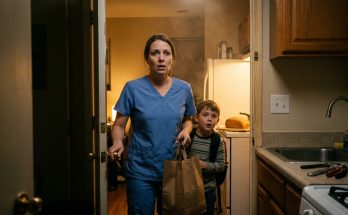
Friday afternoon, Liam and I were carrying groceries upstairs when we saw Marcus standing outside our apartment.
Beside him stood a woman with a suitcase.
She was perhaps thirty-seven, with dark hair pulled tightly behind her head and eyes so much like Marcus’s that I knew who she was before anyone spoke.
Marcus looked exhausted.
Rebecca looked furious.
Neither seemed to know what to do next.
Liam whispered, “Who’s that?”
Rebecca heard him.
Her gaze moved from Liam to me.
Then back to her brother.
“You didn’t tell me,” she said quietly, “that somebody took you in.”
Marcus looked at me.
“No,” he said.
“I didn’t.”
Click here to continue reading: PART 6: Rebecca Arrived Ready to Blame Her Brother’s Pride, but One Question from Liam Exposed the Grief Neither Sibling Had Ever Settled
The Stranger Outside the Grocery Store Had Stopped Asking for Help Long Before My Son Refused to Walk Past Him
Part 5 of 28