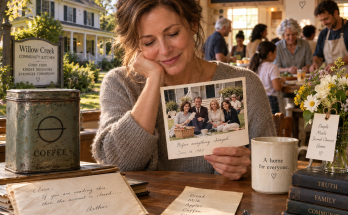
Margaret arrived in the small coastal town just before sunset, carrying one suitcase and the photograph Thomas had left behind.
She had chosen the place without researching it very much. There was a quiet inn overlooking the water, a walking trail along the cliffs, and a train station nearby. That was enough.
She wanted somewhere ordinary.
Somewhere no one knew her.
Somewhere she could wake up without immediately remembering who needed something from her.
The innkeeper, an elderly woman named Nora, handed Margaret a brass key and pointed toward the staircase.
“Room twelve. The window faces the harbor.”
Margaret smiled.
“That sounds perfect.”
Nora studied her for a moment.
“First time here?”
“Yes.”
“Alone?”
Margaret hesitated.
“Yes.”
Nora smiled.
“Then you picked the right place.”
Margaret carried her suitcase upstairs.
The room was small but comfortable.
A narrow bed.
A wooden desk.
A reading chair.
A window overlooking the harbor.
Boats rocked gently against their moorings below.
Margaret placed Thomas’s photograph on the desk.
She unpacked slowly.
There was no reason to hurry.
That realization still surprised her.
For most of her adult life, she had lived as though every ordinary moment was preparation for the next emergency.
Now there was no emergency.
She sat beside the window and watched the sky darken.
Her phone buzzed.
David.
She answered.
“Hi.”
“Did you get there?”
“Yes.”
“Is the room okay?”
“It's lovely.”
“Do you need anything?”
Margaret smiled.
“No.”
There was a pause.
David laughed quietly.
“I almost asked what.”
“What?”
“What you need.”
“And?”
“And then I remembered.”
Margaret smiled.
“You're learning.”
“I am.”
They talked for a few minutes.
David told her the first family at the Thomas Carter House had extended their stay.
The father had offered to pay.
David refused.
The mother had cried.
Margaret listened.
She could hear the pride in her son's voice.
Not pride in money.
Pride in being useful without being needed to feel important.
When they said goodbye, Margaret sat alone again.
She touched the photograph.
“Did you know he'd figure it out?”
There was, of course, no answer.
She went downstairs for dinner.
Nora had prepared soup, bread, and roasted vegetables.
Margaret ate slowly.
A man at the next table was reading a newspaper.
An older couple sat near the fireplace.
Nobody knew who she was.
Nobody knew she had been married for thirty-six years.
Nobody knew her son had once assumed she would always be available.
Nobody knew about the trust.
For the first time, Margaret could simply be a woman having dinner.
Afterward, she walked along the harbor.
The air smelled of salt and wet wood.
A fishing boat returned under the last orange light of the day.
Margaret stood on the pier until the cold forced her back toward the inn.
When she entered the lobby, Nora was waiting.
“You have mail.”
Margaret frowned.
“For me?”
Nora nodded and handed her a white envelope.
There was no stamp.
No return address.
Only Margaret's name.
Her heart began beating faster.
She looked at Nora.
“Who brought this?”
“A man left it this afternoon.”
“What man?”
“I don't know.”
“Did he say anything?”
Nora shook her head.
“He asked whether you had arrived.”
Margaret stared at the envelope.
“Did you tell him?”
“I said I didn't discuss guests.”
Margaret thanked her.
She took the envelope upstairs.
The room suddenly felt smaller.
She locked the door.
Then she sat at the desk.
She recognized the handwriting.
Not Thomas's.
But she had seen it before.
It belonged to Peter Hale.
Margaret opened the envelope.
Inside was a photocopy of a document.
At the bottom was a handwritten note.
You were right to leave. But there is something Thomas never told you about the day he bought the property.
Margaret read the sentence twice.
Then she examined the document.
It was a property transfer.
The date was nearly two years before Thomas's death.
The buyer was listed as a company Margaret did not recognize.
The seller was a name she did recognize.
Richard Hale.
Margaret's stomach tightened.
She called Daniel.
He answered quickly.
“Margaret?”
“I received another document.”
She described it.
Daniel was silent.
“Are you sure?”
“Yes.”
“Don't send me a picture yet.”
“Why?”
“Because I want you to tell me exactly what it says.”
She read the document aloud.
When she finished, Daniel exhaled.
“That changes something.”
Margaret closed her eyes.
“Of course it does.”
“It suggests Thomas didn't simply purchase the property.”
“What did he do?”
“He may have acquired Richard's entire development interest.”
Margaret looked at the photocopy.
“Why would he do that?”
“I don't know.”
“Didn't Thomas tell you?”
“Not everything.”
Margaret almost laughed.
“No. Apparently he didn't tell anyone everything.”
Daniel's voice softened.
“There's another possibility.”
“What?”
“Thomas may have been protecting someone other than you.”
Margaret looked at the photograph on the desk.
“Claire?”
“Possibly.”
Margaret remembered Claire's tearful confession.
She had been afraid of her father.
She had given Thomas the recording.
She had believed he could protect her.
Margaret suddenly wondered whether the lake property had been part of that protection from the beginning.
“Daniel, find out who that company belongs to.”
“I will.”
“And Peter?”
“I'll speak to him.”
“No.”
Daniel paused.
“I'll handle it.”
“No. I want to talk to him.”
“Margaret—”
“I spent years letting everyone else decide what information I could handle.”
Silence.
Then Daniel said, “All right.”
The next morning Peter arrived at the inn.
Margaret met him in the lobby.
He looked older than he had at the lake house.
Tired.
Less certain.
He placed a folder on the table.
“I didn't send the first warning.”
“I know.”
“But I sent the document.”
“Why?”
“Because I don't want this to become another fight.”
Margaret opened the folder.
Peter explained that Richard had transferred his development interests into the company after discovering he could not repay several investors.
Thomas bought those interests.
But he didn't buy them for himself.
He bought them to keep the development from collapsing.
“Why?”
Peter shook his head.
“Because Claire was one of the investors.”
Margaret looked at him.
“She put money into it?”
“Yes.”
“Without telling you?”
“Richard told her it was safe.”
Margaret felt a familiar sadness.
Everyone in this story had been lied to by someone they trusted.
Peter continued.
“Thomas found out that Richard had used Claire's investment to cover another debt.”
Margaret's expression hardened.
“So Thomas stepped in.”
“Yes.”
“And Richard agreed?”
“He had no choice.”
Margaret studied Peter.
“Then why are you still fighting him?”
“Because I didn't know that.”
The honesty surprised her.
Peter looked down.
“I thought Thomas had taken advantage of my brother.”
Margaret closed the folder.
“And now?”
“Now I think my brother took advantage of everyone.”
The room became quiet.
Peter reached into his coat.
He removed a small envelope.
“This belonged to Thomas.”
Margaret stared at it.
“Where did you get that?”
“Claire.”
Margaret opened it.
Inside was a short note.
If Margaret ever learns the truth, let her decide what to do with it.
Margaret's hands trembled.
“What truth?”
Peter looked at her.
“That the lake property was never the real secret.”
Margaret stared at him.
“What was?”
Peter shook his head.
“Thomas knew.”
“Knew what?”
“That David wasn't the only person he was protecting.”
Margaret felt the room tilt.
“Who else?”
Peter stood.
“I don't know.”
Then he left.
Margaret remained at the table.
She looked at Thomas's note.
For the first time since his death, she was not angry that he had kept something from her.
She was afraid of what it meant.
Because every secret had begun to connect.
The trust.
The lake house.
Richard.
Claire.
David.
The recording.
And now this.
Margaret returned to her room and opened her suitcase.
Thomas's letter was still there.
She read it again.
The final paragraph contained a sentence she had overlooked.
There are things you may discover after I'm gone that I could not explain while I was alive.
Margaret lowered the page.
She understood now.
Thomas had not been leaving her answers.
He had been leaving her the freedom to find them.
Her phone rang.
Daniel.
“We found the company.”
Margaret stood.
“Who owns it?”
Daniel's voice was quiet.
“That's the problem.”
“Why?”
“Because the ownership record lists a beneficiary.”
Margaret waited.
Daniel said the name.
“David Carter.”
Margaret's hand tightened around the phone.
“No.”
“Margaret—”
“No. That can't be right.”
“It is.”
She looked at Thomas's photograph.
David had spent years believing he was receiving the lake property.
But perhaps he had been connected to it long before Thomas's final plan.
And perhaps the trust had never been the beginning of the story.
It had been the end of something much older.
Margaret sat down.
“Daniel.”
“Yes?”
“Find out when David's name first appeared.”
“I already did.”
Margaret held her breath.
“Six months before Thomas bought the property.”
Click here to continue reading: PART 10: David’s Name Appeared in Thomas’s Records Long Before the Trust Existed, and Margaret Finally Asked the Question She Had Avoided for Years
Nine Days After Thomas Was Buried, Margaret Opened Her Door to an Unexpected Responsibility—and Realized Her Son Had Already Decided What Her Life Should Be
Part 9 of 27