
The final payment changed the investigation.
Until then, Rachel's identity had been supported by photographs, letters, financial records, and Evelyn's testimony.
Now we had Arthur's final instruction.
For Rachel.
The payment had been made from an account that investigators had never connected to the trust.
It contained almost nothing else.
The account had been created solely to preserve Rachel's future claim.
Harrison described it as a bridge.
Arthur had funded it quietly.
Laura had maintained the records.
After Laura's death, Arthur continued.
Then he stopped because he died.
Rachel sat across from us while the investigators explained.
She looked overwhelmed.
“How much is there?”
“Enough to cover the account's obligations.”
“Not enough to change my life?”
“No.”
She smiled faintly.
“Good.”
I looked at her.
“Good?”
“I don't want money to be the reason anyone believes me.”
That answer reminded me of myself.
Maybe that was the first thing we shared.
Not blood.
Not history.
The refusal to let money define the truth.
The court recognized Rachel as Evelyn's daughter after the evidence was reviewed.
Thomas Vale's paternity remained a separate matter, but the records were strong.
Margaret did not contest it.
Instead, she provided additional documents from her father.
Some were painful.
Some were embarrassing.
All were useful.
The old financial scheme finally became visible in its entirety.
Properties had been acquired through shell companies.
Money had moved through false accounts.
People had been listed as beneficiaries without their knowledge.
Names had been borrowed from dead relatives.
Signatures had been forged.
Some participants had acted willingly.
Others had been threatened.
And some, like Arthur, had tried to undo the damage without exposing everyone to immediate danger.
It was not a story with simple villains and heroes.
That made the truth harder.
But it also made it believable.
Keller eventually admitted that he had known about Rachel.
He had not known where she lived.
He had spent years trying to locate her because her identity could affect ownership of several properties.
He denied wanting to harm her.
He said he wanted leverage.
The investigators did not accept that explanation without scrutiny.
Neither did I.
Wanting leverage over someone whose existence had been hidden for decades was itself a threat.
Keller's cooperation led to more records.
The final account was traced.
The remaining funds were frozen.
Several properties were returned to their rightful owners.
Others required settlements.
The process was slow.
There was no dramatic moment when everything suddenly became fair.
There were hearings.
Appeals.
Documents.
Arguments over dates and signatures.
People who claimed they had forgotten.
People who claimed they had misunderstood.
People who remembered perfectly.
But the structure Arthur had created held.
The evidence did not depend on one person's memory.
It existed in layers.
Rachel's identity was established.
Evelyn's disappearance was explained.
The forged trusts were documented.
The Willow Creek property remained protected.
And the original ledger was preserved as evidence.
Months after the final hearing, I returned to the hidden chamber.
The room was empty.
The shelves had been cleaned.
The old wooden box was gone.
The red scarf had been placed in an archive.
The letters had been cataloged.
The walls looked ordinary.
I touched the stone where the ledger had once rested.
I expected to feel something.
Nothing came.
That surprised me.
For so long, the chamber had represented fear.
Now it was simply a room.
I walked upstairs.
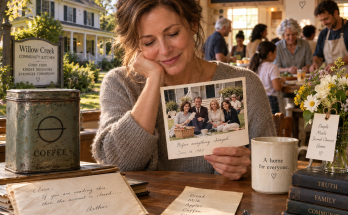
Beatrice was sitting at the kitchen table.
She had a stack of photographs beside her.
“Come here.”
I sat down.
She showed me a picture of Arthur.
He was holding a baby.
The baby was Rachel.
He looked terrified.
Beatrice laughed softly.
“He was terrible with babies.”
“How do you know?”
“He once held our nephew upside down.”
I stared at her.
“He did not.”
“He did.”
I laughed.
The memory was ridiculous.
It made Arthur human.
Not a secret-keeper.
Not a strategist.
Not the architect of a trust.
Just a man who did not know how to hold a baby.
Beatrice looked at the photograph.
“I wish I had known.”
“I know.”
“Maybe I would have helped.”
“You would have.”
She smiled.
“That was the problem.”
“What?”
“I would have helped.”
I understood.
Arthur had spent years deciding what other people could handle.
He had meant well.
But he had taken choices away from them.
That was another lesson I had learned.
Protection without consent can become another form of control.
I told Beatrice that.
She nodded.
“He would have hated hearing it.”
“Yes.”
“That means you should probably keep saying it.”
I laughed.
Rachel moved into a small apartment nearby.
She began meeting Evelyn regularly.
Their relationship was awkward at first.
They had missed too many years.
There were no shortcuts.
Evelyn never asked Rachel to call her mother.
She never demanded forgiveness.
She simply showed up.
Every week.
Sometimes Rachel talked.
Sometimes she didn't.
That was enough.
Anna became part of Rachel's life too.
The two sisters discovered they had similar habits.
Both hated overly sweet coffee.
Both organized books by size.
Both became impatient when Harrison explained legal terminology.
It made them laugh.
Margaret visited occasionally.
She brought records.
Then food.
Then stories.
She told Rachel about Thomas as a young man.
Not to excuse him.
To make him real.
Rachel listened.
She wanted the whole truth.
Not a version polished for comfort.
One afternoon, she asked Margaret, “Did my father love me?”
Margaret answered carefully.
“I believe he did.”
“Believe?”
“I never met him when he knew you existed.”
Rachel nodded.
“I can live with that.”
The past did not need to become beautiful.
It needed to become honest.
Daniel continued helping investigators.
His role was eventually cleared.
He had moved money under Arthur's instructions.
His records proved it.
He kept none of it.
He had lived modestly.
When the investigation ended, he told me he planned to retire.
“From secrets?” I asked.
“From accounting.”
“That sounds healthier.”
He smiled.
“I might open a bakery.”
I laughed.
“You can't bake.”
“I can learn.”
“That's dangerous.”
He grinned.
The house gradually changed too.
The old pantry was repaired.
The hidden floor was sealed permanently.
The kitchen was repainted.
Beatrice chose the color.
It was yellow.
I hated it.
She loved it.
So it stayed.
Every Monday, the community kitchen operated from the back room.
People came for meals.
Some came because they needed food.
Some came because they needed company.
We never asked which.
The coffee tin remained on the shelf.
Empty.
Clean.
Ordinary.
Sometimes children reached for it.
I always moved it higher.
Not because it contained anything dangerous.
Because it had become a reminder.
One evening, Rachel asked me whether I regretted opening the first envelope.
I thought for a moment.
“No.”
“Even after everything?”
“Yes.”
“Why?”
“Because the truth was already there.”
She looked toward the kitchen.
“I wish I had known sooner.”
“So do I.”
“Would you change anything?”
I considered the question.
“I would ask more questions.”
She smiled.
“That's not an answer.”
“It is.”
She laughed.
Then she became serious.
“I don't think I would change my mother.”
“You don't have to.”
“She made choices.”
“Yes.”
“So did Arthur.”
“Yes.”
“So did you.”
I looked at her.
“You're right.”
She nodded.
“That matters.”
It did.
For years, I had thought my life was something other people had done to me.
Julian's choices.
Arthur's secrets.
Keller's schemes.
Evelyn's disappearance.
Laura's silence.
But eventually I understood that my choices mattered too.
Leaving.
Staying.
Questioning.
Refusing.
Forgiving.
Not forgiving.
Opening the envelope.
Walking into the hidden room.
Trusting the wrong person.
Trusting the right one.
I had become part of the story by choosing to remain in it.
That did not make everything my fault.
It simply made my life mine again.
The final court order arrived on a rainy Thursday.
Harrison brought it himself.
The trust was officially restored.
The house was protected.
The financial accounts were separated.
Rachel's identity was legally recognized.
The remaining property claims would proceed independently.
The investigation was closed.
I read the order twice.
Then I put it down.
“That's it?”
Harrison smiled.
“That's it.”
“No more envelopes?”
“Hopefully.”
“No more secret accounts?”
“Hopefully.”
“No more hidden relatives?”
He laughed.
“I wouldn't bet on that.”
I smiled.
The house was quiet that night.
Rain tapped against the windows.
Beatrice slept upstairs.
Rachel had gone home.
Evelyn was staying with Anna.
Daniel had left earlier.
For once, I was alone.
I walked into the kitchen.
The yellow walls reflected the warm light.
I opened the cupboard.
The coffee tin was still there.
I picked it up.
Then I placed it back.
I did not need to check inside.
I already knew it was empty.
That was enough.
Click here to continue reading: PART 20: With the Court Case Finally Closed, Clara Returned to the Place Where Everything Began and Made One Last Choice About What the House Would Become
The Money on the Counter Was Never Meant for Me, Until I Heard What My Husband Planned to Do With His Mother
Part 19 of 27

One Comment on “PART 19 – Rachel’s Identity Finally Became Certain, but the Last Records Revealed Why Arthur Had Kept One Final Payment Hidden Until After His Death”