The first Monday after the case closed, I woke to sunlight.
No rain.
No gray sky.
Just a clean blue morning.
I opened the kitchen window.
Fresh air moved through the room.
For a moment, I remembered the first day.
The envelope.
The money.
The name Hazel.
The feeling of being trapped inside someone else's life.
It seemed impossible that so much had grown from one envelope.
Beatrice entered carrying flowers.
“From the garden.”
“You picked those?”
“Yes.”
“They're crooked.”
“So am I.”
I laughed.
She put them in a glass jar.
The house smelled like coffee.
Someone was cooking downstairs.
The community kitchen had already started.
Voices drifted through the hallway.
Ordinary voices.
That was the sound I had wanted for months.
Not silence.
Life.
Rachel arrived around ten.
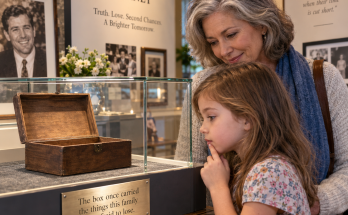
She brought a box.
“What is that?”
“Things from my mother.”
She placed it on the table.
Inside were photographs.
Letters.
A recipe book.
A small blue dress.
“I thought you might want to see this.”
I picked up the dress.
It was tiny.
Hand-sewn.
Evelyn came in behind her.
She stopped when she saw it.
“That was yours.”
Rachel looked at her.
“You remember?”
“I made it.”
Rachel touched the fabric.
“You knew me when I was a baby.”
“Yes.”
“Did you hold me?”
Evelyn smiled through tears.
“Every chance I had.”
Rachel looked at her.
Then, after a long hesitation, she said, “Mom.”
Evelyn froze.
Rachel smiled.
“You can cry.”
Evelyn did.
So did I.
Not because everything was fixed.
Because something had finally been named correctly.
That afternoon, Anna came by.
She brought a box of legal documents.
“The trust records.”
I groaned.
“On a Monday?”
She laughed.
“Everything is better with paperwork.”
We spent the afternoon organizing.
The records were divided into categories.
Property.
Financial.
Identity.
Correspondence.
Court.
Family.
The last folder was labeled Personal.
Inside were Arthur's letters.
Some were addressed to Beatrice.
Some to Evelyn.
Some to Anna.
One was addressed to me.
I had read it before.
But this time I noticed something I had missed.
At the bottom was a sentence written lightly in pencil.
If Clara ever asks why, tell her I trusted her because she had already learned to care for someone who could not repay her.
I read it twice.
Beatrice looked over my shoulder.
“He meant you.”
“I know.”
“No.”
She pointed to the words.
“He meant the thing you did before all this.”
I frowned.
“What thing?”
“You cared for me.”
I understood.
Arthur had watched me care for Beatrice before I knew the secrets.
That was why he trusted me.
Not because I was clever.
Not because I could manage a trust.
Not because I would solve the ledger.
Because I had stayed when staying was difficult.
That was the answer I had been looking for since the beginning.
I closed the letter.
The house was never simply a legal structure.
It was a test of character.
Arthur had left me something I had not realized I possessed.
Trust.
Not his trust.
My own.
I had learned to trust myself.
That mattered more.
Later that week, we held a small gathering.
No reporters.
No lawyers.
No officials.
Just the people whose lives had been tangled in the story.
Beatrice cooked.
Evelyn brought dessert.
Margaret brought wine.
Daniel brought bread.
Anna made a salad.
Rachel brought nothing.
She apologized.
We told her to sit down.
She laughed.
The table was crowded.
There were arguments about recipes.
Someone spilled water.
Daniel burned the bread.
Beatrice blamed him.
He blamed the oven.
Everyone knew he was lying.
I watched them.
A strange thought came to me.
This was the ending.
Not the court order.
Not Keller's conviction.
Not the restored trust.
This.
People sitting around a table without fear.
The past still existed.
But it was no longer the center.
After dinner, Margaret asked whether I would walk with her.
We went into the garden.
“I owe you an apology,” she said.
“For what?”
“For keeping silent.”
“You were afraid.”
“So was everyone.”
She looked toward the house.
“My father made terrible choices.”
“Yes.”
“I spent years trying to decide whether loving him made me guilty.”
I shook my head.
“It doesn't.”
She smiled.
“I needed to hear that.”
“Love isn't an inheritance.”
“What is it?”
“A choice.”
She nodded.
“That sounds like something Arthur would never have understood.”
“Maybe.”
She laughed.
“He thought love meant protecting people from the truth.”
I looked at the house.
“I think he finally learned otherwise.”
Margaret left the next morning.
Evelyn stayed.
She and Rachel were building a relationship slowly.
Anna helped.
Beatrice watched.
I learned not to interfere.
Some things need room.
The community kitchen grew.
We added a second refrigerator.
Then another stove.
We started serving meals on Mondays, Wednesdays, and Fridays.
People volunteered.
Some had never cooked before.
Some knew every recipe in existence.
Children did homework at the long table.
Older neighbors came early just to talk.
The house stopped being a secret place.
It became a useful place.
That was the transformation Arthur could never have predicted.
The house had once been used to conceal wealth.
Now it was being used to distribute food.
The irony was not lost on me.
One afternoon, Harrison brought the final legal paperwork.
He placed it on the table.
“The trust is complete.”
“What does that mean?”
“The responsibilities are clear.”
“Mine?”
“For now.”
“Anna's?”
“Eventually.”
“Rachel?”
“She has her own claim.”
I nodded.
The legal language was dry.
But the meaning was simple.
No one could secretly transfer the house.
No one could forge a beneficiary.
No one could use the property as collateral without oversight.
The structure Arthur created had survived.
It had also changed.
It no longer needed to be secret.
That was important.
I asked Harrison whether we should open the hidden chamber.
He thought about it.
“Why?”
“To show people.”
“Show them what?”
“Nothing.”
He smiled.
“Then leave it closed.”
We did.
The door remained locked.
Not because there was anything dangerous behind it.
Because some places do not need to become public simply because the danger is gone.
A month later, Beatrice asked me to drive her to the cemetery.
We stood beside Arthur's grave.
The stone was simple.
No grand description.
Just his name.
Dates.
Nothing about the ledger.
Nothing about the trust.
Nothing about Evelyn.
Nothing about Keller.
Beatrice placed flowers beside the stone.
“He would hate the yellow kitchen.”
I laughed.
“Yes.”
“He'd complain.”
“Definitely.”
She smiled.
Then she looked at me.
“I think he'd be proud.”
I didn't answer immediately.
“I hope so.”
“He would.”
We stood quietly.
The wind moved through the trees.
I thought about everything Arthur had left behind.
Not money.
Not houses.
Not accounts.
Questions.
Responsibilities.
People.
And eventually, the truth.
On the drive home, Beatrice said something that stayed with me.
“Do you know what the strangest part is?”
“What?”
“I spent years thinking Arthur was protecting the family.”
“And?”
“He was protecting the future.”
I looked at her.
She continued.
“That's why he left the house to you.”
I smiled.
“Not exactly.”
She raised an eyebrow.
“You know what I mean.”
“Yes.”
When we arrived home, Rachel was waiting.
She had a letter.
“From the court?”
“No.”
“Who?”
She handed it to me.
The handwriting was unfamiliar.
I opened it.
The letter was short.
It came from someone who had received money Arthur returned years earlier.
They had never known where it came from.
They had thought it was a mistake.
Now they knew.
They thanked him.
Then they thanked us.
I read it quietly.
Rachel asked, “Does it feel strange?”
“Yes.”
“How?”
“Like the story is still moving.”
She smiled.
“Maybe it is.”
That night, I sat alone in the kitchen.
The coffee tin was still on the shelf.
I took it down.
For months, it had represented betrayal.
Then mystery.
Then evidence.
Now it was simply an old tin.
I opened it.
Empty.
I smiled.
I put it back.
The clock above the doorway showed midnight.
The house was quiet.
But this time, there was no fear in the silence.
I thought about the person I had been when I first found the money.
She had believed she was invisible.
She had believed her worth was measured by what she could provide.
She had believed staying quiet was safer.
She had been wrong.
I turned off the kitchen light.
Before leaving, I looked once more at the coffee tin.
Then I closed the door.
The house remained.
The secrets were gone.
And for the first time, the life inside it belonged to the people who had chosen to stay.
Click here to continue reading: PART 21: The Letter From a Stranger Reopened a Question Clara Thought She Had Buried, Leading Her Back to One Name Arthur Never Explained
The Money on the Counter Was Never Meant for Me, Until I Heard What My Husband Planned to Do With His Mother
Part 20 of 27