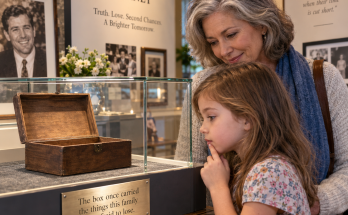
The foundation's annual ceremony was held in spring.
Mom had attended every year since the scholarship program began.
This year, she was the guest of honor.
She tried to refuse.
“I don't need attention.”
Noah laughed.
“You've been saying that for twenty years.”
“Exactly.”
“But they're honoring you.”
“They should honor the students.”
“They are.”
“Then why am I going?”
“Because they asked.”
Mom sighed.
“You sound like your father.”
“That usually works.”
It did.
She agreed.
The ceremony was held in a renovated community center.
Students filled the front rows.
Parents stood along the walls.
Former employees sat together.
Samuel came.
Eleanor came.
Maria Bell came from overseas.
Even people we had not seen in years attended.
The foundation had grown far beyond its original purpose.
It provided scholarships, emergency assistance, housing support, and medical grants.
Mom watched the students arrive.
“They look so young.”
“You were young once.”
“I was.”
She smiled.
“Then everything changed.”
When her name was called, she walked to the stage.
She stood behind the microphone.
For a moment, she looked nervous.
Then she saw Noah.
She saw me.
She saw Samuel.
She saw the students.
And she smiled.
“I was asked to say something inspirational today.”
The audience laughed.
Mom smiled.
“I don't think I'm very good at inspirational speeches.”
More laughter.
“So I'll tell you the truth instead.”
The room became quiet.
She spoke about failure.
Not hers alone.
Everyone's.
She said people make mistakes.
Institutions make mistakes.
Families make mistakes.
Investigators make mistakes.
Sometimes those mistakes cost years.
Sometimes they cost relationships.
Sometimes they cost lives.
“But a mistake does not have to become your identity,” she said.
I watched Noah.
He was listening carefully.
Mom continued.
“What matters is what you do when you finally understand that you were wrong.”
She looked toward the students.
“You can hide.”
She paused.
“You can blame someone else.”
Another pause.
“Or you can tell the truth.”
The room was silent.
She did not mention the murder.
She did not mention prison.
She did not mention Greg.
She didn't need to.
Everyone who knew her story understood.
Then she said something that surprised me.
“I used to think survival meant getting through the day.”
She looked at me.
“Now I think survival means becoming capable of having a good day again.”
My throat tightened.
The audience remained silent.
Then she smiled.
“And there have been many good days.”
That was all.
She stepped away from the microphone.
The applause began slowly.
Then everyone stood.
Mom looked embarrassed.
She waved them down.
Afterward, students approached her.
One young woman asked, “How did you keep going?”
Mom answered honestly.
“People helped me.”
“Who?”
“My sons.”
The young woman smiled.
“Both of them?”
“Both.”
Noah heard that.
He looked at me.
Neither of us spoke.
We didn't need to.
Later, Maria Bell approached Mom.
“My father would have admired you.”
Mom smiled.
“I don't know about that.”
“He would.”
Maria looked at me.
“And your father would have been proud of what you built.”
Mom looked around the room.
“This isn't what I built.”
She gestured toward the students.
“This is what all of us built.”
That was Mom.
She refused to take more credit than she deserved.
She also refused to carry more blame than she deserved.
The ceremony ended.
People stayed to talk.
Samuel told another ridiculous story about Dad.
Eleanor corrected him.
Noah's children ran around the courtyard.
For a moment, the room felt like a family reunion.
Not a memorial.
Not a legal gathering.
A celebration.
I stood outside with Noah.
“You think Dad would recognize this place?”
“No.”
“Why?”
“He'd complain about the chairs.”
I laughed.
“Definitely.”
Then Noah became quiet.
“You know what Mom said about good days?”
“Yes.”
“I think she's right.”
I looked at him.
“We've had a lot of them.”
“We have.”
He watched his children playing.
“That's what Dad missed.”
“Yes.”
“I hate that.”
“So do I.”
“But I don't want to spend my life angry about it.”
“I know.”
He smiled.
“Mom taught us that.”
That night, we returned home.
The wooden box sat on my shelf.
I looked at it differently.
It contained grief.
But it also contained proof of survival.
The drawing.
The letters.
The photographs.
The watch.
The statement.
Every object represented a moment when something had been lost.
But together they represented something else.
We were still here.
The next morning, Mom called.
“I've decided something.”
“What?”
“I want the box opened permanently.”
I laughed.
“Meaning?”
“Take everything out.”
“Why?”
“Because I don't want our family history sitting in a box.”
I agreed.
We spent the weekend framing photographs.
The drawing went into a frame.
Dad's letter went into an album.
The watch went into a small glass case.
The statement was digitized.
The trust records went to the foundation archive.
Nothing remained hidden.
When we finished, Mom looked around the room.
“Better.”
“Definitely.”
She smiled.
“I feel lighter.”
I understood.
The box had served its purpose.
It had carried what we could not yet carry ourselves.
Now we could carry it without fear.
That evening, we put the empty box in the attic.
Not because we were done with Dad.
Because we no longer needed a container for him.
Click here to continue reading: PART 24: On the Night We Finally Emptied Dad’s Box, Noah Asked Whether We Were Ready to Let the Story End for Good
Six Years After My Father’s Murder, I Returned to the Prison Where My Mother Was Waiting for Her Final Goodbye
Part 23 of 27