After the trust was established properly, the remaining documents were returned to Mom.
She kept only a few.
The rest went to the foundation archives.
We agreed that Dad's personal letters belonged with the family.
The legal records belonged where future researchers could access them.
For the first time, there was no reason to hide anything.
That should have felt liberating.
Instead, I found myself thinking about something else.
My own role.
I had spent years believing I was simply another victim.
That wasn't entirely true.
I had made choices too.
Some were understandable.
Some were not.
I had stopped visiting Mom.
I had refused her calls.
I had ignored the small doubts that appeared during the trial.
I had accepted the story because accepting it was easier than living without an answer.
One evening, I told Mom.
“I owe you another apology.”
She looked tired.
“You've apologized.”
“Not for this.”
I sat across from her.
“I should have questioned the case.”
“You were nineteen.”
“I was old enough to know you.”
She looked at me.
“You knew the version of me you had at home.”
“I knew you loved Dad.”
“Yes.”
“I knew you weren't cruel.”
“Yes.”
“I should have asked more questions.”
Mom sighed.
“You were a child caught inside something you didn't understand.”
“I don't feel like a child when I remember it.”
“You weren't one.”
She reached across the table.
“But you were still my son.”
I looked down.
She continued.
“You think believing the wrong thing means you betrayed me.”
I nodded.
“It doesn't.”
“Why?”
“Because you eventually changed your mind when the evidence changed.”
That sentence surprised me.
I had expected forgiveness to require pretending I had never failed.
Mom offered something more honest.
She accepted that I had failed.
And she accepted me anyway.
Noah had a different relationship with the past.
He remembered fragments.
He did not remember every detail.
But he had stopped being afraid of that.
He said memories were not recordings.
They changed.
They became clearer.
Some disappeared.
Others returned when something triggered them.
He understood why investigators had struggled with his childhood statement.
He also understood why they should have listened more carefully.
His work became increasingly focused on witness interviews.
He was particularly interested in cases involving children.
One night, he called me from work.
“I had a strange conversation today.”
“What happened?”
“A witness remembered something years after an incident.”
I smiled.
“Like you?”
“Exactly.”
“Did they believe her?”
“Yes.”
“Good.”
He paused.
“Eventually.”
That one word told me everything.
We talked for a long time.
Afterward, I realized how much Noah had changed.
The frightened seven-year-old who had whispered about Dad's kitchen was gone.
In his place was a man who understood fear but refused to let it decide what was true.
Mom often worried that his work would consume him.
He assured her it wouldn't.
“I have a family,” he said.
“You'd better remember that.”
“I do.”
One Saturday, all three of us met for lunch.
We talked about nothing important.
Movies.
Groceries.
A neighbor's new dog.
The foundation.
Noah's apartment.
Mom's garden.
At some point, she mentioned Dad.
Not the murder.
Just Dad.
“He hated cilantro.”
Noah laughed.
“He did?”
“You don't remember?”
“No.”
I laughed.
“I remember.”
Mom shook her head.
“He said it tasted like soap.”
Noah looked offended.
“It does.”
Mom and I laughed.
That tiny conversation meant more to me than any courtroom victory.
Dad was becoming ordinary again.
That was the final thing I wanted.
For years, his death had been the largest fact about him.
Now it was simply one part of his story.
He had been a father.
A husband.
A businessman.
A flawed man who tried to protect his family.
A man who made mistakes.
A man who loved us.
The murder no longer defined him.
One evening, I found myself standing beneath the framed family photograph.
Mom came beside me.
“You still look at it.”
“Sometimes.”
“What do you see?”
I thought about it.
“Before.”
She nodded.
“I see us.”
I looked at her.
“That's different.”
“Yes.”
She smiled.
The photograph had stopped being evidence of what we lost.
It had become evidence that we had once been happy.
And that mattered too.
Several years after Greg's conviction, the prison notified Mom that he had requested contact.
She refused.
I did not ask why.
She didn't need to explain.
Some doors could remain closed.
Noah was more philosophical about it.
“He made his choice.”
Mom nodded.
“So did I.”
She chose not to let him back into her life.
That was not revenge.
It was a boundary.
I respected it.
The foundation continued growing.
The scholarship expanded.
Families received support.
Students received grants.
Every year, Mom attended the ceremony.
She never spoke about her conviction unless someone asked.
When they did, she answered honestly.
“Yes, I was wrongly convicted.”
“What changed?”
“My son remembered.”
She always said it simply.
No dramatic speech.
No attempt to make herself inspirational.
Just the truth.
One year, a young law student asked her what lesson she wanted future investigators to remember.
Mom thought for a moment.
“Don't decide what happened before you have finished asking questions.”
The student wrote it down.
I knew she had learned that lesson the hardest possible way.
But she had turned it into something useful.
Later that night, I asked her whether she regretted creating the foundation.
She looked genuinely surprised.
“Never.”
“Even after everything?”
“Especially after everything.”
She looked at the scholarship certificates on the wall.
“People deserve a chance to start over.”
I smiled.
“So do we.”
She nodded.
“Yes.”
That became something of a family joke.
Whenever one of us made a mistake, someone would say, “People deserve a chance to start over.”
Mom always added, “Within reason.”
We laughed.
The past had become something we could mention without freezing.
That was progress.
One winter evening, I returned to Mom's house carrying a box.
Inside were Dad's remaining papers.
I had finally decided what to do with them.
I gave the box to Mom.
“What is this?”
“Everything I still have.”
She opened it.
The letters.
The photographs.
The notes.
The original drawing Noah had made.
The final letter.
She touched the drawing.
“Why are you giving me this?”
“Because I don't want to be afraid of it anymore.”
She looked at me.
“You aren't.”
“No.”
I smiled.
“I'm not.”
Mom closed the box.
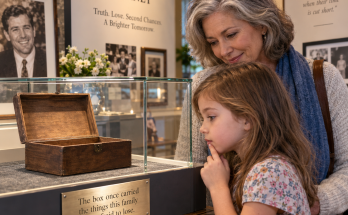
Then she placed it beneath the family photograph.
Not in a locked cabinet.
Not hidden.
Just there.
The evidence had become history.
The history had become memory.
And the memory no longer controlled us.
Click here to continue reading: PART 16: When We Finally Stopped Searching for Answers, a Quiet Visit to Dad’s Grave Gave Us the Ending We Had Never Known How to Name
Six Years After My Father’s Murder, I Returned to the Prison Where My Mother Was Waiting for Her Final Goodbye
Part 15 of 27