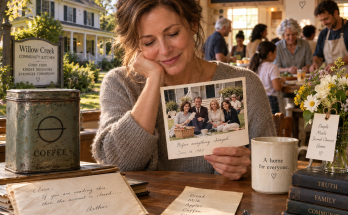
Margaret unfolded the letter carefully.
The paper had been handled more than once, but Thomas's handwriting remained unmistakable.
Daniel sat quietly across from her.
He did not rush her.
He knew that whatever Margaret was about to read belonged to a marriage that had lasted thirty-six years.
The letter began with her name.
Margaret,
If you're reading this, then something has happened that I hoped would never happen.
She stopped there.
Her throat tightened.
Daniel looked toward the window.
Margaret continued.
Thomas wrote that he loved David.
There was no hesitation in that sentence.
But he also admitted that he had watched their son become increasingly dependent on the things his parents provided.
At first it had been small requests.
Then larger ones.
Eventually, David had stopped asking and begun assuming.
Margaret closed her eyes.
She remembered every time she had said yes without being asked.
Every time she had paid a bill.
Every time she had watched the children.
Every time she had changed her plans because David needed something.
Thomas had seen it.
Perhaps he had seen it before she was willing to.
She kept reading.
The lake property was not a gift.
It was an opportunity.
Thomas had purchased it through an LLC controlled by a trust.
David had been shown documents containing his name.
That was intentional.
He was supposed to believe the property was his.
But the underlying ownership remained with the trust.
Margaret looked up.
“Why would he do this?”
Daniel folded his hands.
“Thomas wanted to know what David would do if he believed something valuable had been placed in his hands.”
Margaret stared at him.
“A test.”
“Not exactly.”
Daniel's voice was gentle.
“Your husband didn't want to trap him.”
Margaret looked back at the letter.
Thomas explained that if David became responsible, the trust could eventually transfer the property to him.
If he became entitled, demanding, or reckless, the property would be sold and the proceeds given to charities Thomas and Margaret had supported.
Margaret's hands trembled.
Then she reached the final portion.
Thomas asked her not to rescue their son from consequences anymore.
He wanted David to face his own choices.
He wanted Margaret to stop measuring her worth by how much trouble she could solve.
She lowered the letter.
Daniel waited.
“He planned all this?”
“He planned the framework.”
“And he knew David might fail?”
Daniel nodded.
“He hoped he wouldn't.”
Margaret looked down.
That answer hurt.
Not because Thomas had doubted their son.
Because he had believed David could become someone different.
The folder contained one final document.
Daniel slid it across the table.
It was a trust amendment.
Margaret's name appeared on it.
She read the clause twice.
She was the trustee.
David's future ownership depended on a review of his conduct during the first year after Thomas's death.
Margaret looked up.
“What exactly am I supposed to do?”
“Observe.”
“That's all?”
“Your husband wanted you to stop intervening.”
Margaret gave a sad laugh.
“He knew me too well.”
Daniel smiled faintly.
“He did.”
Margaret sat back.
The room felt strangely quiet.
Thomas had not left her money.
He had left her responsibility.
But not the kind she had spent her life carrying.
This was different.
He was asking her to resist the instinct to fix things.
To watch.
To let David choose.
Three days later, someone knocked hard on the front door.
Margaret knew before opening it that it was David.
Sarah stood behind him.
David looked angry.
Not furious.
Worse.
Confused.
“Mom, we need to talk.”
Margaret stepped aside.
“Come in.”
They entered.
David looked around the house.
“You went on a cruise.”
“Yes.”
“You didn't tell us.”
“I didn't.”
“You just left.”
“I took a vacation.”
“Right after Dad died.”
“Yes.”
David shook his head.
“That isn't normal.”
Margaret felt something inside her become completely still.
“No,” she said.
David frowned.
“What?”
“Burying your father and having your son arrive nine days later with three animals and a list of instructions was not normal.”
Sarah looked down.
David's face tightened.
“I didn't mean it like that.”
“I know.”
“You know I love you.”
“I know.”
“I thought you needed something to do.”
Margaret nodded.
“And I thought you needed to learn something too.”
David looked at her.
“What?”
“That your mother isn't an emergency service.”
Silence filled the room.
David lowered his eyes.
Sarah finally spoke.
“We were worried.”
Margaret looked at her.
“Were you?”
“Yes.”
Margaret waited.
Sarah swallowed.
“I mean, we were worried about you.”
The distinction mattered.
Margaret nodded.
“Thank you.”
David sat down.
His anger had begun to drain away.
“Mom, why didn't you tell us?”
“Because I didn't think I needed permission.”
He looked at her.
She could see the words reaching him slowly.
Then Margaret placed Thomas's letter on the table.
David's face changed.
“What is that?”
“Something your father left.”
She placed the property documents beside it.
David stared.
“The lake house?”
“Yes.”
“You knew?”
“I just found out.”
He looked from the documents to his mother.
“But Dad told me it was mine.”
“He told you it could become yours.”
David's expression hardened again.
“What does that mean?”
Margaret explained.
The LLC.
The trust.
The conditions.
The review.
The possibility that the property could be sold.
The charities that would receive the proceeds if he failed to meet the requirements.
When she finished, David sat completely still.
“So I don't own it.”
“Not yet.”
“What happens if I don't pass?”
Margaret chose her words carefully.
“The property can be sold.”
“And the money?”
“Your father chose several organizations to receive it.”
David stood abruptly.
“So he was testing me.”
“No.”
Margaret looked directly at him.
“He was giving you a chance.”
David stared at her.
Sarah began crying.
She wiped her cheeks and looked toward Margaret.
“We did this.”
David turned.
“What?”
Sarah's voice shook.
“We treated your mother like she would always be here.”
Margaret said nothing.
Sarah continued.
“We assumed she'd handle things. The children. The house. The emergencies. Everything.”
David sat again.
He stared at the table.
For once, he didn't argue.
He didn't explain.
He didn't say Margaret misunderstood.
He simply sat there.
After several minutes, he asked, “What do I have to do?”
Margaret shook her head.
“That isn't the right question.”
He looked up.
“Then what is?”
“What kind of man do you want to be when nobody is giving you anything?”
David's face tightened.
The question seemed to reach deeper than the property.
Deeper than the argument.
He looked at the floor.
“I don't know.”
Margaret nodded.
“That is an honest answer.”
It was the first honest answer she had heard from him in a long time.
The months that followed were not miraculous.
David did not transform overnight.
He still made mistakes.
He still forgot things.
He still occasionally called Margaret with a problem already expecting her to solve it.
But something changed.
The difference was that Margaret stopped solving it.
At first, David became frustrated.
Then embarrassed.
Then capable.
He began paying back money he owed.
He handled his own childcare arrangements.
Sarah found work she enjoyed and stopped relying on Margaret to fill every gap.
They hired help when they needed it.
They asked before assuming.
Most importantly, David began calling for reasons that had nothing to do with a crisis.
Sometimes he simply asked how his mother was.
Margaret noticed the change slowly.
She trusted it cautiously.
Forgiveness did not mean pretending the past had never happened.
It meant allowing the future to be different.
One Saturday morning, David arrived carrying a small box.
“I brought you something.”
Margaret opened it.
Inside were Thomas's old reading glasses.
She looked up.
“Where did you get these?”
“I kept them after the funeral.”
“Why?”
David swallowed.
“Because I missed him.”
Margaret touched the glasses.
“So do I.”
David sat beside her.
For a while, neither spoke.
Then he said, “I was angry when you left.”
“I know.”
“I thought you abandoned us.”
Margaret looked at him.
“I didn't.”
“I understand that now.”
David stared at his hands.
“You left the version of yourself that existed only for us.”
Margaret's eyes filled.
“That sounds like something your father would say.”
David smiled.
“He probably would have yelled at me before saying it.”
Margaret laughed.
They both did.
Then David became serious.
“Mom?”
“Yes?”
“I don't want the lake house.”
Margaret blinked.
“What?”
“I don't want it as a reward.”
She waited.
“I want to earn my own life.”
Margaret reached for his hand.
“That is what your father wanted.”
David nodded.
“I know.”
A year after Thomas's death, the trust review was complete.
David had met every condition.
Not because he had become perfect.
Because he had become responsible.
The property was transferred to him.
But Margaret soon learned that David had no intention of turning it into a luxury home.
He renovated the little house near the lake.
He turned it into a retreat for families caring for loved ones with terminal illnesses.
A place where people could stay without worrying about another bill.
Without wondering where they would sleep.
Without having to pretend they were fine.
He named it the Thomas Carter House.
When Margaret saw the sign, she cried.
“You did this?”
David nodded.
“I thought Dad would like it.”
“He would.”
Sarah stood beside him.
Emily came too.
For the first time in years, Margaret looked at her entire family and realized no one was asking her to fix anything.
No emergency.
No favor.
No demand.
Just family.
David handed her an envelope.
She opened it.
Inside was a cruise brochure.
Alaska.
Again.
Margaret looked at him.
“Why?”
“You and Dad were supposed to go.”
“We were.”
“So go.”
She smiled.
“What about everyone here?”
David laughed.
“We'll survive.”
Margaret hugged him.
“I’m proud of you.”
David held her tightly.
“And Mom?”
“Yes?”
“Thank you for finally saying no.”
Margaret laughed through her tears.
“Your father would be proud.”
David looked toward the lake.
“I think he already knew.”
Six months later, Margaret stood aboard another ship.
Alaska again.
This time she was not escaping.
She was not trying to prove anything.
She was simply living.
Thomas's letter rested in her handbag.
His reading glasses were in her pocket.
A family photograph sat beside them.
As the ship moved through the cold blue water, Margaret stood at the railing.
The mountains rose beyond the horizon.
The sky slowly turned gold.
She closed her eyes.
“Thomas,” she whispered.
“I finally understand.”
The wind moved around her.
She opened her eyes.
For the first time since his death, Margaret did not wonder what he would have wanted.
She already knew.
He would have wanted her to live.
So she did.
Not without grief.
Not without mistakes.
Not without moments when she still reached for the phone before remembering that she no longer had to answer every call.
But fully.
She had loved deeply.
She had lost deeply.
She had forgiven.
She had learned to set boundaries.
And somewhere along the way, she had remembered that being a mother did not mean surrendering the rest of her life.
Thomas had left her one final lesson.
Her life was hers.
Margaret rested her hands on the cold railing.
The mountains glowed in the morning light.
She smiled.
Then she turned toward the open deck and walked forward.
Click here to continue reading: PART 5: Margaret Returned Home With Thomas’s Letter in Her Bag, but One Small Change in David’s Behavior Made Her Question What He Truly Intended
Nine Days After Thomas Was Buried, Margaret Opened Her Door to an Unexpected Responsibility—and Realized Her Son Had Already Decided What Her Life Should Be
Part 4 of 27