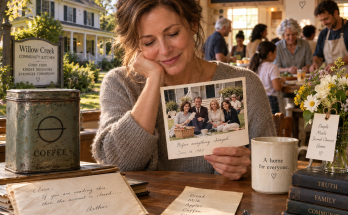
Margaret's train pulled into the station just after noon.
She stepped onto the platform with one suitcase, a canvas bag, and no fixed plan beyond the next few days. She had told David she was traveling somewhere along the coast. That was true. She had simply chosen not to tell him exactly where.
The town was quieter than she expected.
There were narrow streets lined with old shops, a bakery with fogged windows, and a bookstore squeezed between a pharmacy and a hardware store. Beyond the buildings, the ocean stretched beneath a pale sky.
Margaret walked slowly.
She had learned to enjoy arriving somewhere without immediately asking what needed to be done.
At the small hotel, the receptionist handed her a key and a handwritten map.
“Everything is within walking distance,” the young woman said.
“That sounds dangerous.”
The receptionist laughed.
“Only if you plan to buy things.”
Margaret smiled.
She carried her suitcase upstairs.
The room overlooked the harbor.
She opened the window.
Cold air entered.
Margaret stood there for several minutes, listening to gulls and distant traffic.
Then she unpacked.
There was a photograph of Thomas in her bag.
She placed it beside the lamp.
Not because she was afraid of forgetting him.
Because she wanted him with her.
That afternoon she walked to the bookstore.
She had promised herself she would buy something she normally would not read.
After half an hour, she chose a history book about the region.
At the register, the owner looked at her purchase.
“First visit?”
“Yes.”
“Then you're going to find the old harbor interesting.”
“Why?”
“Because half the buildings around here have a story nobody bothered to write down.”
Margaret smiled.
“That sounds familiar.”
The owner looked at her curiously.
But she did not explain.
She carried the book back to the hotel.
That evening she ate alone at a restaurant near the water.
She ordered fish, bread, and a glass of sparkling water.
She watched couples talk.
A family argued affectionately over dessert.
A man at the bar laughed too loudly.
Margaret felt no loneliness.
She felt present.
That distinction had taken her a long time to understand.
Her phone buzzed.
David.
She answered.
“Hi.”
“Did you arrive?”
“Yes.”
“Where?”
Margaret smiled.
“You're getting nosy.”
“I'm your son. It's my job.”
“No, it isn't.”
He laughed.
“How's the trip?”
“Good.”
“Are you eating?”
“Yes.”
“Sleeping?”
“Yes.”
“Then I have no complaints.”
Margaret smiled.
“How is the house?”
“Busy.”
“Good busy?”
“Very.”
David told her that two families were staying at the Thomas Carter House.
One had a little girl who loved the lake.
The other family had arrived after a long overnight drive.
David had spent the afternoon fixing a broken porch rail.
Margaret could hear the satisfaction in his voice.
“You sound happy.”
“I am.”
“Your father would like that.”
“I think so.”
They said goodbye.
Margaret returned to her room.
She opened the history book.
A folded piece of paper fell from between the pages.
She stared at it.
She had not put it there.
Her pulse quickened.
The paper contained one line.
Ask who owned the land before Thomas.
Margaret sat very still.
The handwriting was unfamiliar.
She immediately called Daniel.
He answered after several rings.
“Margaret?”
“Someone left another message.”
Daniel sighed.
“What does it say?”
She read it.
Silence.
“Daniel?”
“I thought we'd settled the property issue.”
“So did I.”
“Where are you?”
Margaret told him.
“Did anyone follow you?”
“I don't know.”
“Don't panic.”
“I’m not panicking.”
She was.
But she had become better at hiding it.
Daniel asked her to photograph the note and send it.
She did.
Several minutes passed.
Then he called back.
“I recognize the handwriting.”
Margaret sat up.
“Whose?”
“Your husband's.”
She stared at the paper.
“No.”
“Yes.”
“Thomas is dead.”
“I know.”
“Then someone copied it.”
“Possibly.”
Daniel's voice became cautious.
“But I compared the formation of the letters to documents we already have.”
Margaret looked at the note again.
“What are you saying?”
“I’m saying the person who wrote this either had access to Thomas's private papers or learned his handwriting extremely well.”
Margaret looked around the room.
The curtains moved slightly.
The window was open.
She closed it.
“Daniel, why would anyone do this?”
“I don't know.”
“Then find out.”
“I will.”
Margaret ended the call.
She did not sleep much that night.
The next morning she returned to the bookstore.
The owner recognized her.
“You're back.”
“I wanted to ask you something.”
“Go ahead.”
“Do you know anything about the old harbor property?”
The man's expression changed.
“Which property?”
“The land near the east pier.”
He wiped his hands on a cloth.
“That land has changed hands several times.”
“Do you know who owned it originally?”
He hesitated.
“Why?”
Margaret took out the photograph of Thomas.
“Do you recognize him?”
The man stared.
“Yes.”
Margaret's heart jumped.
“From where?”
“He came here often.”
“When?”
“Years ago.”
“How many?”
“Maybe fifteen.”
Margaret felt cold.
Thomas had visited this town fifteen years earlier.
She had never known.
“Did he come alone?”
The owner thought.
“Usually.”
“Did he meet anyone?”
“Sometimes.”
“Who?”
“I don't remember.”
Margaret thanked him.
As she turned to leave, he called after her.
“There was one woman.”
Margaret stopped.
“What woman?”
“She worked at the harbor office.”
“Do you know her name?”
“Eleanor.”
Margaret's heart skipped.
Thomas's younger sister had not been named Eleanor.
But the name meant something.
She had heard it before.
At home.
In a conversation Thomas ended abruptly.
She remembered asking who Eleanor was.
Thomas had said, “Someone from before.”
Margaret had not pressed him.
Now she wished she had.
She asked where the woman was.
The bookstore owner pointed toward the old harbor.
“Her family still lives there.”
Margaret walked for nearly an hour.
The harbor was quieter than the town center.
Old warehouses stood beside renovated offices.
Fishing boats rocked against the docks.
At the end of the road was a small blue house.
Margaret knocked.
An elderly woman opened the door.
She looked at Margaret.
Then at the photograph.
Her face changed.
“Thomas.”
Margaret felt her knees weaken.
“You knew him?”
The woman stepped aside.
“Come in.”
Margaret entered.
The woman introduced herself as Eleanor Reed.
They sat in a small living room filled with books.
Eleanor looked at the photograph again.
“He never told you?”
Margaret shook her head.
“What did he never tell me?”
Eleanor sighed.
“Your husband came here because of the land.”
“What land?”
“The harbor property.”
Margaret leaned forward.
“Why?”
“Because he believed someone was trying to take it.”
“Who?”
Eleanor shook her head.
“Not who.”
“What then?”
“Why.”
Margaret stared at her.
Eleanor explained that years earlier, the harbor property had been intended for a community medical center.
A group of investors had purchased it.
Then the project collapsed.
Thomas became involved because one investor had been hiding debts.
Margaret recognized the pattern.
Richard Hale.
“Was Richard involved?”
Eleanor nodded.
“Yes.”
Margaret closed her eyes.
The past was following her.
Eleanor continued.
“Thomas believed the property was connected to the lake land.”
“How?”
“Both were supposed to become community projects.”
Margaret felt something click.
Thomas had not simply discovered the lake property.
He had been working on a larger plan.
One that connected several pieces of land.
“Why didn't he finish it?”
Eleanor looked at her.
“Because he became sick.”
Margaret's throat tightened.
“What happened to the harbor property?”
“Sold.”
“To whom?”
Eleanor hesitated.
“A company.”
“What company?”
She gave Margaret the name.
Margaret recognized it.
The same company Daniel had found in Thomas's records.
The one that listed David as beneficiary.
Margaret stared at her.
“So the company existed before the lake property.”
“Yes.”
“Then Thomas wasn't creating a trust for David.”
“No.”
“He was building something else.”
Eleanor nodded.
“A foundation.”
Margaret sat back.
Thomas had never told her.
Not once.
Eleanor reached for a folder.
“Your husband left these with me.”
Margaret stared.
“How long?”
“Since the week before he died.”
“Why didn't you contact me?”
“He asked me not to.”
Margaret's eyes filled.
“Of course he did.”
Eleanor handed over the folder.
Inside were plans.
Maps.
Letters.
Names.
Margaret recognized some.
Others meant nothing.
Then she saw a familiar name.
Emily Carter.
Margaret froze.
“Why is my daughter here?”
Eleanor looked at her.
“Because Thomas intended her to become involved.”
Margaret turned the page.
A handwritten note appeared.
If David learns to carry responsibility, give him the property.
If he does not, give it to Emily.
Margaret whispered, “He planned for both of them.”
Eleanor nodded.
“But that isn't the most important part.”
“What is?”
Eleanor pointed to a map.
The lake property and harbor property were marked.
So was a third parcel.
Margaret's breath caught.
The third parcel belonged to Thomas.
And according to the map, it connected the other two.
She looked at Eleanor.
“What was he building?”
Eleanor answered quietly.
“A network of temporary homes for families traveling for medical treatment.”
Margaret stared at the map.
The Thomas Carter House had not been the beginning.
It had been one piece of a much larger dream.
And Thomas had been building it long before anyone knew.
Click here to continue reading: PART 14: Thomas’s Secret Foundation Was Larger Than Margaret Imagined, but the Missing Third Property Raised a Question No One Could Answer
Nine Days After Thomas Was Buried, Margaret Opened Her Door to an Unexpected Responsibility—and Realized Her Son Had Already Decided What Her Life Should Be
Part 13 of 27