The following spring, I found the photograph in a drawer I had emptied three times before.
It was a Monday afternoon.
The community kitchen had just finished lunch, and the house was unusually quiet.
I was sorting old receipts when the photograph slipped from beneath a stack of envelopes and landed face down on the table.
I almost threw it away.
Then I saw Arthur's handwriting on the back.
Not a warning.
Not an instruction.
Just a date.
And beneath it, four words.
Before everything changed.
I turned the photograph over.
Arthur stood on the front steps of Willow Creek.
He was younger.
Much younger.
Beside him were Beatrice, Evelyn, and a woman I recognized only after several seconds.
Laura.
Rachel's adoptive mother.
They were smiling.
Not posing formally.
Actually smiling.
A picnic basket sat on the grass.
There were children running behind them.
For years, I had thought of Arthur as a man surrounded by secrets.
The photograph showed something else.
He had once known how to enjoy an ordinary afternoon.
I carried it to Beatrice.
She was in the garden, pruning the roses.
“Do you remember this?”
She took the photograph.
Her expression changed.
“Oh.”
“You know it?”
“I took it.”
“You?”
“Yes.”
She turned it over.
“I had forgotten.”
“What was happening?”
She smiled.
“Nothing.”
“Nothing?”
“That's the point.”
She sat on the garden bench.
“It was before the trouble became visible.”
I sat beside her.
“Tell me.”
She looked at the photograph again.
“Arthur had invited everyone for lunch.”
“Everyone?”
“Not everyone. Just people he trusted.”
“Laura?”
“Yes.”
“Evelyn?”
“Yes.”
“Why?”
Beatrice hesitated.
“Because Evelyn had just returned.”
I stared at her.
“Returned from where?”
“She had been hiding.”
That was not new.
But the date was.
It was years before the official disappearance in the records.
Before the ledger.
Before the trust.
Before Arthur began hiding money.
“What was she hiding from?”
Beatrice looked toward the house.
“Her own fear.”
I waited.
She continued.
“Evelyn had discovered the first transfer.”
“The property scheme?”
“Yes.”
“But I thought she discovered it later.”
“She discovered the beginning.”
That distinction mattered.
The scheme had not started as a massive operation.
It began with one property.
Then another.
Then another.
People discovered how easy it was to move ownership through companies no ordinary person understood.
Thomas Vale became involved.
Jonathan Mercer became involved.
Others followed.
Arthur initially believed he could expose it from inside.
Then he learned what happened to people who tried.
I looked at the photograph again.
“So that was the last peaceful day?”
“Not the last.”
She smiled.
“There were many.”
I realized something.
The story I had built in my head had always divided life into before and after.
Before the secrets.
After the secrets.
Before the house became frightening.
After.
But real life had never worked that way.
People ate lunch while terrible things were happening somewhere else.
They laughed.
They argued.
They raised children.
They bought groceries.
They did not know which ordinary Tuesday would later become important.
Beatrice touched Laura's face in the photograph.
“She loved Rachel from the beginning.”
“I know.”
“She was afraid she wasn't enough.”
“Enough for what?”
“To be her mother.”
I looked at her.
“She was.”
“Yes.”
Beatrice folded the photograph carefully.
“She knew Rachel wasn't biologically hers. But she never treated her like someone else's child.”
That was one of the things I had come to admire most about Laura.
She had inherited a secret.
Then turned it into a family.
Not perfectly.
But sincerely.
The photograph went into a frame.
We placed it in the hallway.
Not among Arthur's legal documents.
Among family pictures.
That distinction mattered.
That evening, Rachel came home.
She stopped when she saw the photograph.
“I've never seen that.”
“I hadn't either.”
She studied it.
“That's my mother.”
“Yes.”
“And Evelyn.”
“Yes.”
“And Arthur.”
“Yes.”
She smiled.
“They look happy.”
“They were.”
Rachel touched the glass.
“I used to think everyone was pretending.”
“Sometimes people are.”
She shook her head.
“Not here.”
“What do you mean?”
She pointed to Laura.
“My mother hated photographs.”
I laughed.
“She does not look like she hated this one.”
“Exactly.”
We stood there together.
Then Rachel noticed something behind the frame.
A folded piece of paper.
I pulled it out.
The paper was old.
The handwriting was Arthur's.
My heart tightened.
“Another letter?”
“No.”
It was a grocery list.
Bread.
Milk.
Apples.
Coffee.
Flour.
Nothing more.
Rachel laughed.
“All that history and he left us a grocery list.”
I laughed too.
But the list stayed with me.
It was the most ordinary thing Arthur had ever left behind.
And perhaps the most revealing.
He had not spent every day thinking about secrets.
He had needed bread.
Milk.
Coffee.
Apples.
He had lived between the mysteries.
That realization changed something in me.
I stopped thinking of him only as the man who created the trust.
He had been a brother.
A friend.
A husband.
A man who forgot groceries.
A man who made mistakes.
A man who protected people badly because he was afraid of losing them.
A man who eventually understood that protection without truth was not enough.
That night, I wrote his grocery list into the family archive.
Not because it had legal value.
Because it had human value.
The next morning, Harrison called.
“There is something you should know.”
My stomach tightened.
“What?”
“Nothing is wrong.”
“That isn't how you start a phone call.”
He laughed.
“Sorry.”
“What is it?”
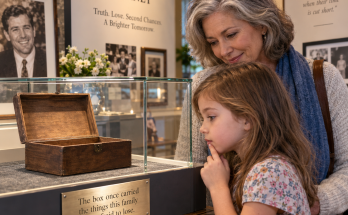
“The historical collection wants to include Willow Creek in an exhibit.”
I looked around the kitchen.
“The house?”
“Yes.”
“Why?”
“Because the records show how the trust worked.”
I considered it.
“Do they want the hidden chamber?”
“No.”
“Good.”
“They want photographs.”
I looked at the framed picture.
“Which ones?”
“Whatever you approve.”
I agreed.
The exhibit opened three months later.
There were copies of the financial records.
Photographs of the properties.
Maps.
Letters.
A section about the people affected.
Miriam spoke about her father.
Rachel spoke about identity.
Evelyn spoke about the years she spent hidden.
I declined to speak publicly.
Not because I was ashamed.
Because I had spent enough time explaining the past.
I wanted to live in the present.
The exhibit was successful.
People came from different towns.
Some recognized names.
Some recognized properties.
A few came because their own families had been affected.
One elderly man approached me after the opening.
“My father worked for Arthur.”
I listened.
“He always said Arthur was trying to fix something.”
“He was.”
The man nodded.
“I didn't understand what.”
“Neither did I.”
He smiled.
“Maybe that's how it should be.”
I wasn't sure what he meant.
Later, I understood.
Not every generation needs to carry every secret.
Sometimes understanding is enough.
The community kitchen became busier after the exhibit.
People donated more.
Volunteers arrived.
Some had heard the story.
Others knew nothing about it.
That pleased me.
I didn't want the kitchen to become a monument to the past.
I wanted it to become useful.
On one Monday, a young girl came into the kitchen with her mother.
She watched me measure flour.
“Is this your house?”
“Yes.”
“Are you the lady from the story?”
I smiled.
“Which story?”
“The secret house.”
Her mother looked embarrassed.
“Sorry.”
I laughed.
“It's all right.”
The girl looked around.
“Where's the secret room?”
I pointed toward the hallway.
“Closed.”
“Why?”
“Because there's nothing there now.”
She thought about that.
Then asked, “Was there treasure?”
“No.”
“Gold?”
“No.”
“Jewels?”
“No.”
“What was there?”
I considered telling her.
Instead, I said, “The truth.”
She frowned.
“That's boring.”
I laughed.
Her mother laughed too.
The girl ran toward the kitchen table.
I watched her go.
Maybe she was right.
The truth wasn't treasure.
It didn't glitter.
It didn't make noise.
It simply remained.
That afternoon, Rachel and I walked through the garden.
She had been accepted into a program she wanted.
She was moving for six months.
I felt proud.
And unexpectedly sad.
“You'll come back.”
“I know.”
“You promise?”
She smiled.
“I promise.”
“Good.”
She stopped beside the maple tree.
“Do you ever wish you had never opened the first envelope?”
I thought about it.
“No.”
“Even knowing everything?”
“Especially knowing everything.”
She nodded.
“I think I understand.”
“What?”
“Sometimes the truth hurts because it removes the story you were using to survive.”
I looked at her.
“That sounds wise.”
“I stole it from you.”
I laughed.
“Fair enough.”
She hugged me.
Then she walked toward the house.
I stayed beneath the maple tree.
The branches were filling with new leaves.
The house stood beyond them.
Still old.
Still imperfect.
Still ours.
But no longer haunted by questions.
The past had not disappeared.
It had simply stopped demanding every room.
That evening, I returned to the kitchen.
The coffee tin was on the shelf.
I lifted it.
Empty.
I smiled.
Then I put it back.
Nothing happened.
No letter.
No hidden key.
No knock at the door.
Just the quiet hum of the refrigerator.
For once, I didn't need anything else.
Click here to continue reading: PART 26: When Rachel Left for Her New Life, Clara Finally Opened Arthur’s Last Unread Page and Discovered the Answer He Had Never Managed to Say Aloud
The Money on the Counter Was Never Meant for Me, Until I Heard What My Husband Planned to Do With His Mother
Part 25 of 27