Two years after the first envelope appeared beneath the sugar jar, I stopped counting how many people had eaten at Willow Creek.
There had been too many.
That was the point.
Numbers were useful for courts.
They were useful for banks.
They were useful for records.
But they could not describe what the house had become.
On Monday mornings, volunteers arrived before sunrise.
The kitchen filled with the smell of bread.
Someone always burned something.
Someone always laughed.
Children did homework at the long table.
Older neighbors argued about football.
People who had never met before exchanged recipes.
The house was noisy.
Arthur would have loved it.
Beatrice still lived there.
She claimed she was too old to climb stairs.
Then climbed them every day.
Evelyn came every Monday.
Sometimes Rachel joined her.
Rachel had finished her program and returned permanently.
She had found work she enjoyed.
She had her own apartment.
Her own friends.
Her own plans.
The house was part of her life.
But it was not her entire life.
That mattered.
Miriam remained involved with the community program.
The scholarship established in her father's name had grown.
Students received help every year.
Some of them later returned as volunteers.
The story continued through people who had never known Robert Cole.
That was perhaps the best kind of remembrance.
It did not require grief.
It required action.
The historical collection eventually published the Willow Creek records.
Researchers studied them.
Law students wrote papers.
Historians argued over details.
Some interpretations were wrong.
Others were incomplete.
That was inevitable.
History was never perfectly controlled.
But the evidence remained available.
No one person could hide it again.
The old ledger was preserved.
The photographs were preserved.
Arthur's letters were preserved.
Laura's records were preserved.
Even the grocery list was preserved.
Not because it was important to a court.
Because it reminded everyone that history was made by ordinary people making ordinary choices.
One afternoon, I received a letter from Miriam.
She wrote that her father's name had been placed on a memorial plaque.
She thanked Arthur.
Then she thanked me.
I wrote back.
I told her Arthur deserved credit for what he did.
But the people who survived the damage deserved credit too.
They had rebuilt.
They had continued.
They had refused to let what happened define everything afterward.
That was the real inheritance.
Not money.
Not property.
A choice.
I still thought about Arthur.
Not every day.
That was another change.
For a long time, thinking about him had meant thinking about the case.
Eventually, it meant remembering his laugh.
The way he drank coffee too strong.
The way he forgot where he put his glasses.
The way he argued with Beatrice about paint.
The way he could never fold a map correctly.
Those memories had once seemed unimportant.
Now they were the ones I wanted.
The secrets had belonged to the investigation.
The ordinary moments belonged to us.
One autumn morning, I went into the attic.
I was looking for winter blankets.
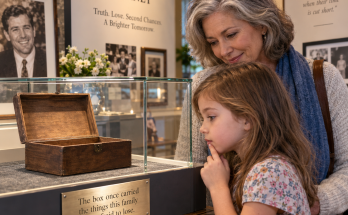
I found an old wooden box.
For a second, my heart raced.
Then I laughed at myself.
Not everything was a clue.
The box contained Christmas decorations.
A broken ornament.
A child's drawing.
Two photographs.
And a small card.
The card was from Arthur.
To Beatrice.
Merry Christmas.
I know I said I didn't need anything.
I was wrong.
I need you.
I sat on the attic floor.
There were no hidden instructions.
No financial records.
No warning.
Just love.
Simple.
Unprotected.
I carried the card downstairs.
Beatrice read it.
Then she cried.
“I forgot this.”
“So did I.”
She pressed it to her chest.
“I don't know why we spent so much time being afraid.”
“Because we thought fear was useful.”
“Was it?”
“Sometimes.”
She looked at me.
“And now?”
“Now I think courage is more useful.”
She smiled.
“That sounds like something you'd say.”
“I've had practice.”
The winter that year was cold.
The community kitchen stayed open.
People needed it more.
The house became warmer inside because it was full.
One evening, the power failed.
The kitchen went dark.
Everyone stopped.
Then Daniel lit candles.
Someone began laughing.
Children shouted.
Beatrice complained about safety.
Rachel found flashlights.
Within minutes, everyone was moving.
No panic.
No fear.
Just people solving a small problem together.
The electricity returned an hour later.
Everyone applauded.
I stood in the doorway.
It struck me that this was the opposite of the old story.
When the house went dark before, darkness meant secrets.
Now darkness meant someone would light a candle.
That was the difference.
We had changed the meaning of the house.
Not by erasing what happened.
By refusing to let it remain the only thing that happened there.
Years passed.
The paint changed.
The garden grew.
The kitchen expanded.
The old hidden chamber remained closed.
Sometimes visitors asked about it.
I told them the truth.
“There used to be records there.”
“What kind?”
“Records that helped people understand what happened.”
“Can we see them?”
“The important ones are in the archive.”
“Why not here?”
“Because this room is no longer for secrets.”
They usually accepted that.
One child asked me once whether Arthur had been a good man.
I thought carefully.
“Yes and no.”
The child looked confused.
“Which one?”
“Both.”
“Can someone be both?”
“Yes.”
“Then how do you know?”
“You look at what they did.”
The child considered this.
Then nodded.
That was enough.
The final legal document remained framed in my office.
The account was closed.
The trust was transparent.
The beneficiaries had been paid.
The property claims were settled.
The historical records were preserved.
Nothing remained legally unresolved.
That did not mean the past was painless.
It meant the past no longer had unfinished business.
There is a difference.
Rachel eventually married.
She did not ask me to give her away.
She walked beside Evelyn.
Anna stood on her other side.
They laughed before the ceremony even began.
Miriam came.
Daniel brought bread.
Beatrice cried before the music started.
I cried after.
The wedding took place in the garden.
Under the maple tree.
The same tree that had watched me discover fear.
Now it watched Rachel begin a life she had chosen for herself.
Afterward, everyone gathered in the kitchen.
Someone spilled wine.
Beatrice blamed Daniel.
Daniel blamed the table.
Rachel laughed.
I looked around.
This was the ending.
Not a courtroom.
Not a vault.
Not a final revelation.
This.
People who had once been separated by secrets now sharing a meal.
Families that had once been divided by money now talking without fear.
A house that had once hidden evidence now giving people somewhere to gather.
Arthur's final instruction had been fulfilled.
The house was full of life.
Later that night, after everyone had gone, I stood alone in the kitchen.
The coffee tin remained on the shelf.
I took it down.
For the last time.
I opened it.
Empty.
I smiled.
Then I turned it over.
The symbol was still there.
The circle.
The line.
The mark that had once sent us chasing names through old records.
I ran my thumb across it.
Then I put the tin back.
I did not throw it away.
I didn't need to.
The past deserved a place.
It simply didn't deserve control.
I turned off the lights.
Before leaving, I looked toward the hallway.
The framed photograph of Arthur, Laura, Evelyn, and the others caught a little moonlight.
Everyone in the picture was smiling.
They had no idea what would come.
Maybe that was why the photograph mattered.
They were not smiling because they knew the future would be safe.
They were smiling because, for one afternoon, life was good.
That was all anyone could ever really have.
One afternoon.
One meal.
One conversation.
One chance to choose differently.
I closed the kitchen door.
The house was quiet.
But not empty.
Never empty again.
The next morning, the community kitchen opened at seven.
By seven fifteen, someone was already asking for coffee.
By seven thirty, children were arguing over the last piece of toast.
By eight, Daniel was complaining that nobody appreciated his bread.
Beatrice told him to stop talking and serve it.
I stood by the window.
Sunlight crossed the floor.
For a moment, I remembered the woman who had once stood in this same kitchen holding an envelope.
She had been frightened.
She had believed the truth would destroy her.
She had been wrong.
The truth had changed her.
But it had not destroyed her.
It had forced her to choose.
Again and again.
Open the door.
Ask the question.
Tell the truth.
Stay.
Leave.
Forgive.
Refuse.
Build.
And eventually, let go.
That was the last thing Arthur had taught me.
Not how to uncover secrets.
How to stop needing them.
I looked around the kitchen.
The house was alive.
The old records were safe.
The account was closed.
Rachel had her own life.
Evelyn had found her daughter.
Miriam had honored her father.
The damaged families had received what could be returned.
Claire had stepped away from the network she inherited.
Julian was gone from my life.
Daniel had his bakery.
Anna had her legal practice.
Beatrice had her yellow walls.
And I had this house.
Not as a vault.
Not as an inheritance.
As a place where people could come in.
I opened the front door.
Morning air moved through the hallway.
A neighbor arrived carrying a box of vegetables.
“Where should I put these?”
“In the kitchen.”
Another volunteer came behind her.
Then another.
Soon the house filled with footsteps.
I stepped aside.
Let them in.
That was the final choice.
Not to guard the house.
Not to hide it.
Not to preserve it exactly as Arthur had left it.
To let it become something new.
Something useful.
Something alive.
The secrets had ended.
The house remained.
And that was enough.
The End
Read more original stories on Feel Every Story.
The Money on the Counter Was Never Meant for Me, Until I Heard What My Husband Planned to Do With His Mother
Part 27 of 27