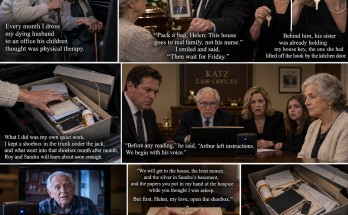
The second first Tuesday arrived under a sky the color of wet cement. Arthur was already dressed when I came downstairs at seven thirty, wearing a navy sweater over his shirt and trying to fasten a cuff with fingers that no longer obeyed him reliably. His cane leaned against the kitchen table. Beside it sat two travel mugs of coffee. For a man who claimed we were doing nothing more interesting than paperwork, he had prepared for the trip with the concentration of someone leaving the country.
I buttoned his cuff for him. “Physical therapy again?”
“If anyone asks.”
“Your physical therapist is going to be offended that someone else is getting credit for all his work.”
Arthur pushed one mug toward me. “He bills enough to survive the disappointment.”
There had always been a dry edge to his humor, but illness sharpened it. He hated being fussed over. He hated language that made him sound fragile. He had once thrown a pamphlet titled Living Courageously With Cancer into the recycling bin because, as he put it, he had been planning to live irritably with cancer instead.
I helped him into the car.
Roy called before we had backed out of the driveway.
Arthur looked at the glowing name on the dashboard. “You answer.”
“He called you.”
“He wants something.”
“How do you know?”
“He called before nine.”
I pressed the button.
Roy’s voice filled the car. “Dad?”
“It’s Helen.”
A pause. “Where’s Dad?”
“Right beside me.”
“Where are you going?”
Arthur lifted his eyebrows.
I looked straight ahead. “Physical therapy.”
Roy relaxed audibly. “Again?”
“The human body remains stubbornly physical.”
Arthur covered his mouth to hide a laugh.
Roy did not appreciate mine. “Could I talk to him?”
I handed Arthur the phone.
“What do you need, son?”
Straight to the point. Arthur always did that with Roy because Roy spent five minutes circling every request he was embarrassed to make.
There was another pause.
“My truck transmission went.”
Arthur closed his eyes.
“How much?”
“Mechanic says thirty-eight hundred.”
“You have savings.”
“I had some expenses.”
“What expenses?”
“Dad.”
“What expenses?”
Roy sighed. “Does it matter?”
“Yes.”
They went back and forth for another minute. Arthur finally agreed to lend him two thousand, not four, and only after Roy sent the mechanic’s written estimate.
When the call ended, Arthur handed the phone back to me.
“You’ll give him the rest,” I said.
“No.”
“You always do.”
“Not anymore.”
I looked toward him.
He was staring through the windshield.
Something had changed after the hospice incident. Not love. Arthur still loved Roy and Sandra with the painful persistence of a father who remembered them at five years old even when they stood before him at fifty. But love had stopped being the same thing as trust.
Mr. Katz met us at the same blue door. This time he carried a small digital recorder.
I noticed it.
Arthur noticed me noticing.
Neither of us mentioned it.
I settled into the waiting room with my coffee and an outdated gardening magazine. Through the wall came the muffled rise and fall of voices. I could not make out words. Once I heard Arthur cough for nearly a minute. I almost went in.
Mr. Katz’s assistant emerged before I could stand. “He’s all right.”
“You can hear that?”
“We keep water in there for him.”
There was something about the answer that told me they had discussed Arthur’s condition before we arrived.
“How long have you represented my husband?”
She smiled politely. “You’ll have to ask Mr. Mercer.”
Of course.
Two hours later Arthur appeared carrying a sealed envelope.
He looked terrible.
His skin had gone gray around the mouth, and the effort of standing seemed to travel through his entire body. I took his elbow.
“This is too much.”
“I’m fine.”
“That sentence has never made anyone fine.”
Mr. Katz stood in the doorway. “Helen, would you bring him next month at the same time?”
I looked at Arthur.
Arthur nodded.
That was how it became a ritual.
First Tuesday.
Coffee.
Brown or navy sweater depending on the weather.
Cane across his knees.
Drive downtown.
I waited.
Arthur disappeared behind the office door.
Sometimes he stayed forty minutes. Sometimes almost three hours.
When he came out, he was always tired.
And strangely relieved.
The children noticed the appointments but did not question them deeply. Why would they? Physical therapy made sense for a man weakened by cancer and heart disease. Sandra once complained that Arthur should be doing more sessions, not fewer.
“You’d be stronger if you took rehabilitation seriously,” she told him during Sunday dinner.
Arthur cut a piece of roast chicken.
“I’ll keep that in mind.”
I looked down at my plate so she would not see me smiling.
Her attention had already moved elsewhere.
“Have you thought about what you’re doing with the garage?”
Arthur paused.
“What about it?”
“Eventually.”
The word landed on the table.
Roy cleared his throat.
Sandra pretended she had said nothing unusual. “It’s just full of tools you don’t use.”
“I use them.”
“When?”
“I used a screwdriver Thursday.”
“That is not what I mean.”
“What do you mean?”
She pushed vegetables around her plate. “Roy could use the space for his boat.”
Arthur looked at his son.
Roy lifted both hands. “I didn’t ask her to say anything.”
“No,” Arthur said. “You generally don’t.”
Roy’s mouth tightened.
That was the first time I saw Arthur deliberately stop cushioning his disappointment.
Later, while I washed dishes, he came into the kitchen and leaned against the counter.
“You heard them.”
“I usually do.”
“The garage.”
“Yes.”
He watched water run over my hands. “What did you think?”
“I think your children are frightened.”
Arthur seemed surprised.
“Of losing me?”
I shut off the faucet.
“No. Of what happens after.”
The answer hurt us both.
Arthur looked toward the dining room where Roy and Sandra were laughing about something Melissa had said.
“They weren’t always like this.”
“I know.”
He told me stories of them as children. Sandra sleeping on the floor beside his bed during a bad case of pneumonia because she was afraid he would disappear during the night. Roy saving allowance money to buy him a fishing lure for his fortieth birthday. Every selfish adult had once been a child capable of uncomplicated love. Arthur lived inside that contradiction.
Three weeks later, Sandra began removing things.
The first item was a silver serving spoon.
“It belonged to Mom,” she said when I noticed the empty space in the cabinet.
“I know.”
“I’m taking it for Melissa.”
“Did Arthur say you could?”
Sandra’s expression changed. “Why would I need permission to take my mother’s things?”
“Because they’re in Arthur’s house.”
“It’s my family’s house.”
There it was again.
Family.
A word sharpened into a blade.
I dried my hands. “Ask him.”
She stared at me.
Then she returned the spoon.
For that day.
By the following month, three pieces were missing.
I did not confront her.
I started writing dates.
That was the beginning of the notebook.
At first it was ordinary nursing habit. I had spent decades documenting medication times, symptoms, dosages, changes. Arthur’s illness had made our household run on schedules: morphine at one hour, anti-nausea medication at another, blood pressure twice daily, laxative adjustments, hydration, pain scores.
Then one evening I counted his tablets.
I counted again.
Four were missing.
Arthur had been unusually sleepy after Roy and Sandra visited.
Not normal cancer fatigue. Not the soft descent caused by his prescribed medication. This was heavier. He had fallen asleep halfway through a sentence and remained difficult to wake for almost six hours.
I blamed myself.
That is the truth.
A nurse can spend a lifetime being careful and still be destroyed by one mistake. I stood at the kitchen counter at two in the morning with the bottle under the light, trying to reconstruct every dose from memory.
Had I doubled one?
Dropped one?
Transferred pills into another container?
I searched the trash.
My purse.
The car.
Arthur’s bedside drawer.
Nothing.
The next morning he found me sitting at the kitchen table with my medication log spread around me.
“What happened?”
“I made a mistake.”
“No.”
“I’m short four tablets.”
He lowered himself carefully into the chair opposite me.
“You did not make a mistake.”
“You cannot know that.”
“I can.”
“How?”
His eyes held mine.
Then he looked away.
That was the moment I first suspected Arthur knew more than he was telling me.
“Arthur.”
He rubbed the top of his cane with one thumb.
“Start keeping the bottles.”
“What?”
“Empty ones. Keep them.”
“Why?”
“And receipts.”
My stomach tightened.
“Why?”
He reached across the table and covered my hand.
“Because I’m asking.”
“That is not an answer.”
“No.”
“Are you afraid somebody is taking your medication?”
He said nothing.
“Roy?”
His jaw moved.
“Sandra?”
Still nothing.
I stood.
“I’m calling them.”
Arthur caught my wrist.
His grip was weak but urgent.
“No.”
“If someone touched your medicine—”
“Helen.”
“No.”
“I need evidence before accusation.”
The words stopped me.
Evidence.
Not suspicion.
Not anger.
Evidence.
The language sounded exactly like Mr. Katz.
I sat again.
“Is that what the Tuesday appointments are about?”
Arthur gave me the faintest smile.
“Housekeeping.”
I wanted to shake him.
Instead I said, “I hate that word now.”
“I’m developing affection for it.”
From that morning forward, I counted everything.
Every pill.
Every visitor.
Every unexplained sleep episode.
Every missing object.
Every strange question from Roy about the house.
Every strange question from Sandra about bank accounts.
I kept the notebook in a shoebox beneath the spare tire compartment in the trunk because nobody but me ever opened it.
Arthur never asked where I kept it.
He only asked, once a month, “Anything for the box?”
Sometimes there was.
A pharmacy receipt.
A photograph of the silver cabinet.
A handwritten medication count.
The first picture of Roy measuring the garage appeared almost by accident.
I came outside one afternoon and found him near the workbench with a tape measure stretched from wall to wall.
“What are you doing?”
He jerked around.
“Nothing.”
I lifted my phone.
“Then hold still.”
He stared at me.
I took the photograph.
“What was that for?”
“Memories.”
He laughed nervously.
I smiled.
That night I printed the photograph and slid it beneath the pharmacy receipts.
Two months later, I discovered that Sandra had stopped waiting for permission altogether.
Arthur and I returned from his Tuesday appointment to find her car backed close to the side door.
The trunk was open.
Inside sat the wooden case containing Margaret’s good silver.
Sandra came out carrying a framed photograph.
She froze when she saw us.
Arthur stared at the trunk.
Nobody spoke.
Finally Sandra said, “I was protecting Mom’s things.”
“From whom?” Arthur asked.
Her eyes moved toward me.
She didn’t need to answer.
I felt Arthur’s body change beside me.
Not with anger.
With decision.
He walked to the car.
He had been weak all afternoon, but something steadied him.
“Put the picture back.”
“Dad—”
“Now.”
Sandra’s mouth opened.
Arthur pointed toward the house.
“Put it back.”
She did.
Then he looked at the silver.
“Leave that.”
“Mom wanted me to have it.”
“If your mother told you that, we can discuss it. Until then, it stays here.”
Sandra’s face went red.
“You’re choosing her again.”
Arthur went very still.
“Helen has nothing to do with this.”
“She has everything to do with it.”
“No.”
“You married your nurse and now you act like we are strangers.”
Arthur leaned heavily on his cane.
For several seconds, I thought he might answer with anger.
He did not.
“You became strangers,” he said quietly, “when you started visiting my belongings more often than you visited me.”
Sandra flinched as if he had struck her.
She slammed the trunk.
The silver stayed inside it.
She drove away with it anyway.
Arthur watched her taillights vanish.
Then he turned to me.
“Photograph?”
I already had.
He nodded.
“Good.”
The following first Tuesday, he carried the photograph into Mr. Katz’s office.
When he came out, he had a new question.
“Where is the shoebox?”
“In the trunk.”
“Keep it there.”
“You knew?”
“I hoped.”
“About what?”
He looked toward the blue office door.
Then back at me.
“They think being sick means I’m not paying attention.”
His voice was calm.
That frightened me more than anger would have.
“Are you?”
“Paying attention?”
“Yes.”
Arthur took my hand.
“To everything.”
On the drive home, he asked me to stop at a bank.
Not ours.
He remained inside for twenty-seven minutes.
When he returned, he carried no envelope and offered no explanation.
That night, after he fell asleep, I added the date to my notebook.
Then I wrote one sentence beneath it.
Arthur is preparing for something.
I did not yet understand that his children were doing the same.
Click here to continue reading: PART 3: The Night Arthur Pretended to Sleep, I Saw His Children Put Papers Beside His Bed and Learned Why He Needed Proof
Before the Flowers Had Wilted, Arthur’s Children Were Measuring My House and Telling Me I Had Until Friday to Leave
Part 2 of 48