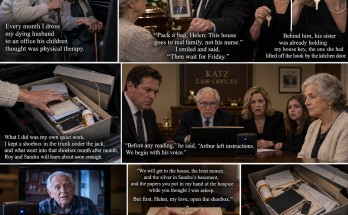
Arthur woke before dawn on the final first Tuesday. I knew he was awake because I heard his cane touch the bedroom floor once, then stop. He had spent the previous week sleeping fourteen or fifteen hours a day, but that morning his eyes were clear. He sat on the edge of the bed in his undershirt, breathing carefully, and looked toward the window as darkness thinned over Hawthorne Lane.
“We should cancel,” I said.
“No.”
“You haven’t stood up yet.”
“I’m building suspense.”
“You’re building my blood pressure.”
He smiled.
I brought his clothes from the closet.
He chose a gray jacket I had not seen him wear in months.
“Why that one?”
“It has inside pockets.”
“For what?”
“Things.”
“Arthur.”
“Helen.”
We had been using each other’s names as complete arguments for years.
I helped him dress.
His body had become startlingly light. The man who once carried fifty-pound bags of soil through the yard now had wrists I could nearly circle with my fingers. Illness had taken muscle, appetite, privacy, patience. What it had not taken was the particular way Arthur watched the world when he was making a decision.
By six thirty, I had the car warming.
He stopped at the kitchen door.
His eyes went to the brass hook beside it.
My spare key hung there.
Sandra had borrowed it months earlier, claiming she needed access if there was an emergency. Arthur had insisted she return it.
“Take that down,” he said.
“The key?”
“Yes.”
“Why?”
“Put it in your purse.”
I did.
He looked relieved.
The gesture bothered me.
“Are you expecting Sandra today?”
“No.”
“Roy?”
“No.”
“Then why—”
“Humor a dying man.”
“I’ve been doing that for two years.”
“Excellent. You’re experienced.”
Outside, the air had that cold metallic smell that comes before winter. I wrapped a blanket around his legs after he settled into the passenger seat.
His cane lay across his knees.
He placed one hand on it.
For the first ten minutes, neither of us spoke.
Then Arthur said, “Do you remember the first time we met?”
“You accused me of stealing your socks.”
“I had twelve pairs when I entered the hospital.”
“You had eleven when I counted.”
“Twelve.”
“You were on morphine.”
“My arithmetic was excellent.”
“Your arithmetic claimed the television was a window.”
“That happened once.”
I smiled.
The first time I met Arthur, he had been sixty-three and furious about surviving a heart attack. I was the nurse assigned to his recovery floor. He hated the hospital food, the blood-pressure cuff, the physical therapist, the cardiologist, and me in approximately that order.
“Mrs. Mercer keeps calling,” I had told him.
“My wife worries.”
“She loves you.”
“Same problem.”
Margaret died eleven years later.
I did not see Arthur during those years.
By the time our paths crossed again, I had left hospital nursing. He recognized me at a pharmacy while arguing with an automated blood-pressure machine.
“You stole my socks,” he said.
I laughed so loudly the pharmacist looked over.
Coffee followed.
Then lunches.
Then long walks, before his knees worsened.
Then marriage.
Roy and Sandra attended the wedding but refused to appear in photographs.
Arthur never discussed that day without becoming quiet.
Now, as we drove downtown for the twenty-second time, he reached over and touched the back of my hand.
“I’m glad the machine was broken.”
“What machine?”
“The blood-pressure machine.”
“It wasn’t broken.”
“It told me my pressure was high.”
“You were shouting at it.”
“It was provoking me.”
I laughed.
He watched me.
“Remember that.”
“What?”
“Laughing.”
My throat tightened.
“Don’t start.”
“I’m not starting.”
“You are.”
“I’m finishing.”
I gripped the wheel.
“No.”
Arthur looked forward.
“Helen.”
“No deathbed wisdom before breakfast.”
“It’s after breakfast.”
“You ate half a piece of toast.”
“I ate the important half.”
I drove faster than I should have.
Mr. Katz was waiting outside when we arrived.
So was Officer Bennett.
I recognized him from the card in Arthur’s drawer.
He was younger than I expected, perhaps early forties, wearing a dark coat and holding a folder beneath one arm.
I turned toward Arthur.
“You said lawyer.”
“It is a law office.”
“You neglected the police officer.”
“He’s decorative.”
Officer Bennett heard him.
“So I’ve been told.”
I helped Arthur out.
The officer offered his arm.
Arthur ignored it and used the cane.
Pride survived everything.
Inside, Mr. Katz’s assistant had cleared the waiting room.
No magazines.
No cookies.
No other clients.
That frightened me more than Bennett’s presence.
Arthur stopped before the inner office.
“Helen.”
“What?”
“Today may take longer.”
“You can barely stay awake.”
“I know.”
“I’m coming in.”
“No.”
“For once, stop protecting your legal record and let your wife sit beside you.”
His face softened.
“Especially today.”
I understood.
If I entered, somebody could later claim I influenced whatever he was about to sign or record.
Arthur touched my cheek.
“Coffee’s fresh.”
“I hate you.”
“No, you don’t.”
“Currently undecided.”
He smiled.
Then he went inside.
The door closed.
I waited three hours and twelve minutes.
The wall clock seemed to become louder as the morning passed.
At ten fifteen, Mr. Katz’s assistant carried in water.
At ten forty, Officer Bennett came out, made a phone call in the corridor, then returned without speaking to me.
At eleven twenty, another man arrived.
He introduced himself as Dr. Harlan, a geriatric psychiatrist.
My stomach dropped.
Another capacity evaluation.
He entered Arthur’s office.
Forty minutes later he left.
“How is he?” I asked.
The doctor considered his answer.
“Tired.”
“Mentally?”
He looked toward the door.
“Very clear.”
The words were meant to reassure me.
Instead, they told me Arthur had just passed whatever examination mattered.
At twelve seventeen, the office door opened.
Arthur emerged in the wheelchair again.
Mr. Katz pushed him.
Officer Bennett followed carrying two sealed envelopes.
Arthur’s gray jacket was zipped to his throat.
His hands were empty.
I stood.
“That’s it?”
Arthur smiled.
“That’s it.”
Mr. Katz looked at me. “Helen, Friday at ten.”
“I know.”
“Please come even if someone tells you the meeting has been canceled.”
I frowned.
“Who would tell me that?”
Mr. Katz did not answer.
Officer Bennett watched Arthur.
Something passed silently among the three men.
I hated it.
“I would like one person in this building to speak a complete sentence.”
Arthur pointed toward me.
“That’s why I married her.”
Mr. Katz almost smiled.
Then he leaned down toward Arthur.
“Are you certain?”
Arthur nodded.
“Every word.”
The lawyer straightened.
“All right.”
On the way home, Arthur slept.
At one traffic light, his hand slipped from the cane.
I caught it before it fell.
He woke.
“Still here?”
“Where would I go?”
He looked at me for several seconds.
“That’s the point.”
I did not understand.
At home, he asked to sit in the kitchen rather than go straight to bed.
I made tea.
He drank two sips.
The afternoon light stretched across the floorboards.
Arthur looked around the room as if seeing it from a distance.
“Margaret chose those curtains.”
“I know.”
“She changed her mind four times.”
“They’re nice.”
“They cost more than my first car.”
“That explains why Sandra wants them.”
He smiled, then became serious.
“Don’t remove Margaret.”
“I never have.”
“I mean after.”
My throat tightened.
“Arthur.”
“She belongs here too.”
“She always has.”
He nodded.
“I know.”
He took another sip.
“Roy thinks you’re trying to replace her.”
“I know.”
“Sandra thinks loving you means I loved their mother less.”
“I know.”
“They’re wrong.”
“I know.”
He looked almost irritated.
“You know everything today.”
“It saves time.”
His laugh turned into a cough.
When it passed, he looked exhausted.
I helped him to the study.
Before sleeping, he caught my sleeve.
“Friday.”
“Yes.”
“Promise me.”
“I’ll be there.”
“No matter what they say.”
“Who?”
“Roy. Sandra.”
“What are they going to say?”
He closed his eyes.
“Whatever they need to.”
I sat beside him.
“Arthur, what did you do?”
He breathed slowly.
“Made sure you don’t have to ask permission.”
“For what?”
“To stay.”
The word landed harder than I expected.
I looked toward the doorway, toward the hall beyond it, toward the house where we had eaten thousands of ordinary meals, argued over thermostats, folded laundry, watched storms, buried a dog, welcomed grandchildren, and received the diagnosis that would eventually end our marriage without ending what it meant.
“The house?”
Arthur’s eyes remained closed.
“Friday.”
I wanted to demand more.
I didn’t.
That evening Roy came over.
He brought no food.
He sat beside Arthur for twenty minutes, talked about the football season, then wandered into the garage.
I followed after five minutes.
He was standing beside the workbench with the tape measure again.
This time he had a notebook.
“What are you doing?”
He turned.
“Checking whether my boat trailer will fit.”
My mouth went dry.
“Your father is alive.”
“I know.”
“Then why are you measuring his garage?”
Roy frowned.
“I’m planning.”
“For his death?”
“For practical matters.”
I took out my phone.
His expression changed.
“Don’t.”
I photographed him anyway.
“Helen.”
“One more for the memories.”
He stepped toward me.
Then Arthur’s voice came through the open door.
“Roy.”
Not loud.
But enough.
Roy stopped.
Arthur stood in the kitchen doorway, one hand braced against the frame.
I had not heard him approach.
“Come inside,” he said.
Roy looked embarrassed.
“Dad, I was just—”
“I know.”
“You said I could store the boat here someday.”
“I said maybe.”
“I assumed—”
“That is your problem.”
Roy stared at his father.
Arthur’s breathing was labored.
His voice was not.
“You keep confusing maybe with mine.”
Roy’s face hardened.
“What is that supposed to mean?”
“It means stop measuring things that belong to people who are still alive.”
Roy put the tape measure away.
He left ten minutes later.
Arthur sat at the kitchen table until the shaking in his hands stopped.
“That photograph,” he said.
“I know.”
“Box.”
“I know.”
I placed it in the shoebox that night.
Twenty-two dated envelopes were inside by then.
Medication counts.
Pharmacy receipts.
Photographs.
Notes.
Copies of papers I had found near Arthur’s hospice bed.
A list of missing silver.
Dates Roy visited.
Dates Sandra visited.
Dates Arthur became abnormally sleepy afterward.
I tied the box with a length of cotton cord and returned it to the trunk beneath the floor panel.
Four days later Arthur entered hospice again.
This time nobody pretended he was coming home.
His decline was rapid.
He slept more than he woke.
Roy came twice.
Sandra came three times.
On the second night, I woke in the chair beside Arthur’s bed and saw Sandra standing over his bedside drawer.
“What are you doing?”
She jerked around.
“Looking for tissues.”
“They’re on the table.”
She closed the drawer.
Arthur’s eyes remained shut.
Sandra left fifteen minutes later.
I checked the drawer.
A medication bottle had moved.
I photographed it.
Arthur opened his eyes.
“I thought you were asleep.”
“Excellent acting.”
My stomach dropped.
“You saw her.”
“Yes.”
“What did she touch?”
“Bottle.”
I called the nurse.
The pills were counted.
One was missing.
The nurse documented it.
Arthur asked for a copy.
That page became envelope twenty-two.
Three mornings later, Arthur died.
There was no dramatic last sentence.
No sudden revelation.
His breathing simply became farther apart.
I held his hand.
He opened his eyes once.
I leaned close.
He whispered something so softly I almost missed it.
“Friday.”
Then he was gone.
At the funeral, Roy told me to pack.
Sandra took my key.
They believed Arthur’s death had ended his ability to stop them.
They were wrong.
Thursday night, I removed the shoebox from the trunk and placed it beside my bed.
At nine twelve, my phone rang.
Sandra.
I answered.
“You don’t need to go tomorrow,” she said.
I looked at the box.
“Why?”
“Roy talked to someone. Katz is just handling paperwork. The old will is clear.”
“Then going won’t hurt.”
“Helen.”
Her voice sharpened.
“This is family business.”
I looked toward Arthur’s empty side of the bed.
For nine years, those words had been used to place me outside every invisible boundary they wanted to draw.
I touched the cotton cord around the shoebox.
“Ten o’clock,” I said.
Sandra went silent.
Then she asked, “What did Dad tell you?”
I remembered his eyes closing in the kitchen.
Friday.
“Nothing,” I said.
That frightened her more than any answer could have.
She hung up.
I did not sleep much.
At nine the next morning, I dressed in the navy blouse Arthur liked because he said it made me look as if I intended to win an argument.
I took my purse.
I took the shoebox.
Before leaving, I checked the kitchen hook.
Empty.
Sandra still had my key.
I stood there for a moment.
Then I closed the door behind me and drove downtown.
Mr. Katz’s blue door was already unlocked.
Roy’s car was parked out front.
Sandra’s was beside it.
And through the office window, I could see a small black recorder waiting on the lawyer’s desk.
Arthur had spent twenty-two months preparing for that room.
At last, I was about to learn why.
Click here to continue reading: PART 5: The Lawyer Played Arthur’s Voice Before Anyone Saw the Will, and Roy’s First Objection Revealed Exactly What He Feared
Before the Flowers Had Wilted, Arthur’s Children Were Measuring My House and Telling Me I Had Until Friday to Leave
Part 4 of 48