Donna’s nephew was safe.
Officer Bennett told us that first.
He understood which fact mattered most.
Noah was six.
Confused.
Hungry.
Watching cartoons when officers entered the motel room.
His mother was with him.
Roy was not.
The woman Bennett initially reported was Donna’s sister, Claire.
Roy had invited them on what he described as a short trip to a lakeside cabin.
There was no cabin.
“What happened?” Donna asked.
We were still at the station.
Bennett had returned from coordinating with officers at the motel.
“Claire says Roy told her you were in trouble.”
Donna stared.
“What?”
“He said you were facing criminal charges because of documents connected to Arthur.”
“That part might be true.”
“He told her he could help if she came with Noah.”
“Why Noah?”
“Claire says Roy claimed Arthur had established an education account for him.”
Donna looked physically ill.
“There is no account.”
“No.”
“He used my nephew again.”
“Yes.”
Sandra stood beside the wall, arms folded.
“What did Roy want Claire to sign?”
Bennett looked at her.
“How did you know?”
“Because that’s what he does.”
A grim observation.
Accurate.
Claire had been given documents.
One stated Noah Mercer was Roy’s biological son.
Another authorized Roy to act for him regarding the descendants’ trust.
Claire refused.
Roy became angry.
Not violent.
But frightening enough that she locked herself and Noah in the motel bathroom and called Donna.
Donna’s phone had been with police during part of her interview.
The call went unanswered.
Claire then called emergency services.
By the time officers arrived, Roy had left.
“On foot?” I asked.
“Unknown vehicle.”
“Where?”
“We’re looking.”
“What did he leave?”
Bennett’s expression hardened.
“A lot.”
The motel room contained the missing file box from Peter’s office.
Old company records.
Margaret’s documents.
Copies of Arthur’s signatures.
Forgery materials.
A portable scanner.
Two laptops.
A printer.
Blank legal forms.
Not sophisticated criminal equipment.
Ordinary office tools.
That somehow made it worse.
Roy had not needed secret technology.
Only persistence, access, and people willing to accept his explanations.
“What about the originals?” Sandra asked.
“Some are there.”
“Which?”
Bennett listed them.
The old Arthur authorization with the clean signature.
Buyout schedules.
Peter’s debt notes.
Elaine’s altered accounting pages.
Correspondence from Margaret.
Then something unexpected.
Arthur’s letters to Roy.
Not copies.
Originals.
“Why would Roy have Dad’s letters?”
“Some were addressed to him.”
“Recent?”
“Different periods.”
One dated twenty-six years earlier.
One fifteen.
One six.
One only four months before Arthur died.
Arthur had been writing to Roy for decades about the same behavior.
Money.
Honesty.
Responsibility.
Boundaries.
Sandra looked devastated.
“He kept them?”
“Yes.”
That mattered.
A man indifferent to his father would have thrown them away.
Roy kept them.
Even while forging his name.
Contradictions again.
Love did not prevent harm.
Harm did not prove absence of love.
The hardest truths refused to simplify.
Bennett could not show us everything while evidence was being processed.
But one letter mattered directly to the current investigation.
Arthur had written it four months before his death.
Roy,
Peter tells me you are asking questions about the descendants’ trust again.
If you have a child, bring Katz proof and the trust will operate exactly as your mother intended.
Do not manufacture what does not exist.
Sandra closed her eyes.
Arthur already suspected.
The letter continued.
If you are in trouble, tell me the truth.
I may help you.
I will not give you the house.
I will not terminate your mother’s trust.
I will not sign false statements about a child.
Those matters are closed.
Three boundaries.
All three later became targets.
Hawthorne Lane.
Margaret’s trust.
Fake Evan.
Arthur had predicted the exact pressure points.
Then the final paragraph:
I love you enough to let you be angry with me.
Sandra began crying.
That sentence explained the change in Arthur better than any legal document.
After decades of fearing that saying no would cost him his son, he finally accepted the possibility.
He would rather lose Roy’s approval than keep financing his destruction.
Melissa read the letter over Sandra’s shoulder.
“Grandpa finally listened to Grandma.”
Sandra nodded.
Thirty years late.
Still.
He did.
“What else was in the motel?” I asked.
Bennett hesitated.
“Medication.”
My stomach tightened.
“What kind?”
“Several prescriptions. Some in Roy’s name. Some not.”
“Sedatives?”
“Yes.”
Sandra sat.
“The same one?”
“Same class. We need laboratory confirmation.”
“Why did he have them?”
“We don’t know.”
I hated that answer.
Not because Bennett was wrong.
Because uncertainty had become exhausting.
Then he added, “We also found Arthur’s missing medication.”
I stared.
“The pills from March?”
“A bottle matching his prescription information, with tablets inside.”
“How could you know they’re the same missing pills?”
“We don’t yet.”
“Where?”
“In the file box.”
Sandra looked confused.
“Peter had Dad’s medication?”
“Or Roy put it there.”
Again, we needed sequence.
Evidence did not explain itself.
A bottle in a box could mean possession.
Planting.
Storage.
Transfer.
Nothing without context.
Bennett continued.
“There was also a handwritten inventory.”
“Roy’s?”
“Appears to be.”
The inventory listed items removed from Arthur’s safe-deposit box.
Gold coins.
Jewelry pouch.
Tax records.
Policy copies.
Stock certificates photographed but left.
Brown envelope removed.
Sandra whispered, “He wrote it down?”
“Apparently.”
“Why?”
“People document more than they realize.”
Arthur certainly had.
Roy apparently did too.
The brown envelope entry included a notation:
Wrong file. Pete says originals elsewhere.
Arthur’s hidden note matched.
Roy took the wrong brown envelope.
Arthur had somehow learned exactly what Roy discovered afterward.
“How did Dad know?” Sandra asked.
That question had bothered me since the jacket.
Bennett answered.
“Peter.”
Of course.
Peter had told Arthur.
After helping Roy.
Before fully cooperating.
Always moving between sides.
“Peter admitted it?”
“Yes.”
“He told Arthur Roy took the wrong envelope?”
“Yes.”
“Why?”
“Peter says he had begun regretting what was happening.”
Sandra gave him a skeptical look.
“Before or after he sold Grandpa’s coins?”
“After.”
She laughed bitterly.
“At least he’s consistent.”
The motel inventory contained another item.
M. ledger — unknown location.
Roy had been searching for Margaret’s red ledger too.
He never found it.
Arthur did.
Then hid it among Margaret’s things.
That was the irony.
Roy believed inheritance meant possession.
Arthur understood memory.
He knew Sandra would protect her mother’s belongings emotionally while rarely examining them carefully.
The safest hiding place was inside the grief Roy kept exploiting.
Bennett’s phone rang.
He stepped away.
We waited.
When he returned, he looked directly at me.
“We need to talk about your car.”
My stomach tightened.
“What now?”
“Officers found a small electronic device in the motel room.”
“What kind?”
“Vehicle tracker.”
Sandra whispered, “No.”
“Unused?”
Bennett shook his head.
“Not new. It contains stored location data.”
“Whose?”
“We’re checking.”
I already knew.
Or feared I did.
“When did it start recording?”
Bennett gave the date.
January seventeenth.
The day Roy appeared when my battery cable was loose.
My hands went cold.
“He put it on my car.”
“We have not physically matched the device to your vehicle yet.”
“But the date.”
“Yes.”
“And locations?”
Bennett looked at me.
“Your house. Arthur’s doctors. Katz’s office.”
I sat down.
Every monthly drive.
Every appointment Arthur disguised.
Roy had not guessed I was taking Arthur somewhere.
He had tracked us.
That explained too much.
How Roy knew Arthur was making private appointments.
How he became increasingly suspicious.
How he learned Katz was involved.
Perhaps why Arthur changed routes.
Why he sometimes asked me to park behind the building.
Had Arthur known?
I thought back.
One monthly trip.
Arthur asking me to stop at the grocery store first.
Another when he insisted we take my sister’s borrowed car because mine “sounded funny.”
I had thought he was being difficult.
Maybe he had discovered the tracker.
“Did Arthur ever mention surveillance?” Bennett asked.
“Not directly.”
Sandra stared.
“Dad knew.”
“Maybe.”
“No.”
She looked toward Arthur’s notebook copy.
“He asked about the door camera after Roy loosened the battery cable.”
True.
Arthur had already become suspicious of the car.
“Search the notebook around January,” Bennett said.
We did.
January nineteen:
Tracker found behind rear wheel well.
My breath stopped.
Next line:
Left in place.
Sandra stared.
“He found it and left it?”
“Yes.”
“Why?”
I read the next entry.
Useful if Roy believes it works.
Arthur had turned surveillance into misinformation.
He knew Roy was tracking me.
Instead of removing the device, he used it.
Another entry:
Helen thinks PT Tuesdays. Keep that.
I felt something break open inside me.
“Physical therapy.”
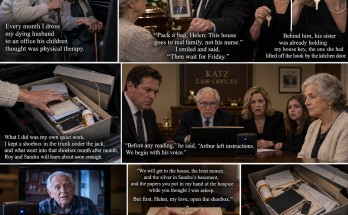
The excuse Arthur gave me for the monthly drives.
Sandra looked at me.
“You didn’t know?”
“No.”
I laughed once through tears.
“He was hiding it from me too.”
Not because he distrusted me.
Because if I did not know, I could not accidentally behave differently.
Arthur had turned my ordinary driving into cover.
The monthly trips to Katz had not always been direct.
Sometimes Arthur asked me to stop at therapy.
Pharmacy.
Bank.
Coffee.
I thought he was tired and indecisive.
He was creating a location pattern that would not reveal which stop mattered.
“He used the tracker against Roy,” Melissa said.
“Yes.”
Arthur knew someone was watching.
He gave them exactly enough truth to remain confident.
Bennett examined later notebook entries.
February:
R. asked Sandra where Tuesdays go. Tracker still transmitting.
March:
Pete says Roy thinks Helen seeing estate lawyer. Good.
Good?
Arthur wanted Roy to know.
Why?
Then the next entry answered.
If he thinks Katz has originals, he searches wrong place.
The safe-deposit box.
The house.
The storage unit.
Arthur had distributed evidence deliberately.
No single search could destroy it.
No single person possessed everything.
Roy kept chasing locations while Arthur built redundancy.
Sandra whispered, “Dad was fighting him.”
Quietly.
Methodically.
While dying.
“Yes.”
The knowledge did not make me proud.
It made me furious.
Arthur should have been spending those months complaining about hospital food and sitting in the garden.
Instead he was protecting his life from his own son.
Bennett’s phone buzzed again.
He checked it.
Then his posture changed.
“Roy used a credit card.”
“Where?” Sandra asked.
“Gas station twenty-eight miles west.”
“When?”
“Fifteen minutes ago.”
“Can police get there?”
“They’re already moving.”
Sandra looked frightened.
“Where would he go?”
I thought of Arthur’s letters.
Peter.
Margaret.
The old company.
The house.
Then Melissa said, “The lake.”
We looked at her.
“What lake?”
“Lake Crescent.”
Sandra’s face changed.
The photograph from the storage unit.
Arthur with young Roy on his shoulders.
Sandra holding the fishing pole backward.
A family before Margaret’s illness.
Before decades of resentment hardened.
“Why there?” I asked.
Melissa hesitated.
“Mom told me Uncle Roy used to go there whenever he fought with Grandpa.”
Sandra nodded slowly.
“He did.”
“Cabin?” Bennett asked.
“My parents rented one every summer. Same place.”
“Address?”
She gave him the name.
The old lakeside property still existed.
Bennett immediately called it in.
Then he turned to us.
“Stay here.”
Sandra stood.
“That’s my brother.”
“Yes.”
“I know where he goes.”
“Police know now too.”
“He might listen to me.”
“No.”
The answer was firm.
Sandra looked angry.
Then frightened.
Then tired.
Finally she sat.
Arthur had spent years rescuing Roy whenever consequences arrived.
Sandra had often helped.
This was another moment when running after him would feel like love.
Perhaps the hardest change was doing nothing.
Twenty-seven minutes later, Bennett received confirmation.
Roy’s vehicle—a borrowed sedan—had been found outside a cabin near Lake Crescent.
“Is he there?” I asked.
“Possibly.”
“Anyone else?”
“Unknown.”
Sandra gripped my hand.
The gesture surprised both of us.
Then Bennett received another message.
His face tightened.
“What?” Sandra asked.
He looked at her.
“Roy called emergency dispatch himself.”
“Why?”
“He says he has something Arthur left for him.”
“What?”
Bennett listened to the dispatcher update through his earpiece.
Then looked toward me.
“A recording.”
My stomach tightened.
“What recording?”
“Roy says it proves Arthur lied about everything.”
Sandra whispered, “Dad wouldn’t.”
I thought of all Arthur’s compartments.
All his private recordings.
All the truths that looked different depending on where you entered them.
“Did Roy say what’s on it?”
Bennett nodded.
“He says Arthur admits the entire estate plan was designed to punish him.”
The room went still.
That claim contradicted Arthur’s video.
But Arthur had also admitted anger.
Regret.
Fear.
He had never pretended to be perfect.
“Is Roy surrendering?” I asked.
Bennett’s expression remained unreadable.
“He says he will come out.”
Relief began to move through me.
Then he added:
“But only if Helen comes to hear the recording first.”
Sandra’s grip tightened around my hand.
“No.”
Bennett agreed immediately.
“You’re not going.”
Outside the station windows, evening had begun settling over the parking lot.
Somewhere beside a lake filled with his childhood memories, Roy was holding one more piece of Arthur’s voice.
And for the first time since this began, I did not know whether Arthur had left it as protection, confession, or one final attempt to reach the son he had spent a lifetime rescuing.
Click here to continue reading: PART 25: Roy Refused to Leave the Cabin Until Police Played Arthur’s Recording, and the First Sentence Sounded Like the Confession He Wanted
Before the Flowers Had Wilted, Arthur’s Children Were Measuring My House and Telling Me I Had Until Friday to Leave
Part 24 of 48