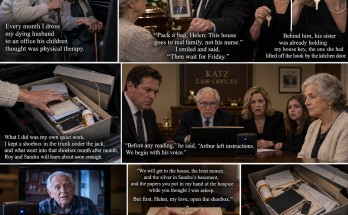
Roy recovered first.
He leaned toward the document but did not touch it.
“That isn’t what you think.”
Officer Bennett sat in the chair nearest the desk.
“I haven’t told you what I think.”
Roy looked annoyed by the answer.
Sandra remained by the door.
Her letter from Arthur was still clenched in her hand.
Mr. Katz folded the will documents and placed them aside.
The shift was unmistakable.
We were no longer discussing inheritance.
We were discussing conduct.
Bennett tapped the photocopy.
“This was found among Arthur’s papers after the hospital incident.”
Roy shook his head.
“No. Dad had it already.”
“Why?”
“He was considering putting the house in our names.”
Mr. Katz looked down at his notes.
“When?”
Roy’s eyes moved toward him.
“I don’t know.”
“Approximate.”
“Months before.”
“Before what?”
“Before he got really sick.”
Mr. Katz wrote something.
Sandra finally returned to her chair.
She sat carefully, as if any sudden movement might draw attention.
Officer Bennett asked, “Who prepared the document?”
Roy shrugged.
“A template.”
“From where?”
“Online.”
“Who downloaded it?”
“I did.”
“Who filled in the property information?”
“I did.”
“Who printed it?”
Roy’s mouth tightened.
“I did.”
Bennett nodded.
“You’ve answered three questions very clearly. Keep doing that.”
Roy looked toward me.
“This is unbelievable.”
I said nothing.
He wanted anger from me.
He wanted an accusation he could push against.
Arthur had understood his son better than I did.
The recorder sat between us like a fifth person.
Bennett slid the document slightly closer to Roy.
“The signature line.”
Roy glanced down.
There was Arthur’s name.
Arthur Samuel Mercer.
Not signed completely.
The first name and part of the last.
The handwriting sloped downward.
I remembered the blue ink streak on the hospice blanket.
My stomach turned.
Bennett asked, “Who wrote that?”
Roy looked up.
“Dad.”
“Were you watching?”
“Yes.”
Sandra said, “No.”
Everyone turned.
Roy’s head snapped toward her.
“What?”
Sandra stared at the desk.
“He wasn’t watching.”
Roy’s face hardened.
“What are you doing?”
“You were near the window.”
“No, I wasn’t.”
“Yes.”
“Sandra.”
Bennett raised a hand.
“Let her answer.”
Roy leaned back.
His mouth was thin.
Bennett looked at Sandra.
“Where were you?”
“Beside Dad.”
“Was he awake?”
“Yes.”
I thought of Arthur lying with his eyes closed.
His finger moving under the blanket.
Sandra continued.
“He was tired.”
“How tired?”
“He knew we were there.”
“That wasn’t my question.”
She swallowed.
“He was drifting.”
“Did he ask for the document?”
“No.”
“Did you explain it?”
“We tried.”
“Did he respond?”
“Some.”
“What does some mean?”
Sandra looked at Roy.
Roy stared straight ahead.
She looked back at Bennett.
“He said he wanted us taken care of.”
“When?”
“That night.”
“Exact words?”
“I don’t remember exact words.”
“Did he say he wanted to transfer Hawthorne Lane to you?”
“No.”
“Did he say he wanted to sign that document?”
“Not exactly.”
Bennett sat back.
“What happened to his hand?”
Sandra’s face changed.
Roy interrupted.
“This is ridiculous.”
Bennett did not look at him.
“Sandra?”
Her voice was quiet.
“He was weak.”
“So?”
“I helped him hold the pen.”
My heart started pounding.
The hospice room returned so vividly that for a second I smelled lemon disinfectant again.
Bennett asked, “Did Arthur ask you to help him hold the pen?”
Sandra’s eyes filled.
“No.”
Roy slapped his palm against the chair.
“Oh, come on. He was our father. We were trying to take care of things before it became impossible.”
Mr. Katz looked at him.
“Before what became impossible?”
Roy realized too late.
“Paperwork.”
“Why would it become impossible?”
“Because he was dying.”
Mr. Katz’s voice remained mild.
“Dying does not eliminate legal capacity.”
“You know what I mean.”
“I want to know what you mean.”
Roy looked away.
Bennett turned another page.
“Arthur told me he deliberately let his hand go limp.”
Sandra closed her eyes.
“He wanted to know what you would do if he stopped cooperating.”
Roy’s face reddened.
“He was testing us?”
“Yes.”
“That’s sick.”
“No,” Bennett said. “He was sick.”
Roy stared at him.
The officer continued.
“He reported that Sandra positioned the pen in his right hand. He reported that you supported his forearm. He reported that when he did not complete his last name, you told him to keep going.”
Roy stood.
“He was on morphine.”
“Then why were you asking him to sign property documents?”
The question landed perfectly.
Roy stopped.
Nobody in the room moved.
Bennett let the silence work.
Then he reached for another paper.
“This is the medication issue.”
Sandra sat straighter.
Roy slowly returned to his chair.
Bennett looked toward me.
“Helen, I need you to confirm something.”
I nodded.
“You maintained Arthur’s medication?”
“Yes.”
“You tracked doses?”
“Yes.”
“Before you became concerned about missing medication, were there unexplained shortages?”
“I found four tablets missing the first time I counted.”
“What medication?”
I named it.
Roy looked at Sandra.
Sandra stared at me.
Bennett asked, “What did you do?”
“At first I thought I had made an error.”
“Why?”
“Because medication mistakes happen. Because I was tired. Because I was responsible.”
“Then?”
“Arthur told me to keep the bottles and receipts.”
“Did he tell you to accuse anyone?”
“No.”
“Did he tell you to photograph anyone?”
“No.”
“Did he tell you what to write?”
“No.”
Bennett glanced at the shoebox.
“You kept independent records.”
“Yes.”
Roy snorted.
“Independent. She was married to him.”
I looked at him.
For once, I answered.
“I documented what happened. You’re welcome to disagree with what it means.”
He stared.
Bennett nodded toward the box.
“May I?”
I hesitated.
Then placed it on the desk.
My hands were shaking.
Not because I feared what was inside.
Because Arthur had known it would arrive here.
Mr. Katz untied the cotton cord.
The lid lifted.
Twenty-two envelopes stood upright inside.
Dates written across each one.
Sandra whispered, “Jesus.”
Bennett removed the first.
Then the second.
Pharmacy receipts.
Photographs.
Medication counts.
Notes written in my handwriting.
Copies of schedules.
A photograph of Roy measuring the garage.
Another of Sandra’s open car trunk with Margaret’s silver inside.
Sandra looked at it and stiffened.
“You photographed me?”
“Yes.”
“That’s disgusting.”
“You were removing Arthur’s belongings.”
“They were my mother’s.”
“Some were.”
Sandra’s expression sharpened.
“What is that supposed to mean?”
I pointed at the photograph.
“The wooden case in your trunk belonged to Margaret. The framed landscape beside it belonged to Arthur’s mother.”
Sandra looked down.
She had no answer.
Bennett continued through the box.
Each envelope tightened the room.
Not because any single item proved everything.
Arthur had been right about that.
Evidence was cumulative.
A pattern formed slowly, then all at once.
Visit.
Missing medication.
Question about accounts.
Visit.
Unusual drowsiness.
Attempted paperwork.
Visit.
Missing object.
Measurement.
Key.
Copy.
Date.
Time.
Detail.
Roy’s face changed from anger to concentration.
He was no longer reacting emotionally.
He was looking for weaknesses.
I could almost see him sorting the evidence into categories.
Explainable.
Disputable.
Dangerous.
Then Bennett opened envelope seventeen.
Inside was a photograph I had forgotten taking.
Sandra stood beside Arthur’s bedside table with an amber prescription bottle in her hand.
The photograph had been taken through the partially open study door.
Her head was turned away.
The label was visible.
Sandra stared at it.
“I was giving him medication.”
“No,” I said.
She turned toward me.
“You weren’t.”
“How would you know?”
“Because his dose was not due.”
“I could have been checking it.”
“You never asked me.”
“You don’t own his pills.”
“No. He did.”
Her face hardened.
Roy leaned closer to the photograph.
“When was that?”
I looked at the date.
“February twelfth.”
Roy’s eyes moved toward Sandra.
Something passed between them.
Bennett noticed.
“What happened February twelfth?”
“Nothing,” Roy said.
Bennett looked at Sandra.
She shook her head.
“Nothing.”
Officer Bennett removed another page.
“Arthur had bloodwork the following morning.”
Sandra’s breathing changed.
Roy frowned.
“Why?”
“Because he told his physician he believed someone was altering his dosage.”
Nobody spoke.
Bennett continued.
“The lab found a concentration inconsistent with the medication schedule documented by Helen.”
Roy said, “That doesn’t prove anyone did anything.”
“No.”
“You just said it yourself.”
“I didn’t say it proved who.”
Roy’s confidence returned slightly.
Bennett turned another page.
“It does prove Arthur’s concern was not imaginary.”
That took it away again.
Mr. Katz had remained mostly silent.
Now he spoke.
“This matters to the trust because Arthur wrote specific conditions addressing coercion.”
Roy turned on him.
“So now we lose everything because Dad got paranoid?”
Mr. Katz looked at the recorder.
“Would you like me to replay his mental-capacity evaluation?”
Roy’s jaw tightened.
“No.”
“Then choose your language carefully.”
Sandra had begun rubbing the edge of Arthur’s sealed letter with her thumb.
She still had not opened it.
I wondered why.
Fear, perhaps.
As long as the envelope remained sealed, her father had not yet spoken to her alone.
Bennett closed the shoebox.
“I’m not making arrests today.”
Roy laughed once.
“Generous.”
“This meeting is not a threat.”
“It feels like one.”
“It should feel like documentation.”
That word again.
Arthur’s word.
My word.
The whole room seemed constructed from things written down before anybody could deny them later.
Bennett looked at Roy.
“Do you have a key to Hawthorne Lane?”
Roy hesitated.
“No.”
“Did you ever?”
“Yes.”
“Do you currently possess a copy?”
“No.”
Bennett turned to Sandra.
She stared at him.
“I have one.”
“The green-tagged key?”
Her fingers tightened around her bag.
“How do you know that?”
I answered.
“Because you took it the day of the funeral.”
“I didn’t take it.”
“You removed it from my kitchen hook.”
“For safekeeping.”
“From whom?”
Sandra’s face flushed.
Bennett held out his hand.
“Give it back.”
She stared at him.
“It’s my father’s house.”
Mr. Katz spoke.
“No. It is currently held by the Mercer Residence Trust for Helen’s exclusive occupancy.”
Sandra looked from him to me.
“This is absurd.”
“The key.”
Bennett’s hand remained open.
Slowly, Sandra reached into her handbag.
She pulled out the brass key with the green tag.
She placed it in Bennett’s palm.
He slid it across the desk toward me.
I picked it up.
The small piece of metal felt strangely heavy.
For two days I had known she possessed it.
I had still slept in the house.
But holding it again made me understand how much fear had entered my thinking.
I had checked the locks twice the previous night.
I had wondered whether I would wake to footsteps downstairs.
Arthur had anticipated even this.
Roy looked at the key.
Then at Mr. Katz.
“So what? Helen lives there until she dies and Melissa gets it?”
“Yes.”
“And Sandra and I get a few thousand dollars if we behave?”
“That is a crude summary.”
“It’s an accurate one.”
“No,” Mr. Katz said. “It omits a significant provision.”
Roy’s expression changed.
“What provision?”
The lawyer opened the third folder.
“Arthur created a second trust.”
Sandra finally looked away from her unopened letter.
“For what?”
Mr. Katz placed a document in the center of the desk.
“The Mercer Family Accountability Trust.”
Roy stared.
“What kind of name is that?”
“One your father chose.”
“What does it do?”
Mr. Katz turned toward me.
Then back to the siblings.
“It holds funds that would otherwise have passed directly to Roy and Sandra.”
Roy’s face reddened.
“How much?”
“A substantial amount.”
“How substantial?”
Mr. Katz named the figure.
Even I stopped breathing for a second.
Arthur had never told me exactly how much money remained from the sale of his company.
Roy swore.
Sandra stared at the desk.
“That money is ours.”
“No.”
“It was Dad’s.”
“Yes.”
“And he made it for us.”
Mr. Katz’s voice stayed level.
“He made the company. He made the money. And he made the trust.”
Roy leaned forward.
“How do we get it?”
Mr. Katz looked down at the document.
“You do not inherit the principal directly.”
“What?”
“Distributions may be made under specified conditions.”
“What conditions?”
Mr. Katz looked toward Officer Bennett.
The officer closed his folder.
Then Mr. Katz said, “The first is that neither of you challenge Helen’s occupancy.”
Roy laughed bitterly.
“Of course.”
“The second is that neither of you interfere with Melissa’s remainder interest.”
Sandra went rigid.
“And the third?”
Mr. Katz paused.
“The third is cooperation.”
Roy’s eyes narrowed.
“With what?”
Mr. Katz tapped the evidence box.
“With determining what happened to your father during the final two years of his life.”
Sandra dropped her envelope.
It struck the floor.
She stared at it.
Nobody moved to pick it up.
Roy looked at his sister.
And for the first time since the meeting began, I saw fear pass between them in both directions.
Click here to continue reading: PART 7: Sandra Finally Opened Arthur’s Letter, and One Sentence About Margaret’s Silver Broke the Story She Had Been Telling Herself for Years
Before the Flowers Had Wilted, Arthur’s Children Were Measuring My House and Telling Me I Had Until Friday to Leave
Part 6 of 48