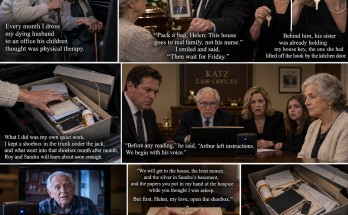
Mr. Katz resumed the video.
Arthur’s frozen face moved again.
“If you are watching this after somebody has filed another document bearing my signature, do not assume the person who benefited from it is the person who wrote it.”
Sandra looked sharply toward the television.
Even Bennett leaned forward.
Arthur continued.
“I learned that distinction too late.”
Mr. Katz paused the recording again.
I stared at the screen.
“You knew this part was coming?”
“No,” he said through the phone. “Arthur recorded portions privately. I remained outside the room for some sections at his request.”
Sandra looked toward the speaker.
“You left Dad alone with the camera?”
“Yes.”
“Why?”
“Because he wanted some statements made without anyone else present.”
Bennett asked, “Do you have the original recording?”
“Secured in the estate file.”
“Metadata?”
“Yes.”
“Unedited?”
“Yes.”
“Good.”
Arthur’s image waited on the television.
I suddenly understood why he had insisted on so many layers.
Doctors.
Lawyers.
Bank records.
Police.
Independent recordings.
Nothing depended entirely on one person’s honesty.
Not even Mr. Katz’s.
I pressed PLAY.
Arthur looked tired now.
His hands were clasped tighter than before.
“The life-insurance form was not signed by me. Whoever produced it had access to examples of my signature and knew the policy existed.”
He paused.
“I suspected Roy because he benefited.”
Sandra swallowed.
Arthur continued.
“But suspicion is not proof.”
Bennett glanced at me.
Arthur’s phrase again.
“After comparing the handwriting myself, I began to suspect someone else wrote the signature.”
I felt the room contract.
Arthur leaned toward the camera.
“I will leave that determination to professionals.”
Then he named the policy company, date, agent, and file number.
Every detail.
Methodical.
Prepared.
When the video ended, nobody spoke immediately.
Sandra was the first.
“Did Dad ever tell you who he suspected?”
Mr. Katz answered.
“No.”
“Did he tell Bennett?”
Officer Bennett shook his head.
“Not me.”
“So he knew something none of you knew.”
“Possibly.”
I looked at the forged brokerage form from Elaine.
The signature was similar to Arthur’s but too smooth.
The handwriting beside it may have belonged to Peter.
Could Peter have forged both?
It fit too easily.
That made me cautious.
“What did the original insurance form look like?” I asked.
Mr. Katz said he would obtain the scanned copy.
Bennett called the insurer directly.
Because Arthur had already reported the attempted beneficiary change before his death, the company maintained an investigation file.
The representative would not discuss details over an informal call, but confirmed the file remained preserved.
Bennett arranged official retrieval.
Sandra sat at Arthur’s kitchen table after the call ended, staring at the court petition Roy had delivered.
“He knew about the insurance.”
“Who?” I asked.
“Roy.”
“How do you know?”
“He complained about it.”
Bennett turned.
“When?”
“Maybe a year ago.”
“What did he say?”
Sandra frowned.
“He said Dad was wasting money on policies Helen would probably get anyway.”
I shook my head.
“I wasn’t the beneficiary.”
She looked embarrassed.
“I know that now.”
“Who was?”
“Originally?” Mr. Katz asked through the speaker.
“Yes.”
“You and Roy equally.”
Sandra stared.
“Dad never changed it to Helen?”
“No.”
That silenced her.
Another assumption gone.
Roy had told her I was taking everything.
Yet Arthur’s original plan had still centered his children.
Until somebody tried to make Roy the sole beneficiary.
Bennett asked, “Did Roy tell you the policy had been changed?”
“No.”
“Did he ever mention submitting paperwork?”
“No.”
“Peter?”
She thought.
“He once said Peter was helping him straighten out old accounts.”
“When?”
“Before Dad’s cancer got worse.”
That phrase covered a lot of time.
We needed dates.
Sandra scrolled through old messages on her phone.
Most were ordinary.
Pictures.
Appointments.
Complaints.
Then she found a text thread with Roy.
Almost ten months before Arthur’s death.
ROY: Pete found the insurance mess.
SANDRA: What mess?
ROY: Dad left everything outdated.
SANDRA: So?
ROY: He’s fixing it.
Sandra stared at the message.
“I assumed he meant Dad was fixing it.”
Bennett took a photograph of the screen.
“What did you understand Pete to mean?”
“Peter.”
“Exactly.”
Another message followed.
ROY: Don’t worry. We’re handling ours before Helen gets involved.
Sandra closed her eyes.
“I didn’t even answer.”
“Did you ask Arthur?”
“No.”
“Why?”
“Because I thought Roy was exaggerating.”
Bennett’s tone remained neutral.
“Was that common?”
“Yes.”
“Yet you sometimes acted on what he said.”
“Yes.”
The admission came easier now.
Painfully, but honestly.
Mr. Katz ended the call after promising to deliver the complete insurance file once retrieved.
Bennett left shortly afterward.
Before going, he asked Sandra not to contact Roy about the handwriting issue.
She nodded.
After the door closed, the house felt abruptly quiet.
Sandra stood near the sink.
“Can I ask you something?”
“Yes.”
“Why didn’t Dad leave the insurance to you?”
I almost laughed.
Not because the question was funny.
Because even now she was measuring inheritance against love.
“He had children.”
“So?”
“So I never expected his money.”
“That doesn’t answer me.”
I dried a cup.
“Arthur once told me marriage did not erase obligations that existed before marriage.”
Sandra looked down.
“That sounds like him.”
“He thought you and Roy would use the insurance for your families.”
“Before we gave him reasons not to.”
I did not answer.
She understood.
That evening Melissa came over with dinner.
We ate at the kitchen table.
For almost twenty minutes nobody discussed trusts, police, forged documents, or inheritance.
It felt unnatural.
Wonderful.
Melissa told us about a patient at work who refused to fill out forms because he claimed his handwriting was constitutionally protected.
Sandra laughed.
I laughed.
Then my eyes moved toward Arthur’s empty chair.
Grief could arrive in the middle of laughter without asking permission.
I stopped eating.
Melissa noticed.
“You okay?”
“Yes.”
It was a lie.
A small one.
The acceptable kind.
Later, after Sandra went upstairs to shower, Melissa helped me gather plates.
“She’s different.”
“Your mother?”
“Yes.”
I looked toward the ceiling.
“She’s learning things she didn’t want to know.”
“About Grandpa?”
“About herself too.”
Melissa dried a plate.
“That’s harder.”
“Yes.”
She hesitated.
“Do you forgive her?”
I set a fork in the drawer.
“I don’t know yet.”
Melissa nodded.
“Good.”
I looked at her.
“Good?”
“I’m tired of everyone acting like forgiveness is a deadline.”
That sounded more mature than anything most adults had said during the week.
I smiled.
“Your grandfather would approve.”
“He’d pretend not to.”
“That too.”
At nine thirty, Bennett called.
He had received an electronic copy of the disputed life-insurance form.
He asked whether I would look at it.
“Yes.”
He sent the image.
Arthur’s false signature appeared at the bottom.
The capital A looked better than the brokerage forgery.
The final r still felt wrong.
But something else caught my attention.
The date.
Written numerically.
Seven.
Slash.
Fourteen.
Slash.
The seven had a line through it.
Peter’s habit, according to Sandra.
I called her downstairs.
She looked at the image.
Her face tightened.
“That looks like his.”
“Could Roy write sevens that way?”
“No.”
“Could Arthur?”
“Sometimes, but not usually.”
Melissa leaned closer.
“Grandpa didn’t slash his zeros.”
The year contained a zero with a diagonal line.
I remembered something.
“Peter did.”
Sandra looked at me.
“You’ve seen it?”
“In Christmas cards.”
Small things survived in memory.
A check.
A gift label.
A note attached to a bottle of wine.
Peter’s neat old-fashioned handwriting always separated zero from the letter O with a slash.
The insurance date did exactly that.
Bennett did not treat our observations as proof.
He sent the document to a forensic document examiner along with verified writing samples from Arthur, Peter, Roy, and Sandra.
Then we waited.
Not passively.
The investigation continued through records.
Peter, now represented by an attorney, gave a formal interview the next day.
Bennett would not share everything.
He told us only what affected Arthur’s estate or our safety.
Peter admitted he had helped Roy locate forms related to the insurance policy.
He denied forging Arthur’s name.
He also admitted he knew Roy planned to change the beneficiary.
That distinction felt almost absurd.
“You helped prepare a fraudulent change but you didn’t sign it?” Sandra said when Bennett summarized.
“That is Peter’s position.”
“Do you believe him?”
“That isn’t a useful question.”
She sighed.
“Dad would like you.”
“So Helen tells me.”
Three days later, the handwriting examiner issued a preliminary opinion.
Bennett came to Hawthorne Lane to discuss it.
He carried no dramatic folder this time.
Just a tablet.
We sat in Arthur’s study.
Sandra had returned to her own house but came over when Bennett called.
Melissa joined by phone.
Bennett began carefully.
“The examiner cannot identify authorship with absolute certainty.”
Sandra nodded impatiently.
“But?”
“The questioned signature is inconsistent with Arthur’s known signatures.”
That much we expected.
“The handwriting used for the date and certain accompanying entries shows significant similarities to one comparison writer.”
Sandra stared.
“Peter.”
Bennett looked at her.
“No.”
I felt a cold sensation.
“Who?”
He turned the tablet toward us.
The name appeared in the report.
MARGARET ELAINE PORTER.
For a second I did not understand.
Then the name resolved.
Elaine Porter.
Arthur’s former accountant.
Sandra stood.
“That’s impossible.”
Bennett did not react.
“She identified the brokerage forgery herself.”
“Yes.”
“She helped Dad.”
“Yes.”
“She called Dad when Roy contacted her.”
“Yes.”
“Then why would she forge an insurance form?”
Bennett folded his hands.
“That is what we need to ask.”
I remembered Elaine’s office.
Her precise hands.
Her quiet confidence.
Arthur showed me photographs.
Her explanation of Roy’s planned Friday appointment.
She had appeared to be one of the few people who had behaved correctly.
Perhaps she had.
Later.
That did not erase earlier conduct.
“When was the forged insurance form submitted?” I asked.
“July fourteenth of the previous year.”
“And when did Elaine stop handling Arthur’s accounts?”
“About nine months before that.”
“So she still knew the policy details.”
“Yes.”
Sandra sat again.
“Why would she make Roy sole beneficiary?”
Nobody knew.
Then Bennett showed us another finding.
The form had been faxed.
The originating number still existed in the insurer’s records.
Not Roy’s.
Not Peter’s.
Elaine Porter’s old office fax line.
Sandra whispered, “Oh my God.”
I felt something different.
Not shock.
Recognition.
Arthur’s warning in the false-bottom note returned.
Peter knows more than he admits.
Do not assume Roy acted alone.
We had interpreted that as Peter being the hidden partner.
But Arthur had not written Peter acted with Roy.
He wrote do not assume Roy acted alone.
There could have been more than one person.
Different people at different times.
Different motives.
Bennett said, “I’m speaking with Elaine tomorrow.”
“Do you think she was working with Roy?”
“I don’t know.”
“She knew he planned to file another forgery.”
“Yes.”
“Yet she invited him in.”
“Yes.”
“Maybe because she knew exactly what he was doing.”
“Possibly.”
Sandra looked sick.
“We gave her everything.”
“What?”
“Tax records. Family records. Dad’s accounts. She knew what existed before we did.”
That mattered.
Access.
Knowledge.
Opportunity.
But motive remained absent.
Until Melissa’s voice came through the phone.
“Mom?”
Sandra raised it.
“What?”
“You said Elaine’s husband got sick.”
“Yes.”
“When?”
Sandra thought.
“Years ago.”
Melissa continued.
“Grandpa helped them, didn’t he?”
Sandra frowned.
“With what?”
“Money.”
The room changed.
“How do you know?” I asked.
“Grandpa mentioned it once. He said Elaine never forgave him for helping.”
That made no sense.
People did not usually resent financial assistance.
Unless the help carried a story we did not know.
Sandra stared at the phone.
“What did he mean?”
“I don’t know.”
Melissa paused.
“He said some debts cost more when they’re forgiven.”
Arthur.
Always speaking in sentences that sounded ordinary until months later.
Bennett wrote it down.
I remembered the ledger in the storage unit.
Roy’s debts marked forgiven.
Arthur had understood the corrosive side of rescue.
Perhaps Elaine had her own version.
Bennett stood.
“Until I speak with her, don’t contact her.”
We agreed.
After he left, Sandra remained in the study.
She looked at the old radio.
Then Arthur’s notebook.
Then me.
“Every time I think I know who betrayed Dad, there’s another layer.”
“Yes.”
“How did he live with that?”
I thought about the monthly drives.
The cookies in Katz’s waiting room.
Arthur coming out tired but lighter.
“By documenting it.”
Sandra looked toward me.
“That sounds lonely.”
It was.
That realization hurt more than anything.
Arthur had spent his final two years testing people he loved, recording people he once trusted, and preparing for conflicts he knew he would not survive to see.
He had protected me.
But protection had cost him peace.
The next afternoon Bennett called from Elaine Porter’s office.
His voice was controlled.
“She admitted completing the insurance form.”
Sandra, who was with me, gripped the table.
“Did she sign Dad’s name?”
“Yes.”
The word landed softly.
“What does she say happened?” I asked.
Bennett paused.
“She says Roy never asked her to do it.”
Sandra stared at me.
“Then why?”
Bennett’s answer chilled the room.
“Because she claims Arthur asked her to.”
Click here to continue reading: PART 18: Elaine Said Arthur Ordered the False Insurance Change Himself, but a Recorded Call Revealed Why He Had Let Her Believe the Forgery Would Stand
Before the Flowers Had Wilted, Arthur’s Children Were Measuring My House and Telling Me I Had Until Friday to Leave
Part 17 of 48