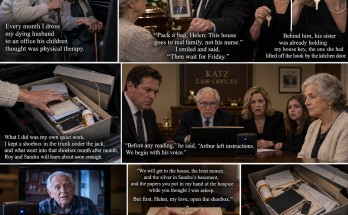
Elaine’s statement sounded impossible until Sandra began to remember.
Not one event.
Several.
Small.
Old.
Dismissed.
“He signed school papers.”
Bennett, still on speaker, asked, “Whose school papers?”
“His own.”
Sandra sat in Arthur’s study, staring toward nothing.
“When Roy was in high school, he used to sign Dad’s name on absence notes.”
“That is not unusual criminal behavior by itself,” Bennett said.
“No. But Dad caught him.”
“What happened?”
“Nothing.”
The word came too quickly.
Sandra corrected herself.
“I mean Dad yelled. Roy lost the car for a month.”
“Anything else?”
“No.”
Elaine spoke through the phone.
“There was more.”
Sandra looked toward the speaker.
“What?”
“When Roy was nineteen, he wrote Arthur’s signature on a company reimbursement check.”
The amount was not enormous.
Eight hundred dollars.
Enough to matter.
Not enough to trigger outside review.
Arthur discovered it because the account reconciliation did not match.
“What did Dad do?” Sandra asked.
Elaine’s answer was quiet.
“He covered it.”
Of course.
Arthur’s video returned to me.
I paid debts I should have let you face.
I solved emergencies you created.
This had started long before business failures and mortgages.
“He didn’t fire him?” I asked.
“Roy wasn’t officially employed yet. He was helping during summer.”
“Did Arthur call police?”
“No.”
“What happened?”
“He made Roy work the rest of the summer unpaid.”
Sandra almost laughed.
“That sounds like Dad.”
Elaine continued.
“And Arthur reimbursed the company personally.”
There it was.
The rescue.
Again.
Roy stole.
Arthur created a private consequence.
Then erased the external one.
No record.
No prosecution.
No lasting barrier.
Bennett asked, “Did Roy forge anything else?”
Elaine hesitated.
“Yes.”
Sandra closed her eyes.
“How many?”
“I know of four incidents before he was thirty.”
Checks.
Vendor authorizations.
Once, a loan reference.
Each time, Arthur discovered enough to intervene.
Each time, he handled it privately.
“Why?” Melissa asked from the doorway.
I had not heard her arrive.
She stood holding her coat.
“Why would Grandpa keep letting that go?”
Sandra answered before anyone else.
“Because he was Roy.”
Not because Arthur believed forgery was harmless.
Because he could not separate consequences from abandonment.
Roy was his son.
So Arthur corrected privately and protected publicly.
Year after year.
Bennett asked Elaine for documentation.
She had retained some archived company records.
Others might still exist in old accounting backups.
That would take time.
But the broader pattern no longer depended on memory alone.
Roy had used Arthur’s signature before.
Repeatedly.
That did not prove he forged the current brokerage document.
It made the possibility more plausible.
Elaine’s voice came through the phone.
“Arthur always believed Roy would grow out of it.”
Sandra whispered, “At thirty?”
“Then at thirty-five.”
Silence.
“Then forty.”
Another pause.
“And eventually Arthur stopped saying he would grow out of it.”
I looked at the television where Arthur’s video had played.
“He realized he had helped it continue.”
“Yes.”
After Elaine ended the call, Melissa sat beside her mother.
“Did you know any of this?”
“Some.”
“How much?”
Sandra thought.
“I knew Roy got in trouble at the company.”
“For forging Grandpa’s signature?”
“I knew he used it on something.”
Melissa stared at her.
“And everyone just kept going?”
Sandra flinched.
“Yes.”
That answer seemed to disturb Melissa more than the crime itself.
Families can normalize almost anything if it happens slowly enough.
One lie.
One rescue.
One private correction.
Then another.
By the time the pattern becomes visible, everyone has learned how not to see it.
Bennett left us with instructions not to contact Roy.
Again.
That request had become almost absurd because Roy contacted us first.
At ten fourteen the next morning, Sandra received a text.
ROY: Dad would hate what you’re doing.
She showed me without replying.
A second message arrived.
ROY: You’re letting Helen destroy the family.
Then:
ROY: Meet me alone. No cops.
Sandra’s fingers tightened around the phone.
Melissa looked at her.
“Don’t.”
“I wasn’t going to.”
Another message.
ROY: There are things you don’t know about Dad.
Sandra laughed quietly.
“That line used to work every time.”
She handed the phone to me.
“Take a picture.”
I did.
Then she forwarded everything to Bennett.
Roy did not stop.
ROY: Ask Helen why Dad changed his will only after she started controlling his meds.
Sandra typed.
Then deleted.
Typed again.
Deleted.
Finally she wrote:
Communicate through lawyers.
She sent it.
Roy replied almost immediately.
Coward.
Sandra stared at the word.
I watched an old reflex move across her face.
The urge to defend herself.
Explain.
Prove.
She locked the phone instead.
“That felt terrible.”
“It usually does at first.”
“You’ve done this before?”
“With patients’ relatives who screamed at nurses.”
“That’s not the same.”
“No.”
“But similar?”
“Enough.”
By afternoon, Mr. Katz had filed a formal response to Roy’s petition.
Arthur’s capacity reports.
Selected recordings.
Affidavits.
Not everything.
Katz explained that litigation was not an excuse to expose every private detail.
Arthur’s life did not become public property merely because his son filed papers.
That mattered to me.
The story had already expanded beyond the family.
Police.
Lawyers.
Accountants.
Banks.
Insurers.
I wanted some part of Arthur to remain ours.
The probate judge scheduled an initial hearing for the following week.
Roy’s attorney sought temporary restrictions on the trust.
He argued that no property should be distributed while validity was contested.
Mr. Katz did not oppose preserving most assets.
He strongly opposed any restriction on my occupancy.
Arthur’s trust expressly protected it.
That evening, I walked through Hawthorne Lane alone.
Sandra had gone home.
Melissa had work.
The kitchen-door repair was complete.
For the first time since Arthur died, the house felt physically secure.
Emotionally, it felt enormous.
His shoes still waited beneath the hall bench.
His glasses remained beside the study chair.
A book lay face-down where he had stopped reading three weeks earlier.
I picked it up.
Page 184.
Arthur hated folding page corners.
He used receipts as bookmarks.
Inside this one was an old gas receipt.
On the back, his handwriting.
Call Roy. Tuesday.
No date.
No clue.
Just an ordinary reminder.
Not evidence.
Not strategy.
A father reminding himself to call his son.
I sat in his chair and cried harder than I had at the funeral.
That was the cruelty of evidence.
It reduced people to acts.
Forgery.
Coercion.
Missing pills.
But Arthur had not spent his entire life investigating Roy.
He had loved him.
Called him.
Loaned him tools.
Attended school plays.
Bought birthday cakes.
Argued about football.
Fixed bicycles.
Paid debts.
Forgave.
Again and again.
The wrongness of Roy’s actions did not erase that history.
It made it more tragic.
My phone rang.
Bennett.
I wiped my face.
“Yes?”
“We found the old company checks.”
I sat straighter.
“And?”
“Three contain unauthorized signatures attributed to Arthur.”
“Roy?”
“We have contemporaneous internal notes identifying him.”
My chest tightened.
“So the examiner can compare?”
“Yes.”
“And the brokerage forgery?”
“Preliminary comparison is stronger now.”
“How strong?”
“Strong enough that I’m comfortable telling you this: the questioned signature on the brokerage form appears consistent with Roy’s historical imitation method.”
Not proof for court yet.
But close.
“Does Roy know?”
“No.”
“What happens now?”
“We’re seeking additional records.”
“Arrest?”
“Not yet.”
I exhaled.
Then Bennett said, “There’s something else.”
Always.
“One of the old incidents involved Peter Lang.”
My skin prickled.
“How?”
“The loan reference Roy forged at twenty-seven was for a company connected to Peter.”
“Did Peter know?”
“That is unclear.”
“What company?”
Bennett named it.
I recognized part of the name from Roy’s failed development deal.
Not the same company.
A predecessor.
A thread stretching decades.
“So Peter and Roy have been doing business together since then.”
“Intermittently.”
“And Arthur knew?”
“Apparently.”
I thought of Peter’s resentment over the buyout.
Arthur’s silence about Elaine’s manipulation.
Roy’s old forgery.
Their financial relationships were not separate lines.
They crossed repeatedly.
Bennett continued.
“We also found a memorandum Arthur wrote after the twenty-seven-year-old incident.”
“What does it say?”
“I’m sending a copy.”
The image appeared.
Arthur’s handwriting was younger.
Stronger.
Still unmistakable.
Roy believes signatures are permission if he expects permission would eventually be given.
I read it twice.
Below:
This is my failure too. I have taught him that consequences can be negotiated after the act.
Thirty years before the hospice room, Arthur understood.
And still he kept rescuing.
The next line hurt most.
I do not know how to punish my son without losing him.
I closed my eyes.
That was the entire relationship.
Not greed alone.
Not entitlement alone.
Fear.
Arthur feared losing Roy.
Roy learned that fear had value.
Not necessarily consciously at first.
But over decades, love became leverage.
When I showed Sandra the memorandum the next morning, she cried quietly.
“He thought consequences meant losing us.”
“Yes.”
“Why?”
“Maybe because Margaret got sick.”
Sandra looked toward me.
Their mother’s long illness had rearranged the family.
Arthur had spent years trying to keep everything stable.
Perhaps conflict felt like another form of loss.
Sandra whispered, “After Mom died, Dad stopped saying no to us.”
I remembered Arthur telling me Margaret had been the stricter parent.
“She was the boundary,” Sandra said.
“Maybe.”
“And when she was gone, he tried to be both parents.”
“He tried.”
“He was terrible at her job.”
Despite ourselves, we laughed.
Sandra wiped her face.
Then her expression changed.
“I remembered something.”
“What?”
“Mom caught Roy signing Dad’s name once.”
“When?”
“Before she died.”
“On what?”
“I don’t know.”
“Did she tell Arthur?”
“Yes.”
“How do you know?”
“I heard them arguing.”
Sandra stood and paced.
“Mom said, ‘If you cover this again, he’ll do it when the stakes are higher.’”
The words hung between us.
Margaret had predicted it.
Not the specific act.
The pattern.
“What did Arthur say?”
Sandra closed her eyes.
“He said, ‘He’s my son.’”
“And Margaret?”
Sandra opened her eyes.
“She said, ‘That is why you have to stop saving him.’”
I felt grief for a woman I had never met.
Margaret had understood Arthur.
Perhaps better than anyone.
“Did they stop him?”
“I don’t know.”
“What happened after?”
“Roy didn’t speak to Dad for weeks.”
There it was.
Arthur’s fear.
Boundary equals loss.
Roy withdraws.
Arthur relents.
Pattern reinforced.
Sandra sat again.
“Dad wasn’t weak.”
“No.”
“But this was his weakness.”
“Yes.”
She nodded slowly.
“That’s harder to admit.”
Before I could answer, a car pulled into the driveway.
Not Roy’s truck.
A black sedan.
A man in a suit stepped out.
He carried an envelope.
Formal process server.
Sandra looked at me.
“More papers?”
“Yes.”
He served her first.
Then me.
Roy had amended his petition.
New allegations.
Not just undue influence.
He now accused me of financial exploitation.
Medication abuse.
And deliberate interference with Arthur’s relationship with his children.
But attached to the filing was something new.
An affidavit.
Signed by Peter Lang.
Sandra read the first page.
Her face went white.
“Peter changed his story.”
I took the document.
Peter now claimed Arthur had privately told him he feared me.
That I controlled his appointments.
That I pressured him about the estate.
That I refused to let him see Roy alone.
Every claim contradicted Arthur’s recordings.
But Peter had sworn to them anyway.
Why?
The answer appeared near the end.
Peter claimed his earlier police statements had been made under pressure.
He withdrew his admission about providing the sedative knowingly.
Sandra stared.
“He’s protecting Roy again.”
Maybe.
Or himself.
Then I reached the final attachment.
A check.
Dated two days earlier.
Roy Mercer to Peter Lang.
Fifty thousand dollars.
Marked:
Loan repayment.
Sandra laughed once.
“Subtle.”
I did not laugh.
Because Peter had just altered his story after receiving money from Roy.
And unlike decades of family memory, this transaction had happened while an active investigation was underway.
Roy had not learned from Arthur’s death.
He was still trying to purchase a version of reality that obeyed him.
Click here to continue reading: PART 20: Peter’s Sudden Fifty-Thousand-Dollar Payment Looked Like a Bribe, Until the Bank Records Revealed the Money Had Come From Arthur’s Missing Account
Before the Flowers Had Wilted, Arthur’s Children Were Measuring My House and Telling Me I Had Until Friday to Leave
Part 19 of 48