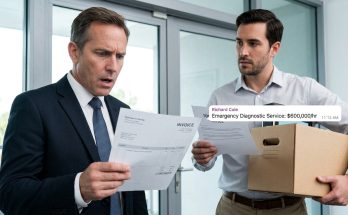
Samuel Langford reached Bay Three three minutes after the call ended.
At sixty-three, he still moved with the compact certainty of the machinist he had been before Horizon grew from a rented industrial unit into a company employing hundreds. His hair had gone silver, but his hands still carried the faint scars of someone who had spent years around metal before boardrooms replaced machine bays.
He didn’t greet us.
His eyes went first to the silent machining center.
Then to me.
Then to Richard.
“Show me.”
Nadia turned her laptop toward him.
She explained the parameter changes without embellishment. Twenty-three writes between 10:43 and 10:47. My employee login. My badge credential opening Bay Three. My workstation simultaneously active inside Engineering Conference Two.
Samuel listened without interrupting.
When Nadia finished, he looked at Richard.
“When were you going to tell me?”
Richard kept his voice controlled. “We didn’t know the scope until Ethan began digging into it.”
Samuel looked at me.
“True?”
“No.”
Richard’s head turned.
I pointed toward Walter.
“Walter saw Tyler Brooks at this controller before my termination.”
Samuel looked at Walter.
Walter nodded.
“Around ten-thirty. Control cabinet was open.”
“Why was Tyler here?”
“He told me Richard asked him to verify commissioning settings.”
Samuel’s eyes returned to Richard.
Richard answered quickly. “I never instructed Tyler to alter parameters.”
Samuel’s voice stayed quiet.
“That wasn’t the question.”
Richard said nothing.
Nadia opened the camera archive.
“East entrance. Starting 10:35.”
We gathered around the laptop.
The corridor appeared in grayscale.
10:39.
Empty.
10:40.
Nothing.
Then at 10:41:21, a figure entered the frame.
Mason leaned forward.
“That’s Tyler.”
It was.
Gray Horizon polo.
Dark work pants.
He walked directly toward the Bay Three entrance.
Something white was in his right hand.
“Pause,” I said.
Nadia froze the frame.
Walter pointed.
“Badge.”
She enlarged the image.
The resolution wasn’t good enough to read the photograph on the card, but the shape was obvious.
Employee access badge.
Nadia resumed playback.
Tyler reached the reader.
10:41:36.
He touched the badge to it.
The door unlocked.
Exactly the timestamp assigned to my credential.
Samuel looked at me.
“Could that be your badge?”
“No.”
“You’re certain?”
“I was wearing mine.”
Nadia zoomed the card.
Most details blurred.
One didn’t.
The final digits printed along its bottom edge.
417.
My badge number.
Nobody spoke.
Samuel said it first.
“Someone duplicated Ethan’s badge.”
Nadia nodded.
“That would explain the security record.”
I looked at Richard.
All the color had left his face.
Samuel saw it too.
“Where is Tyler?”
Nobody knew.
Mason called him.
No answer.
Walter tried.
Nothing.
Security checked Tyler’s locker.
Empty.
Then they checked the employee parking lot.
His vehicle was gone.
Samuel took a radio from one of the guards.
“Daniel, when did Tyler Brooks leave?”
Daniel Ross, Horizon’s security supervisor, answered from the front desk.
“Checking.”
We waited.
The radio crackled.
“Eleven-oh-nine.”
I looked at the clock without meaning to.
11:09.
Two minutes after Richard fired me.
Three minutes before the machine’s failure became known upstairs.
Samuel’s voice hardened.
“Badge exit?”
“No, sir.”
“How did he leave?”
“Visitor gate was manually opened.”
Samuel’s eyes moved to Richard.
“Who authorized it?”
A pause.
Then Daniel answered.
“Operations override.”
“Credential?”
Another pause.
“Richard Cole.”
Walter stared at Richard.
Mason lowered his eyes.
Nadia slowly closed the laptop halfway.
Richard shook his head.
“I open that gate constantly. Vendors. Deliveries. Employees who forget their badges.”
Samuel didn’t raise his voice.
“At 11:09?”
“I don’t remember.”
“Two minutes after Ethan’s termination?”
“I said I don’t remember.”
I watched Richard carefully.
The evidence looked terrible.
But something still bothered me.
If Richard had orchestrated everything, why remain on the floor while we pulled logs?
Why let Nadia arrive at all?
Maybe arrogance.
Maybe panic.
Or maybe Richard was guilty of something without being responsible for everything.
Samuel turned toward me.
“Can you restore the machine?”
“Yes.”
“How long?”
“Forty-five minutes if the bad parameters didn’t cause physical damage.”
“Do it.”
I didn’t move.
Samuel frowned.
“What?”
“Different service.”
Richard erupted.
“You already took six hundred thousand dollars.”
“For diagnostics.”
Samuel held up one hand.
Richard stopped.
“What are your terms?” Samuel asked.
“Restoration, documentation, witnessed restart: two hundred fifty thousand.”
Richard stared at me.
Samuel didn’t.
“And qualification support?”
“Separate.”
“How much?”
“One hundred fifty thousand.”
Richard looked at Samuel as though expecting sanity to return.
Instead Samuel said, “Approved.”
Richard’s mouth opened.
Samuel looked at me.
“Send the paperwork.”
I did.
Finance processed it twelve minutes later.
By then, Parker Precision Services had earned one million dollars on its first day.
I should have been celebrating.
Instead I stood in front of a sabotaged machine wondering whether someone had deliberately arranged for my name to be attached to its failure.
I restored the parameters one at a time.
Every correction was photographed.
Walter witnessed the values.
Mason recorded timestamps.
Nadia preserved network logs.
Nobody complained about my caution anymore.
At 2:18, the machine restarted cleanly.
At 2:31, we ran a dry cycle.
At 2:46, spindle vibration settled inside its normal range.
By 3:10, the machine was cutting aluminum test stock smoothly.
Walter grinned.
Mason clapped once before noticing Richard across the bay.
His hands dropped.
I almost smiled.
But Tyler was still missing.
And Richard’s credential had opened the gate when Tyler left.
I was finishing the restoration report when Nadia approached.
“Ethan.”
Her voice made me stop typing.
“What?”
“There’s something I didn’t want to say in front of everybody.”
I looked toward Richard.
He stood with Samuel across the bay.
“What did you find?”
“When I checked your badge history, I noticed something.”
“What?”
“The duplicate credential wasn’t created today.”
A cold feeling moved through me.
“When?”
“Three weeks ago.”
I stared at her.
“That’s impossible.”
“No.”
She opened her laptop.
“First activity was August twenty-second.”
“What activity?”
“Engineering Records.”
That room was restricted even by Horizon standards. Machine documentation. Customer manufacturing files. Commissioning notes. Internal specifications.
“How many times?”
“Four.”
She showed me the dates.
August twenty-second.
August twenty-ninth.
September fourth.
And last night.
“All using my identity?”
“Yes.”
“Camera?”
Nadia hesitated.
“I checked one.”
“And?”
“It wasn’t Tyler.”
My attention sharpened.
“Who?”
She opened a still image.
A man stood outside Engineering Records wearing a dark jacket. His hand rested on the door.
The face was clear.
I recognized him instantly.
I looked across Bay Three.
The same man was standing less than fifty feet away.
Samuel Langford.
At that exact moment, Samuel turned toward us.
Then he smiled.
Nadia whispered, “I don’t think Tyler started this.”
I stared at the photograph.
The founder of Horizon had apparently used a credential carrying my identity weeks before someone used that same identity to sabotage the Meridian machine.
I closed Nadia’s laptop.
“Don’t tell anyone yet.”
Her eyes widened.
“Why?”
“Because we don’t know what we’re looking at.”
“Ethan—”
“If Samuel is involved, telling him what we found is dangerous.”
“And if he isn’t?”
“Then somebody wants us to think he is.”
Samuel started walking toward us.
“Everything okay?”
Nadia turned the laptop toward herself.
“Network documentation.”
Samuel looked at her.
Then me.
“Ethan?”
“Machine is stable.”
“That isn’t what I asked.”
I held his gaze.
“Then ask what you mean.”
Something changed in his expression.
Interest, perhaps.
He glanced toward Richard.
“Walk with me.”
“Where?”
“My office.”
Richard heard.
“Sam, Meridian arrives soon.”
“You prepare.”
“Sam—”
Samuel didn’t even look at him.
“Ethan.”
I picked up my folder.
Before following him, I looked at Nadia.
“Save everything.”
She nodded.
Samuel noticed.
He said nothing.
His office overlooked the manufacturing floor from the second level. Once inside, he closed the door.
“Sit.”
“I’ll stand.”
He moved behind his desk.
“Still angry about this morning?”
“That depends.”
“On what?”
“Whether being fired was the worst thing somebody intended to happen to me today.”
His expression changed.
“What exactly are you accusing me of?”
“Nothing.”
“Yet.”
“Yet.”
He studied me for several seconds.
Then he said, “Show me the photograph.”
My stomach tightened.
“What photograph?”
“The one Nadia showed you.”
He knew.
Samuel leaned back.
“You weren’t subtle.”
“Neither were you.”
“No.”
I had taken a photograph of Nadia’s screen before closing the laptop.
I placed my phone on his desk.
Samuel studied the security image.
He didn’t deny it.
“That’s me.”
“You entered Engineering Records using my credential.”
“Yes.”
The answer came so easily that it caught me off guard.
“You admit it?”
“Yes.”
“Why?”
Samuel looked through the windows toward the production floor.
“Because three months ago I discovered somebody inside Horizon was stealing company information.”
I said nothing.
He opened a drawer and removed a folder.
“Customer process data. Bid packages. pricing. Machine programs.”
“Who?”
“If I knew, this would already be over.”
He placed several documents on the desk.
Competitor quotations.
Internal pricing comparisons.
Different customers.
Different projects.
Same pattern.
Competitors had repeatedly underbid Horizon by margins too precise to be coincidence.
One quote beat Horizon by fourteen dollars on a component worth more than eleven hundred.
“They knew our price,” I said.
Samuel nodded.
“Close enough to beat us without sacrificing margin.”
“So you hired investigators.”
“Outside investigators.”
“Richard knew?”
“No.”
“Anyone inside?”
“No.”
That mattered.
Samuel continued.
“The leak required access across engineering, operations, and finance. I couldn’t trust an internal investigation.”
“Still doesn’t explain my badge.”
His face tightened.
“The investigators needed access to Engineering Records without creating an obvious trail connected to me.”
“So they cloned an employee profile.”
“Yes.”
“Mine.”
“Yes.”
“Why?”
“You had broad legitimate access.”
“So did other engineers.”
“You were considered low-risk.”
I almost laughed.
“What does that mean?”
“You weren’t management. Your access wouldn’t attract attention.”
“And if somebody discovered it?”
Samuel said nothing.
I felt anger rising again.
“You used my identity as camouflage.”
“We used your access profile.”
“My name was attached to it.”
“Yes.”
“If something went wrong, whose name appeared?”
Samuel met my eyes.
“Yours.”
For a moment, neither of us spoke.
Then I understood.
The cloned credential used to investigate the leak had somehow become the credential used to frame me.
“You built the weapon somebody used against me.”
Samuel looked down.
“That appears to be what happened.”
I finally sat.
“Who knew the duplicate existed?”
“Me and two outside investigators.”
“Security?”
“No.”
“IT?”
“No.”
“Richard?”
“No.”
“Tyler?”
“No.”
“Then somebody compromised your secret investigation.”
Samuel didn’t argue.
I looked through the glass toward Richard.
“When did you learn I was being fired?”
“10:58.”
“Did you authorize it?”
“No.”
That answer hit harder than I expected.
“Richard told me my position was eliminated.”
“That was the paperwork.”
“You own the company.”
“I don’t personally approve every termination.”
“Eleven-year senior engineer?”
Samuel looked uncomfortable.
“Richard had authority.”
“Did you agree?”
“No.”
“Did you try to stop it?”
“I called him.”
“When?”
“As soon as Claire told me.”
“He didn’t answer?”
“No.”
“Claire?”
“She said your meeting had already begun.”
My thoughts moved backward.
10:58.
I had been entering HR.
Nine minutes later, I was unemployed.
Samuel opened another folder.
“At 11:15 Richard called me.”
“What did he say?”
“That the Meridian machine had failed.”
“And?”
Samuel hesitated.
“He said you had left angry.”
I felt something tighten.
“What else?”
“He said he was concerned you might have done something before leaving.”
I stared at him.
“At 11:15?”
“Yes.”
Before Nadia had checked the logs.
Before anyone had found my badge record.
Before we knew parameters had been deliberately altered.
Richard had already suggested I was responsible.
“He knew,” I said.
Samuel remained silent.
“He knew what the evidence was going to say.”
“That is possible.”
“No.”
I stood and looked down through the office glass.
Richard was near Bay Three.
“That is not a possibility. Someone had already written the story.”
Samuel’s expression hardened.
I turned back.
“Was Richard part of your leak investigation?”
“We examined everyone with access.”
“That isn’t what I asked.”
Samuel said nothing.
“Was he a suspect?”
“Yes.”
“How serious?”
“Serious enough that I planned to restrict some of his permissions this week.”
“Did he know?”
“He shouldn’t have.”
“Which means you don’t know.”
“No.”
I thought of Tyler.
“Where did Tyler work before Horizon?”
Samuel frowned.
“I don’t know.”
“I do.”
I had once reviewed Tyler’s résumé.
“Calder Manufacturing.”
Samuel’s expression changed.
I noticed.
“You know the name.”
He pulled one competitor bid from the folder and turned it toward me.
CALDER INDUSTRIAL SYSTEMS.
“Related?”
“Calder Industrial acquired Tyler’s former employer eighteen months ago.”
“And Calder has been bidding against Horizon?”
“Repeatedly.”
Tyler had joined Horizon fourteen months ago.
The leaks had started only three months earlier.
But Tyler lacked access to executive pricing.
He couldn’t see everything being stolen.
He couldn’t authorize gates.
He couldn’t create this operation.
“He’s a tool,” I said.
Samuel nodded.
“That’s my belief.”
“And Richard?”
“Possibly another one.”
“What does Calder gain?”
Samuel walked to a cabinet and removed a thin folder.
He placed it in front of me.
Acquisition proposal.
Calder Industrial Systems.
Six months old.
“They tried to buy Horizon?”
“Yes.”
“You refused?”
“Yes.”
“If Horizon loses Meridian?”
“Our valuation falls.”
“How much is Meridian worth?”
Samuel hesitated.
“Five-year projection?”
“Yes.”
“One hundred eighty-four million.”
I stared at him.
I had known the contract mattered.
I hadn’t known it mattered enough to reshape the company.
“How many jobs depend on it?”
“If we win, we add around sixty.”
“If we lose?”
He looked toward the factory floor.
“If Meridian walks and two renewals fail next quarter, eighty to a hundred jobs could disappear.”
Walter.
Mason.
Nadia.
Operators who had mortgages and children and lives far removed from boardroom politics.
Someone wasn’t gambling with one machine.
They were gambling with a company.
“If Horizon looks unstable,” I said, “Meridian leaves.”
Samuel nodded.
“Revenue falls.”
“Yes.”
“Valuation drops.”
“Yes.”
“Calder returns with a cheaper acquisition offer.”
“That is what I’m afraid of.”
“And someone inside Horizon gets rewarded.”
Samuel didn’t answer.
My phone vibrated.
Nadia.
COME BACK DOWNSTAIRS.
URGENT.
I showed Samuel.
We were already moving when another message arrived.
THERE IS MORE THAN ONE CLONED BADGE.
When we reached Bay Three, Nadia was waiting beside the terminal.
Richard wasn’t there.
Neither was Walter.
“What did you find?”
I asked.
Nadia turned the laptop toward us.
“Three cloned employee profiles.”
She opened the first.
Mine.
EPARKER.
The second belonged to Claire Donnelly in HR.
The third belonged to Walter Briggs.
Samuel leaned closer.
“When were they created?”
“Same day. Within twenty minutes.”
“Who created them?”
“That’s the problem.”
Nadia expanded the administrative record.
ADMIN-02.
Samuel frowned.
“Security account?”
“Yes.”
“Assigned to?”
Nadia looked at us.
“Daniel Ross.”
The security supervisor.
The man who had reported Tyler leaving.
Samuel immediately called him.
No answer.
Again.
Nothing.
Then the overhead speaker clicked.
“Mr. Langford, please contact security.”
Samuel picked up an internal phone.
We watched his expression change.
“When?”
Silence.
“Don’t touch anything.”
He hung up.
“What happened?”
I asked.
“Daniel’s gone.”
“Gone?”
“Locker empty.”
Mason stared at him.
“Did he leave?”
“Security doesn’t know.”
The absurdity would have been funny on any other day.
The security supervisor had disappeared without security seeing him leave.
Then Walter came quickly down the aisle.
His face was tight.
“Ethan.”
“What?”
“There are people in Engineering Records.”
“Who?”
He looked toward Samuel.
“Richard and Claire.”
Samuel started walking.
We followed.
By the time we reached Engineering Records, the door was open.
Richard stood beside a filing cabinet.
Claire was holding a document box.
Both of them froze when they saw us.
Samuel’s voice was quiet.
“What are you doing?”
Claire looked at Richard.
Richard answered.
“Preserving documentation.”
“In Engineering Records?”
“We were told there may be evidence connected to Ethan’s access.”
I looked at the box in Claire’s hands.
“What evidence?”
Richard’s expression hardened.
“Company property.”
Samuel stepped forward.
“Put the box down.”
Claire obeyed immediately.
Richard didn’t move.
Samuel looked at me.
“Check the room.”
Several drawers were open.
One cabinet had been unlocked.
On the table sat a black binder.
MERIDIAN — QUALIFICATION MASTER.
I opened it.
The original commissioning baseline was inside.
Axis-three servo gain: 122.
Exactly as I remembered.
Behind that page was something that didn’t belong.
A printed email.
From Richard Cole.
To Tyler Brooks.
Sent the previous night.
9:46 p.m.
Attached was a parameter list.
I felt my pulse change as I read it.
Servo gain 184.
Modified acceleration.
Altered spindle compensation.
Every value that had destabilized the machine.
I carried the papers into the hallway.
Richard’s face changed when he saw them.
Samuel took the email.
“What is this?”
Richard recovered quickly.
“A commissioning review.”
“These values damaged the machine.”
“I didn’t create the attachment.”
“But you sent it.”
“That doesn’t mean I authored it.”
I looked at Claire.
She looked frightened.
“Why were you taking that box?”
“I was told to.”
“By Richard?”
She hesitated.
Richard snapped her name.
“Claire.”
She flinched.
Samuel noticed.
So did I.
Claire lowered her voice.
“He told me there was a legal hold request.”
“There isn’t,” Samuel said.
Richard answered, “There could be.”
I opened the box.
My termination paperwork.
Performance history.
Compensation.
Access-removal checklist.
The authorization page.
Reason: POSITION ELIMINATION.
Authorized by Richard Cole.
Owner approval blank.
Then I found another document.
A draft incident report.
Dated today.
But the creation timestamp at the bottom was from the previous night.
8:14 p.m.
I began reading.
My hands went cold.
The report described an event that supposedly occurred after my termination.
It claimed I had intentionally altered the Bay Three controller after learning I was being fired, causing the machine failure and threatening Meridian’s qualification.
Except the report had been created nearly fifteen hours before any of those things happened.
Before my termination.
Before the sabotage.
Before the machine failed.
Samuel read over my shoulder.
Richard spoke behind us.
“I can explain.”
I turned.
“Please do.”
“It’s a template.”
“With my name?”
“Scenario planning.”
“For a scenario where I get fired at 11:07 and a machine fails five minutes later?”
Richard didn’t answer.
I looked at the timestamp again.
Someone had written the official version of my guilt before there was anything to be guilty of.
And for the first time, I knew with certainty that losing my job that morning had not been a business decision.
It had been part of the machinery.
Click here to continue reading: PART 4: A Report Written Before the Sabotage Proved My Firing Was Part of the Plan, but the Order Came From Above Richard
Five Minutes After Horizon Took My Badge, the Machine Only I Understood Failed With the Company’s Biggest Contract at Stake
Part 3 of 24