Denise Harrow walked into Horizon at 6:04 in the morning carrying two banker’s boxes and a laptop wrapped in a grocery bag.
She looked exhausted.
Samuel started toward her.
She held up one hand.
“Before anyone asks, yes, I’m fine. No, I wasn’t kidnapped. Yes, I know disappearing without telling anyone was stupid.”
“Where were you?” Samuel asked.
“Records storage.”
“Whose?”
“Mine.”
Samuel stared.
“You have private company records?”
“I have copies of records I believed someone was altering.”
I liked her immediately.
Denise had served as Horizon’s CFO for nine years. I knew her mostly as the person who rejected capital requests with terrifyingly polite emails.
She looked at me.
“You’re expensive now.”
“Apparently.”
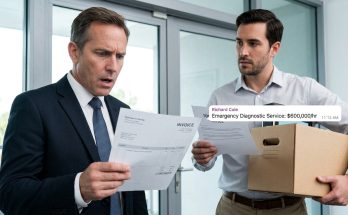
“Six hundred thousand dollars for an hour.”
“You approved it.”
“I did.”
“Why?”
“Because Richard wanted you gone, the machine was failing, and the company stood to lose one hundred eighty-four million dollars.”
She shrugged.
“Cheap.”
Samuel almost laughed.
Then Denise became serious.
“The payment was also the reason I left.”
“Why?”
“Someone tried to reverse it.”
My attention sharpened.
“Who?”
“Authorization appeared under my credentials.”
“Cloned.”
“Yes.”
“The L.C. channel wanted me gone permanently.”
“I didn’t know that yet. I only knew somebody was using my authority.”
“So you started pulling records.”
“The liability account first.”
She opened one box.
Paper ledgers.
Original bank statements.
Trust documents.
Insurance schedules.
“Why paper?”
“Because Nadia told me three months ago our executive archive had unexplained metadata changes.”
Nadia looked surprised.
“You listened?”
“I’m CFO. Paranoia is part of the job.”
Denise had quietly printed sensitive legacy records whenever something looked wrong.
Not everything.
Enough.
Reyes entered with two people behind him.
A woman in a dark suit introduced herself.
“Rebecca Sloan. FBI Economic Crimes.”
That changed the temperature of the room.
Her colleague handled cyber intrusion and trade-secret theft.
Sloan looked at me.
“Mr. Parker, we’ve been briefed on the corporate intrusion, the attempted theft of proprietary technology, credential cloning, and possible manipulation of interstate commercial systems.”
“That’s a long morning.”
“We understand yours started earlier than ours.”
She looked at the boxes.
“May we?”
Denise nodded.
“With receipts.”
Sloan almost smiled.
“Absolutely.”
We began with the contingency ledger.
The Parker Development Trust had received Horizon royalties under Michael’s licensing agreement.
The numbers matched Samuel’s account.
Payments before my father’s death.
Payments after.
No unexplained spike before the crash.
No secret payoff afterward.
The two-million-dollar Horizon insurance claim appeared separately.
The insurer paid Horizon.
Horizon used most of the proceeds to replace technical capacity, settle customer obligations, and cover business interruption after Michael’s death.
No transfer to Samuel personally.
No transfer to Jonathan.
No transfer to my family.
Sloan looked at me.
“That doesn’t eliminate every possible motive, but it removes the financial pattern someone appears to have been suggesting.”
“Jonathan.”
“And perhaps others.”
She was careful.
Good.
Denise opened the next ledger.
My father’s royalties had funded the Parker Development Trust.
My mother received the house payoff.
An annuity.
My education.
Customer restitution.
Legal expenses.
The engineering foundation.
Then the $200,000 contingency reserve.
“What was it for?” I asked.
Denise pointed to the original trust language.
INDEPENDENT TECHNICAL REVIEW AND DEFENSE OF PARKER INTELLECTUAL PROPERTY.
My father had set aside money specifically to protect Phoenix if ownership was challenged.
Trustee sequence:
Lena Cross.
Daniel Ross.
Then, only if both were unavailable:
Samuel Langford.
Samuel stared.
“I never knew.”
“Because Lena never died while Daniel was unavailable,” Denise said.
“Daniel was successor trustee?”
“Yes.”
That explained part of his seventeen-year commitment.
He wasn’t only obeying my father informally.
He had a legal duty.
“Why didn’t Daniel tell me?” I asked.
Denise shrugged.
“You’ll have to ask him.”
I already knew the likely answer.
Because my father told him not to until I found Phoenix.
Sloan examined the life-insurance schedule.
Multiple key-person policies.
Samuel.
Michael.
Two early engineers.
And Jonathan.
Jonathan’s policy was different.
Beneficiary:
Parker Development Trust.
“Why?” I asked.
Samuel looked uncomfortable.
“Jonathan’s acquisition work involved Michael’s technology.”
Denise found the supporting agreement.
If Jonathan died while negotiating acquisition or transfer of Alden assets, the trust would receive funds to defend Michael’s intellectual-property claims.
It was not a personal bet on Jonathan’s death.
It was business-risk coverage.
Again, a suspicious fact became ordinary once the missing context appeared.
That pattern had defined the entire conspiracy.
Sloan said, “Someone knew which documents to remove.”
“Yes.”
“Who had access?”
Denise opened an audit sheet.
“Legacy founder certificate.”
“Jonathan?”
“Originally Samuel and Jonathan.”
Samuel said, “Jonathan should have surrendered his token when he left.”
“Should have.”
“But didn’t.”
“No.”
Nadia had already confirmed the old certificate remained active through a compatibility layer nobody had audited because the original systems were decades old.
Jonathan had used that forgotten credential to create transactions that appeared to originate from Samuel or Denise.
Not every modern breach required modern sophistication.
Sometimes all it needed was a password nobody remembered existed.
Sloan asked about the Bay Three sabotage.
We walked her through it.
Tyler loaded the altered values.
Richard sent them.
Owen facilitated.
The L.C. channel supplied timing.
Elias controlled the Crossfield legacy environment.
Mercer provided technical parameter packages.
Jonathan separately used Keane to install Phoenix collectors.
Multiple schemes had overlapped.
“Did Jonathan order the machine sabotage?” Sloan asked.
“No evidence of that,” I said.
“Did he know it would happen?”
“Probably.”
“Probably isn’t evidence.”
“No.”
She nodded.
I appreciated her more with every sentence.
Richard arrived with counsel at 6:41.
He had agreed to a formal interview.
Sloan took him into a separate room.
I expected hours.
He lasted twenty-seven minutes before asking to speak with Samuel and me present.
His lawyer looked unhappy.
Richard looked worse.
He sat across from me.
“I knew your credential had been duplicated.”
Samuel’s jaw tightened.
“When?”
“Three weeks ago.”
I stared at Richard.
“You knew?”
“Yes.”
“And you still fired me.”
“Yes.”
“Why?”
“Owen told me the duplicate would be used to justify your termination.”
There it was.
Not a misunderstanding.
Not a mistake.
A choice.
“You knew they planned to create evidence against me.”
“I thought access violations.”
“You thought someone would use my identity to make me look dishonest.”
“Yes.”
“And that was acceptable?”
He looked down.
“I wanted you gone.”
“Why?”
“You made my job harder.”
I almost laughed.
“How?”
“You documented everything.”
Of course.
“You challenged schedule decisions. Procurement substitutions. Maintenance deferrals.”
“Because they mattered.”
“I know that now.”
“You knew it then.”
He looked at me.
“Yes.”
That answer mattered more.
People often knew.
They simply valued something else more at the time.
“Did you know the machine would be sabotaged?”
“I knew there would be a disruption.”
“You sent Tyler the parameters.”
“Yes.”
“You understood they were control values.”
“Yes.”
“You were operations director.”
“Yes.”
“So don’t tell me you thought twenty-three unauthorized changes were harmless.”
Richard swallowed.
“I knew the machine would stop.”
“Did you know they planned to blame me?”
“Not until yesterday morning.”
“What changed?”
“The incident report.”
“The one written before my firing.”
“Yes.”
“You saw it?”
“Owen showed me.”
“And you proceeded.”
“Yes.”
“Why?”
He took a long breath.
“Because by then I was already involved.”
That was the most believable thing he had said all day.
One bad decision became leverage for the next.
Then the next.
Until backing out felt more dangerous than continuing.
“What did Owen tell you?”
“That if I stopped, everything would point to me.”
“Which was true.”
“Yes.”
“Who told you Meridian would cancel after failure?”
“Mercer.”
“Who promised your post-acquisition job?”
“Owen.”
“Who ordered my exact termination sequence?”
“The L.C. channel.”
“Did you know who controlled it?”
“I thought Owen.”
“But?”
“After yesterday, I think Elias.”
Sloan asked, “Why?”
Richard explained that Owen occasionally argued with the L.C. account.
One message from two weeks earlier:
O.V.: PARKER TERMINATION TOO RISKY.
L.C.: NOT OPTIONAL.
Owen had not initiated my firing.
He had objected.
Then complied.
Sloan asked whether Richard had retained the messages.
“Yes.”
“Where?”
“Personal backup.”
“Why?”
Richard looked at me.
“Because Ethan taught everyone in engineering to preserve original records before changing anything.”
The irony was almost offensive.
His backup gave investigators the complete message chain.
Elias’s Crossfield legacy account coordinated the schedule.
Mercer provided technical files.
Owen coordinated corporate pressure.
Richard executed.
Tyler touched the machine.
The structure was finally becoming evidence instead of theory.
Sloan’s phone rang.
She stepped away.
When she returned, her expression had changed.
“Tyler Brooks has agreed to cooperate.”
Samuel exhaled.
“Good.”
“Daniel Ross too.”
“Mercer?”
“Located.”
I stood.
“Where?”
“Federal agents detained him at a private aviation terminal forty minutes ago.”
“He had Phoenix?”
“The index drive was already recovered from the warehouse.”
“What did he have?”
“Contracts. Multiple passports. Cryptocurrency access devices.”
Sloan paused.
“And a draft sale agreement for Phoenix.”
“To whom?”
“A foreign industrial consortium.”
Mercer had been exactly what he admitted.
A broker.
No loyalty except price.
“Elias?”
“In custody pending charging decisions.”
“Owen?”
“Cooperating through counsel.”
“Jonathan?”
“Not cooperating.”
No surprise.
Sloan looked at me.
“There is something else.”
“What?”
“Your father’s archive includes records relevant to potential historical trade-secret theft and manufacturing certification fraud. We’ll need formal access.”
“You’ll get it.”
“Through counsel.”
“Yes.”
“Do not publish it.”
“I wasn’t planning to.”
Jonathan’s demand to release everything had always been reckless.
My father’s letter had settled that.
Evidence belonged with people capable of separating crimes from innocent customer information.
Sloan handed me her card.
“We’ll also need your documentation from today.”
I almost smiled.
“I have a lot.”
“I’ve heard.”
At 7:22, Laura entered.
“Meridian finished analyzing the contaminated verification packages.”
“And?”
“Removed.”
“Any execution?”
“No.”
“Qualification?”
She looked toward Bay Three.
“We can resume.”
Samuel glanced at me.
I shook my head.
“Not yet.”
Laura raised an eyebrow.
“What do you need?”
“Independent validation of every controller, gateway, and machine-state file before we run anything.”
“That could take hours.”
“Yes.”
“Meridian’s team is already exhausted.”
“So is mine.”
“Your team?”
I looked toward Walter, Mason, and Nadia.
Then at the visitor badge clipped to my shirt.
PARKER PRECISION SERVICES.
I had created the company less than twenty hours earlier.
But Horizon was no longer my employer.
If they wanted me to certify a machine tied to a one-hundred-eighty-four-million-dollar program after an industrial sabotage investigation, the relationship needed to be clear.
Laura understood before Samuel did.
“You’re not doing it as Horizon’s former engineer.”
“No.”
Samuel looked at me.
“What do you need?”
“A written qualification-support contract.”
“You already have one.”
“For the original scope.”
“And now?”
“Cyber-integrity validation, forensic configuration review, witnessed restart, and certification.”
Samuel rubbed his face.
“How much?”
I thought about the six-hundred-thousand-dollar diagnostic invoice.
The restoration.
The qualification support.
One million dollars already paid to Parker Precision.
Then I looked at the machine that had nearly been used to destroy my career.
“Today?”
Samuel sighed.
“Ethan.”
“Two hundred thousand.”
Walter coughed to hide a laugh.
Samuel looked at Laura.
She said, “Meridian will split it.”
He stared at her.
“Of course you will.”
She smiled.
“We’re expensive too.”
The contract was signed at 7:41.
For the first time since Richard stopped me at the door, nobody was asking me for a favor.
Nobody was telling me to help the company that had fired me.
Nobody was deciding what my knowledge was worth without me.
Parker Precision had a second customer.
And before Bay Three moved another axis, every person in that room understood that the engineer they had tried to turn into a scapegoat was now the independent specialist responsible for telling them whether their own machines could be trusted.
Click here to continue reading: PART 19: Meridian’s Qualification Restarted Under My Company’s Name, and Richard Finally Admitted the Exact Moment He Chose His Career Over Mine
Five Minutes After Horizon Took My Badge, the Machine Only I Understood Failed With the Company’s Biggest Contract at Stake
Part 18 of 24