The officers stayed another forty minutes.
By the time they left, my front door was secured temporarily with a metal plate, the attic had been photographed, and Grady had given them Kelsey’s phone number, vehicle information, and the address of the townhouse.
No one accused her of anything.
Not yet.
But her name now existed in a police report.
That seemed to terrify Grady more than the burglary itself.
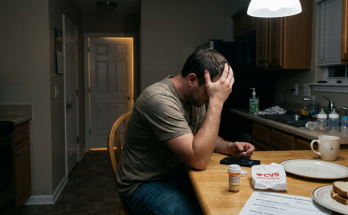
We sat at my kitchen table after the patrol cars disappeared.
For years, that table had been where Grady brought permission slips, college applications, birthday cakes, and eventually wedding plans.
Now I placed Nathan’s documents between us.
“Start with Caroline.”
Grady stared at the papers.
“Kelsey told everyone she was an only child.”
“She told me that too.”
“Caroline was older. Eight years.”
“Why hide a sister?”
“They had a bad relationship.”
“That doesn’t explain pretending she never existed.”
“I know.”
“When did you learn?”
“About four years ago.”
“One year before Caroline disappeared.”
“Yes.”
“How?”
“A Christmas card came.”
“From Caroline?”
“No. Their aunt.”
He rubbed the edge of a bank statement.
“She wrote something like, ‘Tell Caroline I still think about her.’ I asked Kelsey.”
“What did she say?”
“That Caroline was mentally unstable and had been out of the family for years.”
I disliked the ease of the label.
“Did you meet her?”
“Once.”
“Where?”
“At a diner.”
“Why?”
“She contacted me.”
My irritation rose.
“You have known for years that your wife had a hidden sister who later disappeared, and you never mentioned it?”
“I was trying to respect Kelsey.”
“There is respect, and there is helping someone rewrite reality.”
He flinched.
“What happened at the diner?”
“Caroline said Kelsey owed her money.”
“How much?”
“About thirty thousand.”
“For what?”
“She wouldn’t explain clearly. She kept saying it was ‘their mother’s money.’”
“Was their mother dead?”
“Yes. She died before I met Kelsey.”
“Estate money?”
“Maybe.”
“What did Kelsey say?”
“That Caroline was obsessed with inheritance and had spent years harassing her.”
“Did you believe her?”
“At the time.”
“Why?”
“Because Caroline seemed frightened and angry.”
“Those aren’t evidence of dishonesty.”
“I know that now.”
The realization in his voice sounded genuine.
“What does Nathan have to do with Caroline?”
“He was her doctor.”
I stared at him.
“What kind of doctor?”
“Internal medicine, I think. She had some chronic condition.”
“And later he lent you money?”
“Yes.”
“That is an extraordinary coincidence.”
“It wasn’t coincidence.”
Of course it wasn’t.
“Explain.”
“After Caroline vanished, Nathan contacted Kelsey because Caroline had listed her as family.”
“Vanished from where?”
“Her apartment.”
“Was there an investigation?”
“Yes.”
“And?”
“Police said there wasn’t evidence of foul play.”
“Did they find her car?”
“At a bus station.”
“Phone?”
“No.”
“Bank activity?”
“Stopped.”
I thought of all the financial records surrounding Kelsey.
“Did Caroline have money?”
“I don’t know.”
“Nathan apparently knows something.”
“He suspected Kelsey knew more than she admitted.”
“Why?”
“Caroline had told him she was afraid of her.”
That landed heavily.
“Afraid of what?”
“Financial stuff.”
Of course.
“What exactly?”
“She said Kelsey was using her identity.”
The kitchen became completely still.
I looked at the forged loan application bearing my own name.
“Using Caroline’s identity?”
“Yes.”
“For loans?”
“Credit cards, maybe accounts. I don’t know all of it.”
“And when Caroline confronted her?”
“She disappeared not long after.”
I sat back.
“Did Walter know about Caroline?”
Grady nodded slowly.
“He learned part of it.”
“How?”
“I told him after I met her.”
“So Walter’s concerns about Kelsey weren’t only about debt.”
“No.”
“What did he do?”
“He started keeping records.”
I looked toward the hallway leading to the attic stairs.
“The red folders.”
“Yes.”
“What was in his notes?”
“I only saw some of them.”
“What did they say?”
“Dates. Things Kelsey had told us that didn’t match documents he found.”
“What documents?”
“Property searches. Old addresses. Caroline’s name. Their mother’s estate.”
Walter had spent his entire career as an engineer, but privately he loved records almost as much as I did.
When something did not align, he kept digging.
“Why didn’t he tell me?”
Grady’s expression tightened.
“He thought you’d confront Kelsey immediately.”
“He was probably right.”
“He wanted proof first.”
“And did he get it?”
“I think so.”
“What proof?”
“That’s what was in the second red folder.”
The folder now missing.
I pressed my palm against the table.
“Who knew where Walter kept it?”
“Me.”
“Kelsey?”
“Yes.”
“Nathan?”
“No.”
“So if someone came here today for those folders—”
“It could have been her.”
“At last.”
He looked ashamed.
“I’m not saying it was.”
“You are still protecting her.”
“She’s my wife.”
“And I am your mother.”
“That’s not what I mean.”
“It is exactly what you mean. You think marriage requires loyalty even when loyalty means ignoring evidence.”
He looked down.
I softened my voice.
“Grady, if Kelsey has been using people’s identities for years, this is no longer about your marriage.”
He nodded.
“I know.”
“No, I don’t think you do.”
My phone rang.
Nathan again.
This time I answered.
“Are you still at the hospital?”
“No. They discharged me.”
“Already?”
“I insisted.”
“That sounds reckless.”
“I needed to get somewhere safe.”
“Where are you?”
“I’d rather not say over the phone.”
I looked at Grady.
“He’s here.”
Nathan understood immediately.
“Your son?”
“Yes.”
“Ask him whether he ever saw Caroline after the bus station.”
Grady heard through the speaker.
His head snapped up.
“What?”
Nathan repeated it.
Grady stared at the phone.
“No.”
“You’re sure?”
“Yes.”
Nathan’s voice remained calm.
“Think carefully.”
“I said no.”
“Then someone lied to me.”
“About what?”
“Caroline used a clinic account six weeks after she supposedly disappeared.”
Grady went pale.
“What clinic?”
“Mine.”
I sat straighter.
“How?”
“A prescription pickup under her patient ID.”
“Could someone else have used it?” I asked.
“That’s what I suspected.”
“Who?”
Nathan paused.
“The medication was collected by an authorized family contact.”
“Kelsey.”
“Yes.”
Grady stood so quickly the chair scraped backward.
“No.”
Nathan continued.
“I didn’t know about it until months later. The pharmacy audit flagged the signature.”
“Was it Caroline’s medication?” I asked.
“Yes.”
“What kind?”
Nathan hesitated.
“A controlled pain medication.”
My stomach tightened.
“So Kelsey picked up medication in her missing sister’s name.”
“It appears that way.”
“Did police know?”
“I reported it.”
“And?”
“They interviewed her.”
Grady stared at the wall.
“She never told me.”
Nathan said, “There are many things she didn’t tell you.”
“Don’t talk about my wife like you know her.”
“I knew Caroline.”
“That doesn’t mean you know Kelsey.”
“No. But I know documents.”
That sentence could have come from me.
Nathan continued.
“Karen, Walter contacted me once.”
Everything inside me stopped.
“When?”
“About two months before he died.”
“You knew my husband?”
“I spoke to him by phone.”
Grady sat again.
“What did Dad want?”
“He asked about Caroline.”
“How did he know to call you?” I asked.
“She had mentioned me to him.”
“Caroline knew Walter?”
“Apparently.”
I closed my eyes.
Another hidden connection.
“Did they meet?”
“I don’t know.”
“What did Walter ask you?”
“Whether Caroline had ever discussed identity theft.”
“And what did you say?”
“I told him patient confidentiality prevented me from discussing medical details.”
“But?”
“But I warned him that if he had evidence of fraud, he should preserve everything somewhere outside the house.”
I stared toward the attic.
“He didn’t.”
“I thought he had.”
“Did Walter tell you what he found?”
“No. He said he had enough to prove a pattern.”
“What pattern?”
Nathan’s voice lowered.
“Kelsey assumed identities of people who trusted her.”
I looked at my own loan application.
Caroline.
Me.
Possibly others.
“Did Walter mention Grady?”
“No.”
My son released a breath I had not realized he was holding.
Nathan continued.
“He said he was worried his son had no idea what was happening.”
Grady’s face crumpled.
For several seconds, no one spoke.
Then I asked Nathan why he had eventually lent Grady twenty thousand dollars.
“To stay close.”
Grady stared at the phone.
“You used me?”
“I helped you when you came to me. Yes, I also wanted to understand what Kelsey was doing.”
“That’s insane.”
“Maybe. But after Caroline disappeared, I stopped assuming ordinary explanations.”
“Why didn’t you go to police?”
“I did.”
“And?”
“They needed evidence.”
“Which you didn’t have.”
“Not then.”
“What changed?”
Nathan paused.
“Seven months ago, a loan in Karen’s name appeared in a financial packet connected to your medical-equipment business.”
I looked at Grady.
He looked horrified.
“I never saw Mom’s name.”
“You saw the capital injection.”
“I thought Kelsey got private financing.”
“She did. Using Karen’s identity.”
Grady stood again and began pacing.
I asked Nathan, “Where did the seventy-five thousand go?”
“Mostly into the business.”
“Mostly?”
“About fifty-six thousand.”
“And the rest?”
“A transfer to a separate account.”
“Whose?”
“I’m still tracing it.”
“Caroline’s?”
“No.”
“Then whose?”
Nathan became quiet.
“Walter’s.”
I felt my fingers go numb.
“My dead husband’s account?”
“Yes.”
“How?”
“That’s what I was trying to understand when I confronted Kelsey.”
“What did she say?”
“She told me Walter had left instructions.”
I almost laughed.
“That is impossible.”
“I thought so too.”
“Did she show you anything?”
“A photocopy.”
“Of what?”
“A handwritten letter.”
My heart began beating harder.
“Walter’s handwriting?”
“It looked like it.”
Grady stopped pacing.
“What did it say?”
“That certain trust funds should be moved to protect you from creditors.”
“That doesn’t sound like Dad,” Grady said.
“No,” I agreed.
Walter believed in paying debts, documenting everything, and never hiding assets.
Nathan said, “I photographed the letter.”
“Send it.”
“I already did.”
My phone chimed.
I opened the image.
At first glance, the writing resembled Walter’s.
Then I enlarged it.
The capital W was wrong.
Walter formed his W with a sharp first stroke.
This one curved.
The date at the top made my stomach drop.
Four months after Walter died.
I showed Grady.
He stared.
“That’s impossible.”
“Yes.”
Someone had created a letter in my husband’s handwriting after his death.
Someone had used it to justify moving trust money.
Then another message arrived from Nathan.
A second image.
This one was not a letter.
It was a photograph of Kelsey sitting across from a woman in a restaurant booth.
The date stamp was two years after Caroline’s disappearance.
I looked at the woman.
Same eyes as Kelsey.
Same narrow chin.
Older.
Tired.
Alive.
“Grady.”
He leaned closer.
His face changed.
“No.”
“You recognize her?”
He whispered one word.
“Caroline.”
Click here to continue reading: PART 7: A Photograph Proved Caroline Was Alive After Her Disappearance, but the Woman Beside Kelsey Had Been Living Under Another Name
My Son Asked Me to Stay Away From His Home, but the Car Outside Made His Explanation Impossible to Believe
Part 6 of 28