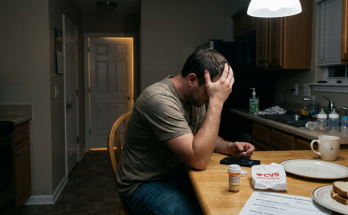
I read Walter’s sentence three times.
The man helping them is someone you know.
Grady stood beside me inside the small private viewing room at First Union Trust.
Neither of us spoke.
The bank employee had left us alone with the box.
I continued reading.
His name is Martin Vale.
My breath caught.
Grady frowned.
“Who is Martin Vale?”
I knew immediately.
“My old bank adviser.”
“From where?”
“North County Savings.”
I had worked with Martin for more than fifteen years.
He had helped Walter and me refinance the house.
He had advised us when we established Grady’s college savings account.
After Walter became ill, Martin had sat at this very kitchen table—our kitchen table—explaining beneficiary forms in a patient voice.
“He retired,” I said.
“When?”
“About four years ago.”
Grady’s face tightened.
“That’s around when Dad started writing these notes.”
I returned to the letter.
Walter wrote that he had discovered irregularities while reviewing a trust statement. A transfer authorization appeared to carry his signature even though he had been hospitalized on the date it was supposedly signed.
I remembered that hospitalization.
Pneumonia.
Ten days.
Walter could barely hold a spoon.
He had not signed financial transfers.
Walter confronted Martin privately.
Martin claimed it was a clerical error.
Walter did not believe him.
He began reviewing older statements.
The more he examined, the more anomalies he found.
Small transfers at first.
Then larger ones.
Accounts opened and closed within months.
Mailing addresses changed temporarily, then restored.
Contact numbers replaced.
The same pattern now appearing in my SUV lease.
Grady read beside me.
“This started before I married Kelsey.”
“Yes.”
That changed everything.
Kelsey could not have created the original system.
She may have learned it.
Joined it.
Expanded it.
But someone had been manipulating our financial records before she entered the family.
I continued.
Walter had traced Martin’s name to paperwork connected with Kelsey’s mother’s estate.
“How would Dad even know to look there?” Grady asked.
The next paragraph answered him.
Caroline had contacted Walter.
Not after she met Grady.
Before.
She had found Walter because his name appeared on a document Martin handled.
I stared at the page.
“So Dad and Caroline knew each other before you met her.”
Grady looked stunned.
Walter explained that Caroline believed Martin had helped move money from her mother’s estate into temporary accounts.
Kelsey’s name appeared on some documents.
Caroline’s appeared on others.
Several signatures looked inconsistent.
Caroline initially blamed Kelsey.
Later she became uncertain.
Martin had told each sister the other was responsible.
“He divided them,” I said.
Grady nodded slowly.
“And kept them blaming each other.”
Walter’s letter continued.
Caroline eventually admitted she had signed some documents voluntarily because Martin promised the transfers would protect estate money from taxes and creditors.
Kelsey had done the same.
Neither fully understood where the funds went.
By the time they realized money was missing, both had signatures on fraudulent paperwork.
They were trapped.
That did not make them innocent.
Walter wrote exactly that.
They have both lied and both participated. But Martin appears to understand the system better than either of them.
I read the line aloud.
Grady sank into the chair.
“So Kelsey may have started as part of someone else’s fraud.”
“Yes.”
“That doesn’t excuse what she did to you.”
“No.”
He looked relieved I said it.
Understanding was not absolution.
Walter described one meeting with Martin.
He had accused him of using clients’ financial information to create unauthorized credit and temporary accounts.
Martin laughed.
Then he told Walter something that made my skin crawl.
People sign more than they remember.
The phrase was written in quotation marks.
I could hear Martin saying it.
Calm.
Confident.
Dismissive.
Walter wrote that he immediately moved several assets and created the trust for Grady.
“He created the trust because of Martin,” Grady said.
“Yes.”
“To protect money.”
“Yes.”
“And then I gave Kelsey access.”
His voice cracked.
“You didn’t know.”
“I should have.”
“You should have asked more questions.”
He looked at me.
I did not soften it.
“You were warned.”
He nodded.
Walter’s final pages became more urgent.
He believed Martin was using old client files to create new financial identities.
People who had moved.
People who had died.
People who rarely checked credit.
Claire Bennett had been one of those identities.
The real Claire had been a former client.
Dead for years.
Martin apparently retained enough documentation to resurrect her financially.
“Then Kelsey didn’t invent Claire Bennett,” Grady said.
“No.”
“She got the identity from Martin.”
“Probably.”
“And Caroline later used it.”
“Apparently.”
“Why would Martin want Caroline hidden?”
I kept reading.
Walter suspected Caroline threatened to go to authorities.
Martin responded by convincing her that she would be prosecuted first because her own signature appeared on fraudulent estate transfers.
Kelsey apparently reinforced the threat.
Whether willingly or under pressure, Walter did not know.
Then came another sentence.
If Caroline disappears, do not assume Kelsey killed her.
I stopped.
Grady stared.
“Dad actually wrote that?”
“Yes.”
The next sentence was worse.
Assume someone wants you to think she did.
My chest tightened.
For weeks—or perhaps years—every clue had been arranged to point toward Kelsey.
Some clues were real.
She had forged my signature.
She had used my identity.
She had lied about Caroline.
She had hidden financial activity.
But someone more experienced had taught the method long before.
Martin.
The envelope contained another document.
A list of account numbers.
One belonged to Walter’s secret account.
Another matched the number in the red notebook.
A third was unfamiliar.
Beside it Walter had written:
M.V. operating account — transfers through holding companies.
Nathan needed to see this.
So did police.
I photographed every page.
Then I called Officer Ramirez.
He listened without interrupting.
When I finished, he said, “Do not contact Martin Vale.”
“I wasn’t planning to.”
“Do not contact your daughter-in-law either.”
“That may be harder.”
“Why?”
Because my phone was ringing.
Kelsey.
I showed Grady.
He looked at me.
“Don’t answer.”
For once, we agreed.
The call stopped.
Then came a message.
Karen, please. I need to explain before Grady hears this from someone else.
Grady read it.
His face hardened.
“He already has.”
Another message arrived.
Martin contacted me.
My blood chilled.
A third.
He knows you found Walter’s box.
Grady stood.
“How could he know?”
I looked around the bank room.
No one except the branch staff knew we were there.
Unless someone had been watching us.
My phone rang again.
Unknown number.
Officer Ramirez was still on my other line.
“Someone else is calling,” I told him.
“Don’t answer unless you can put it on speaker.”
I did.
“Hello?”
A man spoke.
Older.
Smooth.
Familiar.
“Karen.”
I knew the voice before he identified himself.
Martin Vale.
It had been years since we spoke, but his tone had not changed.
Warm enough to sound trustworthy.
Controlled enough to conceal everything else.
“Martin.”
“I hear you’ve been asking questions.”
Officer Ramirez was listening.
“So have the police.”
A pause.
“That seems unnecessary.”
“I disagree.”
“Walter always had a talent for making ordinary bookkeeping look sinister.”
“My husband found forged signatures.”
“Did he?”
“Yes.”
“Karen, Walter was very ill near the end.”
Anger sharpened my voice.
“Do not use his illness to discredit him.”
“I’m not.”
“You are.”
Martin sighed.
“I’m trying to prevent you from destroying your son’s family over paperwork you don’t understand.”
The same phrase Kelsey had used.
Things you don’t understand.
“You trained her.”
Silence.
Just long enough.
“Who?”
“Kelsey.”
He gave a small laugh.
“You’ve always been dramatic when frightened.”
“I’m not frightened.”
That was partly a lie.
But I was angrier than afraid.
“What do you want?”
“To meet.”
“No.”
“You should.”
“No.”
“There are things Walter never knew.”
“Then tell me now.”
“Not by phone.”
Officer Ramirez sent me a text while remaining connected on the other line.
KEEP HIM TALKING.
I swallowed.
“Why did you use Claire Bennett’s identity?”
Martin stopped breathing for a second.
Then his voice changed.
Only slightly.
“Where did you hear that name?”
“Walter.”
“Walter is dead.”
“Yes.”
“He cannot tell you anything.”
“He already did.”
Another silence.
Then Martin said, “You opened the box.”
Not a question.
A statement.
“How did you know there was a box?”
He recovered quickly.
“Walter mentioned it once.”
“He never mentioned it to me.”
“You weren’t involved in every conversation your husband had.”
That was true.
It was also a deliberate wound.
I refused to react.
“Did you help Kelsey forge my loan application?”
“No.”
“Did you give her my financial information?”
“No.”
“Did you access Walter’s trust?”
“No.”
“Did you know Caroline?”
Silence again.
Then:
“Yes.”
Grady gripped the edge of the table.
“How?”
“She came to me for help.”
“With what?”
“Her mother’s estate.”
“Did you steal from it?”
Martin laughed softly.
“Karen, stop.”
“Did you?”
“No.”
“Why did Caroline disappear?”
“I don’t know.”
“She’s alive.”
The line went silent.
Grady looked at me sharply.
We had not planned to reveal that.
Officer Ramirez texted:
GOOD. WAIT.
Martin finally spoke.
“That’s interesting.”
“You already knew.”
“No.”
“Kelsey met her last year.”
“I wouldn’t know anything about that.”
“Under the name Claire Bennett.”
This time the silence lasted longer.
When Martin returned, the warmth was gone.
“Listen to me carefully.”
I felt Grady move closer.
“What?”
“You are holding documents that do not mean what Walter thought they meant.”
“Then explain them.”
“I will.”
“Now.”
“Not there.”
I looked toward the bank door.
He knew where I was.
My pulse jumped.
“Where am I, Martin?”
No answer.
“Tell me.”
Still nothing.
Then he said, “Go home.”
Officer Ramirez immediately texted:
DO NOT.
Martin continued.
“There’s a package waiting for you.”
“What package?”
“One Walter never found.”
“How do you know?”
“Because I put it there.”
Grady whispered, “Mom.”
I raised a hand.
“Where?”
“Garage.”
“What is inside?”
“The reason Caroline disappeared.”
My mouth went dry.
“And Kelsey?”
“The reason she lied.”
“And you?”
He gave one quiet breath.
“The reason Walter was wrong.”
Then he ended the call.
Officer Ramirez immediately spoke through my other phone connection.
“You and Grady stay inside that bank.”
“Martin said there’s something in my garage.”
“I heard him.”
“We need to get it.”
“We will.”
“I’m coming.”
“No.”
“Officer—”
“Mrs. Whitlow, that man knew exactly where you were without you telling him.”
I looked at the small security camera above the bank-room door.
“Could he have someone here?”
“We’re checking.”
Grady paced once across the room.
Then his phone buzzed.
He looked down.
His entire body went rigid.
“What?”
He showed me.
A message from Kelsey.
I’m sorry. I tried to keep Martin away from you. I failed.
Below it was a photograph.
My garage.
Taken from inside.
On Walter’s old workbench sat a black metal case.
And beside it was a woman I recognized from Nathan’s photograph.
Caroline.
Alive.
Standing inside my home.
Click here to continue reading: PART 9: Caroline Was Waiting Inside My Garage, but the Black Case Beside Her Contained Proof Walter Had Never Lived Long Enough to See
My Son Asked Me to Stay Away From His Home, but the Car Outside Made His Explanation Impossible to Believe
Part 8 of 28