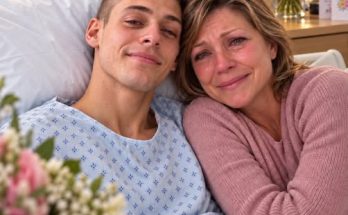
Emily came home from St. Matthew’s eleven days later.
Not to my home.
Her own.
I had to keep correcting that language in my head.
Laura sent me a photograph from their driveway that morning. Emily stood beside the passenger door wearing a mask, loose gray sweatshirt, and shoes that looked deliberately chosen for comfort rather than dignity.
No yellow socks.
Her message underneath said:
I negotiated the socks.
I replied:
You’re learning.
Three days later, after her transplant team approved a short outing, Laura drove her to my house.
I spent the entire morning pretending I was not preparing.
I cleaned the kitchen twice.
Checked the weather four times.
Bought bananas.
At noon, I caught myself rearranging yogurt containers in the refrigerator and started laughing.
Caleb’s notebook had been offensively accurate.
Daniel arrived twenty minutes before Emily.
He walked into the kitchen, saw the bananas, and pointed.
“No.”
“Do not start.”
“You bought six.”
“They were on sale.”
“You don’t eat bananas.”
“I might.”
“You won’t.”
“Leave.”
He did not.
At twelve forty-seven, a car pulled into the driveway.
My body reacted before my mind did.
Heart racing.
Hands cold.
For one terrible second, every irrational thought I had fought since the transplant returned.
Caleb is here.
No.
Emily is here.
Caleb’s heart is an organ inside her body.
It is helping her live.
It does not make her him.
I repeated that silently until the doorbell rang.
When I opened the door, Laura stood slightly behind Emily, giving her space.
Emily looked different outside the hospital.
Still thin.
Still pale.
But she wore jeans.
Her hair was loose.
No monitors.
No IV pole.
She looked eighteen instead of like a patient.
“Hi,” she said.
“Hi.”
We stared at each other.
Then she looked down at her socks.
Black.
“I followed the dress code.”
“Barely.”
She smiled.
Good.
Normal.
“Come in.”
She stepped across the threshold.
I did not look at her chest.
That became my first victory.
Laura hugged me.
Emily looked around.
I watched her see the house Caleb had described.
The staircase.
The kitchen.
The dent in the hallway wall from when he tried moving furniture alone.
The framed school photographs.
Then her eyes reached the mantel.
She stopped.
The photograph beneath the maple tree sat beside David’s picture.
Caleb’s arm around Emily.
Emily leaning into him.
Her hand rose to her mouth.
“You put it up.”
“He told me to.”
She laughed softly.
“Of course.”
“I chose it.”
That mattered.
Her eyes filled.
“I didn’t know Marcus took that one.”
“There are dozens.”
“He was spying.”
“Apparently.”
“He said he was photographing plants.”
“Marcus has never voluntarily photographed a plant.”
Emily smiled through tears.
Then she moved closer to the mantel.
Her fingers hovered near the frame but did not touch.
“He looked really sick.”
“Yes.”
“I didn’t notice that day.”
“Good.”
She turned.
“Good?”
“He probably wanted that.”
Emily considered.
“Yes.”
Laura went to the kitchen with Daniel.
Deliberately.
Giving us room.
Emily looked toward the stairs.
“His room?”
“Up there.”
She did not ask immediately.
Good.
Instead she wandered through the living room.
Caleb’s old game controller sat beneath the television.
A pair of shoes remained by the door because I had not moved them.
His ridiculous ceramic mug that said WORLD’S MOST TOLERABLE SON sat on a shelf.
Emily picked it up.
“He sent me pictures of this.”
“He bought it for himself.”
“I know.”
“He wrapped it and gave it to me for Mother’s Day.”
“That part he didn’t tell me.”
“He was proud of himself.”
“He should’ve been.”
We sat.
I had imagined this moment too many ways.
Crying.
Silence.
Maybe some unbearable awareness of the heart beating inside her.
Instead Emily asked:
“Do you actually hate cilantro?”
I stared.
“What?”
“Thomas wrote that David said you hated cilantro.”
“Oh.”
“I’ve been wondering.”
“Yes.”
“Caleb liked it.”
“He was wrong.”
“He said you called it soap weed.”
“That is accurate.”
Emily laughed.
And suddenly the room became easier.
We talked about food.
Movies.
Caleb’s hatred of yellow.
His inability to keep houseplants alive.
The fact that he had once claimed a cactus died because it “lacked ambition.”
Then Emily grew quiet.
“Can I ask something?”
“Yes.”
“Do you regret saying yes?”
I knew immediately what she meant.
The donation.
“No.”
“Even now?”
“Yes.”
She looked down.
“I keep thinking maybe you only said yes because you were in shock.”
“I was in shock.”
Her face tightened.
“But Caleb had already made his wishes clear.”
“Yes.”
“And I knew them.”
“So you would do it again?”
I hated the hypothetical.
Because doing it again meant losing him again.
“I would never choose his death.”
Emily nodded.
“But if he were dying anyway?”
“Yes.”
I swallowed.
“I would honor his choice again.”
She breathed out slowly.
“Okay.”
“Why?”
“Because sometimes I feel guilty for being relieved.”
“That you survived?”
“Yes.”
“You are allowed.”
“It feels ugly.”
“No.”
“I woke up after surgery and the first thing I thought was, I’m still here.”
“That is not ugly.”
“Then I remembered why.”
My throat tightened.
“Both can be true.”
She nodded.
“I miss him.”
“I know.”
“And I’m happy I’m alive.”
“I know.”
“Those don’t cancel each other?”
“No.”
The answer came more easily now.
Maybe because Caleb had trained all of us.
Emily smiled faintly.
“He said you’d get there.”
“He was becoming intolerably confident.”
“He already was.”
I glanced toward the stairs.
“Do you want to see his room?”
She looked afraid.
Not physically.
Emotionally.
“Yes.”
We went slowly because she still tired easily.
At the top, she paused to catch her breath.
I waited without fussing.
That was difficult.
She noticed.
“Caleb would be impressed.”
“Do not tell anyone.”
His bedroom door remained open.
Emily stepped inside.
The room changed around her.
Not magically.
Just context.
She knew the person who slept there.
She recognized things.
“That hoodie.”
“What?”
“He wore that constantly.”
“I know.”
“He told me you hated it.”
“It had holes.”
“He said ventilation.”
I laughed.
She saw the blue notebook on the desk.
I had left it there.
“Can I?”
“Yes.”
She flipped through.
When she reached THINGS MOM DOES WHEN STRESSED, she laughed so hard she had to sit.
“Bananas.”
“Enough.”
“He told me about the bananas.”
“Everyone apparently knew except me.”
She read the terrible band names.
Then reached the page of things Caleb wanted if treatment worked.
Her smile disappeared.
Meet Emily in person.
Her finger stopped on the line.
“He did.”
“Yes.”
She kept reading.
Nineteen is not enough. I am allowed to be mad.
Emily closed the notebook.
“He never said that to me.”
“What?”
“That he was angry.”
“He probably didn’t want you carrying it.”
“I told him I was angry all the time.”
“He was a hypocrite.”
“Yes.”
We sat together on his bed.
For several minutes neither of us spoke.
Then Emily whispered:
“Sometimes I want to be angry at him.”
“Then be angry.”
Her eyes widened.
“For dying?”
“Yes.”
“That isn’t fair.”
“Grief is not court.”
She looked at me.
“That sounds like something you learned recently.”
“Very.”
“I’m angry he lied to me.”
“Good.”
“I’m angry he made plans without asking.”
“Very good.”
“I’m angry he gave Marcus passwords and made everybody keep secrets.”
“Excellent.”
She laughed.
“I’m angry he left me with all these instructions.”
“So am I.”
Then her face crumpled.
“I’m angry he got to stop being scared.”
That one hurt.
“And I still have to be.”
I reached for her hand.
Not her chest.
Her hand.
“You’re allowed.”
She cried.
Quietly.
I did too.
After a while, she looked toward his closet.
“Is that the shoebox?”
“Yes.”
“The pictures?”
“Yes.”
We opened it together.
She remembered each one.
Botanical garden.
A bench near the fountain.
Caleb making a face because Marcus took too long.
Emily holding two coffees neither doctor would have approved.
Then one photograph I had not noticed before slipped from between two others.
Caleb alone.
He was looking away from the camera.
On the back, in Marcus’s handwriting:
He had just told her.
I frowned.
“Told you what?”
Emily took the photograph.
Her expression changed.
“I don’t know.”
“Marcus wrote it.”
She stared longer.
Then recognition.
“Oh.”
“What?”
“That day.”
“What did he tell you?”
Emily looked at me.
“That he had recorded something for you.”
My stomach tightened automatically.
“What?”
“He said it wasn’t for Lantern.”
“What was it?”
“He wouldn’t tell me.”
“When did he make it?”
“Before the garden.”
“Where is it?”
“I don’t know.”
“Did he say?”
Emily thought.
“He said you would find it when you stopped looking for evidence.”
That sounded irritatingly Caleb.
I looked around the room.
Not evidence.
Something ordinary.
The notebook?
Closet?
Photographs?
Emily turned the picture over again.
“There’s writing under Marcus’s note.”
Faint pencil.
Almost erased.
I held it toward the window.
MOM KNOWS WHERE I KEEP THE DAYS I WANT BACK.
I stared.
“What does that mean?” Emily asked.
I knew immediately.
The hall closet.
Years ago, when Caleb was little, I made yearly photo boxes.
Not digital albums.
Actual prints.
Birthday tickets.
School drawings.
Vacation receipts.
I called them memory boxes.
Caleb once asked why I kept junk.
I told him some days deserved a place to come back from.
He had mocked the sentence for years.
I went downstairs.
Top shelf.
Boxes labeled by year.
The year David died sat between two others.
I pulled it down.
Inside were photographs.
Caleb at nine.
David grilling.
A school certificate.
A broken plastic airplane.
And beneath them, a small black flash drive.
No label.
My hands shook.
Daniel appeared behind me.
“What is it?”
“I don’t know.”
Emily stood in the doorway.
“Caleb’s.”
We used the clean laptop Holt had given me.
One file.
MOM_ONLY.mp4.
I stared.
Emily stepped backward.
“I can leave.”
“No.”
“Are you sure?”
I thought.
“Yes.”
Caleb had told her about it.
Maybe he expected her there.
I opened the file.
Caleb appeared.
No hospital gown.
No Lantern backdrop.
He sat in his room.
“Mom.”
His voice was softer than in the investigation recordings.
“If you found this because you finally stopped searching for evidence, congratulations.”
I laughed.
Then his face became serious.
“This is not another clue.”
Good.
“I need to tell you something I couldn’t say while I was alive.”
My breath stopped.
He looked down.
Then back at the camera.
“I was scared you would make my dying harder.”
The sentence hit like a physical blow.
Emily’s hand found mine.
Caleb continued.
“Not because you did anything wrong.”
He paused.
“Because you loved me so much that every time I admitted I was scared, you became twice as scared.”
My eyes filled.
“So I started protecting you.”
No.
“And then I got good at it.”
No.
“I told Emily things.”
Marcus.
Nina.
Everyone.
“Not because I trusted you less.”
He swallowed.
“Because I needed one place where my fear didn’t become your fear.”
I covered my mouth.
“I’m sorry.”
He shook his head as though answering me.
“Don’t make this another thing you did wrong.”
Too late.
“I should have told you more.”
Pause.
“You should have let me sometimes.”
That was fair.
Brutal.
Fair.
He smiled sadly.
“We both messed it up.”
I cried harder.
That sounded like us.
Not saint and grieving mother.
Two people terrified of losing each other.
Caleb continued.
“The night the doctor told me the treatment probably wasn’t working, you sat in the parking lot and said we would find another option.”
I remembered.
Rain.
Hospital garage.
My hands gripping the steering wheel.
“I knew you needed to say that.”
His voice cracked.
“But I needed you to say something else.”
I whispered:
“What?”
Video-Caleb answered.
“I needed you to say you knew I might die.”
I closed my eyes.
I had never said it.
Not then.
Not until days before the end.
“I thought saying it would mean giving up.”
He nodded slightly, as if he knew.
“It wouldn’t have.”
I sobbed.
Emily squeezed my hand.
Caleb continued.
“So if you are watching this, I need you to know something.”
Pause.
“I knew you knew.”
My breath caught.
“You were just scared.”
Yes.
“So was I.”
He smiled.
“We can call it even.”
I laughed through tears.
Then he said:
“And if Emily is there, tell her she still owes me fourteen dollars.”
Emily gasped.
“What?”
I laughed.
“She does.”
“No, I don’t.”
Caleb continued:
“She absolutely does.”
Emily started laughing and crying at once.
The recording ended with Caleb looking straight at the camera.
“Mom.”
Pause.
“You don’t have to keep being brave now.”
Then black.
I sat in front of the screen for a long time.
For months, everyone had told me how brave Caleb was.
How brave I was.
I hated the word.
Bravery had become another demand.
Another job.
Caleb had finally released me from it.
Emily rested her head against my shoulder.
Not because of the heart.
Because she was eighteen and grieving too.
Downstairs, the mantel held their photograph.
For the first time since she entered the house, I understood what Caleb wanted me to see.
Not donor and recipient.
Not victim and survivor.
Two young people under a maple tree.
One died.
One lived.
Both had mattered before either fact became true.
Click here to continue reading: PART 34: The Public Learned About Bellwater, but Caleb’s Name Was Nearly Turned Into the Story He Had Spent Months Trying to Prevent
At My Son’s Funeral, a Stranger Handed Me a Letter He Had Written for a Girl I Had Never Met
Part 33 of 43