The first subpoena arrived on a Tuesday morning.
I was standing at the kitchen counter cutting an apple while Max waited beneath me with the concentrated patience of a dog who had learned that gravity occasionally delivered miracles.
My attorney called.
“Sarah, the court approved the first round of examinations.”
I set down the knife.
“Who?”
“Eleanor. Marcus. Chloe. Thomas. Gerald if his doctors clear him. Samuel by protected deposition. Several Meridian witnesses.”
“And me?”
“Eventually.”
“Good.”
There had been a time when that answer would have frightened me.
Now it felt strangely clean.
No anonymous message.
No hidden compartment.
No one asking me to meet at an abandoned property.
Questions would be asked in rooms with transcripts.
That was progress.
The civil litigation had split into several related matters. Lillian’s estate claims. Hayes corporate accounting. Restitution. Challenges to old ownership transfers. Questions surrounding the unauthorized use of trust money. Meridian transactions. Personal benefits received by family members.
Nothing moved quickly.
For once, that was useful.
Slow meant records could be authenticated.
People could contradict themselves under oath rather than over dinner.
Claims could be tested instead of absorbed because someone looked convincing while making them.
Eleanor fought nearly everything at first.
Then something changed.
Her lawyers stopped filing aggressive motions.
They began negotiating.
I learned why when an independent forensic accountant finished tracing thirty-one years of transactions.
The number Eleanor had moved through unauthorized family structures was not hundreds of millions.
That had been one of the fears driving everyone.
The actual amount was smaller.
Still enormous.
But measurable.
Forty-seven million dollars in principal across decades, not including growth, indirect benefits or disputed transfers.
Marcus received a fraction.
Chloe received less.
Other relatives benefited indirectly.
Eleanor had controlled the majority of the movement.
When my lawyer told me the figure, I felt almost disappointed by its ordinariness.
Not because forty-seven million dollars was ordinary.
Because numbers, once established, lacked the emotional mythology everyone had wrapped around them.
No bottomless fortune.
No single vault.
No mysterious empire vanishing in smoke.
Money had moved from accounts to companies to trusts to mortgages to real estate.
It could be followed.
Mostly.
That word remained.
Mostly.
The independent audit also confirmed something important.
David had not transferred company control entirely to me.
The fear Eleanor had voiced at the funeral—that I would somehow take the whole Hayes fortune—had never been true.
David had protected certain voting rights from her through trusts.
He had transferred the condo to me.
Personal accounts to me.
Insurance proceeds.
Some defined beneficial interests.
But the larger company structure had professional trustees and restrictions he could not simply erase.
I remember laughing when my attorney explained it.
“What?”
She looked concerned.
“Nothing.”
But it was something.
The entire family had invaded my condo because they assumed David had made me the gatekeeper to everything.
He had not.
They had panicked over a version of the estate that existed mostly inside their own expectations.
Fear did the rest.
The deposition room for Eleanor was beige.
That detail stayed with me.
After all the drama that had surrounded her for decades, the room where she finally answered questions under oath had beige carpet, beige walls and a bowl of wrapped mints nobody touched.
I did not attend in person.
My attorney advised against it.
I watched selected portions later.
The first hours were tedious.
Company dates.
Account names.
Property structures.
Authorization forms.
Eleanor answered carefully.
Then opposing counsel asked about Lillian.
“Did you know Lillian Hayes had refused to sign the transfer that reduced her ownership?”
Eleanor looked toward her attorney.
“Yes.”
“When did you know?”
“Before it was recorded.”
“Did Richard know?”
“I believed so.”
“Did Gerald?”
“Yes.”
“Did you?”
“Yes.”
“Did you retain a blank authorization form bearing Lillian’s identifying information?”
A pause.
“Yes.”
“Why?”
“I thought it might be needed.”
“For what legitimate purpose?”
Longer pause.
“None I can defend now.”
That sentence was the first time I heard Eleanor publicly surrender the language of necessity.
No family protection.
No business judgment.
No blood.
Just none I can defend now.
It mattered.
Counsel continued.
“Did you personally sign Lillian’s name?”
“No.”
“Do you know who did?”
Eleanor looked down.
“No.”
That remained unresolved.
Gerald denied doing it.
Thomas denied it.
Richard was dead.
Forensic analysis could not identify the exact hand because the signature appeared to have been traced from an authentic specimen.
The truth had limits.
I had learned to let them remain limits.
Then counsel asked about my condo.
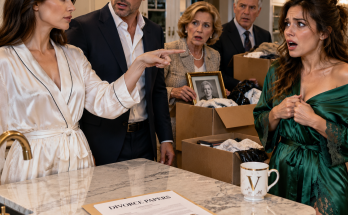
“Mrs. Hayes, did you enter Sarah Hayes’s residence after David Hayes’s funeral?”
“Yes.”
“Did you have her permission?”
“No.”
“Did you bring luggage?”
“Yes.”
“How many pieces?”
Eleanor closed her eyes.
“I don’t remember.”
A lawyer produced security images.
Eight.
There they were.
Eight suitcases.
The image looked absurd now.
A family invasion caught under fluorescent lobby lighting.
“What did you intend to remove?”
“Items belonging to David.”
“Who decided they belonged to you?”
“I did.”
“Based on what legal authority?”
Eleanor did not answer.
Counsel waited.
Finally:
“None.”
I paused the video.
Rachel, sitting beside me, said nothing.
I was surprised by how much that word affected me.
None.
For months, the larger crimes had dwarfed that afternoon.
Lillian.
Halcyon.
Martin.
Meridian.
Paul.
But the first violation mattered because it showed the belief beneath everything else.
If Eleanor felt entitled, possession became authority.
People became categories.
Property became family property.
My marriage became temporary because David had died.
None.
It was the answer she should have known before entering my home.
Marcus’s deposition came next.
He admitted the mortgage benefit.
Admitted signing documents he had not read closely.
Admitted assuming family lawyers had reviewed everything.
When asked whether he understood that assumption did not erase responsibility, he said yes.
His attorney must have hated the simplicity.
I respected it.
Chloe’s deposition was harder.
She admitted modifying records while young.
Admitted continuing after she understood some transfers were not legitimate.
Admitted helping David later.
Admitted participating in the funeral-day entry.
When asked whether she believed helping David corrected her earlier conduct, she said no.
That answer mattered.
Nobody’s later good act canceled an earlier bad one.
No perfect moral arithmetic.
Thomas’s testimony was worse.
He admitted drafting replacement documents for Lillian’s transfer despite knowing she had not signed them.
Admitted accepting Richard’s claim that authorization existed elsewhere.
Admitted not verifying enough.
Admitted decades of silence.
Then came the gun.
“Why did you bring a weapon to the hunting lodge?”
Thomas looked exhausted.
“I wanted Paul Denning to be afraid.”
“Did you believe you were in immediate danger?”
“No.”
“Did you fire at him?”
“I fired toward his vehicle.”
“Did you intend to hit him?”
“No.”
“Did you understand you could have?”
“Yes.”
No heroism.
No excuse.
The prosecutor handling that conduct later offered a resolution reflecting his age, cooperation, lack of injury and circumstances, but not erasing the act.
Thomas accepted.
He lost his license voluntarily before disciplinary proceedings could finish.
When he told me, I asked:
“Do you regret retiring?”
“I regret needing to.”
Fair answer.
Paul Denning’s criminal matter became more complicated than newspapers wanted.
Reporters tried to turn him into the mastermind.
He was not.
He was a central exploiter.
He had obstructed investigations.
Threatened witnesses.
Used confidential information.
Held evidence to influence others.
Participated in financial concealment.
But prosecutors were careful not to claim he created every original fraud.
That mattered to me.
A lazy story would have made Paul responsible for thirty years because he was the easiest villain to understand.
The record was uglier.
Richard began some systems.
Eleanor exploited others.
Gerald built concealment structures.
Samuel helped move money and evidence.
Paul converted secrets into leverage.
Voss corrupted information flow.
Claire made unauthorized disclosures she thought harmless.
Dad altered records to protect James.
Mom concealed evidence for reasons she later regretted.
David manipulated people while trying to expose them.
Everyone added something.
Paul eventually agreed to cooperate after weeks of resisting.
Not out of remorse.
His lawyers recognized the evidence against him had become too strong.
He surrendered additional files.
Some were duplicates.
Some useful.
One mattered deeply.
The original copy of Charles Avery’s departure threat.
Not the anonymous photograph note.
A second letter.
This one from Gerald.
Charles,
Leave Chicago for six months. I can protect Lillian and Emily only if Richard believes you are gone. Do not contact them directly until I confirm the restructuring has been frozen.
It was not proof Gerald protected them successfully.
It showed the original disappearance had indeed been intended as temporary.
Then a handwritten notation at the bottom:
RICHARD FOUND OUT.
No date.
No explanation.
Charles read the scan and went quiet.
“He knew.”
His voice came through video.
“You think Richard sent the photographs?” I asked.
“I think someone acting for him did.”
“Can you prove it?”
“No.”
“Then?”
“I can believe it without calling it proved.”
I had learned that distinction too.
Emily sat beside him in Nova Scotia during the call.
She did not correct him.
Her relationship with Charles remained tentative.
But she had gone.
That was her decision.
Daniel had not tried to stop her.
That mattered.
The forensic audit of the Hayes companies produced another surprise.
David had already drafted a restructuring before his diagnosis.
Not merely for estate purposes.
To remove family-controlled discretionary access and place major assets under independent management.
He was planning to end the financial conditions that let Eleanor, Richard and others treat corporate accounts like family extensions.
His cancer did not create that plan.
It accelerated it.
My lawyer showed me his board memorandum.
David wrote:
No family member, including me, should possess unilateral access to structures whose ownership and obligations remain disputed.
I stared at the including me.
That was important.
He had already begun moving away from the family habit of equating control with stewardship.
Slowly.
Imperfectly.
But before death forced the issue.
The board eventually adopted a modified version.
Not because David was dead.
Because independent directors and auditors agreed the structure needed reform.
The Hayes family lost much of its discretionary control.
Including me.
I did not object.
Eleanor did.
Then withdrew her objection.
Marcus supported the change.
Chloe did too.
Months earlier, that would have felt impossible.
One afternoon Chloe came to the condo carrying a box.
I eyed it.
“If there are eight more in the elevator, I’m calling security.”
She laughed.
“Fair.”
Inside were old photographs.
David as a child.
David missing a front tooth.
David asleep in a laundry basket.
David at sixteen holding a fish with an expression of deep disappointment.
“These were Mom’s?”
“Yes.”
“Why give them to me?”
“I made copies.”
I looked at her.
“Good.”
No one needed to surrender all memory for someone else to have some.
She sat on the sofa.
Max put his head on her knee.
Traitor.
“Mom is selling the big house.”
I looked up.
“Why?”
“Legal bills. Settlement. Also she says she hates it.”
“That last part may be new.”
“It is.”
“Where will she go?”
“Smaller place.”
“Near you?”
“Not that near.”
I smiled.
Chloe looked through the photographs.
“I spent years thinking David judged me.”
“Did he?”
“Yes.”
That surprised me.
She continued.
“He also loved me.”
Both.
Of course.
“I used to think those couldn’t coexist.”
“I did too.”
We sat quietly.
Then she said:
“Are you going to sell the condo?”
“No.”
“Ever?”
“Probably.”
“When?”
“When it becomes a place I’m preserving instead of living.”
She nodded.
That distinction made sense to her.
After she left, I spread David’s childhood photographs on the kitchen table.
No evidentiary gloves.
No photographs before touching.
No chain of custody.
Just pictures.
One showed David and Eleanor at the lake.
Same trip as Chloe’s old memory.
Eleanor was younger.
Laughing.
Really laughing.
Gerald stood in the background.
Charles barely visible at the edge.
I looked at Eleanor’s face.
For months, every photograph had been used to prove something.
This one proved nothing.
Maybe she had been happy that afternoon.
Maybe she had already participated in fraud.
Maybe both.
People do not become different species when they cross moral lines.
They still smile at lakes.
That was uncomfortable.
It was true.
My attorney called that evening.
“The first major settlement framework is drafted.”
“Lillian?”
“Yes.”
“Emily approved?”
“Her counsel did.”
“What happens?”
“The restitution reserve transfers into an independently managed settlement trust for Lillian’s estate beneficiaries.”
“Does Emily get all of it?”
“No. Distribution follows estate and trust analysis. She is primary beneficiary, but there are tax and legal questions.”
“Good.”
“Good?”
“She should not wake up with thirty-six million dollars because a dead family stole from another dead family.”
My attorney laughed.
“Most clients do not phrase it that way.”
“Most clients have better weeks.”
She continued.
“The Hayes entities will acknowledge Lillian’s disputed ownership was improperly removed.”
“Publicly?”
“Yes.”
My chest tightened.
That mattered more than money.
For decades, Lillian had been treated as someone who signed away control.
She had not.
The record would say that.
“What about Richard?”
“The acknowledgment states available evidence shows he accepted and benefited from the unauthorized transfer after learning Lillian disputed it.”
Careful.
Accurate.
Not claiming what could not be proved.
“Eleanor?”
“Separate admissions remain under negotiation.”
“Paul?”
“Criminal case.”
“Gerald?”
“Separate.”
“Fine.”
After the call, I went to David’s office.
I had begun changing it.
Not erasing him.
Changing it.
One shelf now held my work.
His old files were mostly gone to lawyers or archives.
The locked lower desk drawer remained.
Remember that?
The drawer Eleanor had recognized on the day of the funeral.
The one that helped start everything.
I had never opened it.
Not properly.
The key had surfaced among David’s ordinary belongings weeks ago.
By then I had been too tired to care.
Now I inserted it.
The drawer opened.
Inside:
Pens.
A warranty booklet.
Old receipts.
A half-eaten roll of mints so ancient I threw it away immediately.
And one photograph.
No secret document.
No ledger.
No key.
A photograph of me asleep on the sofa with Max curled against my legs.
David had written on the back:
My whole ridiculous life.
I sat in his chair.
Laughed.
Cried.
Then my phone rang.
Walsh.
I almost declined.
Not because I feared another clue.
Because I no longer lived waiting for one.
I answered.
“Sarah.”
“What?”
“We finished the phone-source attribution.”
My chest tightened slightly.
“The anonymous messages.”
“Yes.”
“Finally.”
“We can identify nearly all of them.”
Samuel.
Chloe.
Claire.
Evan.
We knew those.
But there had been others.
The ones that seemed to know what no single person should know.
“Who sent the remaining messages?”
Walsh hesitated.
“David.”
I stared at nothing.
“No.”
“Not after death directly.”
“What does that mean?”
“He scheduled several through an automated service.”
My anger rose instantly.
Of course.
“Which?”
“The first warning about your family being in the condo.”
“That was in his shared file.”
“Separate.”
“What else?”
“Some prompts around Thomas and Daniel.”
“How many?”
“Seven.”
I closed my eyes.
Seven messages.
Mixed among living senders.
No wonder the network felt impossible.
“Any still scheduled?”
“No.”
“You are sure?”
“Yes.”
“Absolutely?”
“We obtained the account and service logs.”
Good.
“Why tell me now?”
“Because one message failed delivery.”
I almost laughed.
“No.”
“It was scheduled for the anniversary of his death.”
“No.”
Walsh went quiet.
“I do not want it.”
“Understood.”
That answer came immediately.
No pressure.
No romanticizing.
“What happens to it?”
“It can be deleted without opening.”
I stared at the photograph in my hand.
My whole ridiculous life.
“Yes.”
“You want it deleted?”
“Yes.”
“You’re certain?”
“No.”
That was the truth.
Then:
“Delete it anyway.”
Walsh waited one beat.
“Okay.”
The message disappeared without me ever knowing what David had intended to say.
That decision hurt.
It also felt necessary.
There had to be a point where love stopped arriving as instruction.
I placed the photograph on my desk.
Not his.
Mine.
That night I slept without checking my phone.
In the morning there were no messages.
And for once, that silence felt like something I had chosen.