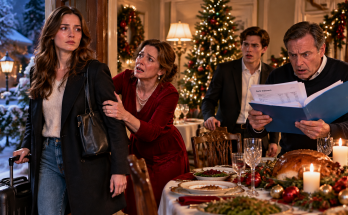
The next Christmas Eve arrived quietly.
No threatening messages.
No investigators waiting outside.
No dark SUV.
No secret documents hidden in a blue folder.
I woke in my own apartment at eight.
Made coffee.
Opened the balcony door for exactly six seconds before Chicago winter convinced me independence did not require stupidity.
My business had closed for the week.
The staff had bonuses.
Real bonuses.
Not guilt payments.
Not emergency rescues.
Money agreed upon in advance for work completed.
I had become strangely passionate about transparent compensation.
Occupational hazard.
On my bookshelf sat the ceramic mug.
I had considered throwing it away.
Never did.
Not because it was sentimental.
Because it made me laugh.
Take chances and fly.
Mom had handed me those words while secretly needing me to prove I could not.
Life had a mean sense of humor.
At eleven, Sebastian texted.
Dinner at six. Dad says five because he thinks everyone is late.
I replied:
So six.
Michael immediately joined the group chat.
Five thirty. Arthur becomes unbearable after twenty minutes.
Dad replied:
I can see this.
Daniel added:
This family should not use group chats as evidence.
Lily reacted with a laughing emoji.
Ordinary.
That was the gift.
The year since I walked out had not repaired everything.
Grant’s case remained ongoing.
Carol had received consequences under a negotiated resolution that included substantial cooperation, asset surrender, and continuing legal restrictions.
David’s case also continued through the courts.
Lily maintained limited contact with him.
On her terms.
Eleanor no longer managed L-1998 alone.
The recovery center project had an independent board and a new name chosen by survivors rather than Evelyn’s estate.
Anna advised only when she wanted.
Claire declined a board seat and volunteered occasionally instead.
Margaret sent handwritten notes from Vermont.
Marianne became active in the Hayes public-access trust.
The Lake Geneva shoreline easement had been permanently transferred into public conservation protection after court approval.
No Montgomery controlled it.
No Whitmore.
No Mercer.
No Voss.
Samuel Hayes finally got what he had written into the deed decades earlier.
The access stayed public.
The larger corridor was divided.
Some land went to conservation.
Some returned through settlements.
Some was sold to fund restitution.
Mercer acquired a limited portion at independently appraised value for its redesigned inland project.
Daniel recused himself from those negotiations.
The company survived.
So did its employees.
The development became smaller.
Nobody died from receiving less profit.
That lesson should probably be taught in business school.
The victim trust continued working.
Slowly.
There was no final number yet.
Maybe there never would be.
History did not balance like a spreadsheet.
But money that could be traced was being traced.
Claims were reviewed.
Records remained public where legally appropriate.
Independent people made decisions.
Nobody had a secret master key.
Especially me.
My own life became almost boring.
I loved it.
I traveled twice.
Bought better health insurance.
Finally completed the dental work I had postponed while sending Mom money.
The dentist asked why I waited so long.
I said, “Family budgeting.”
That was enough.
I began looking for a home.
Not a mansion.
Not the family house.
Not Lake Geneva.
A small place with good windows and a room I could use as an office.
When the realtor asked whether my parents needed to approve anything, I laughed so hard she looked concerned.
“No.”
That answer still felt beautiful.
Dad adapted to his condo.
He and Michael lived twelve minutes apart.
Close enough to rebuild.
Far enough not to kill each other.
Michael decided to remain in Illinois for another year.
He refused to promise longer.
Dad had learned not to ask.
Daniel visited Michael regularly.
Their relationship did not resemble an instant father-son reunion.
Too much time.
Too many other parents.
Thomas Mercer remained Daniel’s dad.
Michael was also his father.
Daniel refused to let biology erase upbringing.
Michael understood.
Mostly.
Sebastian stayed in sales.
Earned enough to buy a newer car.
Did not.
“I’m saving.”
The first time he told me, I nearly applauded.
He threatened to hang up.
We were becoming siblings instead of roles.
That may have been the best outcome of all.
Mom’s situation remained the hardest.
Her final sentencing had occurred months earlier.
She received a combination of incarceration, restitution obligations, financial restrictions, and supervised conditions that reflected the offenses she admitted and those established through the proceedings.
I did not celebrate.
I did not call it unfair.
The judge had more information than I did.
That was the point of having judges instead of daughters.
Mom and I wrote occasionally.
Not weekly.
No schedule.
Sometimes I answered.
Sometimes I did not.
She stopped asking why.
Her letters became shorter.
Less explanatory.
One included a line I kept.
I spent years believing being needed was the same thing as being loved. I made you pay for that confusion.
I believed she meant it.
Believing did not erase what happened.
That was okay.
At five forty-seven, I drove to Dad’s.
Snow had started.
Not dramatic snow.
Thin flakes drifting through streetlights.
His condo building looked aggressively normal.
I carried dessert.
Store-bought.
I could cook.
I simply did not feel like it.
Another tiny freedom.
Dad opened the door.
“You’re late.”
“It’s five forty-seven.”
“I said five.”
“Sebastian said six.”
“Sebastian lies.”
From inside, Sebastian shouted, “Inherited trait.”
Dad tried not to laugh.
Failed.
I stepped inside.
Michael was in the kitchen.
Daniel opened wine.
Anna and Lily were arranging food.
Eleanor had brought salad.
Sebastian had apparently been banned from bread after last year.
No one wore anything formal.
No one performed wealth.
No expensive watch.
No carefully staged gifts.
No invisible competition over who appeared most successful.
I set down the dessert.
Dad hugged me.
He had learned to wait half a second.
Just enough for me to move toward him too.
Small thing.
Important.
Dinner was loud.
Michael told a story Dad disputed.
Daniel corrected both of them.
Lily asked Sebastian about work.
Anna complimented Dad’s lasagna.
He admitted it came from a neighborhood restaurant.
I looked at him.
“You let us praise you for ten minutes.”
“I heated it.”
“Heroic.”
We laughed.
Then came gifts.
Modest.
Intentional.
Sebastian gave me a nice notebook.
Inside the cover he wrote:
For things nobody else gets to decide.
I hugged him.
No hesitation.
Dad handed me a rectangular box.
I narrowed my eyes.
“If this is a mug—”
“It isn’t.”
I opened it.
A framed photograph.
Grandma Evelyn sitting in her garden.
I was beside her.
Maybe six years old.
Mud on my knees.
A notebook in my lap.
Grandma was looking at me rather than the camera.
On the back, Dad had written the date.
Nothing else.
I swallowed.
“Where did you find this?”
“Michael.”
Michael shrugged.
“Mom sent me copies years ago.”
“Thank you.”
Dad looked nervous.
“I wasn’t sure whether you wanted another picture of Grandma.”
“I do.”
That was true.
I did not need to turn Evelyn into either a saint or a villain.
She had helped build a financial structure later corrupted by others.
She had protected people.
Controlled people.
Failed people.
Tried to repair damage.
Made mistakes while repairing it.
Loved me.
All true.
I could keep the photograph without inheriting every decision she made.
That realization felt like adulthood more than any apartment lease ever had.
After dinner, we cleared plates together.
Dad tried to make me sit.
I told him I was carrying dishes because I wanted to.
He stopped.
That distinction had become almost a family joke.
Almost.
At nine, snow covered the cars.
Daniel and Michael argued about whether to scrape them now or wait.
Lily helped Anna with her coat.
Eleanor asked whether they wanted company home.
Anna said no.
Eleanor nodded.
No offense.
No persuasion.
Progress could look very boring from outside.
Sebastian stood beside me near the window.
“Remember last year?”
“Unfortunately.”
“I really laughed.”
“Yes.”
“I thought you were finally getting what you deserved.”
I looked at him.
He winced.
“Bad phrasing.”
“Very.”
“I mean, I thought Mom and Dad were forcing you to grow up.”
“I know.”
“And then you walked out.”
“Yes.”
He stared at the snow.
“Everything changed.”
That was true.
But not in the way he meant.
My departure did not magically create the secrets.
The fraudulent mortgage story already existed.
The trust already existed.
Daniel existed.
Michael was alive.
Anna was alive.
Lily existed.
Grant’s network existed.
Grandma’s recovery structures existed.
Samuel’s history existed.
The land existed.
The lies were already there.
Walking out did not create the collapse.
It stopped me from holding up one corner of it.
That was enough.
“I used to think leaving changed everyone,” I said.
Sebastian looked at me.
“It kind of did.”
“Maybe.”
I watched Dad and Michael arguing in the kitchen.
“But mostly it changed what everyone was allowed to keep pretending.”
Sebastian nodded.
Mom could no longer pretend I depended on her.
Dad could no longer pretend avoiding conflict kept the family peaceful.
Sebastian could no longer pretend favoritism was achievement.
Carol could no longer pretend private repair excused secret control.
Eleanor could no longer pretend protection automatically justified deciding for others.
David could no longer pretend disappearing for his family was the same as staying for them.
Even Grandma’s memory changed.
Love stopped being evidence that every decision had been right.
That was healthier.
At ten, I put on my coat.
Dad frowned.
“You can stay.”
The words carried a shadow.
Last Christmas, he had told me to leave.
This Christmas, he was offering the opposite.
I smiled.
“I know.”
“You have the guest room if the roads get bad.”
“I know.”
“No pressure.”
“I know.”
He laughed.
“I’m working on it.”
“I noticed.”
The roads were still fine.
I hugged him.
Then Michael.
Anna.
Lily.
Daniel.
Eleanor.
Sebastian followed me downstairs because he had parked near me.
Outside, the cold hit immediately.
Snow crunched beneath our shoes.
He looked at my car.
“You still have that?”
The used car Dad gave me.
“Yes.”
“You have millions of dollars.”
“It runs.”
“That is deeply disappointing.”
“You sound like Mom.”
He recoiled theatrically.
“Cruel.”
I laughed.
Then he became serious.
“You okay driving?”
“Yes.”
“Text me when you get home?”
I looked at him.
“That’s normal sibling behavior, right?”
“I think so.”
“Then yes.”
We separated.
I drove through quiet streets.
Past houses glowing with Christmas lights.
Past families I knew nothing about.
Past places where people were probably having wonderful dinners.
Or terrible ones.
Or ordinary ones.
At home, I carried Grandma’s photograph upstairs.
My apartment was quiet.
Warm.
Mine.
I placed the frame on the bookshelf beside the ceramic mug.
Then I noticed the contrast.
The mug told me to fly.
The photograph showed Grandma looking at a little girl who had not yet learned how often adults would mistake her quietness for agreement.
I stood there for a long time.
A year earlier, I had entered this apartment with one suitcase.
I believed the biggest change in my life was that my parents had thrown me out.
I was wrong.
The biggest change was that when the door opened, I kept walking.
Not because leaving was always brave.
Not because family should be abandoned when it becomes difficult.
Not because independence meant needing nobody.
I still needed people.
Dad.
Sebastian.
Friends.
Employees.
Lawyers.
Sometimes investigators, apparently.
Need was not the problem.
The problem was being taught that love required surrendering the right to choose.
Grandma had tried to give me money so I would always have an exit.
Mom had tried to use money so I would never take one.
In the end, neither woman made the decision.
I did.
I changed into pajamas.
Made tea in the Christmas mug.
My phone buzzed.
Sebastian:
HOME?
I replied:
Yes.
Dad immediately wrote in the family chat:
Good.
Michael:
She is 26, Arthur.
Dad:
25.
Me:
Still not the point.
Daniel:
I am muting this family.
Lily:
You say that every week.
I smiled and put the phone down.
Outside, snow covered the balcony railing.
There was no dramatic feeling of closure.
I did not believe lives worked that way anymore.
Cases continued.
Relationships changed.
Some wounds healed.
Others became things we learned to carry without handing them to someone else.
The future remained unfinished.
That no longer frightened me.
I took Grandma’s letter from the drawer.
I had read it enough.
I did not need another instruction.
So I put it away.
Then I sat by the window with my tea and looked around the apartment I had rented before anyone knew I was capable of leaving.
Christmas Eve had started with my family telling me I needed to become independent.
They had meant it as humiliation.
Mom had secretly meant it as a trap.
Sebastian had treated it as a joke.
Dad had believed it was necessary.
None of them understood that I had already done the hardest part.
I had prepared.
I had stopped explaining every private decision.
I had saved money.
I had signed a lease.
I had collected records.
I had canceled the transfer.
Then, when the moment came, I walked.
Everything after that—the loans, the trust, Daniel, Michael, Anna, Lily, Grant, Carol, Samuel, the land, the restitution—had been waiting behind doors other people kept closed.
My departure did not make me powerful.
It simply made me unavailable for the role everyone had assigned me.
That changed everything.
I finished my tea.
Turned off the lights.
And went to bed in a home where nobody could ask me to leave.
More importantly, nobody needed to ask me to stay.
The End
Read more original stories on Feel Every Story.
Christmas Dinner Was Almost Over When My Parents Told Me To Leave, Then Mom Asked The Question Dad Was Never Supposed To Hear
Part 40 of 40