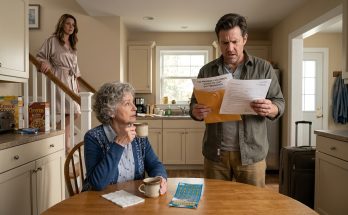
The scratch ticket Paige pushed across the table cost less than the candles on my birthday cake. I knew because she had not bothered to remove the little price sticker from the corner.
It was my seventy-third birthday, and dinner was nearly over. Graham was refilling his wineglass. Owen and Chloe were bickering about a phone charger. Paige sat across from me, watching with the amused expression of someone waiting for a joke to land. The cake between us tilted slightly because I had baked it myself, and the frosting had softened while the roast was in the oven.
“Go ahead, Evelyn,” Paige said, tapping the ticket with one polished fingernail. “Maybe tonight’s your lucky night.”
Graham laughed. “If Mom wins five dollars, coffee’s on her.”
“Five?” Paige said. “I was hoping she’d at least cover bus fare.”
The children laughed because their parents did. I smiled because I had learned that some humiliations became larger when you protested them.
A quarter lay beside Graham’s keys. I picked it up and scratched the silver coating.
Nobody watched for long.
That was important later.
Paige began clearing plates. Graham asked Owen something about soccer practice. Chloe lowered her phone beneath the table and started typing. Around me, the evening resumed its ordinary rhythm while the symbols appearing beneath my quarter rearranged my entire life.
I scratched the last panel.
Then I stopped.
I read the instructions along the bottom.
I checked the symbols again.
Eleven million dollars.
My heart struck hard enough against my ribs that I wondered whether someone might hear it.
Surely I had misunderstood.
I read everything again, slowly this time. Three matching symbols. Prize amount. Validation instructions.
Eleven million.
“Anything?” Graham asked.
His chair scraped.
Before he could lean toward me, I folded the ticket.
“No bus fare,” I said.
Paige laughed. “Should’ve bought the crossword one.”
Then she carried the plates away.
That was all.
Nobody demanded to inspect the ticket. Nobody noticed my shaking fingers when I slipped it into the inside pocket of my cardigan. Within thirty seconds, Owen wanted ice cream, Chloe had disappeared into her phone, and Paige was complaining that the frosting was too sweet.
I stood at the sink washing dishes from my own birthday dinner with eleven million dollars pressed against my chest.
My name is Evelyn Mercer. By then, I had lived with my son and his family for almost four years.
My husband, Thomas, had died after forty-six years of marriage. Graham had insisted afterward that I should not remain alone in the house Thomas and I had shared. He said he worried about me waking in empty rooms. He said his house had space. He said the grandchildren would love having me nearby.
At the time, I believed him.
In the beginning, living together had felt like exactly what grief required. Graham brought coffee to my room some mornings. Paige asked what I thought about curtains. Chloe wanted me to braid her hair before school. Owen was still young enough to crawl beside me on the sofa with a blanket.
I began helping because helping gave structure to days that otherwise felt hollow.
I cooked dinner.
I folded laundry.
I collected groceries.
I drove the children.
I stayed home when Graham and Paige went out.
Nothing changed dramatically. That was why I failed to notice the change at first.
Requests became assumptions.
Paige stopped asking whether I happened to be going to the supermarket and began leaving lists beside my purse. Graham stopped checking whether I had plans before informing me that he needed me with the children. If dinner was late, someone asked what had happened. If my knees hurt and dishes remained overnight, Paige cleaned them the next morning with sharp, efficient movements.
I still had a bedroom.
I still had photographs on the dresser.
Technically, I belonged there.
But usefulness had begun replacing belonging.
Six months before my birthday, I learned how far that transformation had gone.
I was walking down the hall carrying towels when I heard Paige say my name in the kitchen.
I stopped.
“Your mother is becoming a burden, Graham.”
There was no cruelty in her voice. Only exhaustion.
Somehow that hurt more.
Graham sighed.
“What do you want me to do? She’s my mother.”
I stood in the hallway holding the towels against my chest.
He did not say I helped them.
He did not say I was family.
He did not tell Paige never to speak about me that way.
What do you want me to do?
I returned upstairs without making a sound.
That evening, I sat beside Thomas’s photograph until the bedroom became dark.
I never confronted Graham.
Maybe I was afraid of hearing the same sentiment expressed more carefully. Maybe I had reached an age when I understood that asking someone to prove you matter can sometimes reveal that you do not matter in quite the way you believed.
So when Paige’s two-dollar joke turned into a fortune, I kept quiet.
After everyone went to sleep on my birthday, I locked my door and placed the ticket beneath my lamp.
I checked it online.
Then I checked again.
The prize was real.
My first thought was Thomas would know what to do.
My second surprised me.
Do not tell Graham.
I loved my son. That had not changed.
But when I imagined announcing the money downstairs, I did not picture Graham embracing me. I pictured calculations. Mortgage payments. Tuition. Retirement. Debts.
And I pictured Paige looking at me differently.
The following Monday, I lied for the first time in years about where I was going.
I told Paige I had a dental appointment.
Instead, I took a taxi downtown to see Martin Hale, the attorney who had helped with Thomas’s estate.
Martin examined the ticket for almost a minute.
Then he looked at me over his narrow glasses.
“Who knows?”
“No one.”
“Graham?”
“No.”
“Paige?”
“No.”
He leaned back.
“Keep it that way for now.”
The relief I felt frightened me.
Martin immediately began asking questions. Had Paige clearly given me the ticket? Who had access to my accounts? Was my will current? Did Graham possess power of attorney? Did I have debts? Had I promised anyone money?
By the end of the appointment, the ticket no longer felt like a miracle.
It felt like a responsibility.
Over the following weeks, Martin helped me claim the prize with as much privacy as legally possible. Taxes and payment arrangements reduced the advertised amount substantially, but what remained was still more money than Thomas and I had ever imagined possessing.
My first major decision concerned Owen and Chloe.
“Education,” I told Martin.
He nodded. “Trusts?”
“Yes. Controlled ones.”
He glanced at me.
“I don’t want their parents able to withdraw the principal.”
His pen paused.
“I love Graham,” I said.
“I know.”
“I want this to belong to the children.”
“Then it will.”
The trusts were funded generously. Owen and Chloe could someday study without beginning adulthood beneath crushing debt. Graham and Paige could not borrow against the money or redirect it.
They would not even know the trusts existed until I chose to tell them.
Martin warned me against suddenly changing my lifestyle.
“I’m seventy-three,” I told him. “I doubt I’m about to become reckless.”
“You would be amazed what money does to people.”
So I continued clipping coupons.
I bought store-brand flour.
I cooked Graham’s favorite chicken stew.
I waited outside soccer practice in the rain.
Paige continued leaving grocery lists.
But everything felt different because I knew one thing I had not known before.
I could leave.
The knowledge changed me quietly.
When Paige complained about the detergent I bought, her irritation no longer frightened me.
When Graham announced one afternoon that I would be watching the children Saturday, I said, “I already have plans with Ruth.”
He blinked.
“Can’t you change them?”
“No.”
“Paige and I already bought tickets.”
“I’m sorry.”
He stared at me.
Then he said, “Okay. I’ll figure something out.”
I went upstairs afterward and smiled.
Nothing terrible had happened.
My son had solved his own childcare problem.
Several months later, Martin called with news about the house Graham and Paige rented.
The elderly owner was considering selling.
I looked around their kitchen while Martin explained the details. The refrigerator was covered with school notices. Owen had once dented the pantry door with his scooter. Thomas had helped Graham put shelves in the garage.
The house held pieces of my family’s history.
“What would it cost?” I asked.
Martin told me.
“Could I purchase it privately?”
“Yes.”
“Do it.”
Three weeks later, T&E Property Holdings became the owner.
Thomas and Evelyn.
The initials had once appeared on boxes and invoices from Thomas’s little outdoor-supply business.
Graham had grown up seeing them.
He noticed nothing.
“Some investment company bought the house,” he told us at dinner. “T&E Property Holdings.”
Paige frowned. “Are they raising the rent?”
“Apparently not.”
I passed the potatoes.
“That’s fortunate.”
My son was paying rent on property I owned.
He had no idea.
I did not buy it to gain leverage over him. I told myself I was protecting stability for the grandchildren, and at the time I believed that completely.
Then Ruth found the cottage.
She telephoned one afternoon and said, “I found your house.”
“I’m not searching for one.”
“You are. You simply haven’t admitted it.”
The cottage stood fifteen minutes from her home outside Wilmington. Two bedrooms. Old hardwood floors. Roses beside the porch. A stubborn window. A railing that needed repair.
And a yellow kitchen.
I walked through it twice.
Then I told Ruth, “I want it.”
Over the summer, I furnished it slowly.
A blue sofa.
An oak table.
A brass lamp beside a reading chair.
Guest beds.
Herbs near the kitchen window.
Everything I chose because I wanted it.
Still, I did not move.
Some foolish part of me was waiting for Graham to look closely enough to realize his mother was disappearing while still living beneath his roof.
Then November came.
One evening, Graham placed a glossy brochure beside my dinner plate.
“Mom,” he said, “Paige and I have been talking.”
Paige smiled.
The brochure showed an older couple strolling beside a pond.
PINE HARBOR SENIOR LIVING.
“We toured it,” Paige said.
I looked up.
“You toured it?”
“Just to see whether it might work.”
“Without me?”
Graham shifted.
“We didn’t want you worrying before we knew it was suitable.”
Paige opened the brochure to a floor plan.
A studio.
Meals included.
Transportation.
Activities.
Exercise classes.
“You’d be around people your own age,” she said.
I looked at the tiny bedroom.
“You chose a unit?”
Graham cleared his throat.
“We put down a refundable deposit.”
Something inside me became very still.
“When?”
“What?”
“When would I move?”
Neither answered quickly enough.
Finally Graham said, “January first.”
It was mid-November.
I looked toward Owen.
He stared at his plate.
“Why January?”
Graham rubbed his thumb along his fork.
“Owen’s older now. He needs privacy.”
I understood.
“My bedroom.”
Paige shifted. “Eventually.”
“You've discussed giving him my room?”
Silence.
“How long?”
“Mom—”
“How long?”
“A few months.”
They had planned the future of my bedroom while I was sleeping in it.
Paige leaned forward.
“Evelyn, I really think you’d be happier there. You’d have your own life.”
My own life.
They had toured it, selected the room, paid money, chosen a date and discussed what would happen to my bedroom.
Then they had handed me my own life like another cheap birthday gift.
Graham said quietly, “It’s probably best.”
I folded the brochure.
“All right.”
Paige blinked.
“What?”
“January first sounds like an excellent time for everyone to begin living differently.”
Their relief was immediate.
That was what finally decided me.
I finished dinner.
I loaded their dishwasher.
I wiped their counter.
Then I went upstairs, closed my bedroom door and called Martin.
He answered quickly.
“Evelyn?”
“I’m ready.”
A pause.
“What do you want done?”
I looked at the Pine Harbor brochure beside the suitcase I had pulled from my closet.
“Everything.”
Click here to continue reading: PART 2: While They Prepared My Room for Someone Else, I Quietly Chose the Morning Their Comfortable Arrangement Would End
A Two-Dollar Birthday Joke Left Me Holding a Fortune While My Family Went Back to Dinner Without Looking Twice
Part 1 of 44